The Chinese Language as Industry--Following the Thai Model
Coral Lee / photos Chuang Kung-ju / tr. by Michael Hill
August 2005


As the Chinese language becomes ever more popular in the 21st century and as the ASEAN "plus" China framework is established, the Chinese language market in Southeast Asia is becoming increasingly important. Once an important site for Taiwan's efforts in overseas Chinese education, this region has come under the strong pull of mainland China's politics and economy. One surprising exception, however, has been Thai-land's market, which has become a golden opportunity for Taiwan's Chinese language industry.
"Don't assume that overseas Chinese-language education is just about Chinese teachers making a little money on the clock," says Michael Lee, a Taiwanese businessman in Bangkok who is very active in the Chinese education world of Taiwan and Thailand. According to Lee, there is strong potential in the Chinese-language education industry, including such areas as Chinese language proficiency exams, tourism, and cultural exports. With the potential to become an emerging cultural industry, the sector may even come to rival high tech industries.
But what is so special about the "Thai model" for the Chinese language market? How might the government use an "industry" model to promote Taiwan's culture worldwide?
At a time when Chinese serves as an important means of communication, people who travel frequently between Taiwan and Thailand have moved from being Thai laborers, Taiwanese businesspeople or tourists into principals, teachers, and students at all levels of schools!
In mid-March, when Ming Chuan University (MCU) held its anniversary celebration, it invited the president and three provosts of sister school Rangsit University to participate. Rangsit's president, who once served as Thailand's Minister of Foreign Affairs, not only took a tour of MCU's Chinese Language Center and learned about MCU's experience of international collaboration in staging courses, but also visited MCU's "e-campus" and planned to use it as an important point of reference in promoting e-campuses in Thailand.
In mid-April, over 20 high school Chinese students from southern Thailand came to Hsing Wu College's Chinese Language Center in Linkou to study Chinese for three weeks. In late April, a group of middle and primary school principals and vice-principals led by a Thai senator came to Chung Yuan Christian University's Department of Teaching Chinese as a Second Language to gather information for planning Chinese-language curricula in middle schools. All told, they spent five days in classes and two days touring the country. After their return to Thailand, they organized a Chung Yuan alumni association to keep up their contacts.
Similar activities have continued ever since. In early July, Thailand's teachers' colleges invited staff from university-level Chinese language centers around Taiwan to visit that country. This event was not only a response to an invitation extended to 21 Thai teachers' colleges to visit Taiwan, but also part of an effort to discuss plans for teacher training.

Chinese departments in universities abroad are key sites for promoting the Chinese language industry. Last year National Taiwan Normal University and Thailand's Chulalongkorn University launched a joint M.A. program, establishing a new model for success. This photo shows M.A. students on the Chula-longkorn University campus.
Good business sense
When it comes to teaching Chinese to foreigners, Taiwan has the advantage of five decades of strong experience and professional leadership. Led by economic growth in mainland China, the Chinese language has become very popular in the last five years. The landscape has changed dramatically, however, as China has used its position to promote Mandarin education abroad. In response, Taiwan's government has formed the Overseas Chinese Language Education Policy Committee, whose membership, drawn from such government agencies as foreign affairs, education, overseas Chinese affairs, and the Government Information Office, has proposed setting a new direction to treat education as an export "industry."
Deputy Minister of Education Fan Sun-lu, who supervises Chinese language education policy, says that Taiwan's goal is to become the world's leading brand in Chinese language education. The government has set a four-year goal to actively seek out advice from industry, government, and academia to put together an all-round plan that includes Chinese language proficiency testing, teacher certification, preparation of teaching materials, and international cooperation. In terms of policy, the government is exploring a range of measures to support the Chinese language industry.
"The value chain supporting Chinese language education is enormous, and it has the potential to become a strategic industry," says Michael Lee, who works in Thailand to promote Chinese language education. According to Lee, Rangsit University is an example of how, making the most of short-term demand, Chinese language education can serve as a first step in cooperation with foreign universities, producing scholarly collaboration with other departments, drawing international students, and, more significantly, producing a new opportunity for cooperation between business and academia-the transfer of technology for building e-campuses.
Moreover, since its president is a member of a Thai think-tank on Chinese language education policy, the value of providing an opportunity for Rangsit University to learn about Taiwan's knowledge economy and peaceful democracy is very high. According to Lee, "If these important figures are willing to say a few words on Taiwan's behalf, the effect will be far greater than we could accomplish on our own."

"The value chain supporting Chinese language education is enormous," says Michael Lee, a Taiwanese businessman in Thailand. If Taiwan seizes the opportunity, he says, "the sector may even come to rival high tech industries, with tremendous value for Taiwan's economy."
Made in Taiwan
Michael Lee argues that while the government sets aside money every year in its budget for Chinese language teacher training, too much of this funding is directed toward funding primary school teachers for Chinese communities overseas or toward subsidizing young ethnic Chinese from abroad to come to study in Taiwan. Lee believes that Taiwan will need to change its strategy, making the Chinese language another "Made in Taiwan" product to be marketed to people at the highest levels worldwide.
First, "university departments of Chinese are the most important battleground for Taiwan and China." According to Lee, because the scholarly world is relatively free from political or ideological influence, it is prepared to make objective assessments. For example, through discussions with Taiwanese, Thailand setled on a policy of teaching both traditional and simplified characters. Taiwan should take a more active stance toward the country. If Taiwan can establish a "Thai model" for marketing Chinese language education, then it can also use this model in other countries.
To meet market demand abroad, Fan Sun-lu believes that projects modeled on the cooperative Chinese language teacher training program run by National Taiwan Normal University (NTNU) and Thai-land's Chulalongkorn University can be used elsewhere, and that teachers can also come to Taiwan for basic training. At the same time, educational exchanges can also be developed along the lines of the cooperation between universities in Taiwan and Sinology departments in Europe.
In addition to taking up key points in higher education, another area-Chinese language certification-is essential to developing education as a cultural industry.

Chinese departments in universities abroad are key sites for promoting the Chinese language industry. Last year National Taiwan Normal University and Thailand's Chulalongkorn University launched a joint M.A. program, establishing a new model for success. This photo shows M.A. students on the Chula-longkorn University campus.
Emphasizing accreditation
Currently China is putting great effort into promoting the Chinese Language Proficiency Test (Hanyu shuiping kaoshi, or HSK, also known as the "Chinese TOEFL") worldwide. The HSK serves as a certification standard for applying to certain university departments and professional positions, and testing centers have been established in 30 countries worldwide. Some companies intent on entering the China market have even started to use the HSK as a requirement when applying for work.
In recent years Taiwan has also worked actively to develop a certification test based on traditional Chinese characters. Two years ago, NTNU developed the Chinese Proficiency Test-Taiwan (CPT). The Ministry of Education, taking a cautious course of action, has asked NTNU to expand the test so that it can be used as the testing standard at the national level.
According to Michael Lee, "Third-rate enterprises sell products, second-rate enterprises sell services, and first-rate enterprises sell the fact that they have accreditation." Lee, who is very familiar with the principles of the market, recommends looking at the public-private British Council as a model for bringing the CPT and Taiwan's Chinese language culture onto the world stage.

Holding "Chinese TOEFL" certification exams is one area of the Chinese language industry where Taiwan cannot fail to compete. The chart compares the levels in the CPT and HSK systems.
The TAITRA model
According to Lee, the initial phase of this model will require active government guidance to establish an organization similar to the Taiwan External Trade Development Council (TAITRA) that brings together economists, marketing experts, and people from the education and arts fields. Together, they can apply Taiwan's extensive experience in holding international trade shows to promote "Made in Taiwan" Chinese language courses.
Additionally, in the Internet age, Taiwan's advantages in the IT sector can also provide great help in promoting the Chinese language.
MCU International College president Kao Shaw-fawn, who has made strong efforts in recent years toward internationalizing university education, points out that Taiwan could use online teaching platforms to overcome the barriers between traditional and simplified Chinese characters. MCU has already started to develop a "global institute of Chinese language and literature" that includes virtual classrooms, a variety of teaching materials, interactive learning, and choices of languages. When characters can be converted back and forth, the competition between traditional and simplified characters is no longer an issue.
"The greatest potential for computerized educational platforms lies in greatly expanding exports," says Kao. Aside from Southeast Asia, northeast and central Asia could also be included in this work. According to Kao, "Recently everyone has been discussing language certification exams, and how we can only have a wide range of exposure and establish an image by using the Internet."
While discussions have been going on between industry, government, and academia about strategies for expanding the Chinese language market abroad, an important Chinese language "business opportunity" has quietly been taking shape on Taiwan's own college campuses.
According to Hsiung Shen-kan, president of Chung Yuan Christian University, "Most people think that humanities education is a division that only spends money and never makes any." In the past, he says, most universities depended on cooperation between industry and science and engineering departments to bring in funding, but Chung Yuan's Department of Teaching Chinese as a Second Language has developed surprisingly fast in the past few years, and Taiwanese universities' longstanding desire to "take education out into the world" can finally be put into practice.
Kao says that since the department was established two years ago, it has held a number of teacher training courses on behalf of the World Chinese Language Association, Chinese language courses for foreign spouses sponsored by the Taoyuan County Government, and Chinese language training sponsored by the Ministry of Defense for high-level military officials from countries that have diplomatic relations with Taiwan. Since the department's students can provide one-on-one training, the teachers it trains also have internship opportunities that yield good results.
While there may be strong business opportunities, Hsiung Shen-kan hopes that Chinese language education at Chung Yuan will develop in a scholarly direction and avoid becoming too commercialized.
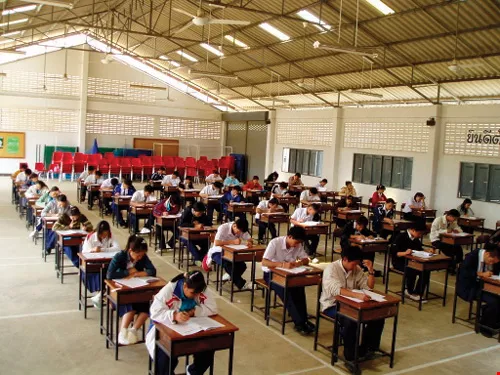
Holding "Chinese TOEFL" certification exams is one area of the Chinese language industry where Taiwan cannot fail to compete. The photo above shows students sitting last year's Chinese Proficiency Test - Taiwan (CPT) at National Taiwan Normal University.
High added value
Many people predict that the popularity of the Chinese language must also result in foreign students coming to Taiwan or China to study Chinese. Aside from students majoring in Chinese overseas who come to Taiwan to improve their Chinese, students from other fields may also be attracted to Taiwan to learn Chinese.
"The Chinese language is going to create great added value in Taiwan's efforts to promote internationalized education," says Kao Shaw-fawn. According to Kao, if teachers and specialists from across Southeast Asia come to Taiwan to take a master's or PhD degree in an international program, learning Chinese at the same time is a major added attraction. Currently MCU's International College has over 100 foreign students in its bachelor's degree program and over 20 foreign students in its graduate program. While English is used in the classroom the campus has a comfortable and convenient bilingual environment that still allows students to study Chinese.
Kao Shaw-fawn believes that although China is attractive to foreign students, higher education in Taiwan is superior in many ways. For example, departments related to information sciences in Taiwan's universities are extremely strong, and Taiwan's business management knowledge and talent is at the very top in Asia. Moreover, the close connections between IT and film, video and TV production are another strong point for Taiwan.
Looking at the overall environment, the degree of freedom and general friendliness of Taiwanese society is a major factor that attracts international students. Practically speaking, tuition fee policies that set the same rates for local and foreign students also add competitive power, since studying in Taiwan for a year costs US$3-4000, about three times less than what would be needed in Europe or North America, and half the cost of studying in South Korea.
Looking at Britain's experience, with the help of the British Council, the "English language education industry" and "study in England" campaign worked together to create rapid development in the educational, study tour, and cultural export industries. Thus the UK's strategy for competition in the English language industry with the world's superpower-the United States-can also serve as a model for Taiwan's Chinese-language industry.
"When the British Council opened an office in Taiwan in the late 1980s, only 60 students went to England to study a year," recalls Li Kuang-hua, a Ministry of Education adviser stationed in Thailand. Since then, the British Council has held a range of lectures, events, and educational exhibitions, and has managed over the years to create a sound image for itself. Now Britain attracts 9,000 Taiwanese students a year.
According to British Council statistics, over 600,000 students from around the world go to the UK each year to study English, while another 80,000 international students go there to study for undergraduate or graduate degrees, resulting in an output value of about 600 million British pounds for the education industry. Since students going to Britain must take the International English Language Testing System (IELTS) exams, providing services related to the IELTS exams is also an important business activity.

According to Deputy Minister of Education Fan Sun-lu, Taiwan's long history of teaching Chinese both at home and abroad and its success in maintaining and preserving Chinese culture provide competitive advantages to make it the top brand in Chinese language education.
Aiming at Southeast Asia
"If we want to market education as an international industry, then Southeast Asia is the first major market we should concentrate on," says Li Kuang-hua. According to Li, Taiwan has great potential in attracting Southeast Asian students because it offers a high-quality academic environment and low tuition. In Taiwan, however, few educational institutions have recognized this trend.
"I tell Thai people that Thailand has 65 million people and over US$4 billion in foreign reserves, while Taiwan has 23 million people and US$240 billion in foreign reserves. How can Taiwan, which lacks natural resources but has plenty of earthquakes and typhoons, manage to do it? The key is education!" says Li. "And right now is the first time in decades that Taiwan is going to share its educational resources with the international community-it's a great opportunity!" Li believes that this appeal is very convincing to Thai students.
Moreover, many people have high hopes for internationalizing Taiwan's professional and technical education.
Li Kuang-hua says that the journey to Thailand on a long-distance training ship arranged by National Taiwan Ocean University and the Fisheries Administration drew over 300 students from around Thailand to board the ship and to see Taiwan's seagoing vessels and advanced equipment.
"Taiwan's fishing industry is suffering a labor shortage, and fisheries workers from Thailand can now come to Taiwan for training," says Li. Things also look good for cooperation with Southeast Asia in the area of medical technology. Recently Thailand's 186-year-old Mahi-dol University and Tzu Chi University signed an agreement that set a new precedent for cooperation in medical education between the two countries.
Whether it is Chinese language teacher education, Chinese language educational network platforms, Chinese language industry-academia cooperation, or higher education related to the Chinese language and the internationalization of professional and technical education, all of these areas provide a stage for Taiwan to show its strengths. Currently many people in education have high hopes for this trend and are actively planning to work with it. However, if the Chinese language industry truly wants to become an emerging strategic industry in Taiwan, it must undertake further discussion and coordination with people in other areas, such as the government and the general public, as well in as such fields as trade, culture, and tourism.

Chinese departments in universities abroad are key sites for promoting the Chinese language industry. Last year National Taiwan Normal University and Thailand's Chulalongkorn University launched a joint M.A. program, establishing a new model for success. This photo shows M.A. students on the Chula-longkorn University campus.

The British Council, whose worldwide exhibitions on education in the UK attracted thousands of students, is one model for Taiwan to consider as it develops its language industry.
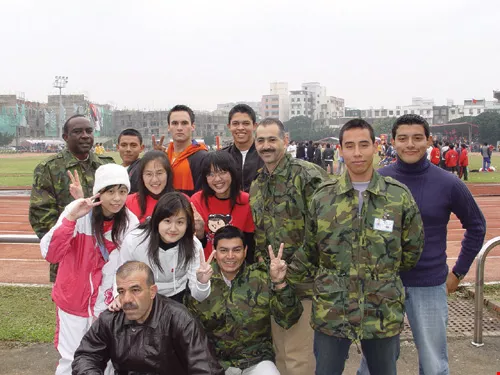
Chung Yuan Christian University's Department of Teaching Chinese as a Second Language has developed rapidly in recent years, demonstrating the unlimited scope of business opportunities for the Chinese language industry. The provision of one-to-one tutoring of foreign students by local students in the department is one of the standout characteristics of the courses they offer.

Chinese departments in universities abroad are key sites for promoting the Chinese language industry. Last year National Taiwan Normal University and Thailand's Chulalongkorn University launched a joint M.A. program, establishing a new model for success. This photo shows M.A. students on the Chula-longkorn University campus.


@List.jpg?w=522&h=410&mode=crop&format=webp&quality=80)


@List.jpg?w=522&h=410&mode=crop&format=webp&quality=80)
