Feeding Frenzy: Taiwan's Manic Media
Jackie Chen / photos Vincent Chang / tr. by Phil Newell
September 1994


The changes in Taiwan's society in the past few years have left people gaping with their tongues hanging out. Reporters, often on the cutting edge of events, have become critical keepers of the records. If we put reporters--who have spent their lives observing society--under the microscope, what do they look like?
What do you think of when you think of Taiwan reporters? Huang Juei-hsiang, the head of the Bureau of Agriculture in Changhua County, who recently created quite a stir by announcing the overuse of pesticides on some Changhua grapes, laughs, "Demolition and manufacturing." By "demolition" Huang means that reporters demolish the reputations of the main figures and government agencies in their stories. "Manufacturing" means that they "manufacture news."
Of course there are those who would reject Huang's characterization. And some people who rarely have contact with reporters might not grasp the implications or be able to distinguish the truth from fiction. Perhaps the impression most people have of reporters is that they jostle and crowd around any time there is news.
The "Chiao-Tang Meeting" between representatives of the two sides of the Taiwan Strait was held in Taipei this August. Perhaps most people don't really have an understanding of the significance of the meeting, but everyone has a deep impression of reporters crowding around the venue, poking their heads in and out and jostling for position, and "casting" their microphones to try to "hook a fish."
"Last night we hung around outside the room of Chiao Jen-ho [secretary-general of Taiwan's Straits Exchange Foundation] until one in the morning," says Central Daily News reporter Meng Jung-hua. The next day, bleary-eyed, she complained: "What can we do? We're afraid of missing something, afraid that he will say something important."
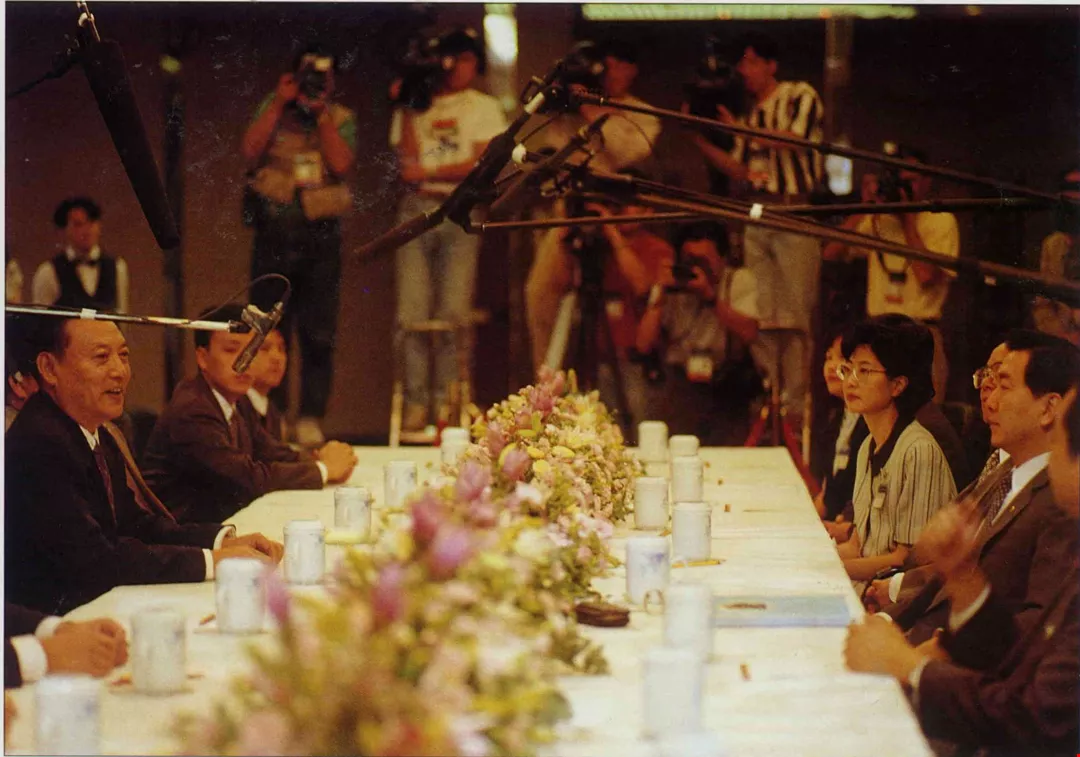
Each day before the formal opening of the Chiao-Tang talks, the two principals made brief statements which reporters recorded aurally and visually.
Feeding frenzy
The pressure that arises from the fear of "missing something" causes reporters to lock in on their news targets. Thus reporters camped out, eating and sleeping, at the hotel where Chiao Jen-ho and Tang Shubei were staying each night.
Ten or so years ago, when the Russian writer Alexander Solzhenitsyn came to Taiwan, one woman reporter crawled over the roof into where Solzhenitsyn was staying to try to get an exclusive interview. She was refused, but still wouldn't leave until the author called for security. Compared to that deed, perhaps reporters today are a bit more "civilized," but the spectacle of "harassment" of interviewees continues.
Surrounding and harassing an interviewee is common all around the world. This approach is most evident when some major event occurs, or some individual becomes the focus of attention. The sieges that foreign reporters lay around Michael Jackson are at least as intense as the ones Chinese reporters set for actress Lin Ching-hsia. Some have called this phenomenon a "feeding frenzy." The reporters appear to be a school of sharks homing in on the hapless victim and chewing him (or her) up mercilessly.
The victims of the harassment are of course unhappy, but the reporters are often no less so: "When the person refuses to be interviewed, or will not sit down and talk to you nicely, and the story is very important, then what else can you do but surround them and harass them?" wonders United Evening News reporter James Chen.
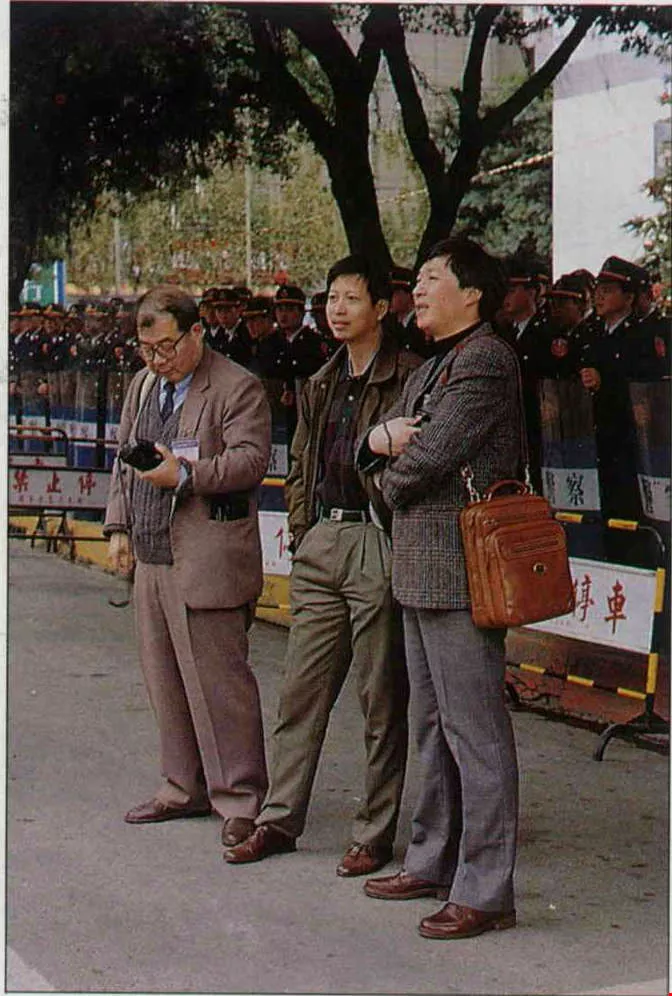
When mainland reporters came to Taiwan, they were the center of the story. These reporters came in January of 1990, but by now the novelty--and newsworthiness--has passed.
Getting a shot of the premier
Indeed, many reporters feel that such tactics have their place. Luo Wen-hui, a professor in the Graduate Institute of Journalism at National Chengchih University, provides data which shows that 72% of reporters in Britain, 8% in Germany, and 47% in the United States feel that harassment" may be justified."
But, whether they like it or not, do reporters really have the power to reject this type of news-hounding, and to forget about the stories that go with it? The answer is: Impossible!
"When something newsworthy is happening, reporters do not retain 'the right to remain silent,'" says Huang Cheng-chi, assistant editor-in-chief at the United Daily News, without hesitation. The responsibilities that go with the position and the pressures of competition for news do not give reporters this option.
Last December, Premier and Mrs. Lien Chan went to Malaysia for a little "vacation diplomacy." Because of fears that China would protest, the itinerary was kept secret. The head of one news agency was extremely agitated by the inability of his front line reporters to get near the premier or to interview anyone associated with the trip, so he ordered his reporter, "Climb a tree if you have to to get a photo of the premier playing golf." The reporter did not dare make excuses, and actually did find out where the premier was playing golf, evaded heavy security, climbed a tree, and got the picture without anyone being the wiser.
During the Chinese New Year this year, President Lee Teng-hui went to Southeast Asia for a trip. One television reporter took the risk of invading a Thai military airstrip to get pictures of President Lee walking along with the ministers of Foreign Affairs and Economic Affairs.
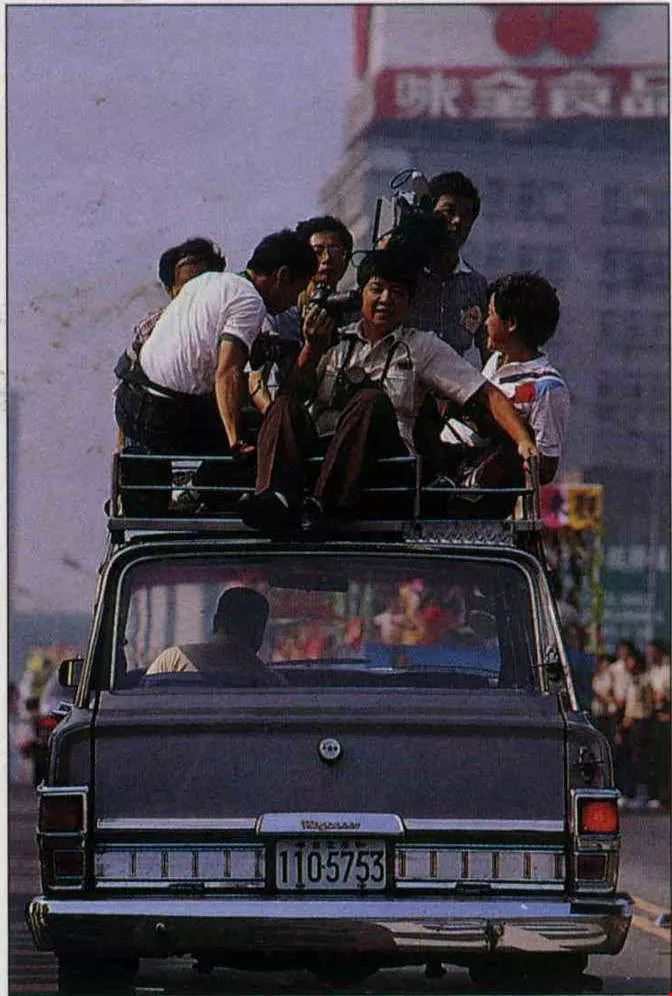
In September of 1986, when the taipei City Zoo moved from Yuanshan to Mucha, some reporters leapt onto the roofs of the vehicles to photograph the animals. (photo by Cheng Yuan-ching)
Where's the beef?
Premier Lien playing golf? President Lee walking off a plane? This is news? In fact, it seems like there is little significance to this type of story, but it means a great deal to those in the corps of reporters and their editors who know the business of news-gathering inside out. Getting these types of stories indicates that even when reporters are in a "high risk area" where getting news is very difficult, they still can get something, they still are striving to be conscientious in their profession, and they have the skills to get the job done.
For the past two years, Taiwan has been making every effort to expand its external relationships. The president and the premier have repeatedly gone abroad under the guise of "taking a vacation" or "attending a conference," and flocks of reporters trail in their wake.
Wang Chun, a senior reporter at the Commercial Times, points out that on this type of trip the significance all lies in the formal visits made or the golf matches played. Except for the symbolism of broadening diplomatic contacts, there is little that is newsworthy. He says, "but because our leaders do not go abroad very often, and the newspapers are all willing to put up the money," when one member of the media decides to go, the others can't not go for fear of losing an exclusive to their competitor. As a result, the presence of a large gaggle of reporters itself becomes part of the news beyond the original event itself
After Premier Lien visited Latin America. the interaction abroad between Taiwan's diplomats and reporters was pursued by many media outlets. Wang Chun wrote a series of articles entitled "Diary of the Foolish Reporters."
Perhaps it is because after the lifting of restrictions on newspapers in 1987 they were allowed to expand greatly, and most added a large amount of new space that had to be filled. Looking at trips abroad by national leaders as a case in point, stories appeared on everything from visits by the premier's wife to overseas Chinese schools and patting the heads of the children, to inscriptions in English and Chinese made at a pottery factory, to where the next stop on the itinerary would be. Julian Baum, the Taipei correspondent for the Far Eastern Economic Review, reads stories by Taiwan reporters and often feels that, though they are interesting, he can't figure out what the point is.
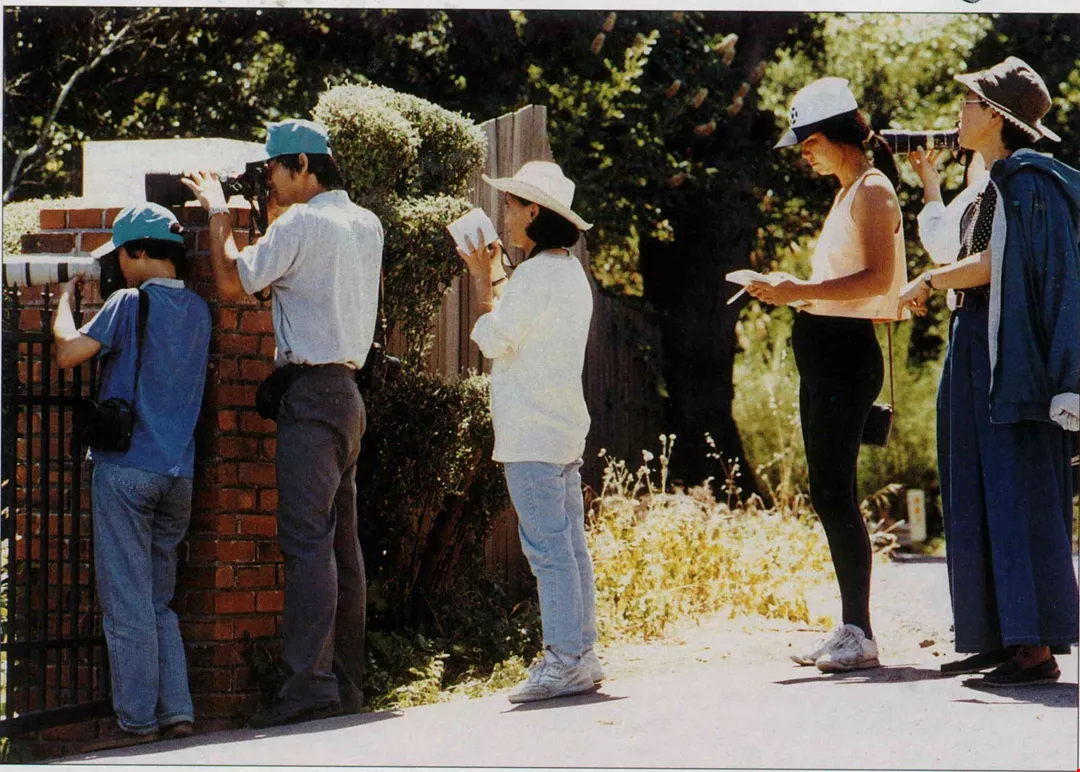
Taiwan reporters waiting anxiously outside the home of film star Lin Ching-hsia in America. They gave little thought to the hot sun, only hoping to win the star's favor and get an interview with her. (photo by Chang Chen-hsien)
What's the buzz?
The demands of editors and the competition in the industry often push reporters to plunge blindly into news stories. Naturally the problem is not that reporters do not understand the need for detached thinking. It's just that when they are in the middle of it all they think, "First get something out and worry about it later." This decision often rides roughshod over everything else.
"Our superiors at the newspaper will say, 'if you don't like what you are writing about, then find something else to write about!'" says Wang Chun. Hsiao Lung-chi, the reporter who got the footage of President Lee getting off the plane, states that he did not feel he was doing something dangerous when he first broke into the Thai military airhase, but only thought "how I could use my techniques to get the best possible story." As far as television reporting goes, whoever gets the visual is the winner, so he feels he made the right decision.
Many reporters have no scruples about breaking rules to get a story. Julian Baum says that one often feels like one is "wasting time" attending press conferences. "Reporters make long speeches when they ask their questions," he complains. And when a controversial topic comes up, reporters will "debate" with the interviewee right on the spot, even dragging in ideology to confront the respondent.
Some reporters' questions also are culturally prejudiced, and invade others' privacy.
When the American actress Joan Collins of "Dynasty" fame came to Taiwan, reporters repeatedly badgered her with personal questions. They asked about her wig, about her relations with her boyfriend, and so on, making her flare up in anger. Reporters of course understand that these types of questions are likely to put the interviewee in a difficult position and should thereby be avoided. But they have the mindset that tells them that they have no choice if they want to "satisfy the voyeuristic instincts of the public."
Some reporters find it hard not to transgress the rules when doing a story. This is especially the case when the story breaks overseas, where there are many variables beyond the control of visiting reporters. "Having no choice but to take a risk" becomes the excuse for rushing in without a second thought.
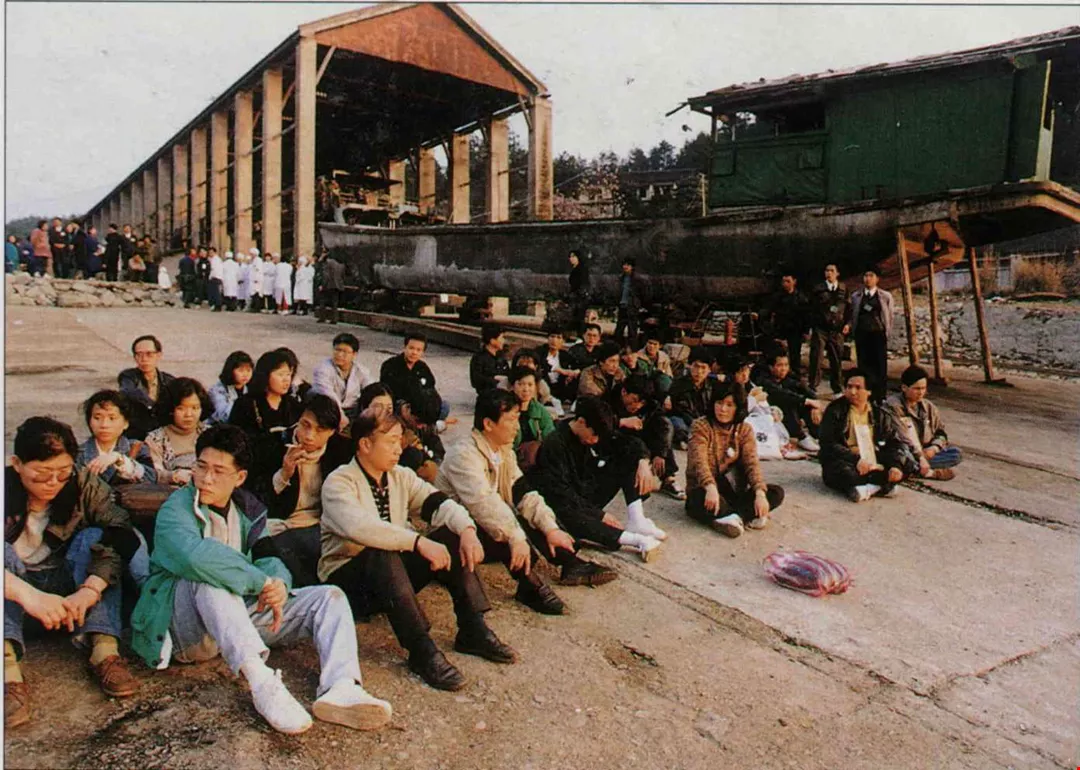
After the Qiandao Lake incident, bereaved family members were joined by reporters disguised as family members in a protest at the scene. (photo by Hsing Ting-wei)
Method to the madness
In April of this year, a China Airlines flight crashed in Nagoya, Japan; the tragedy claimed 260 lives. At the scene of the accident, while Japanese reporters waited outside the gymnasium that was used as a temporary morgue, Taiwan reporters ignored the restriction that "no one but family members" could enter, and simply forced their way in to the gym. "Perhaps there is some cultural difference. The Japanese reporters were under strict collective restrictions, and if anyone broke ranks the others would look askance. But among the Taiwan reporters, whoever got something was considered to be the best," observes China Television reporter Chen Pai-chia. One reporter even had the nerve to say, "If we didn't get into the temporary morgue then how could we ask the bereaved relatives questions?" Yet in the end, the Japanese reporters outside still got their interviews with family members.
In June, actress Lin Ching-hsia was married in the United States. The Taipei media spared no expense to send flocks of reporters for the story. Unwilling to be disturbed, Lin refused to be interviewed. Reporters then camped out around her home. Some unfurled banners in protest, others went in a group with their publisher to present a "gift" of a golden Boddhisattva, and others also sent lavish presents. And some "set a new record for the Chinese media in America" by renting a helicopter to watch the wedding ceremony from the air, attracting disapproving stares from the local citizens and greatly disturbing the peace and quiet of the neighborhood.
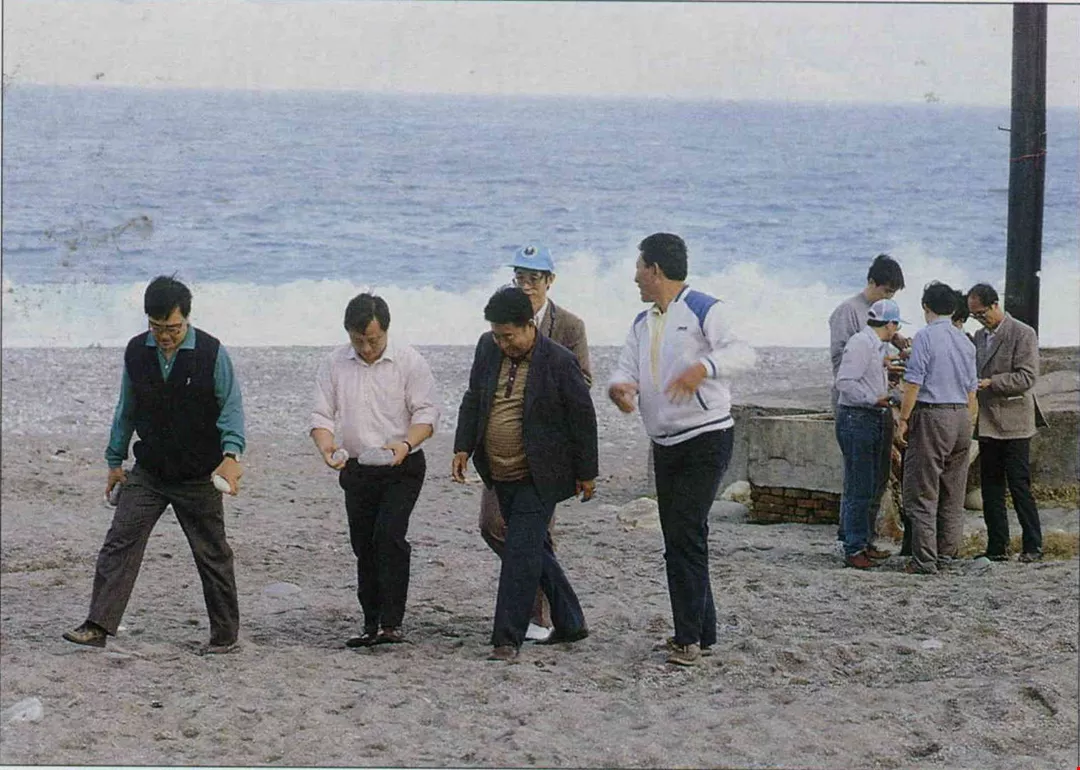
In order to build up relationships, reporters often engage in social activities with sources. When leaders of China's 1989 democracy movement came to Taiwan in 1990, several reporters accompanied them to the seaside at Hualien.
Person first, reporter second
What is the content of this type of news, done without regard for the feelings of others? Three days after the air disaster, several newspapers used a page three headline to report that the mother of the pilot cried at the coffin, "My child, why didn't you pull up the plane?!" The family strongly protested after the event, because in fact the mother of the pilot was not even there.
When the story of Lin Ching-hsia hit the papers, it had become a detailed description of the star and her wedding. "They especially stressed the jewelry, ring, flowers, menu, and bodyguards, giving people the impression of extravagance, luxury, and waste," states Tai Chen-chih, chairman of the Department of Broadcast Journalism at the World College of Journalism and Communications. These kinds of "show-off" reports will perhaps contribute to making the next generation even more materialistic.
Chengchih University professor Luo Wen-hui points out that reporters not only have the obligation to get a story, they also have a responsibility to society. "So-called social responsibility does not just mean doing things that benefit society, it also means showing respect and sympathy for victims," he explains. It is perhaps understandable that in a context in which newspapers are commercialized that Lin Ching-hsia's wedding would become a major story. But when it comes to the relatives of the victims of the Nagoya crash, seeing their deep bereavement. reporters should have respected their refusals to be interviewed or to have debasing photographs published in the media.
Cool, not cold
In April of this year, 24 Taiwanese tourists were robbed and then burned to death on their tour boat in the "Qiandao Lake Incident" in mainland China. After the event, more than ten reporters pretended to be relatives of the deceased to get to the scene in Hangzhou for reports. They cried, lit incense, and prayed with the bereaved families, becoming full participants in the event. One reporter even wrote a series of reports in the paper posing as the relative of a victim.
This was just at the time when news came out that Hsi Yang, a reporter for the Hongkong periodical Ming Pao, was sentenced to 12 years in prison for "acquiring state secrets." The reporters posing as relatives of the deceased did not dare to openly write stories, nor would they have been able to do so given the strict news censorship imposed by the mainland authorities. Reporters had to lay low to the ground in the middle of the night and call in their stories speaking in Taiwanese, while cameramen tried to get their videotapes out as "local products" and photographers smuggled pictures out as "scenic postcards." Some reporters would arrange to meet couriers, and then climb down from their windows at the hotel to evade the Public Security Bureau. Others would arrange to meet in little restaurants, and stuff the news items into the courier's pockets. The level of danger was no less than that in a detective novel.
The reporters from the Qiandao Lake incident-- who had uncovered a great many discrepancies in the original, falsified mainland account of the incident and helped uncover the truth--were greeted as heroes when they returned to Taipei. But many foreign reporters found the scene a strange one. "It was very risky for the Taiwan reporters to pose as relatives of the victims to get the story. If the Chinese Communists had arrested one or two and sentenced them to prison, as they did with Hsi Yang, would the media or government in Taipei have had any way to get them out?" At the press conference for local and foreign reporters sponsored by the Government Information Office after the Qiandao Lake incident, one foreign reporter explained that foreign reporters thought of themselves as "not cold-hearted, but cool and self--restrained."
Luo Wen-hui feels that whether or not such "masquerading" for a story as occurred in the Qiandao Lake incident is proper or not depends on the circumstances. With a complete news blackout imposed by the Communist authorities, there was truly no other way to get any accurate information. Since the story was extremely newsworthy and important, the method used is understandable.
Walking a fine line
But this type of tactic requires extreme prudence.
A reporter for the Chicago Sun in the United States pretended to be a businessman and opened a bar; in the bar they used a hidden camera to film local officials taking payoffs to allow the bar to stay open. The reporter later was nominated for a Pulitzer Prize for the series of reports he wrote. However, he did not win the prize because his method was not considered open and above-board enough.
In post-martial law Taiwan society, there have been many new movements on behalf of environmental protection, educational reform, and protection for disadvantaged groups, and some reporters have come to understand these movements and have become participants in trying to report. In the end they have even become cheerleaders or activists for the movements; some have even left journalism altogether.
But let's leave aside these relatively extreme cases. More frequent are cases in which reporters themselves become directly part of the news because of their professional duties.
In February of this year, when the case of the murder of Captain Yin Ching-feng--who was believed to be about to blow the whistle on high level corruption in military weapons procurement-- reached an impasse, one Taipei newspaper arranged for a meeting in Singapore between a certain individual thought to be involved in the case and prosecutor Ko Shih-pin. A reporter then wrote an exclusive story based on a tape of their meeting. However, the reporter was immediately rebuked by the two principals for breaking his promise not to write about the meeting, saying "we made a mistake trying to make friends with a reporter."
Luo Wen-hui believes that you could look at this incident from several levels. As for arranging the meeting in the first place, the reporter simply took advantage of his role to help out a judicial investigation, and there was nothing in the process open to criticism. The problem was that the reporter released the audio tape as a news story. If the two principals had given the reporter the tape voluntarily, then the reporter indeed had the right to release it. Moreover, it was by no means a violation of the legal proscription against publicizing an ongoing investigation. The problem with this is that if the reporter did promise not to do the story, and then did anyway, then this violates journalistic ethics.
You can see from this that reporting often requires walking a fine line, and one careless step can topple the reporter over into the realm of illegality or unethical behavior.
Making off with vegetables
After the lifting of the ban on new newspapers (in 1987), the number of papers increased from 31 to over 300 at the present. The number of magazines increased from about 2000 to over 5000. Competition and diversity in the print media began in turn to affect the electronic media, and the former monopoly on news held by the three government-run television stations has been broken by cable TV.
Some now believe that because of the intense competition, the media itself has become a "source of chaos" in society. Chen Shyh-yaw, chief of the Politics Section at the United Daily News, contends that only in Taiwan do you see reporters still phoning up officials at home at 10 or 11 at night to get a story, doing the minimum to "pass along what someone else has to say." "Reporters are busy competing with each other all day, and have little time to sit and reflect or inform themselves more deeply. They just 'grab the vegetable basket and assume they've got the vegetables.' Those lucky enough to escape become behind-the-scenes staff. The others just become burned out," he says with deep dismay.
Senior reporter Chang Tsuo-chin believes that reporters must bear some responsibility for being a "source of chaos," but argues that the more important cause lies in Taiwan's political and social environment. "There are many careless and irresponsible political figures who say anything they want about anything the want, from national political affairs to personal affairs. When they are wrong they duck responsibility and blame the media for believing 'second hand' or 'third hand' reports. In this way they seem to substantiate the wrong impression people have of the media."
Chen Pai-chia suggests that the relationship between the reporter and the reportee is a combination of "confrontation" and "coexistence." Take for instance the news about Lin Ching-hsia. Although the media's ruthless search for news was of questionable ethics, there is also the fact that by refusing any interviews, the film star stoked up the media's curiosity to pursue the story and led to having even more space devoted to it.
Hsiao Lung-chi, who works the political beat, says that often when officials are asked to comment about some controversial matter, they simply refuse to say anything. But when they want to talk about their achievements or to "make an impression," they are happy to seek out reporters. "To put it harshly, they see reporters as nothing more than propaganda tools to be manipulated," says Chen Pai-chia. People visited by the media must change their attitude toward reporters from seeing them as being "instrumental" to being trustworthy "honorable opponents," but there is still quite some ways to go before this is achieved.
Competition: not just to get the story
Despite this, China Times editor-in-chief Huang Chao-sung believes that the reporters themselves have a lot of room for improvement. "What reporters should compete with each other about is not their harassment skills, but their routine channels for getting data, their observations and thoughts about events, and their ability to lay out the news."
"It should go so far as when a reporter has an exclusive story in hand, the editorial department must inquire: 'Where did this come from?' If the methods used were improper, such as buying news, even if the contents are stimulating the story should be suppressed," argues Huang. Or, in a case of kidnapping, stories should not be released until the victim is safe. Or when the victim in a story is a minor, names and photographs should not be published. These are obligations that the media should respect.
Of course, there are also things that not only the news community, but also the sources of the news, should reflect on. These include not falsifying or exaggerating news, and carefully seeking supporting evidence in order to minimize the error rate. There are already some rules that have become routine for handling news, such as not publicizing cases still being investigated, having respect for the dignity of the accused, and so on, about which both the media and the police need to be educated.
Indeed, the people who each day read and listen to the news may have some of their own thinking to do. If you say that a newspaper is full of errors, is boring, or makes personal attacks, but the sales continually increase, notes one reporter, then perhaps the problem is with the readers.
At the Chiao-Tang meeting, the elevators and restaurant doorway were jammed with reporters. Tang Shubei, secretary-general of the mainland's Association for Relations Across the Taiwan Strait, was moved to say that the intensity of the news media in Taiwan "made his heart skip a beat."
When will the day come that this heart-stopping Taiwan media will make people think of something else besides "demolition and manufacturing"?
[Picture Caption]
p.38
Last February, when it had just been announced that provincial governor Lien Chan would be the next premier, he was surrounded by reporters upon leaving the meeting of the Kuomintang Central Standing Committee. (photo by Hsu Po-chin)
p.40
Each day before the formal opening of the Chiao-Tang talks, the two principals made brief statements which reporters recorded aurally and visually.
p.41
When mainland reporters came to Taiwan, they were the center of the story. These reporters came in January of 1990, but by now the novelty--and newsworthiness--has passed.
p.42
In September of 1986, when the Taipei City Zoo moved from Yuanshan to Mucha, some reporters leapt onto the roofs of the vehicles to photograph the animals. (photo by Cheng Yuan-ching)
p.43
Taiwan reporters waiting anxiously outside the home of film star Lin Ching-hsia in America. They gave little thought to the hot sun, only hoping to win the star's favor and get an interview with her. (photo by Chang Chen-hsien)
p.44
After the Qiandao Lake incident, bereaved family members were joined by reporters disguised as family members in a protest at the scene. (photo by Hsing Ting-wei)
p.45
In order to build up relationships, reporters often engage in social activities with sources. When leaders of China's 1989 democracy movement came to Taiwan in 1990, several reporters accompanied them to the seaside at Hualien.


