

At the Berlin Film Festival in Febru-ary two Chinese-language films, Betelnut Beauty and Beijing Bicycle, took Silver Bears in five different categories, including the prizes for best director and best newcomer, as well as the special jury prize. The producer of both films was none other than Peggy Chiao, the doyenne of Taiwan film critics.
From working as a movie critic and organizing film festivals to producing films herself, how has Chiao helped films from Taiwan win honor after honor at international film festivals?
In over an hour Peggy Chiao has managed to travel just a short distance on the main street at Cannes. As soon as she takes a step, she is greeted by old friends-other major players in the international film festival circuit, such as the directors of the San Francisco Independent Film Festival, the International Rotterdam Film Festival, and the Nantes Film Festival. Says fellow critic Chris Wang, a witness to this scene, "The success of her ten years of 'diplomacy' on behalf of Taiwanese films is obvious from how these people chat with her."
Mai Juo-yu, a reporter for Taiwan's United Daily News, said that the 51st Berlin Film Festival seemed to have been organized on behalf of Chinese-language film. The five Chinese who received awards-Wang Xiaoshuai, Li Bin, Tsui Lin, Lee Sinjie and Chang Chen (who accepted a prize on behalf of Lin Cheng-sheng)-all thanked Peggy Chiao and her co-producer Hsu Hsiao-ming. It is extremely unusual for the same people to be thanked five different times at an international film festival awards ceremony.
"Spending my days shuttling between festivals, I've become very familiar with their regulations and quite clear about what themes to package and promote," says Chiao in her Mucha office, which is covered with movie posters. The promotional materials for Betelnut Beauty first explained what betelnut was and its importance for working class Taiwanese. And for Beijing Bicycle, which was directed by Wang Xiaoshuai, a graduate of the Beijing Film Academy and a member of the new generation of mainland directors, Chiao's notes elucidated the symbolic significance of bicycles in China before and after the liberalization of the early1980s. Only with this sort of background information will foreigners take an interest in Chinese films and understand what they are about.
Before going to Berlin, Chiao was very confident that these films would win prizes, and alerted the media to pay attention. "In fact, the film festival community is a like a small family," says Chiao. "On the jury, the mainland's Xie Fei was an old friend, as were the jurors from Spain and Japan. When I got to the hall for the awards ceremony, I first noticed happily that no one was trying to avoid me. Then I heard that there wasn't any strong competition, and I was quite sure." It is very unusual for two films from the same production company to be nominated and win major prizes.
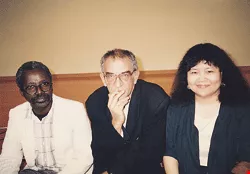
Chiao with actors Kao Chieh and Niu Cheng-tse and director Chen Kuo-fu at the retrospective on Taiwanese film held at the Nantes Film Festival in 1993. This was a milestone in the history of bringing Taiwanese films to Europe. (courtesy of Peggy Chiao)
Cross-strait cooperation
Betelnut Beauty and Beijing Bicycle are from the "Tales of Three Cities" series made by different directors from Taiwan, Hong Kong and mainland China, for which a total of NT$120 million has been budgeted. Peggy Chiao explains that the European rights to the "Three Cities" series were sold in advance to Pyramid Productions, one of France's ten big film distributors, which had previously released Smoke by the Chinese-American director Wayne Wong and the Russian film Burnt by the Sun.
How was it they could get French money? Chiao explains, "Chinese film is more important in France than any other foreign market in the world." Several hundred thousand tickets were sold to Flowers of Shanghai in Paris, and 350,000 were sold to A One and a Two (that's NT$70 million when you figure each ticket costs about NT$200). 600,000 tickets were sold for In the Mood for Love, and 1.6 million for Crouching Tiger, Hidden Dragon. The trend in Europe is toward multinational cooperation to make films. When the credits roll for European movies, you usually see a long list of film companies from various nations.
Apart from looking abroad for financing and screening opportunities, the "Tales of Three Cities" series also provides a new example of how to market Chinese-language films in the new millennium.
"The film industry in Taiwan cannot rely on the local market," says Chiao. "For marketing, financing, and production techniques, it's got to look to the Chinese-language film industry as a whole to survive." Taiwan is moving in synch with the globalization of capital, she notes. The mainland is moving quickly from authoritarianism to capitalism, and Hong Kong has returned to Chinese rule after a century and a half as a British colony. The film industry has got to reflect this change. The three cities of Taipei, Beijing and Hong Kong are seen as representative of the new challenges facing Chinese society in the 21st century.
Moreover, in the hope that the films will break new ground from a visual standpoint, the directors of this series of films-Wang Xiaoshuai and Jia Zhangke from the mainland, Yu Lik-wai from Hong Kong, and Lin Cheng-sheng, Yi Chih-yen and Hsu Hsiao-ming from Taiwan-are all young directors who tell stories about youth.
Having been involved with film ever since she finished her education, Chiao has worked in various capacities in the film industry for the last 20 years. At first she was one of the most influential film critics when Taiwan's "new wave cinema" burst onto the scene in the 1980s.
Born in 1953, Chiao studied journalism at National Chengchi University before pursuing graduate studies in America. After one semester of work toward a graduate degree in journalism, she grew bored and shifted her focus to film. She enrolled in a doctoral program in film, but before she could graduate she was called back for a job in Taiwan's media, returning in 1981 at a time of tremendous historical change for film in Taiwan.
Chiao edited two columns: "Cinema Plaza" in the United Daily News and "Everybody's a Critic" in the China Times. She would invite "new wave cinema" critics like Huang Chien-yeh and Chen Kuo-fu to offer their opinions. Their often sharp evaluations of films resulted in a war between them and the film industry. When Chiao criticized movies, their makers launched their own counter-offensive, saying she was "too subjective and emotional, too harsh and uncaring about others' fates, too out of touch and foreign in her tastes, and too theoretical and removed from most people's reality."
However polarized people's opinions of her were, Chiao was certainly one of the most influential critics of the day.
Huang Chien-yeh, a leading critic of new wave cinema films, recalls that it was a low ebb for Taiwanese cinema, with an abundance of social realist films and movies about women taking revenge that were really just about sex and violence. "Peggy Chiao had a sturdy foundation in film studies, and she didn't pull her punches. In Taiwan there hadn't been such cutting criticism before. By bringing together the work of six different critics, she quickly established public credibility for film criticism."
"The public wouldn't necessarily watch the films we recommended," says Huang Chien-yeh, laughing. "But they definitely wouldn't see the films we said were awful." Later the industry started to put pressure on the newspapers, threatening to pull advertisements. The papers hoped that the critics would dwell on the positive. But it was against their principles, so they resigned.
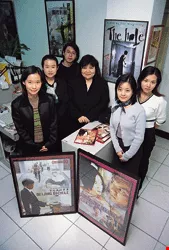
Chiao and her colleagues at the Arc Light office with the English editions of Taiwanese movie posters. All are superb examples of packaging Chinese-language films for foreign audiences. (photo by Jimmy Lin)
Taking film abroad
Apart from writing film criticism, Peggy Chiao participated in the filming of Woman of Wrath and wrote the screenplay for Center Stage, which Hong Kong's Stanley Kwan ended up directing. She has also written and translated books about film and organized annual awards ceremonies and film festivals. She has both promoted Taiwan films to major international festivals and promoted art films from the mainland and elsewhere in Taiwan.
Olivier Assayas, the editor-in-chief of Cahiers du cinema, played an important role in getting Taiwanese films to be shown at international festivals.This French friend and early discoverer of Taiwanese film came to Taiwan in 1984, and during his visit saw Hou Hsiao-hsien's The Boys from Fengkuei. He loved the film and invited it to be shown at the Nantes Film Festival the following year. For two years running, Hou was awarded the prize at Nantes for best film. It was Chiao who suggested that Assayas see The Boys from Fengkuei.
And it was also largely Chiao's doing that a retrospective of Taiwanese film was held at the Pesaro Festival in Italy in 1987, which brought together a large group of "new wave cinema" filmmakers, including directors Hou Hsiao-hsien, Wan Jen, Ko I-cheng, and Chen Kun-hou, producer Hsu Li-kung, and screenwriter Chu Tien-wen. Meeting the sponsors and organizers of film festivals, the group picked up valuable experience, and Chiao came to believe that it was necessary to take the films and filmmakers overseas to meet those responsible for foreign festivals. From familiarity would come trust.
Two years later, Hou Hsiao-hsien's City of Sadness won the Golden Lion at the Venice Film Festival. From this start in France and Italy, films from Taiwan went on to participate and win awards at London, Lucarno, Rotterdam, and Berlin.
Chiao is also the best translator for many directors when they go abroad, because she understands what foreigners know and don't know about Taiwan and China and can design the promotional materials accordingly. For instance, for Wan Jen's Super Citizen Ko she explained the defiant meaning of the gesture when prisoners raised both arms up in the air. In the notes for Wu Nien-jen's A Borrowed Life at the Tokyo Film Festival, she put the focus on the Japanophilia of Taiwan's older generation, on mining culture and on social transformation. With this introduction, Wu's portrait of his father took on greater historical significance.
When the Government Information Office designated 1993 a "year of film," it commissioned Chiao to promote films from Taiwan overseas and organize various activities to cultivate filmmakers' skills at home. From these efforts grew the Taiwan Film Center, which keeps up ties with international film festivals, as well as introducing, marketing and packaging Taiwan films at foreign festivals and helping to sell their foreign rights.
Although films from Taiwan won many honors at international festivals during the 1990s, domestic box office returns just sank lower and lower. With no one willing to put up money, filmmakers have had to rely on government grants, and their work has tended toward the excessively artistic and self-indulgent. It's a situation that shows just how moribund the film industry is in Taiwan. What is really depressing is that apart from City of Sadness and The Wedding Banquet, which were well received by audiences in Taiwan, most of the films shown at festivals abroad have fared poorly at home, so that some have joked that acceptance at foreign festivals is a "kiss of death" for domestic box-office success. Industry groups have gone so far as to write letters to major international festivals asking them to boycott Peggy Chiao, saying that she is too arbitrary and can't be trusted.
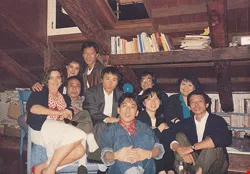
In 1989 Hou Hsiao-hsien's City of Sadness took Venice by storm, winning the Gold Lion for best picture at its film festival. The photo shows the director and his production team. (courtesy of Peggy Chiao)
Cutting her teeth in film production
Just when many film buffs were convinced that the domestic film industry was dead, Chiao established Arc Light Films. In 1997 it produced four 16-millimeter documentaries, including Stanley Kwan's Still Love You After All These..., Ann Hui's As Time Goes By, Hsu Hsiao-ming's Homesick Eyes, and Olivier Assayas's A Portrait of Hou Hsiao-hsien.
Chiao says that she threw herself into film production because she wanted to help film in Taiwan find a way out of its quagmire. The Taiwan film market is so small and there is so little money available that filmmakers must make the most out of shooting techniques, film style, money raising, and distribution. In planning these four documentaries, she researched matters with director Hsu Hsiao-ming. They discovered that independent European filmmakers always shot with 16 millimeter film, and then enlarged the film afterwards. Doing so cuts costs by about half. Since it's harder to guarantee success with dramatic films, they decided to produce documentaries first.
Then there was the matter of raising money. At a time when many filmmakers can only shoot with government grants, Peggy Chiao looked for new sources of capital. She convinced CTV's President Cheng Shu-ming and Chairman Chiang Feng-chi to put up the funding and accept reimbursement when the films were shown at foreign festivals and their rights were sold.
"In one respect I have an advantage over others," Chiao explains. "Because I have worked as a film critic, have experience with film marketing and publicity, and know many festival organizers having organized festivals myself, I have gradually built up relationships with production companies and distributors. There are very few people in the film world who have experience in film criticism, film festivals, and film distribution. Therefore, I have more resources at my disposal than most."
Apart from providing funding and distribution, does she offer opinions on content to directors?
"I suggested that Stanley Kwan and Ann Hui shoot films about the 1997 handover of Hong Kong from their own personal perspective," Chiao recalls. "The experiences the two had growing up can reflect the experiences of Hong Kong people as a whole. Ann Hui intersperses discussion about left-wing terrorists who were setting off bombs in Hong Kong with footage of Josephine Hsiao Fang-fang dancing a-go-go. There's a lot of funny stuff in there." And the theme of Betelnut Beauty was something that Chiao first came up with herself. Then it gradually took shape after discussions with the director and others working on the film.
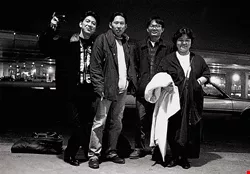
Chiao with actors Kao Chieh and Niu Cheng-tse and director Chen Kuo-fu at the retrospective on Taiwanese film held at the Nantes Film Festival in 1993. This was a milestone in the history of bringing Taiwanese films to Europe. (courtesy of Peggy Chiao)
Box-office and artistic success?
Some people believe that the Taiwan film industry's biggest strength lies with its "auteur" directors, but Peggy Chiao disagrees. As Chiao has learned from constantly shuttling between international film festivals, every time a film from Taiwan receives favorable notices, what follows is embarrassment when no one buys the rights. Film companies and agents say, "If all Taiwanese films are full of suffering and tragedy, then we won't see any more next time," laments Chiao. Although films from Taiwan have earned an international reputation, these artsy films are often inaccessible, and they do poorly at the box office. For instance, none of Hou Hsiao-hsien's works have ever been distributed in the United States.
"Directors from Taiwan must consider the market," Chiao stresses. "There's no country in the world where the director's will is so bowed to as in Taiwan. But film is a collaborative art, and there's no way that directors can always get everything they want. Taiwan's directors are too spoiled. On the mainland conditions are much worse, but the directors just grin and bear it." What worries people even more is that there is a talent gap in Taiwan between the older and younger generation of directors, screenplay writers and other film personnel. Therefore, Chiao has repeatedly asked the government to establish a full-scale film department at the National Institute of the Arts.
Even if she isn't optimistic about the state of film in Taiwan, Chiao very much enjoys her work. She remarks that festivals are half publicity and half partying, and that you get a chance to see the best films from around the world. Film production also has its creative side when you find a story and participate in the editing and sound mixing. Chiao is planning four new movies for next year, and is going to start working with an American company.
"Her influence is invisible but pervasive," says the director Lin Cheng-sheng. "She is particularly good at getting foreign money, having found a whole new method of selling the rights to six films as a package." Though the Taiwan film industry has gone through rough times, Chiao is helping people in the industry to forget their troubles and look toward the future.


@List.jpg?w=522&h=410&mode=crop&format=webp&quality=80)


