Mayaw Vuyu:In the Vanguard of Military Sports Science
Sam Ju Li-chyun / photos Jimmy Lin / tr. by Chris Nelson
November 2008


For a burly, robust Aborigine in the military, what career choices are there besides entering the special forces? Air Force lieutenant colonel Mayaw Vuyu, of Amis extraction, has designed the world's first infrared chin-up bar training device, integrating his knowledge of sports science with his experience in military training. This summer, Vuyu became Taiwan's first career military Aborigine to be accepted into a PhD program. His example is indicative of the new opportunities and choices available to Aborigines in the armed forces.
One blistering August afternoon, on an exercise field at the Air Force Institute of Technology in Kaohsiung's Kangshan Township, cadets are following the orders "Up! Down! Up! Down!" barked out by the drill instructor. The cadets are hanging from chin-up bars, clenching their teeth as they pull themselves up in their attempt to pass the physical. But nobody can accurately tell if the examinees are reaching the qualifying height.
Then the drill instructor pulls out his secret weapon-an infrared chin-up bar training device. The students, straining to lift their chins above the bar, cannot fool the keen infrared eye of the device.
The drill instructor is Mayaw Vuyu. He's not your usual unsmiling "drill sergeant from hell" type whose veins puff out when he yells at you. On the contrary, behind his Coke-bottle glasses are the deep-set, sanguine eyes of an Aborigine.
Once a kid from a poor family in an Amis village in Fenglin, Hualien County, he is now a lieutenant colonel and the leader of the Air Force Institute of Technology's physical education department, in command of several people who were once years ahead of him in school. Vuyu says his military career has shown him an entirely different world from his former village life, and has taught him that there's more to life for an Aborigine than unskilled labor and drinking.
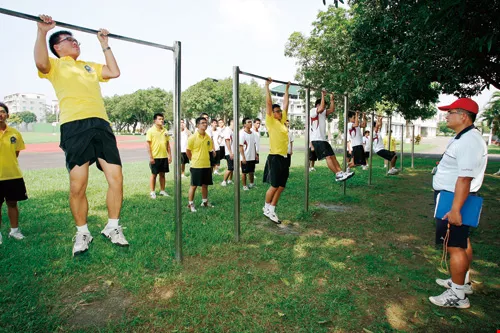
At the Air Force Institute of Technology, Mayaw Vuyu (far right) tells his students hanging from the chin-up bar, "Don't slack off! Get the lead out!"
From a poor farming family
Mayaw Vuyu's parents were over 40 when he was born in 1971 as the youngest of seven children. At the time he was given the Chinese name Wen Kuo-ching. Since his parents were tenant farmers, Vuyu knew how to operate a plow and plant, harvest, dry and thresh rice by the time he started fifth grade.
In elementary school, Vuyu's grades weren't exactly stellar. On his first day at Fenglin Junior High, when he took a placement test, he heard the term "tracking" for first time in his life. The test results startled Vuyu: he was placed in the advanced class. At that, he bid farewell to his carefree Aboriginal childhood.
After entering what the Han Chinese called the "smart kids'" class, he was one of just three or four other Aboriginal students, exposing him for the first time to the socioeconomic differences between him and his Han classmates: when they were playing or studying, he had to cut sugarcane or dig up peanuts in rich people's fields to earn money for his folks.
Vuyu had no hope of buying the supplementary study materials that only Han Chinese could afford; he had to work hard to offset the material differences between him and other students. Before going to school each day, he would stand in his front yard and recite English. In the evenings, when his mother was in the kitchen cooking dinner, he would be hunched over the dinner table solving math problems, making up his own problems, and working on compositions. Thanks to his self-motivated studies, his grades improved until he ranked among the top ten of his class. He would not lose out to his Han peers.
Vuyu's athletic prowess also boosted his self-confidence. He became captain of the school team both in track and field and in soccer, and once held the Hualien County schools' long jump record.
At the time, the dream of all the students in the school was to test into National Hualien High School, but Vuyu knew in his heart that even if he got into this celebrated school, his family wouldn't have the money for tuition or uniform.
One day, his classmates were passing around a recruitment pamphlet for Chung Cheng Armed Forces Preparatory School, and Vuyu saw the description of a monthly salary plus free books and uniforms, as well as a pre-arranged career in the military after graduation. "This is too good to be true," thought Vuyu, deciding then and there that he had to apply.
"I made my decision to attend Chung Cheng entirely for economic reasons," says Vuyu, admitting his naivete at that time of not knowing what a military academy is and yet gambling his entire life on it.
Vuyu tested into the school with high scores. In early August 1986, on the day before he went to Fengshan, Kaohsiung County, to begin his schooling, he packed the harvested rice into sacks, finished the preparations for the village harvest festival, then told his parents he was off to military school the next day. "My parents weren't too upset, because everyday life was tough enough that a child in military school was perhaps a consolation to them," says Vuyu bittersweetly.
Vuyu's parents left for work the next morning at five, so they had no time to say goodbye. His sister took him to the Hualien chapter of the China Youth Corps, and on the way there treated him to a luxurious meal of ten boiled dumplings. Afterwards, with tears in her eyes, she bid him facawlen lanlen (Amis for "have a safe trip"), and boarded him on a bus to the preparatory school.
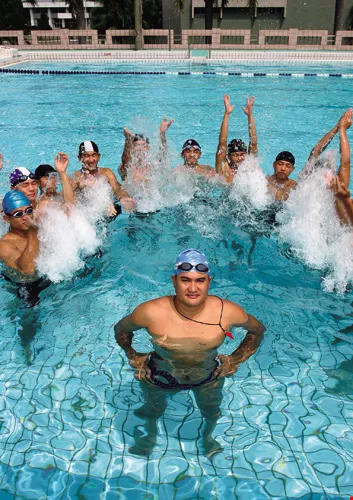
Mayaw Vuyu (foreground), director of athletics at the Air Force Institute of Technology, is of Amis extraction. Specializing in military sports science, this summer he became Taiwan's first career military Aborigine to be accepted into a PhD program.
A greenhorn in the army
The first day of school was an eye-opener for Vuyu. At mealtime, the new cadet saw a meal tray for the first time in his life, and it was also the first time he ate a sumptuous four-course meal with soup and fruit. "How can something this good exist?" Vuyu marveled, itching to share with his family the joy of military school life.
Yet, over the next three years, Vuyu didn't talk much about school-related stuff with his family. He sighs, "The differences between village life and the outside world were too great, and I was afraid they just wouldn't understand if I told them anything."
Some 60% of Vuyu's classmates were offspring of mainland Chinese parents who had come to Taiwan after World War II, and they were able to adapt quickly to the edgy life of the cadet. In retrospect, Vuyu surmises that most were probably children of military personnel who had learned about the experiences of their parents and family friends, so they were able to quickly get up to speed. But he was just a greenhorn: when the officer ordered "Fall in!" he was the only one who would anxiously jump into position and stand at attention; the others did so calmly and slowly while casting taunting looks in his direction.
For a kid of 14 or 15 who had left his home, it was hard to avoid venting due to the tremendous pressure of military school training. One day in 11th grade, a classmate called Vuyu a "savage." As anger and resentment welled up in his heart, he ran into the bathroom and started pounding the wall with his fists, releasing his pent-up emotions.
"I didn't want to be looked down on, and I was angry that they would call me this." Thinking of how he was all alone, far from his village and his family, Vuyu wept bitterly that day.
After that, Vuyu knew there was no going back now that he was in military school. He weathered his "wall-pounding" phase by seeking help in the counseling office, expressing his feelings in his journal and sharing his thoughts with his advisor. A year later, Vuyu graduated ranked third, and was admitted to Fu Hsing Kang College where he majored in physical education.
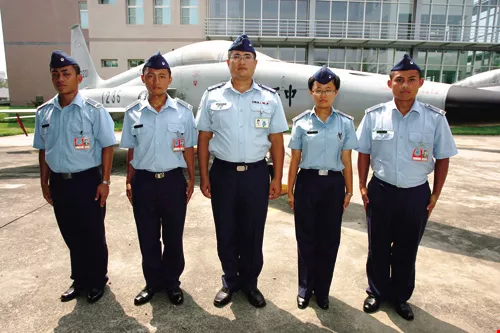
"If a man can do it, so can I!" Proud to follow the example set by Mayaw Vuyu (center), Chen Yuan-chen (second from right), a female Aboriginal cadet at the Air Force Institute of Technology, will not be outdone by her male counterparts as she works toward becoming an Air Force electronic warfare specialist.
A marked man
An Aborigine's identity is not a problem under the anonymity of a Chinese name, but once he sticks his head out from the crowd, his Aboriginal status will often lead to discrimination.
Majoring in physical education at Fu Hsing Kang gave Vuyu the chance to exercise his skills and earn superb grades. In 1993, he was chosen to serve as a trainee battalion commander for the student troops, leading nearly 2,000 students, and it was at this time that he found that his subordinate leaders would not comply with his orders. They clearly intended to humiliate him.
A semester later, as per convention, he should have been promoted to trainee brigade commander, but the school made an exception, elevating him only to the rank of trainee brigade major. "When you're of equal rank to everyone else, nobody cares that you're an Aborigine. But once you outrank them, you become a thorn in their side," says Vuyu. The other cadets saw him as a stumbling block in their career plans.
However, these incidents drove home to Vuyu that, as an Aborigine with a career in the military, he must strive harder than others. "When others get 100 points, we have to achieve 120 if we want to get ahead," he says resolutely.
In 2006, Vuyu was promoted to Air Force lieutenant colonel. He stopped using his Chinese name thereafter, instead reclaiming his traditional Amis name: Mayaw being his given name and Vuyu his family name. His fellow officers advised him not to change his name lest it hinder future promotions, but he didn't care. "Reclaiming my traditional name will be an inspiration to other Aborigines." Like Paiwan major general Tsao Ming-sheng, Vuyu encourages Aboriginal youngsters to enroll in military school. In his view, the more high-ranking Aboriginal officers there are, the more they will attract other Aborigines to enter military careers.
Of pens and swords
Over the last several years, the armed forces have encouraged military personnel to undertake academic studies. Vuyu seized the opportunity, first attaining a master's degree in sports science at Taipei Physical Education College, and this past May he was accepted into the doctoral program in physical therapy and assistive technology at National Yang Ming University. He is the first career military Aborigine to study for a PhD and also one of the few military personnel to enter a research-oriented university.
In military training, there is no lack of running, push-ups, sit-ups and chin-ups. The repeated calisthenics are not only tedious, they lack a basis in quantitative scientific data. Vuyu is working on making military training more scientific, effective and enjoyable. Applying theory learned from his studies of sports science, he has developed an infra-red chin-up bar training device: infra-red scanning can accurately measure whether the bodily motions carried out during chin-ups are correct, thereby boosting the effectiveness of the training.
Vuyu has also designed a miniature golf practice green, three meters square, for users to practice their golf swing, getting exercise and relieving stress in minimal time. A patent is currently pending.
The ultimate purpose of military sports science is its application to military training. As a member of the Air Force, Vuyu is studying how to reduce the effects of g-forces on fighter pilots' fields of vision. The results are expected to improve their missile targeting accuracy.
In his journey from a child of poor tenant farmers to his present position as lieutenant colonel, Vuyu has undergone seven years of military school and 15 years of career experience. Through it all, while convinced that military life gives Aborigines a chance to improve their families' economic lot, he strongly believes that Aborigines in the armed forces are not in a position to slack off.
"The military gave me the chance of a different life!" If not for his military career, Vuyu might now be tilling the soil back in the village or roaming from city to city looking for temporary work. He hopes that his example of success will inspire more young Aborigines to embark on a military career.


@List.jpg?w=522&h=410&mode=crop&format=webp&quality=80)


