Hard Times Hit the Middle Class--A New Lesson in Capitalism for Taiwan?
Vito Lee / photos Jimmy Lin / tr. by Phil Newell
January 2007


In his 1969 book The Coming of Post-Industrial Society, American scholar Daniel Bell predicted that the worldwide advent of the knowledge-based economy would begin an era of intensified competition and a rearrangement of the distribution of wealth.
Over the last three decades and more, the development of capitalist society in the US and Europe has apparently confirmed his predictions. Moreover, since the late 1990s, the rapid growth in Internet technology has spurred global competition, and increased the penetration of a new variant of capitalism across national boundaries. But a more important problem that both governments and intellectuals are struggling to address is that the growing gap between rich and poor is creating a social chasm between classes, and there appears no easy way to reverse the trend.
In the past, these problems were unknown in Taiwan, which prided itself on its highly balanced distribution of wealth. But now waves of new anxieties hitting the white-collar class are raising concerns that Taiwan will follow in the path of those societies where capitalism has reached its highest degree of development.
Compared to the 1970s, a time characterized by the decline of agriculture, and the 1980s, when a great deal of low-end manufacturing fled from Taiwan, these new challenges to Taiwan's white-collar class are having a much greater impact on people's sense of confidence. For the first time, there is the possibility of downward social mobility, as parts of the middle class may become the "new poor." It may be that in finding the balance between competitive efficiency and social stability, Taiwan will have to think about some alternative options.
Finance is the bloody front line on the capitalist battlefield. As in all wars in history, in pursuit of victory the sacrifice of individual foot soldiers counts for little.
It's Monday morning, and George Hsu and his colleagues leave the office together to start their working day. A Starbucks just outside the entrance to Taipei's Zhongxiao-Xinsheng MRT station is where they meet with clients. Ordering a "coffee of the day" and opening their notebook computers, here is where they will present insurance products to their customers.
"It's mornings in the coffee shop, while in the afternoons I usually visit clients in the metropolitan area by bus or MRT," says Hsu, a 36-year-old just two months into a new professional field. "In the past, when I was a loan officer in a bank, clients came to me. Now that I'm selling insurance, I'm the one that has to go to them."
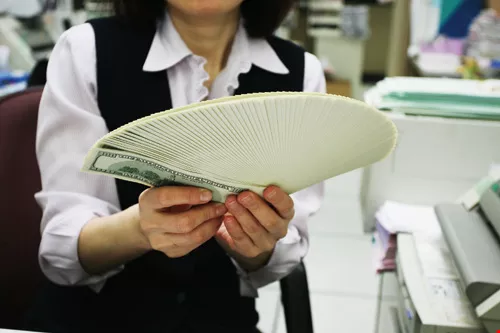
Salaries are rising so slowly that they are barely keeping up with prices; almost all office workers share the common plaint of salary stagnation.
The golden rice bowl?
In response to rising global competition in the financial industry, in 2002 the government decided to permit the creation of financial holding companies (FHCs) to encourage financial institutions to merge and increase economies of scale. Hsu's former employer, Dah An Commercial Bank, was one of the first to feel the effects when it was taken over by Taishin Holdings. After the merger, Hsu accepted a negotiated termination of his original employment contract, thinking at the time that this was just a minor bump in the road in the employment market.
"I got a balloon severance payment of nearly NT$4 million from my ten-year severance plus the negotiated termination settlement, and I also had some savings," he recalls. Even before leaving the bank, with his career experience and a university degree in economics, Hsu had found a new position at Jih Sun Securities through an introduction by one of the his superiors, so he felt pretty secure.
However, life at Jih Sun, where he began working in 2003, was just the beginning of his transformation. Hsu went from department to department, unable to really find his footing. "At Dah An I had handled corporate finance, but when I got to Jih Sun I felt that everything I had learned was completely irrelevant. There's still a big difference between banking and the securities industry."
In early 2006, Hsu left Jih Sun. After taking some time off, he decided to plunge into the insurance industry, starting over from scratch with much tougher sales challenges and much less income stability.
The loss of certainty about their economic futures has unsettled the middle class; the government has initiated a number of policies to reduce public anxieties.
A chill wind
"From the viewpoint of the development of the banking industry, I've got nothing against mergers. It's just that I never in a million years thought that I'd be one of the victims!" says a smiling Hsu, finding some wry humor in the situation. He is by no means alone.
In the two years since Taihsin took over Dah An, of the 1300 people who had been working there, over 1100 have either accepted a balloon severance payment and had their contracts terminated or, failing to adapt to the new environment, have simply quit. Only a very small percentage of these have remained in the banking industry, while all the accumulated skills of the others now count for nought.
"A lot of higher-level managers around age 50 have taken early retirement and with severance packages of over NT$10 million are not left with any basic worries," says Han Shih-chien, president of the national federation of banking labor unions. "In fact, it is the middle managers in their 30s, people like George Hsu, who are now in the most awkward position. They still are sandwiched between the responsibility to take care of their parents on the one hand and the needs of their own wives and children on the other, so they can't possibly retire. But with the wave of mergers and acquisitions in the banking industry, it has become more and more difficult for them to find a suitable job."
With the advent of FHCs--now entering their fifth year--the organizational overlaps and redundancies created by mergers have led to streamlining, and the "golden rice bowl" that banking once represented is no more. After the merger of Cathay with United World Chinese Bank, about 10% of UWCB's employees (roughly 500 persons) left. After Fubon FHC took over Taipei Bank, 1500 of the original 3600 staff of the latter institution left. And in the acquisition of General Bank by the Chinatrust Group, General Bank shed 900 employees, or two-thirds of its original workforce. In total, after the two phases of financial reform in Taiwan, the number of persons employed in the financial industry has fallen by 5000.
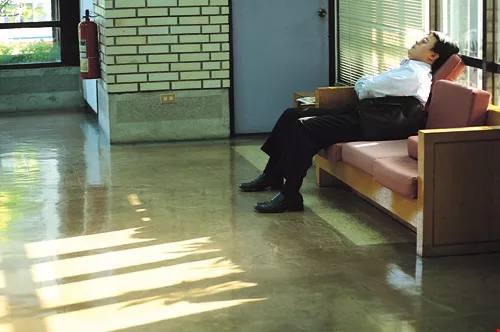
Worn out? Intensified global competition and the ever-increasing pressures of daily life have taken the charm out of a white-collar existence.
Downward mobility
With uniformly high levels of education and average monthly salaries of nearly NT$60,000 (well above the national norm), those enjoying the "golden rice bowl" of the financial industry were "all in the upper half of the middle class, however you define it," says Sheu Jia-you, a researcher in the Institute of European and American Studies at the Academia Sinica. The hemorrhaging of jobs from the financial industry has been one of the most prominent manifestations of the white-collar crisis in Taiwan in recent years.
"High levels of education and professional skills have defined the white-collar group, and these people were confident that they could retain their competitive advantage in the job market for a long time, and never face economic hard times in their entire life," says Sheu. "Today, while they are just as capable as ever, given the trends of globalization, computerization, and privatization, they can be replaced overnight by newly available talent from the Third World or by new technologies."
"In the past, the main activities of banks were corporate finance or home mortgages. The bar for staff was set rather high. But five years ago all the banks decided to focus on the 'two cards'--credit cards and cash cards--as their main profit centers," says Tsai Chiu-fa, president of the labor union of the International Commercial Bank of China. "When the card debt problem exploded in early 2006, the Financial Supervisory Commission immediately insisted that consumer credit be tightened up, and new profit centers have yet to be found, so that even sales activities are considered liabilities and are not generating any new income, and the revolving employment door is only sending people one way--out."
"Another serious issue is that employers use the technique of 'negotiated termination' for older workers and then find cheaper and more pliable young people to replace them," explains Tsai. Taking ICBC, where salaries have not been increased in five years, as a case in point, the starting salary for the lowest grade of incoming employees is NT$26,000, with only 80% of that actually being paid during the initial three-month probation period. After deducting retirement and health insurance contributions, there's not much left. With competition increasingly vicious, and government policies incessantly leaning in favor of employers, Tsai felt the need to stand up for his colleagues' interests. That is why he stood for election as the president of the labor union three years ago.
Job opportunities are declining not only in the banking sector, but also in other industries that have long given outsiders the impression of being high-salary and high-value-added. According to the Directorate-General of Budget, Accounting and Statistics, in the last five years the number of jobs in the investment trust industry has fallen by 318, in legal services by 472, and in telecommunications--for a time listed by college students as the number-one field in which they hoped to work--by 2500. Even the insurance industry, long seen by white-collar workers as a safe port in a storm, employs 3100 fewer people than it once did.
Unhappy white shirts
Even as financial industry employees are being swept out the door, the same drama is being played out in other fields. Among these is the publishing industry, in which the market has been shrinking ever since the advent of the Internet, and in which overall sales fell by nearly 40% in 2006 alone. In the last five years, publishing employment has dropped by 2500.
The print media, closely linked in Taiwan to the publishing industry, has been wracked by one crisis after another in recent years. Since the closing of the Independence Evening Post in 2001, the long-forgotten Power News, then the China Times Express, The Great News, the Central Daily News, and the Taiwan Daily News have all gone out business. The two main media conglomerates, the China Times and the United Daily News groups, have also initiated unprecedented reductions in staff. Most recently, even the Min Sheng Daily News, which once enjoyed a circulation of 500,000, closed at the end of 2006.
"I've never been afraid of anything as much as I have of the newspaper closing," confessed Huang Chih-cheng, who worked for 15 years at Taiwan Daily News, when his nightmare became a reality in June 2006.
"Thinking about it in a coldly rational way, being a reporter isn't such a fabulous job--you work 60 hours a week and the pay is only about NT$40-50,000 a month. But the 100 or so of us who stuck it out to the bitter end really felt connected to the Taiwan Daily News," says Huang, as he recalls how the lifting of restrictions on the opening of new newspapers in Taiwan and the rise of the Internet led to heavy losses that forced the paper to shut up shop after a history of 11 years. Before closing, the paper had already passed through phases in which employees' salaries were cut to 90%, and in which salaries were paid only intermittently (two months on, one month off). A lot of employees borrowed money to keep themselves afloat, so now that the paper has expired, they are caught between their old debts and new worries about the future.
"Me and Chih-cheng are relatively lucky, I guess," adds Chen Ling-fang, who covered cultural affairs for the Taiwan Daily News, "At least we have apartments and we've scrounged up some new sources of income since losing our old jobs."
After the paper closed, Chen, Huang, and some other colleagues pooled their resources to file a lawsuit demanding back pay and severance pay from the paper. Chen also eventually applied for unemployment relief. With unemployment insurance equal to 60% of what she was earning, along with what she earns by writing freelance articles, "plus living a simpler life," Chen is able to get by.
But with her six months of unemployment relief due to expire, she is now wrestling with the decision of whether to dive back into the job market. If she does, the question is: In what field? Chen has thought it over carefully and concluded that "the newspaper industry is hopeless, and in fact I don't feel there is any chance for any kind of print media."
Squeezed toward poverty
Joblessness is forcing people like Huang and Chen to completely restructure their thinking. "If there's not enough fresh meat to eat now, how can there be any to dry for the winter?" With this Taiwanese expression, Huang makes it clear that it is simply impossible to think right now about issues like where the money for his kids' education will come from, or when he will be able to retire.
"A house, a car, money for the children's education, and savings for old age--these have been the common aspirations of the middle class," says Tsai Hung-cheng, assistant professor in the Department of Sociology at Nanhua University. But with income predictability a thing of the past, life plans are going out the window. Overnight, the market value of the advanced university degrees and skills that this white-collar group has been so proud of has crashed through the floor, "not to even mention the innate value of their work in itself or their professional pride."
When white collars turn blue, a sense of crisis hits everyone in the middle class, and each person fears that he or she will be the next victim on the job market. So you can imagine how much worse it is for those who were economically disadvantaged from the start.
One of the clearest ways to see this phenomenon is in the fact that the income gap between households has been continually widening for years now.
From the 1960s to the 1980s, Taiwan's "Gini coefficient" (the income of the top 20% expressed as a multiple of that of the lowest 20%) remained between four and five. In 1990 it hit 5.18 and began to rise steadily, climbing to 6.39 in 2001, albeit moderating slightly in the last three years (see Graph).
Looking at changes in income for the various strata from 1999 to 2005, there is a clear decline in the disposable income of the lowest group (Group 1), with 2005 incomes 6.5% lower than in 1999. Households in Groups 2, 3, and 4 also experienced negative growth, falling on average by about 0.2%. Meanwhile, incomes for those at the top of the pyramid, Group 5, increased by about 2.9% over the same period. In sum, there has been a clear trend toward decline at the bottom, stagnation in the middle, and joy only for those at the top (see Graph).
This is not to say that Taiwan is doing badly. From a purely statistical point of view, while there has recently been an increase in the gap in household incomes between the rich and the poor as the economy has developed, the "winner-take-all" effect has still been quite moderate in comparison to other countries. For example, the Gini coefficient is 6.8 in Korea (as of 2000), 9.8 in the US (2003), 17.7 in Hong Kong (2001), and 20.9 in Singapore (2000).
"Nonetheless," says Minister without Portfolio Lin Wan-i, "although the income gap in Taiwan cannot be considered especially large, because the social safety net of unemployment insurance, national pensions, and so on is far from complete, it is relatively easy for people from the middle class to fall into poverty and become the 'new poor.'"
Carrying capacity
Looking once again at the numbers in Taiwan, why did the Gini coefficient of 5.55 in 2000 shoot up so suddenly to 6.39 in 2001?
"This is the surface manifestation of a number of problems," says Huang Ming-sheng, chair of National Chengchi University's Department of Public Finance. In terms of the external environment, in 2001 there was a global economic downturn as well as the 911 attacks in the US, which had a definite impact on the global economy. Domestically, that same year Taiwan had its first year of negative growth (-2.17%) in 30 years, and per-capita income declined from US$14,721 to US$13,348.
"In that global economic climate, there was a decline in the number of jobs created, and salary earners and the disadvantaged were hardest hit," explains Huang. "In contrast, wealthy people could hire experts to invest their money for them all over the world, and even found ways to turn a profit from the regional recession."
In fact, when you look at the income structure for the wealthy class, investment income often outweighs salaries. These people also have a higher ability to absorb risk, so one can see why the top of the economic pyramid not only doesn't crumble when society as a whole is experiencing economic contraction, there can be an even faster accumulation of assets there.
"Nonetheless, it would be overly sensationalist to claim that the growing differential in wealth between rich and poor means that the middle class is disappearing and that an M-shaped society is coming into being," cautions Su Kuo-hsien, an associate professor of sociology at National Taiwan University who specializes in inter-class mobility. "There is no clear evidence that the middle class in Taiwan is withering, although the fact that the gap between classes is widening certainly should be taken seriously."
Getting back to the banking industry, it has clearly lost its luster as a white-collar paradise. "To sum it up in one sentence, now that white collars are turning blue, never again will our rice bowls be golden," says Tsai Chiu-fa, who, despite laughing as he speaks, hardly finds the situation risible.
Moreover, the curtain has not yet come down on mergers and acquisitions of Taiwan's banks. Another wave--this time international in scope--has already started rolling.
A sense of exploitation
Mr. Lin, an executive at Hsinchu International Bank, which is due to be merged into British-owned Standard Chartered Bank, takes a break from playing ping-pong with some co-workers to explain the labor union's position: "Having seen all the blood shed over the last few years, of course people at a regional bank like ours are scared," he says, "In the past, everybody thought of themselves as white-collar workers and felt that unions were something that only blue-collar workers in traditional industries got involved in. But now everybody has woken up."
The sense of status and security that white-collar workers once thought distinguished them from their blue-collar counterparts has disappeared. Staff at Hsinchu International Bank have turned to their union to fight back. Personnel at the Taiwan Daily News, faced with an employer who is going bankrupt and owes unpaid back salary, have pooled their resources to file a lawsuit. Nonetheless, even today when white-collar job actions are increasingly common, the root of the problem can only be addressed by going beyond the perspective of the white-collar class.
"You could consider this Taiwan's second lesson in capitalism," opines Tsai Hung-cheng. "Its not enough just to organize unions for people to defend themselves, you also have to take into account social justice and long-term development issues."
In the early days, the Kuomintang propped up its regime with omnipresent state-run corporations like China Steel, China Petroleum, and Taiwan Power, and played a guiding role in the economy. "But over the past decade or so, 'state-run corporation' has become a synonym for inefficiency, so now there is privatization. These ideas are linked to the globalization and deregulation of the 1990s." But, Tsai Hung-cheng also reminds us, "The destructive results of the rampant spread of unchecked free markets across the globe are increasingly obvious. What will happen to the vast majority of losers who cannot make it into the winner's circle? What will be the impact on society and the state?"
Einstein once remarked that the greatest flaw in capitalism is its distortion of human nature. This distortion arises from an incessantly ingrained, exaggerated competitive attitude. Similarly, competition, sacrifice, and success have been unchallengeable pillars of Taiwanese values. Yet, looking at the experience of the advanced capitalist countries, economic and social dislocations and the creation of disadvantaged classes impose their own costs, which may be higher than the gains that are supposed to compensate for them.
How should we compete? How can we compete fairly and efficiently? And how can we offer the losers in competition a second chance to develop?
In economic terms, creating employment with economic development, and improving human resources to promote a virtuous circle of economic development, is the standard prescription.
But economies do not grow limitlessly and cannot fully satisfy demands for employment. The unfortunate who find themselves in the troughs that come between the peaks can only stay out of trouble by relying on a sound social foundation.
"Today, since we don't have a very comprehensive social welfare system, if Taiwan blindly rushes toward advanced capitalism, society will be unable to stand it," says Lin Wan-i, the mind behind the "Big Warmth" program which aims to help the "new poor" in Taiwan. After a decade of promoting economic liberalization, it is time for a reassessment. "The government is busy on the one hand adjusting the regulatory system to make it easier for businesses to meet the challenge of global competition, but at the same time it must build a new social foundation."
A new social foundation involves not only the construction of a social welfare system, and coordination with education policy and the development of human resources, it also requires leading society away from competition toward cooperation and mutual aid. It will require government and civil society to work together to give a hand up to those who have tumbled downward in life as they wait for the coming of new industries and new plateaus of economic growth where they can find a foothold.
In this way, as Taiwan today tastes some of the bitterness of capitalism, perhaps the phenomenon of the new poor is really a warning call, and today's frustrations can become the driving force behind the evolution of a more well-rounded society.


@List.jpg?w=522&h=410&mode=crop&format=webp&quality=80)


@List.jpg?w=522&h=410&mode=crop&format=webp&quality=80)
