

"Morning!"
"Morning!"
"Have you eaten?"
"Yes, have you?"
"Not yet."
A new nasilemak opened upstairs in the basha, and it's good. My husband can't eat enough of it, and wants to take some home, too."
"Wow! Then I'll have to give it a try."
When these two women meet unexpectedly in the basha and stop to say hello, they are speaking true Malaysian Chinese. Readers from abroad might scratch their heads, so let me explain.
Usually, we do not say zao'an (good morning); we just say zao (morning); we also say zheyang zao a (so early). Someone who hears this might reply, "Right, come buy some groceries."
Basha is a word for a food market that is commonly used in Malaysia and Singapore; it comes from pasar in the Malay language ("bazaar" in English). Here, if you said you were going to the market, and not the basha, people might give you a double-take and ask, "Where's that?"
Nasilemak is a Malay word meaning "coconut milk rice," a true Malaysian dish.
As second-generation Chinese born and raised in Malaysia, we talk about "going to China," not "going back to China." Of course, because we understand written and spoken Chinese, we have a sense of closeness to Chinese culture, even if it is not as close as people who grew up in that culture.
Because their history and geography are so closely linked, few differences exist between Mandarin Chinese spoken in Malaysia and Singapore. In addition to Mandarin, we also speak dialects such as Cantonese, Fukienese, and Hakka in our daily lives. Mandarin Chinese binds together Chinese people from different native places, and Malay is a bridge for communication between people of different ethnic groups in Malaysia. In Singapore, English is the primary language.
It's sometimes said that Malaysian Chinese are pretty smart-pick one off the street at random, and he or she can speak three different languages and one or two other dialects. As we like to say, though, sometimes "though you carry many knives, none of them are sharp." We understand many languages, but we may not be able to use all of them very well.
Malaysian Chinese don't use the "retroflex"sounds-the "sh" or "zh" that require the tongue to roll upwards-that are used in standard northern Mandarin. One friend of mine was educated in English since she was a child, and sent by her employer to Shanghai to work. When her Western boss asked her what a billboard said, and she told him she couldn't read it, he was shocked. "How come you never told me that you don't understand Chinese?" he asked. "You never asked before," she replied. Afterwards, her company hired a Chinese tutor from Beijing who spoke in a thick northern accent. Later she told me that after an hour of practicing to speak with a northern accent in class, her whole mouth, and especially her tongue, was exhausted!
Malaysia is a multicultural society with three main ethnic groups: Malay (indigenous), Chinese, and Indian. In the Malaysian education system, primary schools are divided into three different tracks: national primary schools, Chinese-language primary schools, and Tamil-language primary schools. National primary schools use Malay as the primary language for teaching, while the other schools use Chinese and Tamil. "Vision Schools" refers to the educational concept of integrating all three tracks together.
After completing primary school, the majority of ethnic Chinese students go on to junior high school, which use Malay and English as their main languages and treat Chinese as a single language course. Of course, for those who choose to go to independent (private) junior high schools founded by ethnic Chinese organizations, things are different. Since the founding of Southern College and New Era College in the 1990s, such organizations have taken another step in achieving their ideal of a thoroughgoing Chinese-language education from primary school through college.
In any case, people can freely choose to attend a primary school in any track. Some ethnic Chinese choose the national primary schools that use Malay, losing the opportunity for Chinese-language education in childhood. Some "friendly ethnicities" (i.e. non-Chinese), on the other hand, choose Chinese-language schools for their children.
Jandullah, a student in the sixth grade, is Malay, but rather than go to the national primary school in his community, he travels eight kilometers to a Chinese-language primary school. He says he is going to the school so he can learn another language. When I ask him if he thinks Chinese is hard to learn, he says, "It's very hard!" Although his Chinese is far from perfect, he can still communicate.
I ask him, if he cannot do his homework, what does he do? "I ask my big brother or big sister," he says. Even though their parents do not speak Chinese, all of Jandullah's eight brothers and sisters are studying at Chinese-language primary schools.
Like me, many people go on to junior high school when they complete Chinese-language primary school, but the Chinese education we receive is incomplete, or as we say locally, "half a bucket of water," influenced by the local languages and dialects to form a unique Malaysian version of Chinese. Many words and their usages may not follow the rules of modern Chinese, but, then again, this is Malaysian Chinese.
Malaysia can be separated into eastern and western halves, and different Chinese dialects are prevalent in different places. In parts of central Malaysia such as Bursa, Ipoh, and Seremban, the majority of ethnic Chinese speak Cantonese. In the Penang area, however, you can get by just with Fukienese.
In southern Malaysia, especially Johore Bahru, the influence of television programs from Singapore means that many people speak Mandarin. Malaysian Chinese TV broadcasts mainly in Cantonese and Mandarin, but after many years of working to promote Mandarin, Singaporean TV and movies are mostly in Mandarin and English, and do not encourage the use of dialects. As a result, watching Hong Kong films in Singapore is never very much fun because the dialogue, always dubbed into Mandarin, has lost its vivid Cantonese character.
The broad-based use of dialects has also made them a deeply rooted part of Malaysian Chinese. For example, a drinking straw, called a xiguan (literally "sucking tube") or xishuiguan ("water sucking tube") in standard Mandarin, is called a shuicao ("water grass") in the Chinese used locally. No matter how they try, it's unlikely that a non-Malaysian Chinese speaker would ever guess that these seemingly unrelated words actually mean the same thing.
Some people say that Malaysian Chinese is "mixed-up" Chinese. There may be some truth to this; its standards are not as high as the orthodox Mandarin spoken in Taiwan and mainland China. What we speak is rojak ("mixed salad") Chinese, combining many different languages and dialects into one. Rojak is a Malaysian specialty: mixing a variety of ingredients and topped with fragrant peanut sauce, it's truly delicious.
Long ago, the ancestors of the Malaysian Chinese traveled from different parts of China to Southeast Asia in search of their fortunes. They dreamed only of making some money and of returning home with wealth and honor. In the beginning few of them planned to stay for long. Fukienese, Hakka, and people from such places as Hainan, Fuzhou, and Guangdong brought their languages, cultures, and traditions with them and combined them all together here. It was like taking fish of many different colors and letting them swim in the same pool. Naturally, they would influence each other, producing new kinds of fish that were different from the original ones.
Some foreign influences have been accepted into everyday speech, such as "jumping out of a plane" (tiao feiji), which means "going abroad to make money;" we also use ji duo qian and ji duo sui, which mean "How much money?" and "How old are you?" Of course, don't forget that we are also accustomed to using the word you and a verb together to create the past tense, such as you zuo ma and you chi ma to say "Have you done it?" and "Have you eaten?" Although it is not grammatically correct, we are used to it, so we don't think of it as a mistake. In any case, if the speaker and the listener can understand one another and use it to communicate, it works.
The native culture and language of Malaysia have also made their way into the Chinese language here. Some Malay words, like saman (a "summons") have become a part of spoken Chinese. We say "to get a saman," which means to be served with a summons. Other words that are a part of Malaysian Chinese include luoli ("truck," from the British English "lorry"), nadu (an aristocratic title), and baba nyona, the name for a type of dish first made by children of Malays and locally born Chinese that brings together sweet, sour, fragrant, and spicy flavors.
In terms of the written language, Malaysian Chinese uses mainland China's simplified characters and Hanyu Pinyin romanization. All schools teach simplified characters, so most young Malaysian Chinese can only write simplified characters, though they can more or less read and understand traditional characters. Older people, on the other hand, mostly use traditional characters.
Under the influence of all kinds of external factors, Malaysian Chinese has formed into a unique "Singapore-Malaysian Chinese." Some may be proud of its peculiarities, while others see them as "language pollution," but that's how it is. The great task and duty of unifying or adjusting domestic and foreign Chinese languages probably won't fall on an average person like me. But then again, I'm not that pandai-"clever"-either.

Homework assignments at Chinese-language primary schools are quite heavy, and primary school proficiency tests are held for sixth graders. Pictured is a textbook that uses Chinese as its primary language.
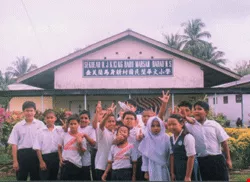
In a country that emphasizes acceptance of its multicultural heritage, students from Chinese, Malay, and other ethnic backgrounds happily come together as one.


@List.jpg?w=522&h=410&mode=crop&format=webp&quality=80)


