Marching to Their Own Beat--Economic Development in Aboriginal Villages
Coral Lee / photos Jimmy Lin / tr. by Jonathan Barnard
May 2006


In the fields, hunched old-timers work the land, but the streets are empty. Able-bodied men in the prime of life are especially notable for their absence. Here and there children play, providing a rare note of vitality amid the otherwise desolate atmosphere. In recent years, this image of an Aboriginal village has gradually given way to another--that of tourists scurrying back and forth, homestays perched on ridges and along riverbanks, women toiling in and out of the kitchen on weekends and holidays, and young guides laughing and singing along forest trails.
The indigenous peoples' movement has been around for two decades now. Its quest for "economic independence"--long regarded as the weakest link in the chain of tribal social development--has shifted from forestry to tourism, which has proven more and more promising. What achievements and warnings do these local economic development efforts, which revolve around ecological and cultural tourism, offer?
At 7:30 p.m., the Bunun village of Wanghsiang (elevation 1000 meters) in Hsinyi Township, Nantou County, is already dark and quiet. But on the plaza in front of the Presbyterian church the lights are going on and people's spirits are rising. Every Sunday a community dance group practices here. Some 20-odd villagers trickle in. On the basic stage, one dance after another starts up accompanied by music: "tribal aerobics," a blend of the modern and the traditional; a "millet spirit dance" in which the women dancers float around the stage like millet riding the wind; and the "heroes' dance" in which young men dance rough steps with great vitality.
During a break, Sunny, whom everyone calls the "troupe mother," responds to a visitor's request by shouting for the strapping young men to perform the eight-part harmonies that the Bunun have traditionally used to call for rain. Eight or nine men huddle on stage, clasping their arms in a circle as they piously and spiritedly hold their breath, raise their heads and make sounds that seem to rise from the earth itself, deep notes gradually gaining pitch, now falling, now rising again--the layers of sound ascending like the wind or harmonizing cicadas, seemingly shooting through the roof of the stage to the clouds.
"For the most part, only old folk can sing that eight-part harmony," says Sunny. "These guys had to work really hard at it." With obvious pride, she explains that the group performed it successfully without the direction of village elders for the first time yesterday--at a performance in Taichung. It was a great boost to their confidence. Comprising men aged 35-45, the troupe, which formed two years ago, is a vital new force for promoting tourism in the village. Its members work in the fields during the week and perform on weekends and holidays.
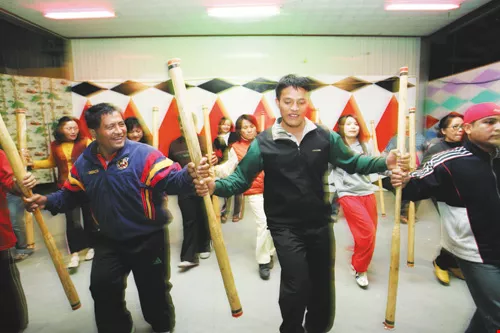
Every Sunday evening, Wanghsiang villagers, young and old alike, gather together to practice dancing in a variety of traditional and modern styles.
Forgotten village
During Chinese New Year Wanghsiang Village launched its "open your doors to Jade Mountain" tourism campaign. As a result, tourists dotted the village like the pink and snow-white cherry and plum blossoms set against the mountain backdrop of the New Central Cross-Island Highway. More than two years ago, Yohani Isqaquvut, now a national policy advisor and formerly minister of the Council of Indigenous People, moved back to his hometown of Wanghsiang, where he advocated using the views of Yushan, which villagers see every day, as a basis for creating an "autonomous" tourism village.
"Yohani wanted to push tourism here more than a decade ago, but we wondered how that would be possible," notes a villager with some embarrassment. "We doubted that anyone would want to come to this remote place with nothing in it." Yohani, who had left the village as a youth to find long-term employment, always regarded the village ringed with mountains as a kind of Shangri-La. Located in an agricultural area with elevations ranging from 700 to 1500 meters, it has some valuable tourism resources nearby, such as a several-hundred-hectare National Taiwan University experimental forest, and some canyons created during the 921 earthquake. He kept pushing the idea when he was the minister of the Council of Indigenous Peoples, but lower-level staffers never picked up on it, so its implementation had to wait for his own return to the village.
Mountain forests, culture and agriculture are three basic components of recent plans to transform tribal villages and create new conduits for economic development.
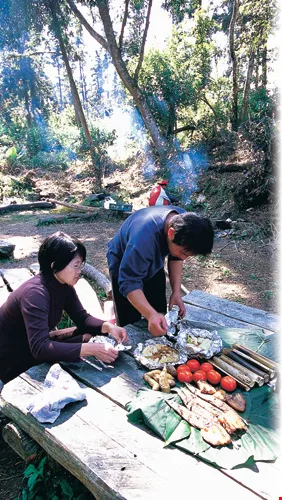
After returning from the historic Hunters' Trail, the guides have already prepared a table of authentic tribal food: just-picked cabbage is matched with a meat sauce and then the whole thing is cooked until it's sweet and fragrant. Then there's rice in a bamboo segment, roasted boar meat, and the juicy tomatoes that also excite the appetite.
Tribal village revival
The first efforts at village development came out of the 1990s Aboriginal movement's call for the educated tribal elite to return to the villages and work the land.
"After the indigenous people's movement had been making waves for many years, the many successful legal and political campaigns based in the cities had not improved life in the tribal villages," notes Sun Ta-chuan, director of the Graduate Institute of Development for Indigenous Peoples at Dong Hwa University. "People in the villages were still largely unemployed and struggling to make ends meet." The native elite realized that reviving the long-term fortunes of the tribes depended upon pulling up the villages. As a result, great numbers of the tribal elite returned home. Some focused on cultural identification, and others on economic development planning at the village level.
Among those who went the economic development route was Reverend Kao Cheng-sheng of the Tsou tribe. He returned to Shanmei Village in Alishan Township, Chiayi County, where he concentrated his efforts on reviving the ecology of the Tanayiku River. After more than ten years of ups and downs, he was finally able to raise the villagers' ecological consciousness and forge a consensus to create a tourism industry based around Taiwan ku fish swimming in the clear river water. The number of visitors to the village has passed 300,000 a year, and tourism dollars have improved residents' material lives, with profits being plowed into community benefits. It's a virtuous cycle.
Among those villages focusing on developing cultural identity, many have based their efforts on reviving or reinventing cultural ceremonies. For instance, there is the revival of the Monkey Festival in the Puyuma village of Nanwang, Taitung, and the Harvest Festival in the Amis village of Takangkou, Hualien. And then there are those who focus on reviving tribal village life based on other aspects of tribal culture, such as the Rukai tribesman Auvini Kadresengan, who returned to his tribal village to record the rules behind his ancestors' indoor burials and helped to reestablish the old village of Kucapungan.
This wave of village-based Aboriginal activism has meshed nicely with the government's call for "integrated community building." With the cooperation of government and academia, the campaign has had an impact in various villages.
"You can breathe life into a tribal village by reviving the village's economy or its cultural identity," says Sun Ta-chuan. He reckons that these successive tribal village revival movements have had a tremendous effect in restoring the dignity and vitality of tribal village life. As a result, native peoples have been able to live in modern society with greater self-confidence.
The tribal villages that have taken the route of cultural identification are unfortunately still reliant on government assistance. But while those that have pursued development through tourism may have had some bumps along the way, they "are gathering momentum and hold a lot of hope for the future," says Assistant Professor Lin Yih-ren of Providence University.

Having abundant natural resources is a major advantage when seeking to promote tribal village development. The photo shows Taiwan ku fish in the Tanayiku River at Shanmei Village in Chiayi County.
Model villages
When you study the various approaches that tribal villages have taken in pursuit of economic development, common themes appear. For starters, they all sell themselves as tourism destinations by touting ecological and cultural resources. Shanmei focused its tourism efforts around the Taiwan ku fish, and Hsinchu County's Smangus and Chenhsipao emphasized their virgin cypress forests. Then, to attract more visitors, they gradually added introductions to cultural history, meals of tribal cuisine, and homestays. Meanwhile, tribal villages that are famous for cultural reasons, such as the Rukai villages of Wutai Township in Pingtung County with their stone slab houses, or Alishan's Chashan Village with its traditional pavilions and woodcarvings, also have impressive scenery.
Furthermore, the tribal villages that attract a lot of tourists all feature a strong sense of village solidarity. "It is key that natives return to their villages and get involved," notes Yohani Isqaquvut.
For instance, Kao Cheng-sheng of Shanmei, Bai Kuang-sheng of the Bunun Leisure Farm, and Tzeng Chen-chuan of Chenhsipao were all activists in the Aboriginal rights movement. Steeped in their experiences of that movement, their ideas about tribal village development often differed from those of mainstream society. Mostly, rather than emphasizing the profit motive found in commercial competition, they look to the spirit of sharing and community found in tribal villages. In particular, they stress tribal self-awareness and consensus. A case in point is how the people of Smangus all pitched in to raise a building once they made the decision to build it. Although vigorous development has prompted residents of some tribal villages to sell their land, that sort of tragic outcome won't happen at a village like Smangus.
Although government efforts to spur development, rather than the return of the tribal elite, was responsible for kick-starting growth in Wutai and Chashan, the indigenous peoples' movement has nonetheless had an impact there, encouraging tribal solidarity and independent viewpoints. For instance, the citizens of Wutai saw that travel agencies, to save on costs, were not hiring locals as guides, and that tourists would come through for a quick look and leave behind piles of garbage. Consequently, the town made adjustments. Locals formed the "Homestay Development Association" to collectively market themselves to the outside and published a tourism guidebook, urging visitors and tribesmen alike to cherish the pristine Wutai that is full of beauty and art.
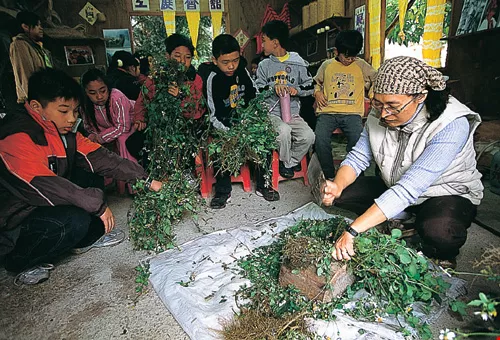
During winter vacation, the Atayal Brave Camp attracted many city kids to experience tribal culture. This class lets kids pick hairy beggarticks (Bidens pilosa) plants to dye their own fabric. It's a good experience and a lot of fun, but it is in fact a Hakka tradition.
Hidden dangers
But no matter how on track they appear, even those wearing the model tribal village halo sometimes feel exploited by the commercial system.
One long-term observer of development in tribal villages cites the example of Smangus, a village of barely more than 100 residents, being suddenly flooded by 300 tourists a day in the high season. The women of the village exhaust themselves preparing meals. But as much of the food, including the meat, poultry and fish, must be bought from down off the mountain, profit margins are low. Travel agencies, moreover, only bring the tourists to the foot of the mountain. The remaining transportation, food and lodging are all the responsibility of the village. The travel agency then takes its cut of one-third. Some villages find it hard to juggle tourists' demands with environmental quality and maintaining good tour content.
"Who says that paths must be wide and easy?" ask the people of Chenhsipao. It's only when trails are a little challenging that they're interesting. Once you pour concrete, you both lose the native flavor and also create storm water runoff problems, but city slickers with children expect an easy vacation and complain if they don't get it. As a result, there is a constant balancing act between meeting the needs of tourists and those of sustainable development.
Much research shows that negative aspects of tribal tourism--pressures from crowding, environmental destruction, restlessness stirred by rising land prices, disputes about how to distribute profits--are to some degree part and parcel of the development process. Consequently, turning conflict into a progressive force is essential for ensuring continued growth.
"Only by bringing people together can you talk about development," says Yohani. When he returned to his hometown, he came to a profound understanding about how inherently difficult it is to forge a consensus. Even in a tribal village of small area and population, the power struggles can be enormous, including those between different religious sects, political parties, private interests, and between elected officials and academics. Pulled from all sides, inside and out, the village can be ripped apart by these conflicts. Even if there is no clear breach in relations, the resulting animosity and bitterness can be very harmful.
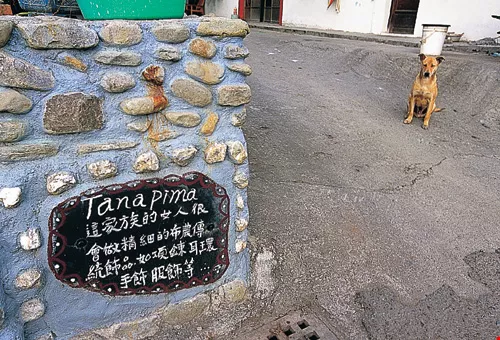
At the entrance of the homes of Wanghsiang, different family stories are told: some families are good at hunting, some weave fine fabric, and some are the descendents of the village chief, giving what had been an insipid tribal village a fertile imaginative space.
Problems of autonomy
From years of observation, Yohani argues that if tribal village development is to be successful it must take an autonomous approach. "It's not that tribal villages don't need the help of outside experts, but the path taken must be based on needs that villagers have seen for themselves and not on what outsiders have told us what we ought to do." For instance, outsiders may suggest that the residents of Orchid Island should return to live in their traditional semi-underground houses. But the eventual decision has got to be given to the islanders to think about for themselves. Or take, for instance, the question of whether tribal handicrafts ought to adopt local small-is-beautiful marketing, or mainstream commercial models. Likewise, the village should study and decide this issue for itself.
Previously, almost without exception, a village's elected representatives would help them get major funding from the central government, but the funds would then fall to local government to administer. The township hall would contract academics or NGOs to draw up a plan, but when the experts or scholars came to the village, they would propose plans to spur development that, however seemingly beautiful and beneficial, wouldn't really take into account the villagers' needs. Once the funding arrived, the experts would go, leaving the village with a bushel of problems. Some villages may have received practical assistance, but without local participation, there was no way to cultivate local personnel. As a result, villages found it hard to acquire knowledge and skills and to stand on their own two feet.
In order to develop skills within the village itself, leaders of various organizations in Wanghsiang, including the local mutual aid society, community development association, youth group, church, women's group and so forth, have established a "tribal leadership council," where they discuss development directions for the village. When they hit bumps on the path to development, they can use this system to seek consensus and resolve problems. For instance, they have decided to push Internet and word-of-mouth marketing, so as to eliminate exploitation by middlemen. They have also established some principles for cooperation, sharing, and managing benign competition. If tourists are especially pleased with the service at a homestay, they can directly contact the individual homestay for a return trip. The system challenges homestays to do their best.
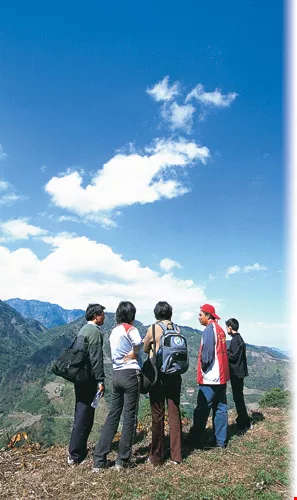
Under the blue skies, young Aborigines explain the origins of the ancient "Hunters' Trail" to tourists from the city. In recent years many remote tribal villages have seen their tourist industries prosper, but achieving continued growth poses some challenges.
Myths of transformation
After a village gains autonomy, will it easily be able to switch from agriculture to eco- or culture-based tourism?
"For both ecological and cultural tourism, neither acquiring the foundation of needed knowledge nor implementing the plan is as easy as one might imagine," says Lin Yih-ren of Providence University. If a village only has homestays, homes on stilts, and local cuisine, but lacks culture-based tourism that is richer and deeper, it's all too easy to devolve into an empty and shallow "search for cultural novelty." At its extreme, this approach can speed the destruction and death of a culture. For instance, can the "hunting experience" that has been very popular in recent years really convey the ecological wisdom of Taiwanese indigenous peoples? Do the cultural performances currently in vogue merely transfer an earlier era's "window dressing" of song and dance to the tribal village?
There are also numerous myths about developing eco-tourism. Many Aborigines and Han Chinese alike believe that Aborigines born and raised in the forest must have absorbed thousands of years of knowledge and wisdom about living in harmony with nature. Therefore it ought to be a piece of cake for Taiwanese Aborigines to develop eco-tourism. Yet they overlook that the last half-century of industrialization has severed these traditions already for a generation or two. How much ecological wisdom do tribes that have been steeped in capitalist civilization still possess? At the same time, the new knowledge and skills required to rebuild the environment are often underestimated.
An example can be found in the campaign of a few years back to create a Magaw National Park that would be co-administered with indigenous peoples.
To protect the virgin cypress forests on Mt. Chilan (what the Atayal call Mt. Magaw) environmentalists have been pushing to establish Magaw National Park. These calls have met with strong opposition from tribal peoples. After discussions were held locally, the two sides agreed to a "new partnership agreement," which was signed by President Chen Shui-bian. The document advocates the government sharing control with Aborigines and drawing up models for Aboriginal control of natural resources, as well as putting some 30 tribal villages near the park on a track toward economic transformation.
The Magaw model is noble in concept, but not so splendid in the way it actually operates. Lin Yih-ren and his students issued that warning after conducting in-depth research about tribal villages for five years. Lin cites the case of Nanshan, which is regarded as the most "modernized" of the tribal villages in the Magaw area. There is a huge gap between the ideal of eco-based development and the reality.
Nanshan Village is located in the headwaters of the Lanyang River and is blessed with outstanding natural conditions. In the 1970s the government promoted cabbage farming in the area. It gradually became a major supplier of summer vegetables to Taipei, and a division of labor developed wiith tribal people responsible for production, and the flatlander produce vendors responsible for marketing.
"The force of modernization has deeply penetrated the village, allowing the economic situation to be much better than in most tribal villages," notes Lin. "But it has come at the price of damaging the environment and sacrificing the health of residents." Lin points out that Aboriginal farmers rely on money for their crops from produce vendors to buy fertilizer and pesticides. They are well aware that the price they get is low and their labor is being exploited. Yet they dare not complain. And because vegetable farms are labor intensive, most of the village's children are pushed to work there as soon as they graduate from junior high. Thus the track to education and work outside the village is broken. The impact has been to limit the horizons and imagination of the village.
With the soil overtaxed for long periods, more and more fertilizers have had to be applied, yet cabbage yields have declined. After Taiwan joined the WTO, the situation grew even direr. Although some villagers realized the need for economic transformation, the "joint administration" and "local control" of the Magaw National Park plan didn't interest them. They were still mostly concerned with the effects on village life in terms of restrictions and development. Five years later, most are still growing vegetables and feeling conflicted, half looking forward to the plan's implementation and half dreading it.
From his experience of seeing how quickly the traditional Atayal gaga rules were lost in Nanshan, Lin recommends that other tribal villages, before opting for an eco-economy, establish an ecological perspective that integrates the traditional with the modern and works in harmony with local community development efforts. Only then is long-term economic development possible.
"Do you want to listen to eight-part Bunun harmonies? Would you like to learn Paiwan hunting techniques? How about experiencing Rukai tatoo culture? This summer there's a special new way of having fun!" All manner of colorful travel ads call to the parched souls of the urban concrete jungle to embrace nature and experience primitive culture. Indirectly, they also urge various tribal villages hoping to experience a revival to come up with "culture" and "ecology" that they are proud of.
Yet, to recall how it was once put in a story: "The hound tells the hare: You better run faster than me. I'm just running for my dinner; you're running for your life!" For Han Chinese society, tribal village tourism adds one more dish to a varied menu of travel choices, but for the villages themselves, these choices are a matter of their very survival. Amid successive tourism vogues, moving tribal villages toward local control and regaining "paradise lost" in practice poses great challenges.
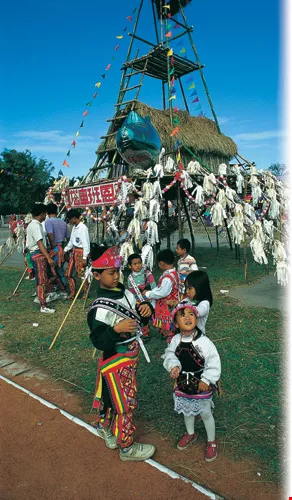
The rebuilding of cultural identification among the tribe can revive tribal villages that had fallen silent. The photo shows the Monkey Festival in the Puyuma village of Nanwang, Taitung; many members of the tribe return for the festivities.
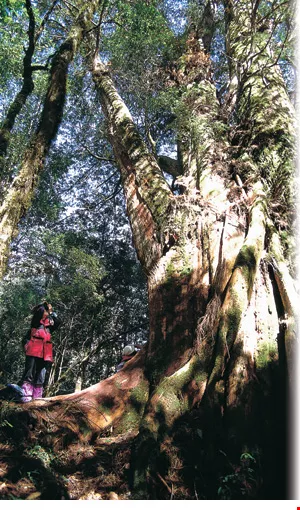
The tribal village of Chenhsipao, which is in Hsinchu County's Chienshih Township, used to be known far and wide for its cypress forests. Although the village had to grope in the dark in pursuit of economic development, because it has a high degree of autonomy, it is regarded as having a lot of potential.


@List.jpg?w=522&h=410&mode=crop&format=webp&quality=80)


