Out of Print: The End of the Moveable Type Era
Wei Hung-chin / photos Cheng Yuan-ching / tr. by Phil Newell
August 1993

Although he says it really doesn't matter, the relationship has been going on for thirty years. Faced with the row after row of moveable lead type that is being outmoded by changing times, printer Yang Cheng-fu naturally has some lingering sentiments. Since entering the moveable type profession at the age of 17 in search of a skill with which to make a living, he has seen this line of work flourish and then fade. As he himself has gone from youth to middle age, moveable type has entered its twilight years, to be replaced by computer printing. Yang Cheng-fu understands that you can't resist changing times. But he also feels a bit of a loss. Is it really necessary that old things from the past must be dispensed with without leaving a trace?
"Before, during the era of full-page moveable type, even 20 or 30 thousand layout boards wasn't enough to go around. Now you can't give them away. " After thirty years at the Chunghua printing factory of the Yutai Corporation, Yang Cheng-fu has worked his way up from apprentice to shift director in the printing room. In the past he would go to work in the factory during the day, and at night go set the type at a newspaper. He passed decades working from dawn to dusk and dusk to dawn, relying completely on his training and his experience in the specialized techniques of movable-type printing. But this once-heralded skill is no longer so desirable. While the Chunghua factory could be considered relatively slow among large-scale printing institutions in moving toward complete computerization, they completed this objective in May. It has been fated that the moveable-type printing factory will be discontinued at the end of July. Only a few important older machines, lead characters, boards, and so on will be left at the original site. These will serve as "historical toys"--witnesses to their times.
You can just imagine the scene in those days: a dusky room, several racks with lead characters, and blueprint machines and printing machines lined up in well ordered ranks, occupying most of the territory. The master would, with great authority, call his apprentices to bring this or that lead character, and if the young acolyte could not find it at once the seasoned instructor would mumble, "Idiot!" Even before the sound of his voice had faded away, he would have already found the character from the more than ten thousand there. More than duly impressed, the apprentices themselves would aquire the same skill several years later.
"It's just like carving on a piece of tofu. Anyone can carve, but it's not easy to do it beautifully," says Yang Cheng-fu. This particular slice of bean curd can only be suitably trimmed with experience and technique, plus great familiarity with the printing process.
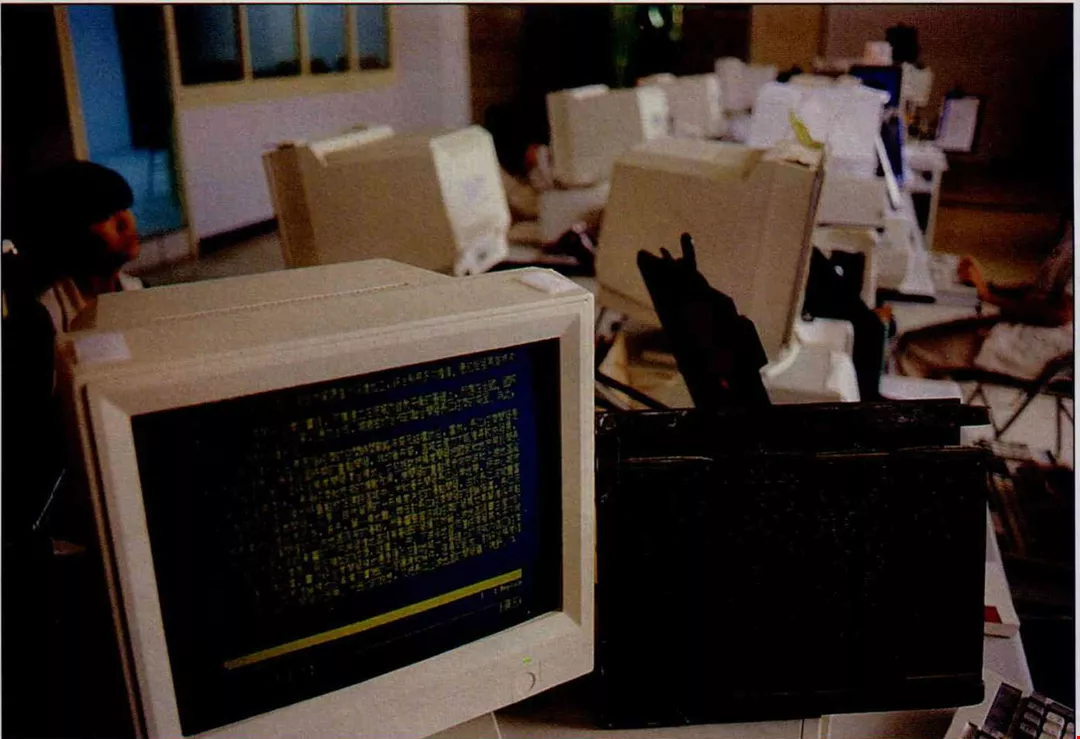
Computer typesetting has already replaced traditional movable type.
A lead force for change:
Moveable print is one of the three great inventions of China. In the year 1041, during the Sung Dynasty, Pi Sheng discovered how to make moveable type with kilnfired clay. With each character added separately, it was easy to arrange any print face required.
Yet Pi Sheng's moveable printing techniques were not truly put to use. This is because the clay material is brittle and would break after no more than a few uses. But this discovery raised the possibility of the development of moveable type. In 1403, brass moveable type appeared in Korea. In 1453 the German Gutenberg invented lead moveable type, which is the printing technique that we have been using for over the last 500 years.
The invention of moveable type changed the way people think about the world. Just imagine, the earliest Chinese who wanted to read the Buddhist scriptures would have to spend more than a decade going to the western regions to collect them, then another ten or so years with the arduous task of copying them out one character at a time. Families that could maintain rich libraries monopolized knowledge, becoming a literate strata influencing court politics.
The invention of moveable type also pushed the spread of communications into an era of fantastically rapid growth.
In the 1970s, major newspapers in Europe and North America steadily entered the era of computer set printing, which was a great blow to traditional moveable type. Computer printing makes for faster entry, convenient editing and amending, and cleanliness, and saves manpower to boot .... Traditional moveable type can't compare in any of these areas. Feng Chien-san, an associate professor in the Department of Journalism at National Chengchih University, wrote in an article drawing on the experience of the adoption of computer printing by the New York Daily News that beginning in May of 1974, the number of workers using the new technique compared to the old linotype machines was 35 compared to 900; so you can see the great advantages the new facilities have.
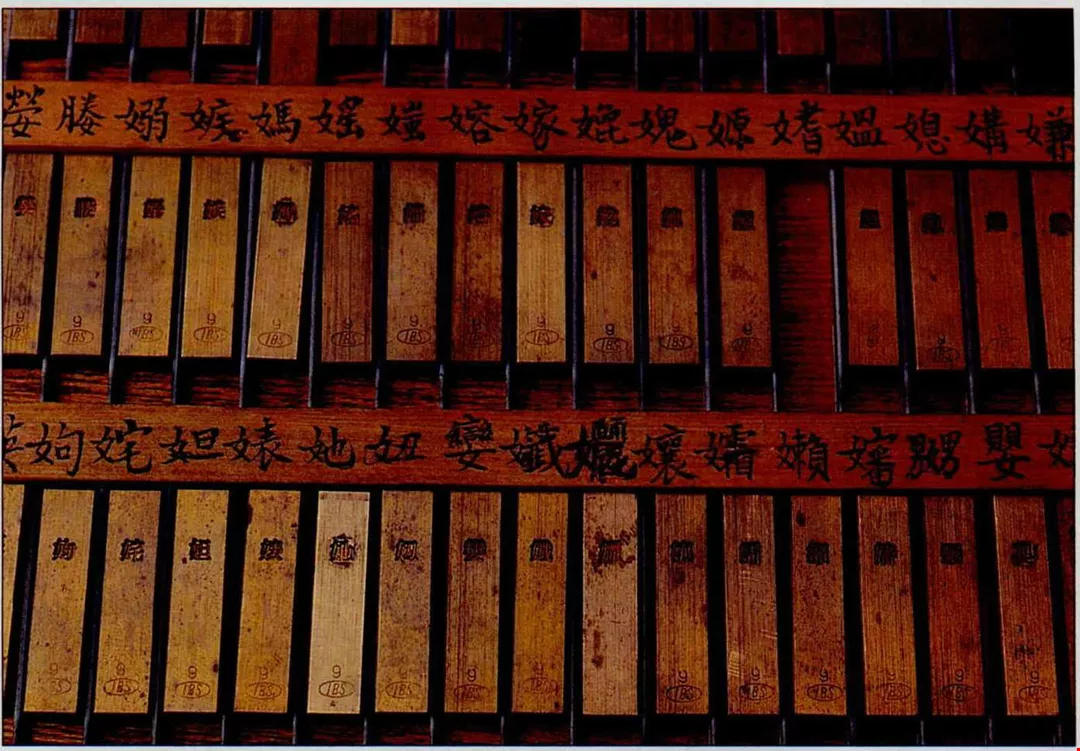
These character molds will be useless hereafter, but they have irreplaceable historical value.
Get the lead out:
In Taiwan, because early on the problem of a Chinese language for computers had not yet been resolved, the printing industry entered the computerized age about a decade later than in Europe or North America. In 1982, the United Daily News began trying computer printing for newspapers. However, it was only with the lifting of the the ban on new newspapers in 1988, leading to intensified competition between newspapers, and further development of Chinese computer software, that the newspaper industry moved fully into the era of computerized typesetting.
As for printing factories, because they need to adapt to a variety of contingencies, they were even slower than newspapers in phasing out their moveable type. But they too have adopted computers one after another in recent years. Moveable type printers have thus become increasingly rare. It seems you can only get a glimpse of them in miniature printing factories tucked away in small alleys in less frequented parts of the city. Even there, their work is largely limited to small scale production of things like wedding invitations and name cards.
But even these remnants of the past will soon be left behind. The printing shop of a certain Mr. Lee has been located in the old neighborhood of Wanhua in Taipei for decades now. Although the shop is run down, you can see that it has had its days of glory, or else you wouldn't see so many shops with the same ambience all in the same area. "There is a lot less work to go around," sighs owner Lee, noting that the age of the printing machinery is more advanced than he himself. Although the machinery is still in good shape, largescale printing works better with computers. And then there is competition from things like photocopying for name cards and invitations. It is certain that moveable type print just can't keep up with the times.
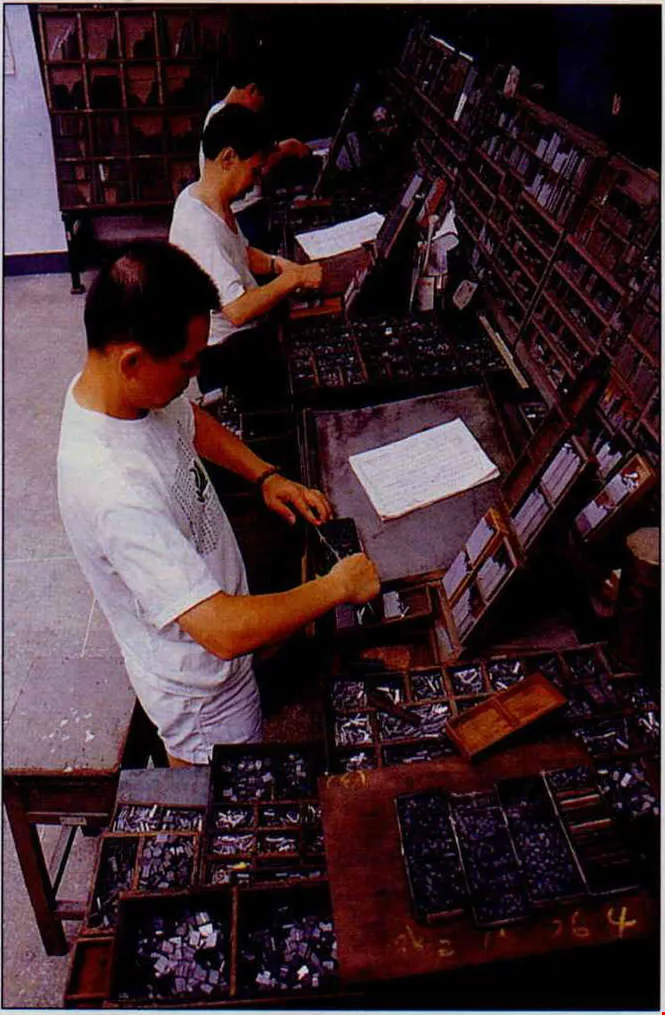
It was impossible to master the skills for lead typesetting in a short time.
You never forget your first love:
Stick with the old machines, or catch up with the age? Old print masters feel their hearts tugged in both directions. Li Ching-chuan has worked at Yutai for 24 years since beginning as a printer's apprentice. After the company switched over to computers, he has been one of the fastest of the printing masters to adapt.
It turns out that he also does printing work at night for the United Daily News, so he experienced one computer revolution a decade ago. Thus he has been able to adapt quickly, and even be transferred to be a shift director in the computer typesetting room at the factory.
Recalling that time when he was first struck by computerized printing, Lee seems a bit hesitant and unenthusiastic. "Everybody just cursed. " Still, in a panic that they might lose their jobs, as well as with various incentives like a newspaper sponsored computer entry competition and financial awards to encourage them, and relying on a unrelenting spirit, the vast majority gradually got familiar with the computer keyboard and learned the new typesetting technology.
In the computer typesetting machine room, the work environment is clean and bright, and there is a lot less noise. But Lee still prefers the old conditions. "Everybody could keep an eye on the characters on the one hand and chat on the other, and there seemed to be a lot more fellow feeling among co-workers, " he reminisces. He has nothing bad to say about the trend toward moveable type being washed out. But when he faces that cold and unfriendly computer, it's hard for him not to feel a little down; when that happens he mutters a few appropriate condemnatory phrases to vent his annoyance.
The times changed long ago!
"Perhaps moveable print isn't as fast as computers, but when you talk about technique, it clearly requires more skill, " says an old master, recalling fondly the skills he used to be able to show off.
Just take for example arranging a sheet music score. It takes large and small notes, as well as all types of slides and half notes, with marks for volume and tempo; it requires a command of spacial distribution as well. An experienced master would take three hours just to arrange a pop song, while a typical worker could be setting type all day and still not necessarily finish. But young computer operators even more often move marks around here and there, misplace things, and get things all turned around. "That's just inexperience, " states Yang Cheng-fu, recalling that it took him 20 or 30 years and he still can't be omniscient. Even he might not be able to find some extremely rarely used characters!
Thirty or forty years might still not be enough to learn all the ins and outs of moveable type but it only takes several months to get familiar with computer typesetting. It used to be that an experienced master could arrange a maximum of 2,000 characters in an hour. But a young girl of some dexterity who has studied only three months can do at least 60 characters a minute with a word processor. Moreover, she can fix her mistakes even faster. So how can old masters compete?
"You couldn't find any apprentices even ten years ago, " says an old master unhappily. It seems that the times had changed long ago.
Fast eyes, a steady hand, and dedication:
Yet there remains something admirable about the old masters. Lee Tien-jen, chairman of the Department of Printing at Chinese Culture University and also the director of the Chunghua Printing Factory, points out that it was no mean feat to become a print worker in the old days. One had to have a certain level of knowledge to be able to arrange a written article or document. Moreover, because the standards were high and the demand in society great, print workers could typically have two jobs, working in the printing factory by day and going to the newspaper office by night, making for quite a tidy income. Moreover, they had more chances than most people to come in contact with written information, an enviable perquisite in the early days.
Chang Yung will always remember the day he entered the printing industry, August 14, 1968, because through work in printing he has truly learned hand-eye coordination. "For example, in setting the type for physics or mathematics books, there are all kinds of special symbols, or special print methods. You had to pay special attention to the characters and the relative size of the print, and you couldn't do anything half way. " He says that the older masters really put their hearts into their work. When they got an article into their hands, they would try to understand what the article tried to say before moving on to type setting, so that chicken scratch hand-written drafts could emerge clean and well ordered.
Type casting aside:
Now that moveable type is being replaced, most of the old masters seem resigned to their fate. "Some things you have to be able to pick up some things you have to be able to put down, " says Yang Cheng-fu as his hand rummages over old lead characters he feels ought to be preserved. He states metaphorically: "If everybody else is driving, could you race them on a bicycle?"
Everybody understands that the computer era is here and that this is the way the tide is running. But what the old masters worry about is whether or not the younger generation developing the new technology can respect the old traditions.
Yang Cheng-fu grabs a few funeral announcements from his office desk and says that you can easily differentiate which are computer type set and which are moveable type just from the form of the printing. " With computer typesetting usually there is a set form already in the computer. You only have to change the name for each client. So in the end all the funeral announcements look exactly alike. And for convenience, these fixed formats are not based on traditional rites, with the names of relatives set in large or small styles depending upon their importance in the clan. They don't look like funeral announcements set by an old master who really knows his rituals, where you can tell who is who in the family with a quick glance at the print size. " He says that of course it is not that computers can't deal with these basic rituals or information--indeed, they could very well do even better. It is just that the young people using the computers need to be a little more humble and learn their stuff.
Life was once glorious:
Whatever one may say, moveable print technology is passing into history. Can it only leave behind nostalgia? Perhaps a certain respect from those who come later? This probably will depend on the meaning that people themselves give it. It can simply be hoped that the next time you walk into a printing museum, when someone picks up a lead character, you might think "these characters really did have a life to them, and they had a substance that one could grip in the palm of one's hand."
[Picture Caption]
p.52
Computer typesetting has already replaced traditional movable type.
p.54
These character molds will be useless hereafter, but they have irreplaceable historical value.
p.54
It was impossible to master the skills for lead typesetting in a short time.
p.56
In a traditional moveable type printing factory, radios, pinups, and religious statues accompanied chatting workers, making the work less like drudgery.


