Investing in Creativity,Unearthing the Treasures of the Mind--A New Light Shines from Taiwan Schools
Chuang Kung-ju / tr. by Michael Hill
May 2004


After a century of dominance by the IQ (intelligence quotient) test, in the 1990s EQ (emotional quotient) tests began to catch up. As we gradually unlock the secrets of the mind, we have come to realize that the mental capacity stored in the brain is as vast as the oceans: it can express emotions and convey meaning, think in abstract terms, and paint a picture of the Milky Way without ever seeing it.
The limitations of the traditional IQ test are the main reasons that the EQ test has come into fashion. IQ tests can only calculate linguistic, logical, and spatial intelligence, while the EQ test includes intrapersonal and interpersonal intelligence. But can IQ and EQ tests really cover all of the brain's forms of intelligence? When it comes to people who are particularly attuned to music, people who use their bodies to make ingenious dances, or people who possess other forms of intelligence waiting to be discovered, where should they go to find someone who understands them?
The problem is most likely that whenever we want to use a yardstick or standard to judge intelligence, at some point it will always fall short.
Since the birth of neuroscience in the 19th century, a number of physiologists have attempted to find a skeleton key to understanding the connection between the brain and mind, whether through studying the brain's weight, its structure, or inherited genes. Up to this point, however, there has been no way to answer any of these profound mysteries. Scientists know, however, that there are roughly ten billion neurons-the basic units that control the brain's functions-whose endings form a huge number of synaptic links to receive information from all directions. This type of structure, like a massive modem, demonstrates that the brain has a kind of plasticity, and in a complex, rich environment, a diversity of stimuli and learning will all reinforce connections between neurons. This is to say, then, that appropriate training can strengthen the brain's functions.
Since every person has a creative, unique brain, the limits to which we can push the brain's potential depend entirely on how we activate and stimulate it.
The popularity of IQ and EQ tests may not have receded, but these standards are already showing signs of transformation. In discussions on education it is now popular to talk about creativity and innovation. Why is it, though, that Taiwan needs creativity education at this moment? If creativity can truly be acquired through nurture, then how should we use education to recharge the brain's batteries and turn on the lights in students' heads?
At the beginning of February, over 200 middle school and elementary school principals from Kaohsiung burst into the meeting hall on the fifth floor at the Ministry of Education (MOE). The reason for this special trip to the north of the island was to participate in this year's big event in the education world: the Creative Education Expo held at the National Taiwan Science Education Center in Taipei's Shihlin District.
At the expo, this group of senior members of the education community were like elementary schoolers. Following the lead of teacher and paper airplane expert Chuo Chih-hsien, step-by-step they folded a piece of green A4 paper into an airliner, and with over 200 hands launched these paper airplanes into the air, symbolizing a desire to make creativity on Taiwan's school campuses spread its wings and take flight.
"Everyone knows that creativity is very important, but how should creative education be undertaken?" asks vice education minister Fan Sun-lu. She says that the Creative Education Expo is a chance to observe the results of the "lights coming on" in the heads of Taiwan's students' over the past two years since the implementation of the "Creative Education Medium-Term Development Project."
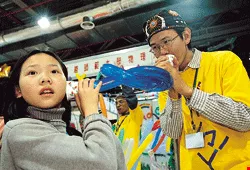
A wild bouquet
Over 100 colleges and universities participated in the first Creative Education Expo, and 210 innovative, interactive booths were set up at the site. Fifty thousand people came to the just-completed Science Exhibition Center during the three days of the exhibition. Adults and children alike personally experienced all kinds of dynamic and static activities, including small-scale interactive simulations, inventions, camps for creative exchanges between urban and rural students, and forums on the process of creative practice.
A "Global Defense Team" formed by six students from the Department of Aeronautical Engineering at Yunlin's National Huwei University of Science and Technology took first place in the National Innovation Competition. As motor-scooter riders themselves, they started from their own experience of often being dazzled by the high beams of car headlights that prevent one from seeing the road ahead clearly. The team had the idea of installing a warning device to remind drivers behind to dip their lights. They combined it with a reversing alert to give a warning if the vehicle ahead backs up, and a turn signal canceling device to automatically switch off the indicator after the scooter has completed a turn and is going straight ahead again. These three devices were all controlled by a single computer chip, and the cost of materials was less than NT$1,000. The invention's highly practical use set it apart from the rest of the pack, earning the team a NT$30,000 prize.
The biggest crowd pleaser at the expo was the Intelligence Ironman Competition, which initially drew 134 teams of academic and vocational high school students and concluded with 23 teams in the final where 16-year-old high-school students put their strength, intelligence, and creativity to the test. Students from the Hsinchu Experimental Middle School drew smiles when they called themselves "The Losing Team" (shibai de yi dui), a pun on the film title Spiderman.
According to the rules of the Ironman competition, entrants had to go through 16 game rounds that covered topics in language, natural sciences, history, and geography, all of which had been thought up by Associate Professor Liu Ko-fei of National Taiwan University's civil engineering department and a number of his graduate students. For example, in the "Seven-Color Rainbow" game, the participants had to use seven different beverages, including milk tea, hard liquor, wine, and water to create a beverage with layers of three different colors. For "Open Sesame," participants poured water into glasses of different heights with different-sized mouths, and by filling them to different levels, tried to play notes that were closest to synthetic sounds produced by a computer. In the "Ironman Travel Agency," students had to come up with a plan for a three-day, two-night tour of historic sites in mainland China.
After passing through each level, participants received several thousand NT dollars in virtual money that they could use to purchase materials they needed from an online store, to work on a theme that was announced on the day of the competition-to design an amusement park with at least three attractions, along with a poster for the park. Participants could not leave the competition area and had to complete their products within 72 hours. It was a test of endurance, team spirit, and practical abilities. In the end, six students from the Taipei First Girls High School who called their team "Missa Brevis" after a choral piece took home the NT$200,000 prize.
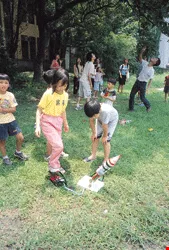
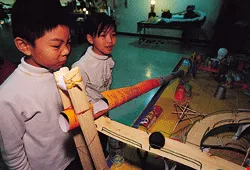
Diverse forms of intelligence depend on a diverse environment and diverse ways of educating. When students engage in a hands-on rocket launch experiment, or use their eyes to look at a dinosaur fossil, or use their hands to touch the surface of a model animal, creativity begins in life and returns to life. (photo above by Diago Chiu)
A competition of national strength
Though this may have been the first creative education expo in Taipei, "creativity" is not a new word-in fact, it has been developing for half a century in the United States.
When the Soviet Union launched the first artificial satellite in 1957, it came as a great shock to the American public and government. Some members of the education world argued that the Soviet Union's success in space technology represented the failure of American education, and the focus of American society shifted to promoting new educational methods, creating new instructional courses, researching creative thinking, and developing individual talent. Following this, a great deal of research was done on intelligence and creativity.
In the 1980s, research on human potential by Harvard professor Howard Gardner led to the establishment of Project Zero, which brought together researchers from the humanities and sciences and to investigate understanding, creativity, problem solving, science, the arts, and reasoning in daily life. Gardner subsequently put forward the theory of multiple intelligences, arguing that humans used seven types of intelligence to study, solve problems, and to create tools: verbal intelligence, logical intelligence, spatial intelligence, bodily or kinesthetic intelligence, musical intelligence, interpersonal intelligence, and intrapersonal intelligence.
But do these seven types cover all of humanity's intelligence? Even Gardner himself reaches no firm conclusions. In 1999 he included natural observation: for example, people who share Darwin's love for investigating nature or who can distinguish different kinds of plants and animals possess this kind of intelligence. Since then, he has also discussed a ninth kind of intelligence-existential intelligence, as exhibited by people such as philosophers and religious figures who sense the infinite life of the universe and the significance of life and existence.
Gardner put a great deal of thought into his intentional use of the term "intelligence" to describe abilities that had previously been called "talents," a move that was designed to break down traditional stereotypes about intelligence and how to measure it, and to emphasize its diversity.
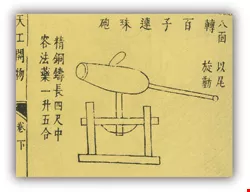
From the inheritance of invention passed down by wise people from both East and West, we may be able to find a few clues about the sources of creativity. Whether in the Song-dynasty encyclopedia of technology Tian Gong Kai Wu or in the works of the Italian genius Leonardo da Vinci, the source of creativity included learning from nature and giving free reign to their soaring imagination.
Creativity is an investment
Creativity education in the United States is a tremendous effort involving industry, government, and the education world.
For example, the Walt Disney Company, which is devoted to creating imaginary worlds for children, has established the Disney Learning Partnership to promote innovative teaching. Since 1989, Disney has spent US$8 million annually to support the American Teachers Award, and has worked with the Harvard University School of Education to create the "Innovative Classroom" series, which takes the practical experience of teachers who have won the award and publishes them as handbooks and teaching videos in order to spread the experience of innovative teaching.
Wu Jing-jyi, executive director of the Foundation for Scholarly Exchange, says that although the process of initiating creativity education in the US was the result of a sense of crisis caused by worries about falling behind in the arms race, cooperation between industry, government, and the educational sector has produced impressive results. If creativity is an investment, then the US has truly reaped astonishing benefits from its integration of various resources; this is especially true in high technology, film culture, and software.
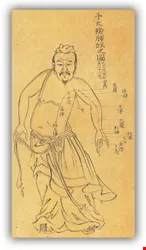
From the inheritance of invention passed down by wise people from both East and West, we may be able to find a few clues about the sources of creativity. Whether in the Song-dynasty encyclopedia of technology Tian Gong Kai Wu or in the works of the Italian genius Leonardo da Vinci, the source of creativity included learning from nature and giving free reign to their soaring imagination.
Who killed creativity?
Turning back to Asia, we see that Asians' intelligence is certainly not inferior to Westerners, but it is always difficult to get away from a negative image about Asians' lack of creativity. In the modern world, Asians who are able to take center stage to show their talents have been few and far between, whether in scientific research or in the arts.
If there is a close relationship between creativity and cultural context, then what factors in Chinese societies are detrimental to creativity?
When he went abroad to study in the US 30 years ago, Wu Jing-jyi focused his research on the creativity of Chinese people, Japanese people, and people in Europe and the US. In response to "Chinese students' relatively low level of creativity," he diagnosed 11 causes. These include, for example, emphasizing that knowledge comes from transmission by authority figures while neglecting the active construction of ideas; emphasizing competitive performance while neglecting group cooperation and sharing of knowledge; emphasizing written tests, memorization, and recitation while neglecting diverse forms of performance; emphasizing standard answers while rejecting inquisitive and independent thinking; emphasizing hard work while neglecting the enjoyment of the work.
The consequences of test-oriented teaching are that when Taiwanese students go to the United States to study, when compared with students from other countries, "their weakness in being unwilling to think outside of predetermined limits is easily seen," according to Ovid Tzeng, vice president of Academia Sinica. Tzeng says that Taiwanese students have sufficient basic knowledge and can do very well on assignments that their teachers give to them, but their ability to work on their own to unearth problems and to combine knowledge from various fields is quite weak.
At a 2001 forum on Inspiration and Innovation at Hong Kong Baptist University, Wu Jing-jyi said, "Chinese students' creativity has yet to be awakened, like a crouching tiger or hidden dragon." His words also drew a response from scholars from Singapore, Hong Kong, and mainland China.
Even more worrisome is that, while people in Chinese societies all know that "you can't get the tiger without entering its lair," ways of thinking in traditional culture that emphasize one-sided respect for Confucianism, high status for scholars, obedience of authority, and the organization of society along close-knit family lines are embedded in social ideologies to such an extent that other skills are seen as having little merit. These ways of thinking do not allow for children to explore, make mistakes, or take small risks by thinking outside of the box; instead, they heap scorn on all of these actions. When children get home after scoring 97 out of 100 points on the test, their parents will still grill them about what happened to the other three points. When overall environmental factors become too deeply ingrained, they will also stifle creativity. If we hope that the dragon will take flight and the tiger will spring forth, major reforms must first be undertaken in society.
Encouraging enthusiasm
"The good thing is that Taiwanese society has already decided that creativity is a must. It has an open attitude toward innovation, and will look for individuals and hold them up as a model and appreciate them. In our lives we see different clues to solving the problem, and it gives us a feeling that it is just waiting to happen," says Wu Jing-jyi. Wu says that the causes of low creativity and the cultural context are being fixed, but no systematic changes have been made as yet. One encouraging point is that the MOE has included creativity as a core educational ability. Industry, government, and the educational sector, however, have yet to come together. If all of them can move forward together and embrace one another, the circle will get larger and larger.
In the US, the number of patents awarded to Taiwan ranks fourth among all countries, behind the US itself, Germany, and Japan. This shows that all people have the ability to create and invent. But Taiwan's authoritarian, competitive educational methods, have strangled everyone's minds.
After the MOE released a white paper on "Creativity in Education" in 2002, efforts on creative education have taken off. What does this special formula in creative education offer to awaken the creative genes in students' minds?
The first thing the white paper set out to do was to break down some of the myths many people harbor about creativity, such as that it is the monopoly of a small number of gifted students, or is inborn and cannot be nurtured and studied. Most people fear and oppose change and are insufficiently able to appreciate the expression of creativity. Creativity may need to be nurtured over long periods, and may involve learning from mistakes. But because the focus on academic achievement dominates people's thinking, innovation is neglected as schools place too much emphasis on academic success and the results of short-term learning.
Wu Se-hwa, a consultant on creative education and dean of the College of Commerce at National Chengchi University, emphasizes that promoting creativity is relevant to transforming Taiwan's economy from a traditional manufacturing economy to a knowledge economy. Wu says, "Manufacturing industries involve large-scale, continuous production, and thus require excellent discipline to maintain consistent quality. In the era of the knowledge economy, the sources of value do not lie in production efficiency, but in product innovation and individual creativity. The scope for using creative abilities is tremendous, and we need to encourage everyone to use their creativity."
Since many teachers and parents have been disappointed with previous education reform policies, however, "We do not want creative education to turn into another education reform, so we will not make changes in the curriculum our primary emphasis," says Wu. Because of this, creative education has been established as a four-year pilot project with an annual budget of NT$60 million. In spirit, it will encourage diversification, differentiation, and maybe even a little rebellion and mischief. In practical terms, whether in innovation in educational methods, reform in educational materials, innovation in student performance or in reforming and restructuring campus spaces, any good ideas will receive support. And because this effort is a local, piecemeal, gradual bottom-up process, it will not encounter much opposition.
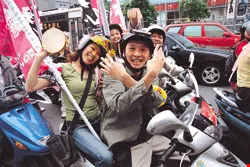
A graduation exhibition designed by the Department of Mass Communication at Chinese Culture University showed young people's mischievous spirit as they sent scooter squads out to take over the road.
Waking the tigers and dragons
To make more students understand the importance of creativity, the office for promoting creativity education held two-credit classes at 19 colleges and universities last year on "Imagination and the Practice of Creativity," which teaches principles and practical experiences of creativity. This year, the number of participating schools will jump to 35.
While everyone agrees that creativity is important, it is extremely difficult to find an appropriate definition for this word. The concept of creativity is something that people can sense, but is very hard to convey in words. In the end, how should creativity be taught and studied?
"I often ask myself jokingly if students have creativity after taking this class," says Wen Chao-tung, who has taught a course on "Creative Imagination" for two years at the Department of Business Management at National Chengchi University. Since Wu Jing-jyi began teaching courses on "Creative Thinking" over ten years ago, he has been thinking constantly about how to teach this class so that it will be effective.
"There are so many books on the market about teaching creativity and spurring innovation," says Wen Chao-tung. "They may have theories and techniques, but the most important thing is to have the right environment and attitude-are the students willing to think? Are they willing to act?" Wen emphasizes that it is only when society encourages innovation and someone is there to become involved at any stage of innovative work that it can create a value chain. He hopes to be able to turn around the model of thinking in which Taiwanese students are skilled at solving questions on paper but do not look for or solve problems on their own. Stimulus in the classroom, however, has its limits. To take business school as an example, ideas about innovation and models for entrepreneurship are all abilities that students need when they enter the workforce. To extend students' practical experience, he encourages them to form teams and participate in all kinds of competitions, such as the Nationwide Innovation Competition and the Urban-Rural Innovation Competition held by the Ministry of Economic Affairs, and the Entrepreneurship Competition held by the Advantech Foundation.
Wu Jing-jyi often uses "story-linking" methods to stimulate students' creativity. He first asks each student to share one of their life experiences with other students, and then asks them all to link the parts together into a single story. In the end, they create a new story out of over 20 different topics.
"It is only through discovery and sharing that one can reflect on and create meaning," says Wu Jing-jyi. Because creativity is also a kind of training in lateral thinking, this method can train students to use the large amount of information they already possess to think in different directions that do not follow traditional models.
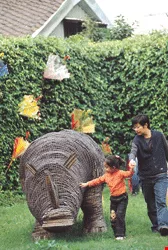
Diverse forms of intelligence depend on a diverse environment and diverse ways of educating. When students engage in a hands-on rocket launch experiment, or use their eyes to look at a dinosaur fossil, or use their hands to touch the surface of a model animal, creativity begins in life and returns to life. (photo above by Diago Chiu)
Happiness is the root of creativity
In his expansive prescription for developing creativity, Wu Jing-jyi argues that, looking at the current educational environment in Taiwan, the most important thing is to emphasize the experience of "enjoying work for its own sake" and giving attention to and appreciating creative abilities in other people. As gatekeepers to the educational system, principals and teachers play an essential role, and thus changing their views toward creativity and nurturing a creative attitude in them is even more important.
Cheng Ying-hui, a professor at the Graduate Institute of Education at National Sun Yat-sen University and director of the Kaohsiung City Education Bureau, once analyzed the work of 36 teachers who demonstrated superior performance at science exhibitions. He discovered that when compared with average teachers, creative teachers find more enjoyment in reading, have broader interests, often think from another perspective, can integrate and organize questions, and enjoy inventing and innovating. In addition, they are optimistic, actively aggressive, have a good sense of humor, and are courageous in trying new things.
Three years ago, when he was minister of education and promoting creativity education, Ovid Tzeng pointed out that when faced with pressure for high achievement and authoritarian styles of school management, many principals and teachers feel powerless to change things. Nonetheless, a more diverse atmosphere is slowly taking hold. In fact, most teachers can understand the concept of multiple intelligences and recognize how their students' cognitive habits differ from their own.
"The younger generation is more oriented toward images, spatial manipulation, and three-dimensional perception, which is very different from the model by which the older generation takes writing-based thought as a symbol of knowledge," says Tzeng. He notes that many universities are currently considering the possibility of allowing students to provide the technical support for their computer systems, and are planning specific projects led by students to automate information throughout their campuses. Some of these projects include having students establish campus web sites, design their content, and help instructors use internal and external networks.
Tzeng says: "If teachers can make good use of students' computer skills and help them to turn from the passive acceptance of knowledge to playing a guiding role in preparing classes, this would define a new era in educational processes and would overturn may years of the traditional model of 'I teach, you listen.'"
Fostering endless creativity
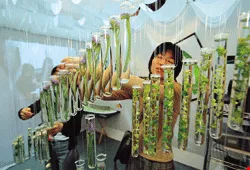
In the last two years, the Creativity Education Office has held 40 "Creative Teacher Activity Project" camps. They hope that teachers from different schools will exchange ideas, discuss issues of classroom teaching, and record their experiences and reflections on designing curricula, and that all of this will make more ideas start flowing. The classroom cannot and should not be a stumbling block that snuffs out creativity.
American psychologist Thomas Armstrong once gave this example to explain the importance of managing the classroom: a group of elementary school students is studying the planets in the solar system. The teacher comes up with the idea of having the students dress up like astronauts and go on a virtual trip to the moon. One child raises his hand and says he wants to dress up like a Martian to welcome the astronauts, but he is immediately told "no" by the teacher, who says, "We all know there are no people on Mars!" We can appreciate the first half of the teacher's performance, but his attitude in the second half is disappointing.
People who research creativity like to say, "A society will produce what it honors." Only a soil that is rich with creativity will give rise to impressive fruits.
It is like the words to the opening scene of the American television series Star Trek: if space is the final frontier, unexplored by humans, then the human mind is the final frontier for our inner exploration. As for what sparks might come from this center that rests between reason and feeling, it depends entirely on how we nurture it!
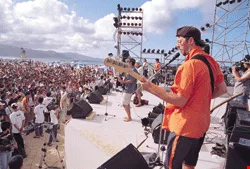
Experiencing the bubbling sounds of human voices and music at a rock music show, the body starts to relax, and creativity develops along with it. (photo by Jimmy Lin)
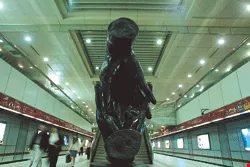
As they rush from place to place, do average people see that creativity is all around them? Pictured here is an art installation in the National Taiwan University Hospital MRT station.
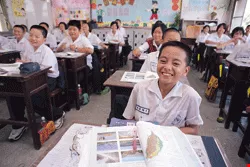
The hope for creativity education is to provide an active, happy environment that will let students enjoy learning and be courageous in exploring new things.
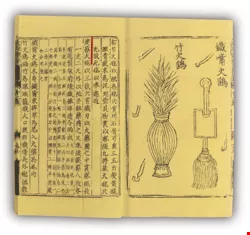
From the inheritance of invention passed down by wise people from both East and West, we may be able to find a few clues about the sources of creativity. Whether in the Song-dynasty encyclopedia of technology Tian Gong Kai Wu or in the works of the Italian genius Leonardo da Vinci, the source of creativity included learning from nature and giving free reign to their soaring imagination.
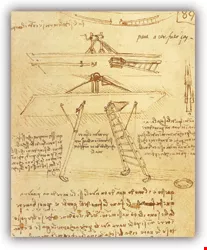
From the inheritance of invention passed down by wise people from both East and West, we may be able to find a few clues about the sources of creativity. Whether in the Song-dynasty encyclopedia of technology Tian Gong Kai Wu or in the works of the Italian genius Leonardo da Vinci, the source of creativity included learning from nature and giving free reign to their soaring imagination.
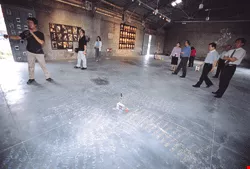
The space for imagination in art is boundless. The No. 20 Warehouse Art Village in Taichung has attracted a number of artists-in-residence from Taiwan and abroad. (photo by Jimmy Lin)
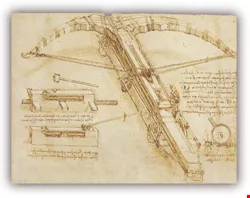
From the inheritance of invention passed down by wise people from both East and West, we may be able to find a few clues about the sources of creativity. Whether in the Song-dynasty encyclopedia of technology Tian Gong Kai Wu or in the works of the Italian genius Leonardo da Vinci, the source of creativity included learning from nature and giving free reign to their soaring imagination.
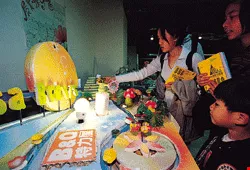
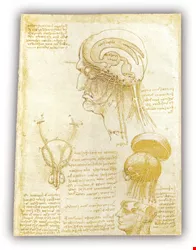
From the inheritance of invention passed down by wise people from both East and West, we may be able to find a few clues about the sources of creativity. Whether in the Song-dynasty encyclopedia of technology Tian Gong Kai Wu or in the works of the Italian genius Leonardo da Vinci, the source of creativity included learning from nature and giving free reign to their soaring imagination.


@List.jpg?w=522&h=410&mode=crop&format=webp&quality=80)


