Four Centuries of Taiwanese Hakkas
Chang Chin-ju / photos Vincent Chang / tr. by David Mayer
August 1999


The Hakkas have long taken pride in their lineage, for they believe themselves the direct descendants of nobility from the Yellow River cradle of Chinese civilization. As such, they stress the importance of ancestor worship. In this picture, a Hakka family shows off the new grave they built when the family's 11th generation first immigrated to Taiwan. (courtesy of Chang Ah-hsiang)
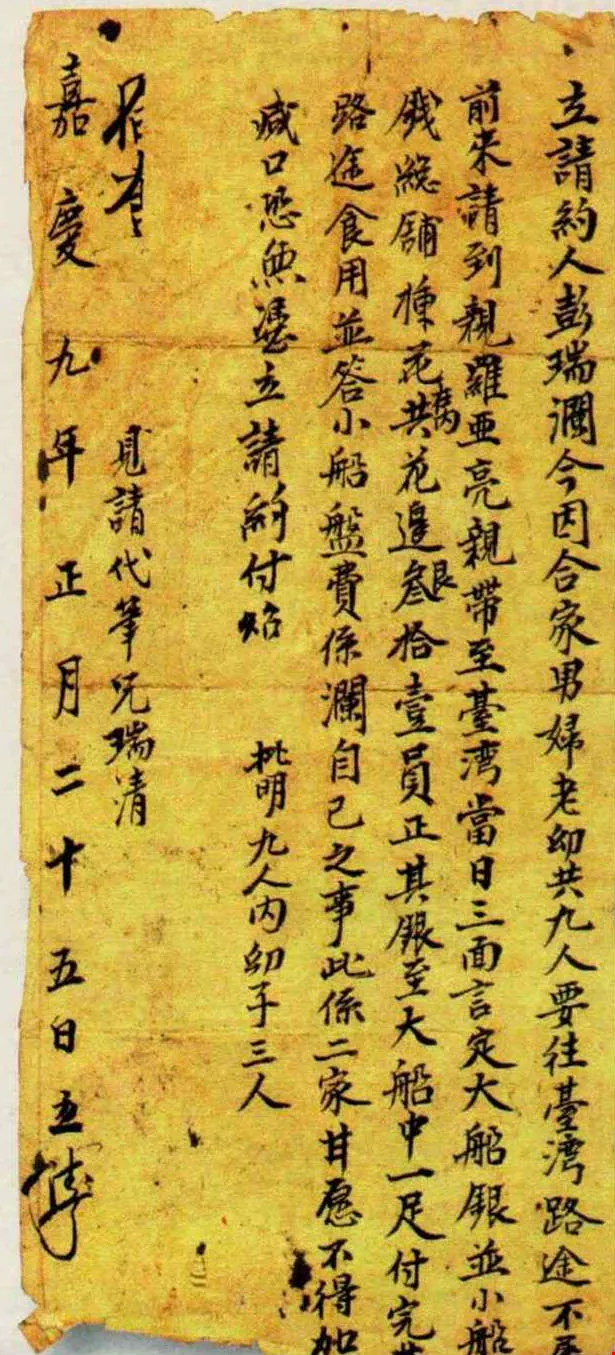
After the emperor Kangxi issued an edict in the 1680s prohibiting emigration to Taiwan from Guangdong, the passage across the strait became more harrowing for Hakkas than for Fujianese from Zhangzhou and Quanzhou. Pictured here is an "emigration services contract" from the early 19th century. This contract was signed by a Cantonese guide and a group of Hakka emigrants. (photo by Huang Jung-luo)
Is it true, as they say, that most Hakkas in Taiwan live either in the northern foothills or down south in the Kaohsiung-Pingtung area? And is it true, as they say, that the Hakkas live in the hills because they didn't arrive in Taiwan until after immigrants from Zhangzhou and Quanzhou in Fujian? There are 4 million Hakkas today in Taiwan, but how many of our notions concerning Hakka history, including ideas accepted by the Hakkas themselves, actually have anything to do with historical reality?
When Taipei City organized a Hakka street festival, ethnic Hakkas turned out in huge numbers. The fact that they had moved away from their hometowns in other parts of Taiwan (or so they say!) no longer meant that they would melt away invisibly into the hubbub of city life. No, these relocated Hakkas would just have to band together and build themselves a new "hometown" in Taipei. Now, however, some revisionist historians have begun to question the long-held assumption that the Hakkas have always lived primarily in either northern Taiwan's Taoyuan, Hsinchu, and Miaoli counties or in the Kaohsiung-Pingtung area. Field studies are turning up evidence to counter the belief that locations farther north-such as Taipei, Tamsui, Hsinchuang, Sungshan, and Neihu-were settled only by immigrants from Fujian. We are finding that these places were also the earliest homes in Taiwan for many a Hakka settler.
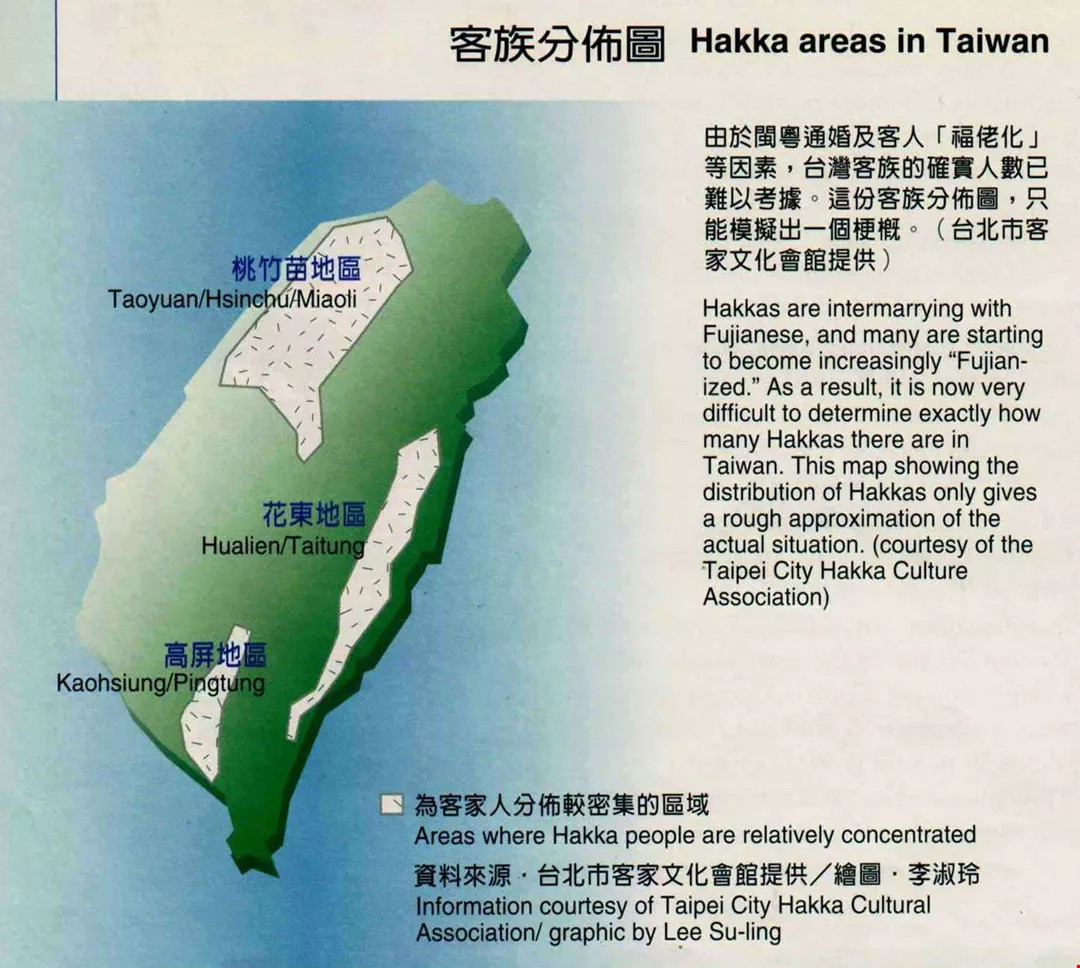
Hakkas are intermarrying with Fujianese, and many are starting to become increasingly "Fujianized." As a result, it is now very difficult to determine exactly how many Hakkas there are in Taiwan. This map showing the distribution of Hakkas only gives a rough approximation of the actual situation. (courtesy of the Taipei City Hakka Culture Association)
The Hakkas of Taipei
An expert on architecture who directed a research project in 1985 at Kuangfu Temple in Hsinchuang asked, "Why would there be such a huge Hakka temple in the middle of what was supposedly one of the area's main Fujianese communities?"
The findings of Yin Chang-yi, a professor in the history department of Fu Jen Catholic University, have taken people by surprise. The three biggest temples in the Hsinchuang area are Kuangfu Temple and Tsu-you Temple (in the north) and Kwanti Temple (in the south). Two of these temples were built by Hakkas, and the third is closely tied to the Hakka community. Says Professor Yin, "This completely overturns the idea that Hsinchuang was mainly settled by immigrants from Fujian."
Studies on the historical distribution of Hakkas in northern Taiwan have generated new insights into Taiwanese history. "In fact," says Professor Yin, "there is even reason to question the idea that Fujianese immigrants were the first Chinese to get here prior to the arrival of the Dutch in 1624." Currently available historical materials and clues indicate that Hakkas may have actually arrived in Taiwan ahead of the Fujianese.
One such piece of evidence is the religious belief in the Three Mountain-Kings, which originated in the province of Guangdong. Linchao Temple in Changhua County is the oldest of Taiwan's temples dedicated to the Three Mountain-Kings. Twelve years ago they celebrated the 400th anniversary of its founding. It is recorded that two men from Guangdong Province came to Taiwan in 1586 to gather medicinal herbs. On the trip across the Taiwan Strait they carried with them incense from Lintian Temple in Guangdong, which is dedicated to the worship of the Three Mountain-Kings. They arrived in Taiwan at what later came to be known as Lukang and in the following year built Linchao Temple in Hsihu.
Historical records indicate that the earliest Han Chinese immigrants arrived in Taiwan in the latter half of the 16th century. Says Chen Yun-tung, a veteran researcher of the history of the Hakkas of Toufen (a township in Miaoli County), "People from Guangdong definitely were among the first immigrants to Taiwan."
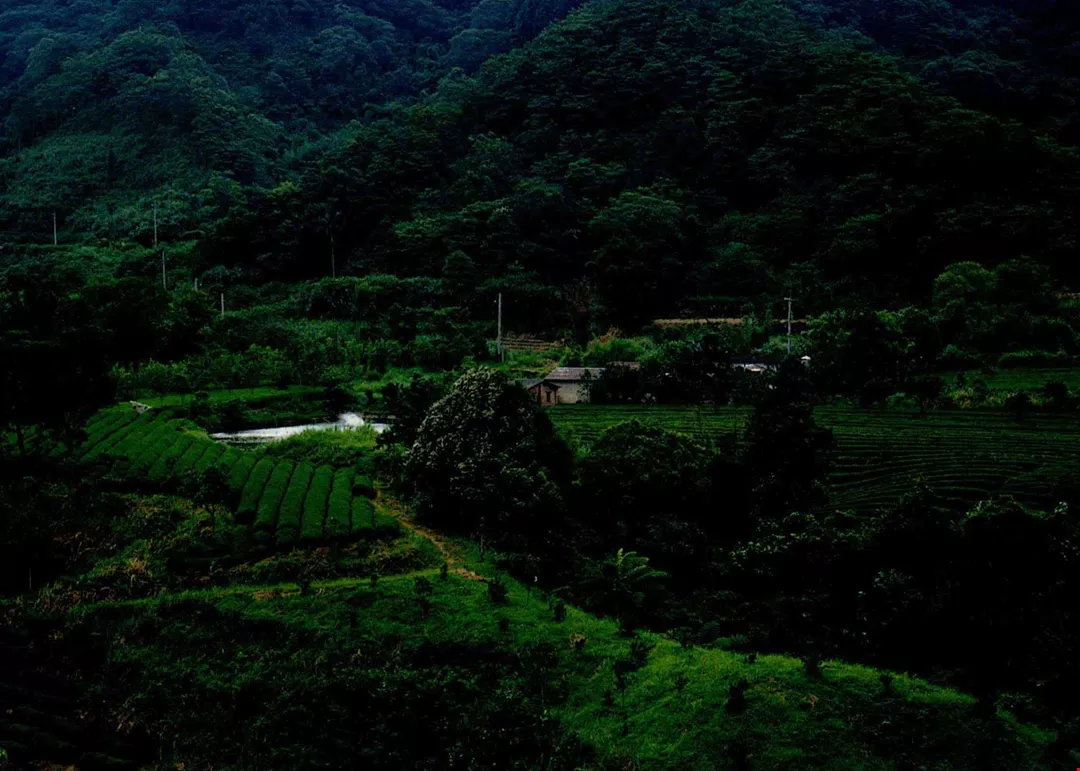
Most people believe that Hakkas live in the foothills because they arrived in Taiwan later than other immigrants, but recent historical studies have revealed that many early Hakka settlers had first established themselves in the plains of northern Taiwan before being attracted to the hills of Taoyuan, Hsinchu, and Miaoli by the chance to make money off tea and camphor. Tea plantations constitute the backbone of agriculture today in the township of Kuanhsi (Hsinchu County). This scene has become the classic image of a Taiwanese Hakka village.
The invisible Hakkas
Of course, President Lee is now championing the idea of "the new Taiwanese." Maybe this Taiwanese version of "the great melting pot" eliminates the need to research the question of who got to Taiwan first. In a multicultural society like ours, however, rediscovering the pioneering deeds of earlier generations of Hakka people is a matter of great significance, for the history of the Hakkas in Taiwan has long been deliberately ignored. Historians in Taiwan, regardless of their ethnic identity, are in general agreement on this point.
In Taipei, for example, if it weren't for the commanding presence of a huge temple dedicated to worship of the Three Mountain-Kings, very few people would realize that the Hakkas had played such an important role in the settlement of the local area. Says Professor Yin, "It's bad enough that people know absolutely nothing about the history of the Hakkas in Taipei. What boggles the mind, however, is the fact that you can't even find any mention of Hakka people in local gazetteers from areas where Hakkas still constitute the majority today!" In Hakkas in Taiwan-Historiography Today and Yesterday, Professor Yin notes that Hakkas get short shrift in local annals from the Qing period, and that this trend even continued on through the Japanese colonial period. Very little mention of Hakka people or Hakka communities is made, for example, in a gazetteer from Tamsui dating back to the reign of the emperor Tongzhi (1862-1874), while gazetteers from Taipei produced in the colonial period and again after Taiwan was recovered from the Japanese make absolutely no mention of the strong presence of Hakkas in Hsinchuang.
Even in Hsinchu County, where 80% of the population is Hakka, it is tough to find much mention of Hakkas in a county gazetteer published in 1976, fully 31 years after Taiwan was recovered from the Japanese. At the risk of indulging in hyperbole, one is tempted to say that anyone who limited his sources to official gazetteers might conclude that there simply were no Hakkas in these areas.
Professor Yin points out that an official history of Taiwan compiled in 1887 (not long after Taiwan was established as a province) includes many records in which Fujianese make disparaging references to people from Guangdong. The language even gets quite strong at times, with some comments referring to "Guangdong bandits." Explains Professor Yin, "Long-standing competition and animosity between the people of Fujian and Guangdong resulted in an expunging of Hakkas from the historical record."
Three Mountain-Kings tell a tale
Chen Yun-tung, a longtime promoter of Hakka culture, bemoans the loss of Hakka culture, which he attributes to ignorance of history. He often has to point out to people, for example, that before the Ming loyalist Zheng Chenggong captured Taiwan in the 17th century, the two most famous pirates operating in the seas off Taiwan were Lin Feng and Lin Daoqian, both from Guangdong. In Takou (modern-day Kaohsiung), where Lin Daoqian came ashore in his forays to Taiwan, the legend of a huge buried treasure on Mt. Shoushan has been passed down to the present day.
Most of the powerful lieutenants under Zheng Chenggong (Koxinga), who is widely credited with initiating the earliest settlement of Taiwan by Han Chinese, were Hakkas. Taiwanese historians like to gloat over the details of how the Zheng military clan managed to hold out in Taiwan for three generations against the Qing dynasty, repeatedly frustrating the attempts of Shi Lang to conquer the island. Much of the credit for this remarkable rebellion goes to the minister Chen Yonghua and the general Liu Guoxuan, two Hakkas from Guang-dong who served under Zheng Chenggong and his successors for some two decades. Chen was a brilliant administrator who is credited with doing more than anyone to lay the foundation for Han Chinese culture in Taiwan.
Northeastern Taiwan was settled by Han Chinese later than other areas. When Wu Sha first led settlers to the Ilan plain, included among them were people from Guangdong, Quanzhou, and Zhangzhou. The Ilan plain is today considered a stronghold of the Fujianese, yet there are 37 Hakka temples here dedicated to the worship of the Three Mountain-Kings, more than anywhere else in Taiwan.
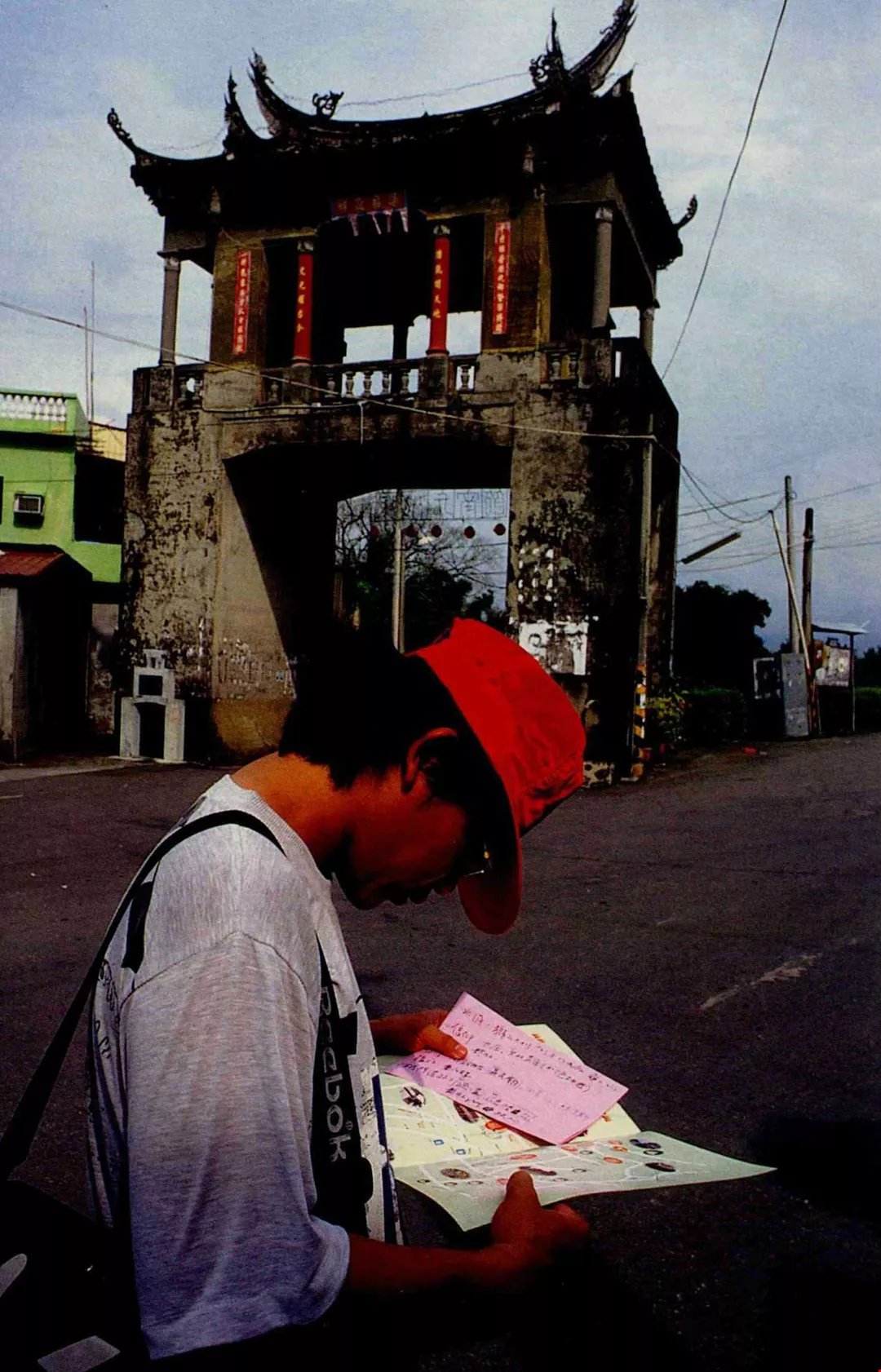
In the wild and wooly days of early Han Chinese settlement, Hakka communities had to take active measures for self-defense. Shown here is Tungmen Tower, the lone remaining lookout tower in the township of Meinung (Kaohsiung County). It was used to guard against attack by the indigenous Pingpu, early plains-dwelling peoples who have since assimilated into the Han majority.
According to Yang Kuo-hsin, an expert in Hakka culture, Taiwan has 145 temples dedicated to the Three Mountain-Kings located throughout the island. In addition to the predominantly Hakka counties of Hsinchu, Miaoli, and Pingtung, these temples can also be found in many non-Hakka areas, such as Ilan and Taipei counties in the north, and Changhua, Yunlin, and Chiayi counties in central and south-central Taiwan. Says Yang, "There are areas in rural Ilan County where just about every little hamlet has its temple for the Three Mountain-Kings." He further points out that there are three such temples in the city of Fengyuan (Taichung County). It would have taken a lot of people and considerable financial resources for new immigrants to Taiwan to build a temple, "so it's clear that there were once a lot of Hakkas living in Fengyuan." Discrimination against Hakkas
In the 17th and 18th centuries, the Hakkas contributed every bit as much as Fujianese immigrants to settlement of the coastal plains of western Taiwan, and the two populations were about equal. This changed abruptly beginning around the middle of the 18th century, when the Fujianese population began to rapidly outnumber the Hakkas. Today the Hakkas are a "disadvantaged minority" accounting for only 20% of the population of Taiwan.
Why did the Hakkas become a minority in Taiwan? The most common explanation has always been as follows: Before Taiwan was designated as a province of the Qing dynasty in 1885 the island had always been administered by Fujian Province, and most immigrants were Fujianese due to this administrative link, not to mention the island's physical proximity to Fujian.
Scholars of Taiwanese history, however, have gathered large amounts of historical materials in recent years, and many have come to conclude that the earliest factor affecting the balance of immigrants from Guangdong and Fujian was the imperial edict of 1684 forbidding immigration from Guangdong.
During the reign of the emperor Kangxi (1662-1722), the general Shi Lang defeated the Zheng clan of Ming loyalists in Taiwan and wrote a memorial to the emperor explaining the strategic importance of Taiwan to China's coastal defense. The Qing court responded by annexing Taiwan as part of Fujian Province and dividing the island into three counties.
Shi Lang was a native of Quanzhou, in Fujian Province. While emphasizing Taiwan's strategic importance, he also issued three writs prohibiting immigration to Taiwan. The third of these writs states: "The Province of Guangdong has for so long been a haven for pirates that this lawlessness has become a way of life. Therefore, residents of Guangdong are prohibited from emigrating to Taiwan." According to Fan Chen-chien, an assistant professor at the Taipei College of Business, the Qing general had been frustrated for two decades by the Zheng family's able Hakka assistants, so when he finally managed to overcome them, his suppression of the Hakkas was motivated by a desire for revenge.
According to Lien Heng's General History of Taiwan, after the edict prohibited immigration from Guangdong, Fujianese became the predominant group of settlers, and large numbers from the Shi clan came to open up new lands. Lien writes that Shi Bang, who settled parts of central Taiwan, established a clan that came to be known as "the richest and most respected family in Fujian and Taiwan."
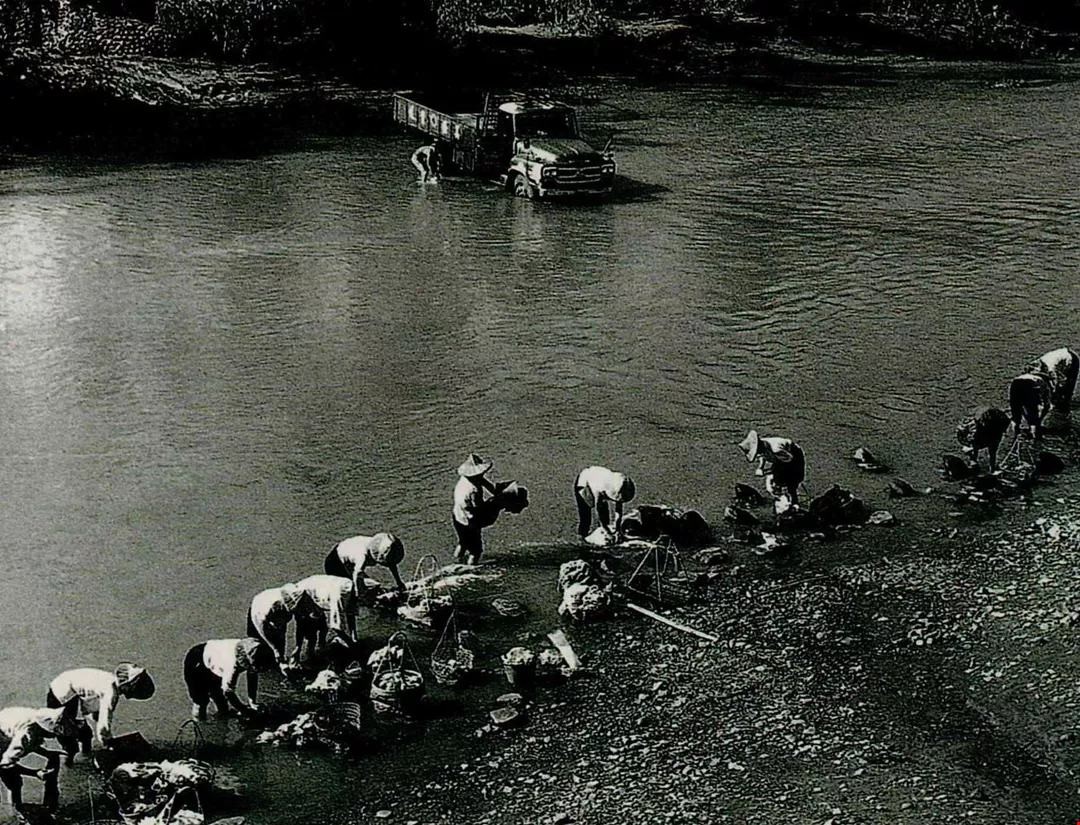
In an earlier time, the Hakka women of Meinung washed their laundry every morning in the river. They always faced the shore as they did the laundry in order to keep on guard against possible enemy ambushes from behind. (photo by Liu An-ming)
The isle of no return
Fan Chen-chien takes issue with Shi Lang's description of the people of Guangdong as inveterate pirates. As mentioned above, Fan's interprets Shi Lang's suppression of Hakka immigrants as nothing more than personal vindictiveness. The Qing dynasty had its hands full dealing with rebellions, however, and Shi Lang was already in an excellent bargaining position as the man who had conquered Taiwan. He was given complete control over the administration of the island. Many Hakkas were forced to return to the mainland, and some fled to the hills. A century passed before the prohibition against immigration from Guangdong was lifted by the emperor Qianlong. It was a time when a voyage to Taiwan was a life-and-death venture for anyone who dared to try. The oft-repeated wisdom at that time was that for every ten people who attempted to cross the treacherous "black channel" (as the Taiwan Strait was then called), "six died and one turned back." The challenge was all the more daunting for the Hakkas, who also had to run the gauntlet of an official prohibition against their emigration to Taiwan.
Huang Jung-luo, a veteran researcher of Hakka ethnology, discovered an old folk song in 1986 that had once been sung by early Hakka settlers toiling to build new lives in the foothills of Taiwan. The song hints at the terrors that these early immigrants faced: "Take some advice: Don't go to Taiwan! That way lies the gate to hell. Thousands go, not one returns. We'll never know who lived or died. Why dig your own grave? Taiwan is a land of death."
Passage to Taiwan in those days was controlled by the Fujianese. At the ports, passengers were charged special fees, and customs agents generally demanded bribes. The Hakkas were naturally subject to discrimination. In 1790, a pair of Hakka physicians in Taiwan appealed to the authorities to prohibit port officials from levying special charges against them.
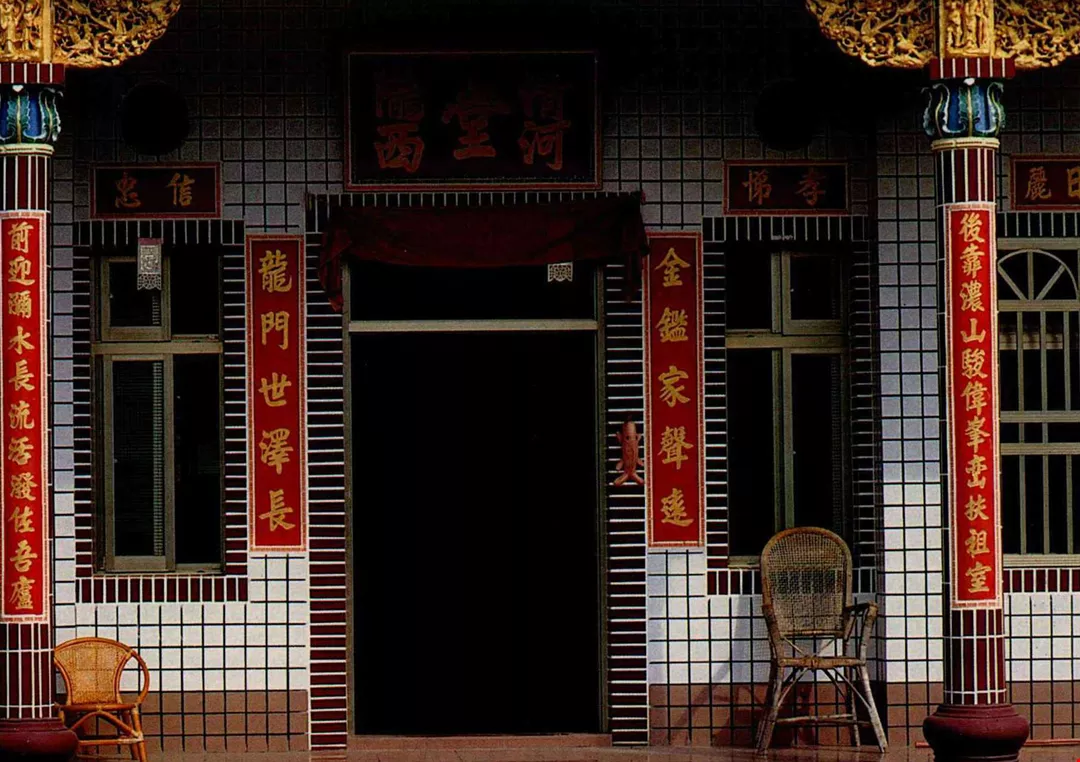
Hakka families hang a plaque in the home to identify where the family's ancestors came from. Having two regions mentioned on the plaque, as in this picture, is unusual--several generations ago, the family had to take an outside bridegroom into the family to continue the family line, so they had to honor the man's ancestors as well.
Taiwan's first "NGO"?
While the imperial edict prohibiting immigration from Guangdong made the passage to Taiwan more painful for Hakkas and greatly affected the overall ethnic balance of settlers, one must look to other factors to explain the complex geographic distribution of Hakka enclaves in Taiwan.
Chen Yun-tung, one of the first to publish studies on the history of the Hakkas in Taiwan, notes that although the imperial edict greatly stanched the flow of Hakka immigrants from Chaozhou and Huizhou, Hakkas from the northern part of the province were more readily able to leave via Fujian and travel to southern Taiwan. This group came to constitute the majority of early-period Hakka settlers in Taiwan.
During the reign of the emperor Kangxi (1662-1722), Hakka immigrants had just as much clout in the coastal plains of western Taiwan as did their Fujianese counterparts from Zhangzhou and Quanzhou, and the imperial edict certainly did not cause them to completely disappear. An important case in point is the Liutui Volunteer Militia, which was organized by Hakkas in the Kaohsiung-Pingtung region. Until recently, however, people knew little about Taiwan's history, and mistakenly believed that the imperial edict marked the end of significant Hakka participation in the settlement of Taiwan. If it hadn't been for the furious controversy in recent years over plans to build a reservoir in Meinung (a predominantly Hakka town), very few people would know anything at all about the Liutui militia.
In Professor Yin's opinion, there are many episodes involving the Hakkas that deserve the close attention of historians. Terms like Liutui militia and the yimin militia go further than anything else toward symbolizing the Hakka experience in Taiwan. "Furthermore," says Professor Yin, "they were also two of the largest social organizations in the early days of Taiwanese settlement."
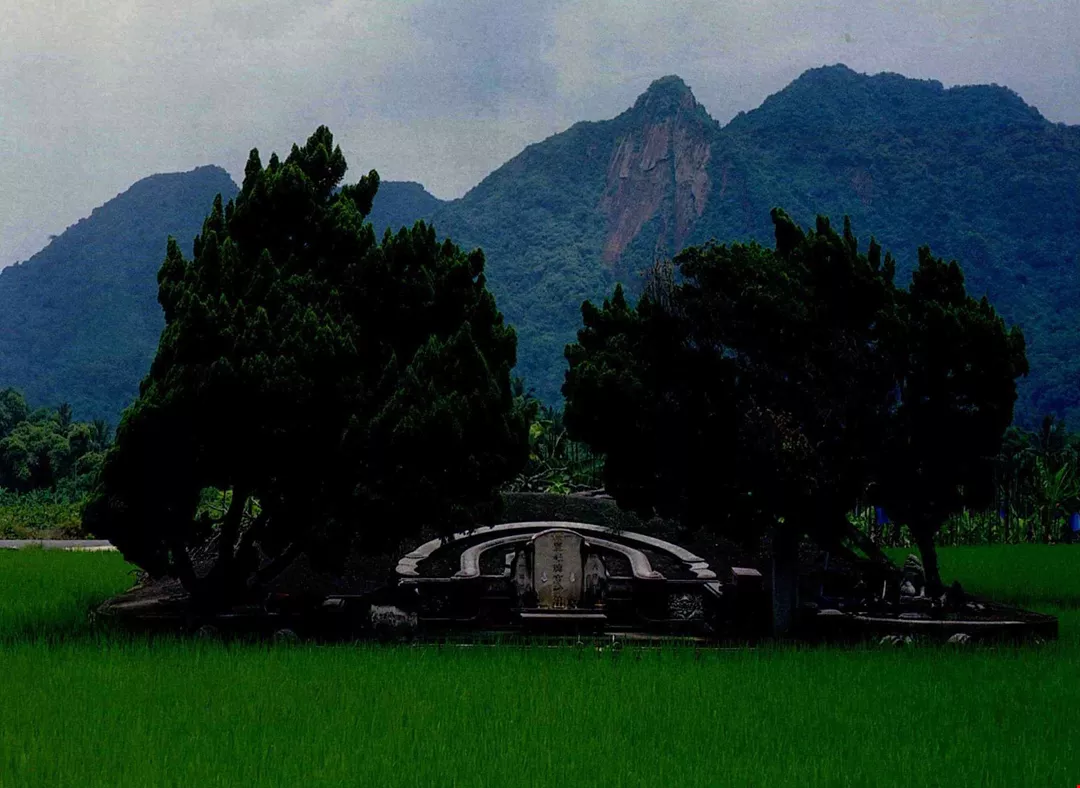
For anyone attempting agriculture in the foothills of Taiwan, water resources are extremely important. Lishe Temple is dedicated to the worship of a water deity. Such deities are a distinctive feature of Hakka religious beliefs.
The Liutui Volunteer Militia
Taiwan saw three great insurgencies during the Qing dynasty. One of these, led by Chu Yi-kui, occurred in 1721 and led directly to the establishment of Liutui Volunteer Militia. Originally from Zhangzhou, Chu Yi-kui raised the flag of rebellion together with Tu Chun-ying in southern Taiwan. The rebels quickly captured Tainan and Chulo (modern-day Chiayi) and proclaimed Chu "Chung Hsing Wang" (i.e., "the king who will restore the Ming dynasty"), but it wasn't long before relations between Chu and Tu disintegrated into bitter internecine struggle, with Hakkas pitted against Fujianese.
To protect their homes from the ravages of war, Hakka communities (including present-day Tienneipu and Meinung) organized the Liutui Volunteer Militia, and it was this force which helped to bring an end to Chu Yi-kui's rebellion. With his Fujianese fighters pursued by Qing troops and hampered by fierce resistance from the Liutui Volunteer Militia in the township of Wantan, Chu was finally defeated in Chiayi County.
Chen Yun-tung, a Hakka from northern Taiwan, admires the fighting spirit of the Liutui militia, and laments that Hakkas of northern Taiwan lack this type of cohesiveness. The spirit of the Liutui militia has lived on, most notably in the person of Liu Yung-fu, who led fierce resistance against Japanese troops sent to take control of Taiwan after the island was ceded to Japan in 1895. Today, the Liutui spirit shows through once again in the movement to prevent the construction of Meinung reservoir from inundating a piece of Hakka culture.
After the Chu Yi-kui rebellion, the Qing official Lan Tingzhen memorialized the emperor to urge repeal of the ban against immigration from Guangdong. Soon thereafter, immigrants began pouring in from Chaozhou and Huizhou. Due to the activities of the Liutui militia and the subsequent favor showed to them by the Qing court, Taiwan's Fujianese population heaped scorn on Hakkas for siding with the officials against the rebels. Even today, Hakkas remain stereotyped as a group that fawns upon whoever happens to be in power. No matter how "trumped up" this charge may be, however, the bad name has stuck to the Hakkas like some sort of "original sin." The Hakkas have had a much tougher time establishing a place for themselves in Taiwanese society than have their Fujianese counterparts from Zhangzhou or Quanzhou. The difficulties that Hakkas face are well illustrated by the furor that blew up last year over the treatment of the spirits of the yimin militiamen in a school textbook.
The ideal of cultivating multiculturalism and encouraging respect for minorities has caught on in recent years in Taiwan. To reflect this new trend, an experimental new junior high school textbook called Getting to Know Taiwan was introduced last year, yet the complete lack of any mention of Hakka culture drew a storm of protest. The textbook committee revised the book, adding a section on the Hakka worship of the spirits of the yimin martyrs, a group of militiamen who were killed while fighting against rebels. Unfortunately, the committee breezily referred to the spirits of the yimin militiamen as a "pack of lonely ghosts and wandering demons." This uncomplimentary language elicited a second storm of protest. The textbook was revised again, and the "lonely ghosts and wandering demons" were upgraded into a group of deities personifying the ideals of loyalty and valor. In the opinion of Fan Chen-chien, the textbook incident highlighted the ignorance of the Taiwanese people concerning Hakka history and focused the spotlight on the existence of a negative bias against Hakka culture. Lonely ghosts or paragons of valor?
Who exactly were the yimin militiamen? How did their spirits come to occupy such an important place in the religious life of Taiwanese Hakkas?
In 1785, official corruption and grinding poverty sparked an uprising in Changhua Country led by Lin Shuang-wen. The fighting spread south to Chiayi and Fengshan (present-day Kaohsiung) and north to Chuchian (present-day Hsinchu), where the rebels met with resistance from local Hakka militia. Over 100 Hakka militiamen died in the fighting in Hsinchu and were buried in a mass grave. A mausoleum was erected at the site, and later the Yimin Temple ("militiamen's temple") was built there.
After Lin Shuang-wen's rebellion was put down, officials rewarded the Hakkas with an inscribed wooden memorial commending them for their help in the fight against the rebels. Thereafter, people got the mistaken idea that the yimin militia had fought to preserve Qing rule, and the Hakka community once again suffered unjust criticism as running dogs for the elite and the enemies of righteousness.
When Yimin Temple recently celebrated its 200th anniversary, Hsinchu county commissioner Lin Kuang-hua pointedly asked a county legislator why anyone should speak in praise of the yimin militiamen. Arguing that the militiamen had sided with the Qing against Chinese heroes who were trying to drive the Manchus out, the county executive asked: What's so virtuous about people like that?
The actions of the yimin militia must be viewed in their proper historical context, however. After immigration from Guang-dong was prohibited, Hakkas gradually became a disadvantaged minority in Taiwan, far outnumbered by Fujianese from Zhangzhou and Quanzhou. They had no choice but to band together to defend their homes and communities against larger ethnic rivals. In the complex and dangerous world of Taiwan during the early years of Han Chinese settlement, when rebellions such as those led by Chu Yi-kui and Lin Shuang-wen broke out, Hakka communities often came under attack. The rebels in these cases were fighting against corrupt officialdom, to be sure, but from the Hakka perspective, these disturbances simply provided other ethnic groups with an excuse to loot and pillage Hakka enclaves.
For Fan Chen-chien, the yimin militia did what it took to defend their lives, homes, and property, and to ensure the continued survival of their language and culture.
Hakkas are still criticized today for the inscribed wooden memorial with which the Qing court honored the yimin militia, yet it would behoove one to remember that the most widely revered Fujianese deity, the goddess Matzu, was shown favor over 40 times by officialdom. What is certain is that worship of the spirits of the yimin militia has provided the Hakkas of northern Taiwan with a sense of cohesiveness for more than 200 years. Every summer on the tenth day of the seventh lunar month, a village in either Taoyuan or Hsinchu county carries out a huge festival in worship of the martyred yimin militiamen. (The festival rotates among 15 different villages, with a different one doing the honors every year.) The 200th anniversary of the founding of Yimin Temple was a big event. As one account puts it: "The gods from 25 sub-temples throughout Taiwan came back to the main temple, and over 30,000 faithful flocked in." Huang Jung-luo notes that if the textbook committee had just made one simple phone call to Yimin Temple they would have found out right away that there are enough faithful followers to ensure that the spirits of the yimin militiamen will never be "a pack of lonely ghosts and wandering demons."
Fan Chen-chien sums up the significance of the worship of the yimin militiamen in the following pithy phrases: "settling in, protecting the home, self-reliance, and love of hometown." Surviving in the face of adversity
Serious ethnic strife was a fact of life in the Taiwan of centuries past for a number of reasons, including linguistic barriers, different places of origin in the mainland, disputes over water rights, and the Qing court's policy of playing off different groups of Han Chinese against each other. There were continual disputes, for example, between Fujianese settlers from Zhangzhou and Quanzhou. Each time a major uprising occurred in Taiwan, tensions between these various groupings exploded into serious armed conflict.
For the Hakkas, who gradually fell to the status of a disadvantaged minority from the 17th century onward, these conditions increased the difficulty of survival. For the modern-day historian, frequent armed conflict between organized groups in Taiwan adds an extra layer of complexity to the past. For the Hakkas of northern Taiwan, these conflicts were one factor in their migration into the mountains.
In A History of the Hakkas in Taiwan, Huang Jung-luo notes that the Hakka settler Chang Ta-chao had already opened up the northwest part of the Taichung plain by the reign of the emperor Yongzheng (1723-1735), and the Chang family's irrigated fields in Tuwu Chienchun already covered an expanse of 3,000 chia (approximately 2,900 hectares). According to a gazetteer for Changhua County: "The Changhua area is populated by two groups of settlers. One is from Fujian and the other from Guangdong. Each group recites from the classics with its own peculiar accent, and each has its own teachers. In the cities and townships alike, families everywhere hire private tutors for their children." Huang Jung-luo argues that the Hakkas were clearly the social equals of the Fujianese. New Hakka arrivals poured into Taiwan in the latter part of the Qing dynasty during the reign of the emperor Jiaqing (1796-1820) and the early part of the reign of the emperor Daoguang (1821-1850). It was not until the huge armed clash between Hakkas and Fujianese in 1826 that the influx of Hakkas declined significantly.
Japanese historian Ino Kanori writes that the armed ethnic clash of 1826 started when a Hakka stole a pig from a Fujianese. "Intense fighting raged along the borders between Hakka and Fujianese communities, and Hakkas in the Yuanlin area (Changhua County) were forced to withdraw for self-defense to Tapu Hsinchuang and the neighborhoods surrounding Kuanti Temple. Turmoil engulfed Taiwan in both the north (from the Tachia River in Taichung all the way up to the Tamsui area) and south (in the area between the Huwei River and the Chiayi County line)."
Huang Jung-luo feels that Hakkas migrated to the mountains primarily because of the 19-year period of armed conflict that began in 1826. Huang writes in his book In Search of Hakka Roots: "The Hakkas were involved in the earliest settlement of some parts of Taipei County, but after the armed clashes many of them moved south to counties like Taoyuan and Hsinchu."
The armed clashes were not always between the Fujianese and Hakkas. Over 100 armed clashes both large and small occurred between various groups in Taiwan between the early-17th and late-19th centuries. The Hakkas even fought amongst themselves over water rights. A General History of Taiwan (revised by Wu Mi-cha, a scholar at Academia Sinica's Institute of Taiwan History) notes that the groups involved in the early settlement of Taiwan recruited settlers from their own ethnic group or hometown. Any dispute over land or water tended to spark fighting between distinct social groupings. Escalation into armed conflict was often the end result. Such clashes in Taiwan occurred between Hakkas and Fujianese, and among fellow Fujianese from Zhangzhou and Quanzhou. Other rifts occurred along clan lines, and there were even armed clashes between opposing occupational guilds. Are all tea pickers Hakka?
Objective conditions prevented anyone in the past from taking a really close look at Taiwanese history, and mistaken notions abounded. It was thought, for example, that people from Quanzhou settled near the mouths of rivers because they had come from a port city; that people from Zhangzhou established farms in the plains and along the rivers a bit further inland because they had generally been farmers on the mainland; and that the Hakkas had no choice but to settle in the foothills because they did not arrive in Taiwan until later. This facile assumption that present-day demographics reflect where Hakkas lived in the early days of settlement is a gross oversimplification of the facts.
Much more research has now been done on Taiwanese history, and many erroneous ideas have been put to rest. The history of Hakka settlement in Taiwan is full of tragedy, but in the view of Chuang Ying-chang, a researcher at Academia Sinica's Institute of Ethnology, we mustn't blow particular bits of history out of proportion in an effort to emphasize the tragic nature of the past. Every period has its own unique character.
Yin Chang-yi, who has long fought to win Hakkas the right to interpret their own history, does not agree with those who say that the Hakkas migrated from the plains to the foothills of Taoyuan, Hsinchu, and Miaoli as a result of the armed strife of the 1820s, 30s, and 40s. In his opinion, such an interpretation doesn't square with the fighting spirit and courage in which the Hakkas take such great pride.
He argues that the Hakkas of Taiwan's northern plains began migrating into the foothills in 1783, and that their settlement in the hills coincides with the development of tea and camphor as major export items. Writes Professor Yin: "It was the newly discovered opportunity to make money from camphor and tea that attracted the Hakkas into the hills. This historical context explains the close correspondence between Hakka enclaves and the distribution of tea-producing areas." Yin also notes that almost all tea-picking songs in Taiwan are sung in the Hakka language, and that one almost never hears such a song being sung by anyone of Fujian extraction. "The reason so many Hakkas left the plains is not because they had 'lost in battle' to the Fujianese, but because they had been attracted by the chance to get involved in a promising new line of business."
From the vantage point of someone living in one of today's highly developed cities, the hills look like a backward place to live, and this perspective leads one to the intuitive conclusion that the Hakkas must have left the plains only because they had no other choice. Viewing this demographic shift within its proper historical context, however, sheds a different light on the issue. Water resources were seldom located in the plains; rather, they were most accessible along the middle reaches of rivers. This was a key reason why Taiwan's early Hakkas chose to live in the hills. Shih Tien-fu, a professor of geography at National Taiwan Normal University, argues that it was natural for the Hakkas to settle in the hills because they already had experience on the mainland in building terraced rice paddies. Although this line of thinking doesn't seem to apply quite so neatly to the experience of Hakka settlers in the plains of northern Taiwan, a lot of Hakkas subscribe to the views of Professor Shih. Getting to know Taiwan
The widespread misunderstanding of Hakka history is actually a reflection of ignorance about Taiwanese history in general. Hsu Cheng-kuang, director of Academia Sinica's Institute of Ethnology, explains that most research on Taiwanese history in the past was done by people interested in writing a general history of the island. What is called for today, however, is more field investigations into the history of individual towns and regions.
Beginning with the "Give back my native tongue!" movement, the Hakka community has now been working for the past ten years to achieve greater visibility in society. The most important thing about this visibility is the deepened understanding of our society and the new opportunities for cultural bridge-building that it can bring. Says Professor Yin, "It's going to take a lot more research on Hakka issues. We need to know more about Hakka history, and about the historical interaction between the Hakkas and other ethnic groups, before we can find a new path to the future." This is an effort in which everyone in Taiwan, regardless of ethnic background, must share.


@List.jpg?w=522&h=410&mode=crop&format=webp&quality=80)


@List.jpg?w=522&h=410&mode=crop&format=webp&quality=80)
