Taiwan Women and Their "New Shanghai Dream"
Chang Chiung-fang / photos Jimmy Lin / tr. by Anthony W. Sariti
February 2007


Shanghai girls are known for being smart and clever and in the city of Shanghai, where it is said some 500,000 Taiwanese are gathered together, women have gradually begun to take center stage as the main players.
An increasing number of "Taiwan girls" are coming to Shanghai for jobs; more and more "Taiwan mothers" are accompanying their husbands on the move westward to make a living. How have these women been able to "hold up half the sky" and far from their native place, overcoming all obstacles, create a hearth and home and make a new world. Let's take a look at the "new Shanghai dream" of Taiwan women.
In late October a hot sun still pours down upon Shanghai. Green leaves still cover the branches of the plane trees that line the streets. There is not a breath of autumn in the air.
In a long line of people waiting for taxis outside Shanghai's Pudong International Airport are crowded people from all countries of the world as well as from all parts of China. They come with different emotions and different dreams to throw themselves into this bustling, vibrant and fascinating city. One can't help but be curious... what about the Taiwanese women squeezed in there? Working and living in Shanghai, what might their likes and dislikes be, their complaints about their lives there and what they find beneficial?
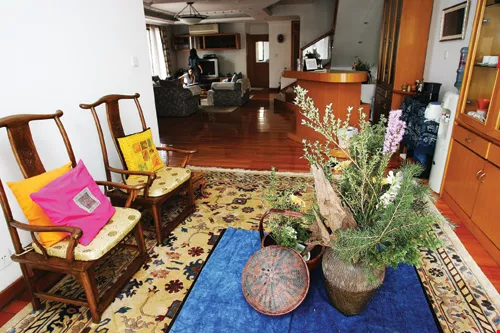
Flowers can transform a low-key and simple living environment. In addition to spending time with her husband and children, the flower-arrangement teacher Yang Yu-chuan has gone ahead and started her own "second spring" business.
The Taiwan girl
There are two kinds of Taiwan women in Shanghai, the "Taiwan girls" and the "Taiwan mothers." The words themselves tell us the former are either married or single but have come by themselves to Shanghai to make a living. The second group is composed of married women who have given up their work in Taiwan and followed their husbands across the strait to be good wives and mothers. With different goals in mind, the lives of these two groups in Shanghai are sharply divided.
"I set foot in Shanghai for the first time on November 24, 1999." Like many other Taiwan girls, chief editor of Shanghai Realty Information, Tiffany Tien, clearly remembers the day she "landed." "Seeing the Hyatt Regency and the Jinmao Tower in the Xiao Lujiazui district soaring up 70, 80 stories really gave me quite a jolt," she says. When she first arrived she was immediately drawn in by the great vitality of the city and felt Shanghai was a place of unlimited potential.
Born in 1976, Tien had followed her boss to Shanghai to work in public relations, market research and editing for eight years. Barely 30 years old, she is in charge of a whole department. Not only can she keep the young Shanghai editors in her department under control, she is cool and dignified in dealing with company inspectors sent by headquarters and not the least intimidated when she presents her report or matches them glass for glass in drinking toasts.
As for living in the city, Tien is already an "old Shanghai hand." In the way she carries herself, in her manner of speaking and expressing herself, she is just like a wily Shanghai girl.
"The boss says I haven't learned a thing--except how to be a Shanghai woman," says Tien with a laugh.
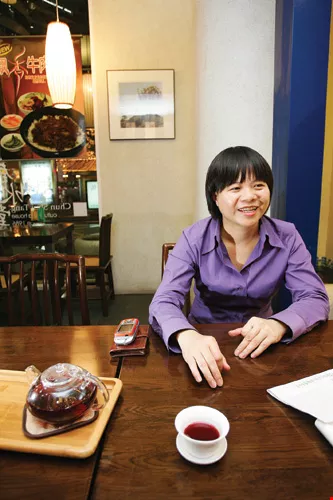
After three years in Shanghai Erica Liao, project manager for Chun Shui Tang, who is without personal entanglements, has already made longterm plans for staying in the city.
Looking for a stage
It is certainly not every Taiwan girl who has been able to integrate into life in Shanghai like Tien. Most girls are confronted with the duel challenge of life plus work.
Erica Liao, who is "still adjusting" and unwilling to reveal her real age, came to China two years ago to investigate the situation and in June, 2006, she opened up the first Chun Shui Tang teahouse.
With a closely cropped, professional hair style just down to her ears, sporting the title of "project manager" and leading her dozen or so employees, Liao still retains the reserved and gentle nature of a Taiwan woman. She doesn't hide the fact that she feels a deep sense of distance from China's most vibrant city. "The difference in mentality is the hardest thing for me to get used to," she says. The whole place is rife with a careless, "OK is good enough" attitude. From the decor to the food, nothing can really meet the level of her demands. "Clearly, it is all far from 'good enough' but they claim there is no difference." The lackadaisical approach she sees everywhere often drives Liao to distraction.
Although the environment is different and the challenges of work never cease, Taiwan girls for the most part see working in Shanghai as a rare opportunity to broaden their horizons and connect with international scene.
Tang Shun-ling, with ten years' seniority at Taiwan's Ling Yueh Software Company, was going through a tough period where everything had become routine and there were no more challenges. Just at this time her company was planning to expand its China business. In response to her vigorous prodding, the company sent her to set up an office in Shanghai in March, 2005 to develop the local industrial computerization business. "I thought I would like to take a look at the world market," says Tang, who is in her early 30s. "The boss put up the money for me to get some new experience... what's wrong with that picture?"
Taiwan girls who have come to China for a job find themselves in all lines of work--food, information and service industries. And the trend is growing stronger.
The first requirement for going overseas to work is the desire to do so. According to a May, 2006 survey of Taiwan women in the office done by 104 Job Bank and Business Today, 37.4% of these women would like to go to China to work, compared with 17.6% at the end of 2004, showing a clear and significant increase. Moreover, there was a direct correlation with educational achievement. The proportion of those with MA or PhD degrees wanting to "make it to the top" in China reached 55.3%.
Monica Chiu, marketing director for 104 Job Bank, explains this phenomenon by the fact that China has become a place where the world's elite have gathered. In addition to Taiwan businesses, firms from other countries also like to enlist talent from Hong Kong and Taiwan to make inroads in China. Thus the elites in the workplace are increasingly willing to go to China to take up the challenge and find a stage for their own personal development.
"The financial institutions coming here in the current wave, like the transnational banks CitiBank, Standard Chartered and HSBC, have a staff made up mostly of Taiwan women," says Tiffany Tien, who makes the observation that there are Taiwan men all over Shanghai, so that they are no longer considered remarkable, and still less does their being Taiwanese give them any inbuilt advantage. Taiwan women, on the other hand, are relatively few and the local people are curious about them and show them deference.
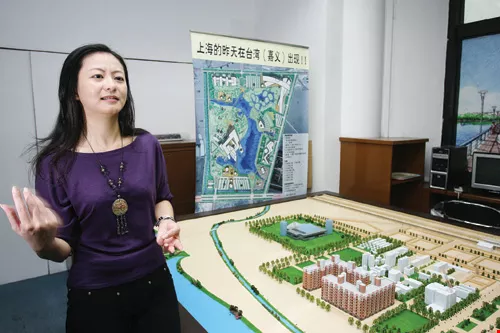
In the past Shanghai Realty Information was aimed at "outsiders" from Hong Kong, Macao and Taiwan. Recent transactions have been promoted in the opposite direction. There is no one better qualified to talk to local people about real estate sales in Chiayi, Taiwan than Tiffany Tien, who grew up there herself.
The trials of Taiwan mothers
Taiwan girls move to Shanghai for their work; Taiwan mothers move there for their family.
Five years ago Teng Yung-hsiang, the wife of a Taiwan businessman, decided to follow him and move the whole family over to Shanghai a year and a half after he had been assigned there. Because in the beginning the family had been split in two, husband and wife and children gradually were growing apart. "My husband would on rare occasions get some vacation time and return to Taiwan but he was not happy about anything the kids did. Feelings between father and children were getting increasingly distant," says Teng Yung-hsiang. This was sufficient reason to make her give up her high-paying salary as a manager in Taiwan and take her two children to Shanghai. Most Taiwan mothers who give up their jobs and arrive in Shanghai find it difficult to find work. There are not enough jobs for them at Taiwanese companies in Shanghai, but salaries at local enterprises are too low and so most Taiwan mothers stay at home. But there are some who start a business with their husbands and become capable assistants to them.
Macoto Tseng's husband, David Kao, was previously a senior manager of the Chiu Yung Han Japanese Institute stationed in Shanghai. Three years ago husband and wife decided to start their own business and began the EET International Language Center with branches in Pudong, Xujiahui and Hongqiao teaching mainly English and Japanese. Tseng, as a manager of the company, is responsible for developing the business end, which is a tough assignment. She points to the flagship school in World Plaza in Pudong. Three years ago there was only EET there, but now there are five language centers doing the same thing. One can imagine the fierce competition.
There are also cases where a Taiwan mother unexpectedly becomes the family breadwinner. Thirty-year-old husband and wife Huang Min-tsung and Lin Yu-hsuan took their two-year-old daughter with them and in October 2005 came to Shanghai looking to start a second business career. Unexpectedly the very next day all the money they had on them plus their credit cards were stolen by a pickpocket at the train station. The family, stranded, didn't even have the money to return to Taiwan. Fortunately, the family-style hotel they were staying at was being run by a Taiwanese, who quickly made them a loan of RMB5,000 (around NT$21,000) and solved this urgent crisis.
"Making a breakthrough in Taiwan is not easy," says Huang, who used to work as a real-estate agent and because of the slump in the real-estate market lost his job twice. Lin used to work as a nurse in a hospital and left her job to have their child. With the encouragement of older family members and the advice of a numerologist they came to Shanghai looking for opportunities.
"We came as a family wanting to avoid 'having problems on the home front,'" says Lin. After arriving in Shanghai husband and wife spent six months discussing and making an evaluation of just what they were going to do.
Three months ago Lin's Rejuvenation Beauty Salon opened up for business in the Gubei district, where Taiwanese gather. The salon focuses on Taiwan wives and offers chemical peeling to its customers.
Huang, in addition to thinking up ways to make the salon better known and to expand his wife's business, has as his current chief occupation becoming skilled in taking care of their child, boiling formula and changing diapers. Although only at it for a year, he is already the model of what essayist and cultural critic Lung Ying-tai has called the "Shanghai man."
Having settled in Shanghai the couple wanted also to integrate into local society, but have not been able to get in the door. "Perhaps it is the language gap. We have not been able to make any connections with Shanghainese," says Huang.
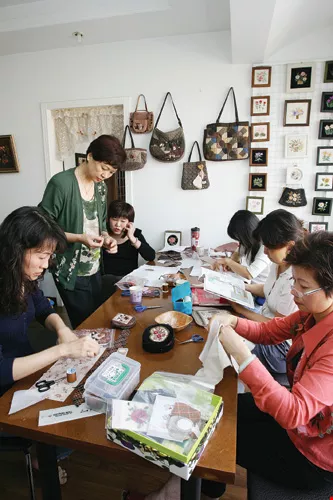
With an ayi doing the housework, Taiwan mothers go out and learn new skills. In the quilting classroom Taiwan mothers take needle and thread to do their close stitching and go right on chatting about their domestic affairs without let-up.
Lonely in retirement?
For families that have been separated on both sides of the strait because of the wife's work and the children's education, once the wife retires or the children become adults a wonderful opportunity for the couple to live together presents itself. This creates a different model for the "Taiwan mother."
Yu Chieh-ying's husband is a Taiwan manager in the electronics industry. After their eldest son graduated with a PhD from Tsinghua University in Beijing he remained in Shanghai for work. It wasn't until Yu retired in 2005 from Fubon Financial that she came to Shanghai to join her husband and left their second son in Taiwan to finish up his studies at Fu Jen Catholic University.
Shanghai is, in Yu's words, a "paradise of loneliness." Her homesickness is a trial for her that she cannot overcome. "I am on the phone almost the whole day long," she says. To "give herself peace of mind," she doesn't allow herself to think of Taiwan every day and not long ago bought some property in Pudong. The home there is quite far from downtown Shanghai and there is no metro. Each Thursday Yu Chieh-ying takes a taxi for RMB60 to Huaihai Road to study flower arranging. No wonder her son jokes that his family might as well be living in Touliu, Taiwan.
Taiwan mother Yang Yu-chuan's husband is a merchant in the timber business who has been operating in China for 20 years. Initially Yang and her family lived the life of separation on both sides of the strait, frequently making the trip back and forth between China and Taiwan. Two years ago their son did not do very well on the high-school entrance exam and so Yang took him and moved to Shanghai where he entered high school.
For over ten years husband and wife had spent little time together but now Yang is with her husband as much as possible. "My husband was always very appreciative of me and felt bad about our being separated," she says. Perhaps the saying is true that "a little separation is better than being newly married." Now the couple's feelings for each other are "growing sweeter and sweeter" as if "eating sugar cane from the tip to the root."
In fact Yang Yu-chuan's husband is very busy and regularly travels internationally staying only for short periods in Shanghai. So she has actively gotten involved in teaching Chinese flower arranging and creating her own "second spring" in the business world.
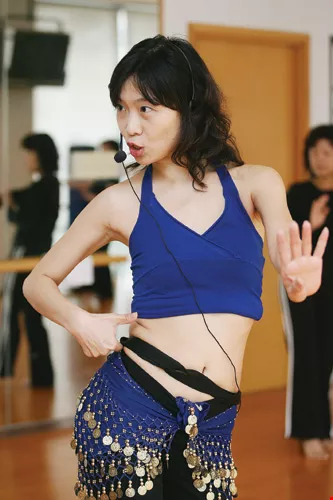
Belly dancing, which is popular in Taiwan, has taken China by storm. When Taiwan mothers have some leisure time on their hands, they exercise by dancing and meet new friends, broadening their social circle. The picture shows a belly dancing studio in the Xujiahui district in Shanghai.
Mistresses take a back seat?
"We came over together wanting to keep our family intact but of ten couples, five are not complete families," says Chang E (not her real name), the wife of a Taiwan businessman. "In Taiwan there is the pressure of the opinion of friends and relatives but here it's different. If you want to divorce, you just divorce... who knows anybody?"
In the past the phenomenon of Taiwan businessmen taking up a job in China and having a mistress was commonplace. Many people blamed this on the loneliness of living far from home. In recent years, to prevent mistresses from "usurping their throne," more and more Taiwan wives have opted to follow their husbands. Despite this, there are men who as before get "seasick" and keep a "little sweetie" (mistress).
Chang E says such cases in Shanghai are too numerous to count. She herself knows an example. Another Taiwan wife took her child back to Taiwan to celebrate the lunar new year and when she returned she discovered a clever, sharp-tongued Shanghai girl living in her home, complete with a kid. The Taiwan mother made accommodations and lived with the woman under the same roof but, unexpectedly, the one who moved out a year later was not the mistress but the Taiwan mother and her child.
"The woman still lives in Shanghai because she would lose face to return to Taiwan and would have no means of supporting herself." Chang E shakes her head and sighs.
After giving up her job and moving her whole family to Shanghai, this Taiwanese mother not only failed to maintain her marriage, but lost her own ability to make a living and ended up far from home and unable to go back. The other Taiwan mothers hear her story and are overcome with grief.

The whole family seeking its dreams in Shanghai, Huang Min-tsung and Lin Yu-hsuan face life with optimism, despite having been robbed of all their cash when they first arrived. They still plan to build their future career there.
The love of Taiwan snacks
Leaving aside the work pressures of Taiwan girls and the mistress worries that plague Taiwan mothers, there are many things in everyday life that take a lot of effort to get used to.
"Shanghainese call Taiwanese 'Taiwan yokels,'" says Erica Liao. There are a lot of nouveaux riches in Shanghai. They look down on people from the outside and subconsciously are prejudiced against Taiwanese.
"When I first came, I was angry every day," says Tiffany Tien, who also cannot take the brutal and pugnacious atmosphere of Shanghai. In the metro people are always cutting in front of you, getting a taxi you always have to fight with someone and when you are walking people are always bumping into you, but I've never heard 'I'm sorry' yet."
There is a big gap in the consumer area. You can eat your fill for RMB3 but you can't guarantee a good meal for RMB300. And the thing Taiwan girls and mothers alike cannot get out of their minds are the snack foods from home.
Generally speaking, the cost of living in Shanghai is less than that of Taiwan and things are actually are pretty easy.
Tiffany Tien, who knows her way around well, counts her chief leisure time activity as finding somewhere to have an hour's foot massage for RMB20 (instead of the usual RMB60); or she squirrels herself away at home watching DVDs (pirated DVDs are everywhere).
"As a result of the efforts of the last few years, the overall environment is in Shanghai is getting better and better," says Yang Yu-chuan, who in Taiwan had been a member of the Tzu Chi Foundation, and who regularly returns to Taiwan to get involved in Tzu Chi's charity projects and visit her daughter who is at university there. "Every time I go back, I get very sad," she says, unable to hide her disappointment in her homeland. "When facing the same problems in Taiwan people get tied up in knots, arguing incessantly, and it's hard to get anything done."
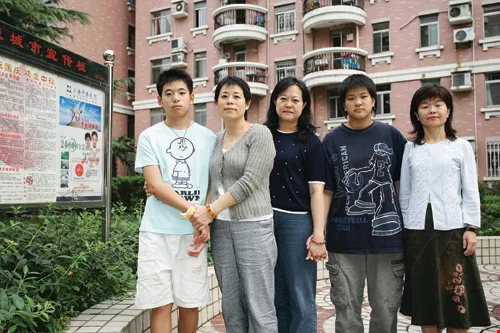
Taking the children to reside in a place far from home can create closeness between parents and children and between friends from the same place back home. From left to right: Teng Yung-hsiang and son, Huang Tzu-shan and daughter and Shih Shu-nu, taken at the Baohong apartments in the Minhang district.
Ayi runs the household
For Taiwan mothers the greatest advantage of the move to Shanghai is that they can afford to hire an ayi ("auntie"--a maid) to do the cleaning and cooking. At RMB800-1000 a month for four hours of work a day, almost every family has to get one.
Every Taiwan mother has her own "ayi bible." "Under no circumstances get an ayi from Fujian," says Shih Shu-nu. To guard against the "walls having ears" when Taiwanese want to keep something secret they speak in Minnan dialect. If they get an ayi from Fujian this trick doesn't work and they always have to be worried about "keeping secrets from spies."
Almost 40 years old, Chin Tsung-chi followed her record producer husband to Shanghai three and a half years ago and hired two ayi just to take care of the children. She says that lately they have been thinking about having their elderly parents come to Shanghai to live with them and hiring another ayi to look after them.
Taiwan businessmen and employees work from dawn till dusk. Taiwan mothers, blessed with an ayi who does all the housework, also have no spare time. Take Chang E, for example. On Mondays she does ballroom dancing, Tuesday it's flamenco lessons and Wednesday to Friday she gets together with the webmasters who run the "Taima Club" website for Taiwanese mothers. On Friday nights couples get together to play squash or go swimming. Each month there is a "web get-together" with her online friends. Chang E is busy to her heart's content all day long.
"Life for a Taiwan mother in Shanghai is so much more leisurely than in Taiwan!" says Chang E, who often compares her life to that of her younger sister living in Taiwan. "My younger sister has to both work and busy herself with taking care of the family, and nearly exhausts herself every day." By comparison, Chang E feels she is really a very fortunate woman.
Some Taiwan mothers come with nothing to do and like looking at real estate. "A few days ago some Taiwan mothers who speculate in real estate turned a big profit in Shangzhijiao," (a prime real estate area) says Shanghai Realty Information editor Tiffany Tien.
Most Taiwan girls and mothers are not good at making local friends and in their daily lives they associate with their own circle of Taiwan acquaintances. For this reason the "Taiwan Girls and Mothers Club" and the "Taima Club" have become their only channel for making friends. In the past two years, benefiting from the development of the Internet, the contact between Taiwan girls and mothers has become more convenient and close.
The "Taima Club" website created by Taiwan businessman Su Wu (not his real name) and wife Chang E has had more than 4,000 registered members over the past year or so and every day there are a good thousand Taiwan girls and mothers browsing the site and exchanging information. The Taiwan Girls and Mothers Blog, created in September 2005 by husband and wife David Kao and Macoto Tseng, already has over 700 registered users. It's interesting that the site also has a "flea market" where there are always people packing up to return home who put their things up for sale.
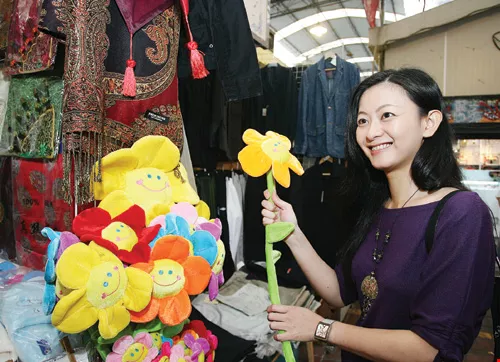
Living in Shanghai is very agreeable. Tiffany Tien, who knows every crook and cranny of the city, is extremely happy living here. The picture shows a market in the Jing'an district.
Road of no return
Whether it's separation or integration, Taiwan girls or Taiwan mothers, the move to Shanghai is a road of no return.
For most of the single Taiwan girls, although they do not have issues with a husband or children, their biggest abiding concern is the great event of their life--marriage. Most Taiwan girls, because of the gap in living standards and value systems, are not willing to take up a relationship with a local boy, and long-distance romances are a difficult matter.
"A little while ago I was thinking about asking for a transfer back to Taiwan," says Tiffany Tien. On the one hand she felt there was too much work pressure in Shanghai and in addition her boyfriend in Taiwan wanted her to come back. Nevertheless, after giving it some thought, she felt in Shanghai she had the responsibility of supervising a section and returning to Taiwan would not necessarily mean a similar spot would be open or there would be a comparable opportunity to get experience. The idea of resigning and returning home was once more rejected.
"I have already made plans to stay here a long time," says Chun Shui Tang manager Erica Liao. The market hinterland in Taiwan is too small--it limits development. There are more opportunities in Shanghai and without any entanglements she can go for broke. As for marriage, well, just let it happen naturally!
The choices Taiwan girls make echo very well the survey results of 104 Job Bank. For Taiwan women in the workplace, the priority of their heart's desire is: work, money, family. Self-realization and work values have long surpassed love and marriage. When Taiwan girls first arrive in Shanghai they all miss home and can hardly wait until they get some vacation, when they always immediately fly back to Taiwan in high spirits. But after a while this flight back home that wastes a whole day with its circuitous and bothersome routing makes them step back a bit and gradually they tend to prefer traveling and spending their vacations in China.
"Changing planes is really tiresome." Last year for the long Chinese national day vacation Liu and another Taiwan girl, Tang Shun-ling, decided to go together to Inner Mongolia. The five-day trip cost them RMB5,000, and they had a great time.
"For Taiwan mothers, Shanghai is also a road of no return," says Chang E. Taiwan mothers give up their jobs and bring their children to live and depend on their husbands--this is really an even bigger risk than that taken by the Taiwan girls. If the husband is the boss, his control over his own career will be fairly substantial, but if he is employed as a manager then there is a lot of agonizing about whether to go or stay.
Some Taiwanese managers bring their family to Shanghai, then not long after are reassigned back to Taiwan and wife and children have to return. There are also those who have been sent to Shanghai and are later assigned to Beijing or Chengdu while the mother stays in Shanghai with the children and the husband once again becomes a frequent flier. Even stranger, there are some men transferred back to Taiwan headquarters while the wife, used to the leisurely life in Shanghai, decides to stay there on her own with the children.
Taiwan girls and Taiwan mothers dream of Shanghai... can their beautiful dreams be realized? It all depends on the person. Overall, there are gains and there are losses, the bitter is mixed with the sweet, and it is hard to do justice to this complex situation in just a few words.
Shanghai Municipality:
Land area: 6,340.5 km2
Population: 13.055 million
Taiwanese residents: 500,000 (estimated)
Taiwanese-invested businesses: 1,600
Websites popular with Taiwanese:
TWGOCN: www.twgocn.com
Pudong Mamas' Park: www.pudongmama-tw.com
Taima Club: www.taimaclub.com
Taiwan Women's Blog: www.tmtsblog.com
1881 Taiwan Professional Women's Society: www.1881tpws.org
Gentlemen Club: www.gentlemenclub.cn
Schools for Taiwanese children:
Shanghai School for Children of Taiwan Businessmen
Shanghai High School, International Division
Shanghai Community International School
Jing'an School (Shanghai International Studies University)
SMIC Private School (Semiconductor Manufacturing Int'l Corp)

Shanghai's Bund is as eye-catchingly glamorous as Shanghai's women.


