Vagabonds under the Bridge-The Story of Sanying's "Urban Aborigines"
Sam Ju / photos Chuang Kung-ju / tr. by Jonathan Barnard
March 2009


On January 10, with nighttime tem- peratures falling to 10°C as the winter's first cold front moved in, a steady stream of traffic traversed Sanying Bridge, which connects Sanxia and Yingge in Taipei County. The brightly lit topside of the bridge contrasted sharply with the darkness underneath-until suddenly that space too was pierced by the headlights of several vehicles. When the cars had reached their destination, the drivers killed their engines and headlights, so that darkness once again prevailed.
With the lights off, it became clear that these were black government sedans. The rear passenger door of one of them opened, and a man in blue jeans and black shoes swung out his legs. He took only two steps before a crowd of people encircled him. One could hear the sound of people falling to their knees, and elderly voices imploring, "Mr. County Executive, please don't tear down our homes."
Their homes-all temporary structures without mains water or electricity-are in the Sanying Community of Amis Aborigines. The community's former buildings were torn down a year ago. At the entrance to the community hang various protest signs: "Fight Oppression," "We Want Our Homes," and "Resist to the End."
According to the cabinet-level Council of Indigenous Peoples (CIP), the term "urban Aborigine" refers to "an Aborigine who lives in an urban area." As of December 2008, there were 205,245 urban Aborigines in Taiwan, accounting for 40% of the island's Aboriginal population. That number far surpasses the 158,370 (33%) living in "mountain townships" or the 130,492 (26%) living in "lowland rural townships."
The Amis, the most populous of Taiwan's indigenous tribes, also make up the largest share of urban Aborigines. According to a 2006 CIP survey, nearly 50% of urban Aborigines are Amis. Northern Taiwan (including Taipei City) is the main base for Taiwan's urban Aborigines, home to more than 60% of them. About 47,000 are Amis-that's more than three times the figure for the next largest group, the Atayal.
Scholars believe lowland Aborigines-unlike those from mountain communities with reserved tribal lands-leave home to seek work and put down roots far away because they lack assets. The Amis exemplify this phenomenon.
The 50 or 60 families that lived in the Sanying Community during the height of its prosperity 10 or 20 years ago were almost all Amis from Hualien and Taitung, as are the 30-some households that remain there today. Over the years, some of the community's residents have settled down to live there for long periods, but many more moved away after short-term stays. Here today, gone tomorrow, they are regarded as a bit of a bureaucratic headache by the government.
Because of its location by the banks of the Dahan River, the Sanying Community was listed as an illegal construction in the river's floodplain. According to a CIP survey, in 2006 there were about 500 illegal structures inhabited by urban Aborigines, accounting for some 0.7% of their 71,604 total homes. These figures demonstrate that urban Aborigines who move under city bridges are a disadvantaged group within a disadvantaged group.
Although more than 90% of the nation's urban Aborigines are safely housed (60% in homes they own and 30% in rentals), the history of transiency among the residents of the Sanying Community encapsulates how Taiwanese Aborigines have, since the 1960s, been leaving their hometowns for lives of wandering. Where have they wandered to? Why are they wandering? And where are their true homes? Let's listen to their stories.
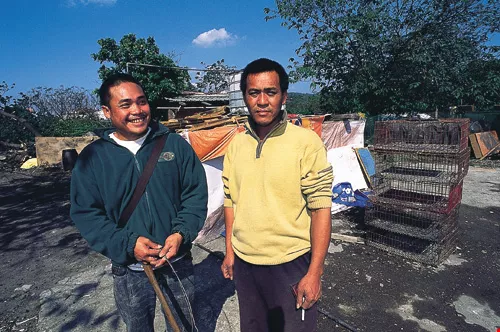
Kuras (right), an Amis who lives in Sanying, worked on fishing boats for more than 20 years. Kalo (left) is the son of a miner who was killed 25 years ago in the disaster at Taipei County's Haishan Coal Mine. Their stories echo the migrations and labors common among Taiwan's urban Aborigines for the last five decades.
Home at sea
Like many Amis of his generation, when Kuras-who is 44 and from Chenggong Harbor in Taitung County-left home to seek work, the first job he found was at sea. He got hired as a cook aboard a boat before he had even finished his first year of junior high school. He was the only Aborigine aboard the vessel, which fished off Taitung and Penghu. Despite his tender age, he would be at sea for three months at a time without any chance of seeing his family.
He first got his seaman's papers in 1980 at age 15. Several Amis from Chenggong who were about the same age decided to go north to find work in Keelung Harbor, but he chose to rely on his uncle's help to find work on a long-range fishing boat sailing out of Kaohsiung.
"To make a living, at least three out of five of the town's youths decided to go to big ports to look for work on boats," he says. "There wasn't any money to be made staying home."
Apart from his military service at age 20-22, most of his life before 35 was spent on boats or in foreign ports of call. Vessels he worked on docked in New Zealand, Argentina, South Africa, Singapore, Australia, Russia, India and elsewhere. He virtually went round the world.
According to a survey by the Fisheries Administration of the now disbanded Taiwan Provincial Government, in 1987 about 18,000 Aborigines worked on long-range fishing boats. They comprised about one-third of the 55,000 workers in the field. Aboriginal labor has truly served as a pillar of Taiwan's fishing industry.
"The boats had Han Chinese, Aborigines and Filipinos in about equal numbers," Kuras recalls.
Back before global fish stocks were depleted, long-range fishing boats reaped abundant hauls. Kuras would go to sea for six months to a year. Apart from NT$9000 in family allowance that was sent to his parents, he would also receive a share of the catch each time the boat returned to Taiwan to unload. Usually, that would be worth from NT$40,000 to NT$100,000. It may not have been a lot of money, but it represented a big chunk of the family's income.
Out at sea, he was largely responsible for tying ropes and hooking fish. He would grow panicked in rough weather, fearing he would never see his parents again. When he became especially homesick, he'd send his family a telegram.
"The last time I came back from working on a boat, I was surprised when I couldn't find my own home. I learned that the government had expropriated the land. My parents had nowhere else to go so they moved to Taipei and built a home for themselves by the Dahan River." As he speaks, Kuras is curled up against the cold in the corner of the temporary wooden structure where he has lived since his original home was razed. He is the very picture of the helplessness endured by those without proper homes.
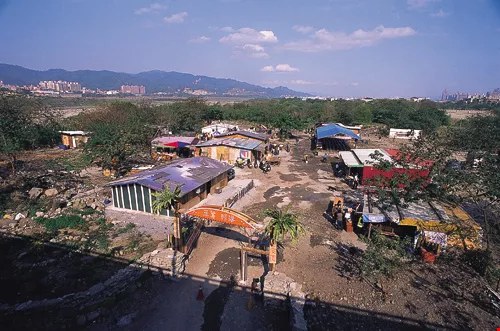
The Amis community located in the shadow of Taipei County's Sanying Bridge has been compared to a ghost community. When residents saw their community demolished last February for the seventh time in its 30-year history, they "voiced" their opposition by quickly rebuilding.
Home amid the coal dust
Coal mines were first opened in Taiwan back during the era of Dutch rule (1624-1662), and they continued producing through Japanese rule (1895-1945). Mining peaked from 1950 to 1970 after the ROC government had decamped to Taiwan. The industry didn't enter its twilight until the 1980s when the coal deposits began to be exhausted.
By comparing data, Yang Shifan, a doctoral candidate in sociology at National Chengchi University, discovered that in the 1980s, when coal mining had begun to decline in Taiwan, the percentage of Aborigines employed in mining was 18 times the percentage of non-Aborigines (8.08% vs. 0.45%). Although daily wages in mining had risen from NT$119 in 1970 to NT$706 in 1980, relatively few Han Chinese were willing to take employment as miners because of the dangerous nature of the work and the poor living conditions. Some 300-400 families would be crammed into the same workers' dormitory, with only about 100 square feet per household.
In 1980 the late Lin Jinpao, who conducted research into the Amis, published A Survey of the Urban Aborigines in Northern Taiwan. The book documents that half of the miners working the Haishan coal mine in Taipei County's Tucheng were Amis, and most of them were related to each other.
After the Sanying Community was razed last year, the villagers who remained and who wanted to fight for their residency rights elected Kacaw, a man in his 50s, as their leader. After leaving his family home in Taitung at 14, Kacaw first worked on boats in the Southern Pacific for six years. Then, via the introduction of a fellow Amis, he was hired to work in the Haishan mine in 1971.
He remembers descending into the mine at 5 a.m. and leaving work at 1:30 p.m. Because they didn't necessarily work every day, employment there didn't provide a stable income. When he wasn't mining, he would fish or plant vegetables under the Sanying Bridge, which was nearby. To make ends meet, Kacaw worked here and there as a carpenter and metal worker and returned to mining in 1984. In June of that year there was an explosion and cave-in in the mine. He was very fortunate not to be at work that day.
When Kalo was seven, his father and uncle died in the cave-in. Kalo's cousin, the 37-year-old Lin Xiuqin, remembers that about 150 Amis were working in the mine. The explosion occurred at noon, and elementary school students were notified to return home early. "Auntie told us, 'Daddy is gone,'" she recalls. "On television there were black-faced corpses everywhere being carried out."
Two years later, during her second semester of seventh grade, Lin and her family were forced to move out of the mine's housing. The company gave the reason that the government was expropriating the land for urban development.
Hong Xiujuan, who is in her early 30s, was not a witness to the mining disaster, but she recalls a line of white tombstones erected in the public cemetery in her hometown of Chenggong, Taitung. "Victim of the Haishan Mine Disaster" was all that was written on each. The cave-in is reported to have buried 74 people alive, more than half of whom (38) were Aborigines.
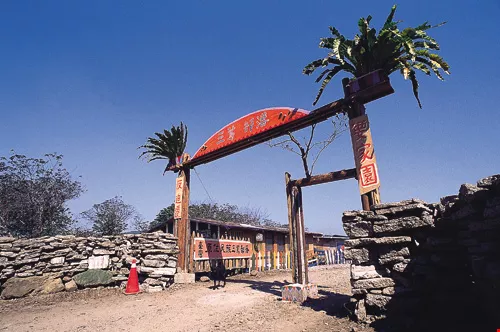
The Amis tribespeople decorated the rebuilt entrance to their community with bird's nest fern they'd grown themselves, and constructed new walls from the debris of their old ones. "Sanying has returned!" they declared.
Home is where the scaffolding is
Nano Mashaw, an Amis who had been a seaman for more than 30 years and is now chairman of the Keelung City Indigenous Peoples Commission, explains that when Aborigines leave their hometowns they move to where they can make money. "Urban development requires the building of high rises," he says. "Aborigines started moving into construction in the 1980s, and the trend accelerated with the decline of mining and long-range fishing in the 1990s."
According to CIP statistics, among urban Aborigines live outside Taipei and Kaohsiung Cities in 2007, at least 24% were employed as day laborers. The figures for Taipei and Kaohsiung were 19% and 16% respectively. In all, 20% of Aborigines worked as day laborers compared to only 3% of Han Chinese; their rate of employment in that kind of work was nearly seven times higher.
In Taipei City, many Aborigines have relatively well-paying service jobs (particularly as nursing assistants), but even Aborigines with steady jobs in Kaohsiung and elsewhere are still mostly employed in construction and manufacturing. These figures show that the "less urbanized" the locale, the more difficult the working conditions, and the fewer employment opportunities available.
For Kacaw, Kuras, Kalo and many fellow Amis at Sanying, day laboring at construction sites is one of their few employment options. The average daily wage for such work is about NT$800.
"But with the economy being so poor in recent years, there is less and less work around, and sometimes you can't even do five days a month." In the run-up to the Chinese New Year, they were worrying that contractors would run away with their wages and they wouldn't get a cent.
"Without any work or paychecks, at least we can plant crops along the river and don't have to pay rent. There's water, and we can eke out a living." As the skilled Aboriginal construction workers of Sanying, who have helped build countless luxury buildings, look out on their destroyed community, they can only hope that they will get an opportunity to build homes for themselves.
Just a dream?
"Why have so many people / Left the green fields / Floated on the boundless sea / Why have so many people / Surged into the dark mines / Forgetting their worries from the world outside."
In "Why," Paiwan poet Monaneng wants to know the answers to such questions as these: Can the Aborigines who have gone to the cities to make a living "return whence they came? Can they find the gate to their old hometowns?" Why do the tribesmen who have left the green fields have "neither joy nor hope?"
Entering the Sanying Community for the first time, Taipei County chief executive Chou Hsi-wei helped up those Aborigines who had knelt before him and admitted that razing the community, though legal, had demonstrated a lack of consideration for tribal culture. To the Aborigines living there, he guaranteed that the county government would hold off on tearing down the new structures until it finds another piece of land for community residents. He also promised that after they move into new homes, the land below the Sanying Bridge will be designated as an Aboriginal preserve, so that Aborigines can continue to raise flowers and vegetables there.
"We Aborigines have been tricked by the government many times. Who knows if they really will honor their promises this time?" Sanying's Aborigines have decided to continue their protests until they are actually given back the land on which they can realize their dream of making a home for themselves.


@List.jpg?w=522&h=410&mode=crop&format=webp&quality=80)
