The Will to Survive:Photographer and Father Diago Chiu Battles Cancer
Chang Chiung-fang / photos courtesy of Diago Chiu / tr. by Josh Aguiar
August 2008


Come fly away with me, / To the far ends of the earth, / Where we can live spirited and free, Far from troubles and pain. / Let's go to that far-off place, / To see the world isn't so desolate, / Let's catch a glimpse of that far-off place, / And know the world is full of light.
Diago Chiu is lying in a hospital bed listening to music after undergoing an operation to remove cancer from his liver. He's listening to a song that songwriter Lee Sau-chuen wrote for his son, and as his thoughts turn to his own son whom he and his wife have entrusted to the care of a friend in Ilan during his hospitalization, he cannot hold back his tears.
Now aged 44, Chiu's career as a photographer spans nearly 20 years, during which time he has worked for Taiwan Panorama, Global Views Monthly, and Common Health magazines. Even when illness struck he was loath to set aside his beloved work; it was only as the disease persisted, with each relapse more ferocious than the last, that he finally quit working in October of last year to devote his energy to combating the disease.
Although Chiu is battling cancer, it is hard to tell from his healthy, energetic appearance and sanguine demeanor. He left behind the frenetic schedule of magazine photographer in favor of a new, more staid line of work as a photography teacher at Ilan Community University. Following in the footsteps of last year's exhibition "Traversing Time: The Tanshui Railway Line," he plans to put on an exhibition in August commemorating the one-year anniversary of the passing of French pantomime artist Marcel Marceau. Called "Mourning a Silent Artist: Marcel Marceau Retrospective Exhibition," it will pay homage to the great performer that Chiu himself had the unexpected privilege of meeting 20 years ago.
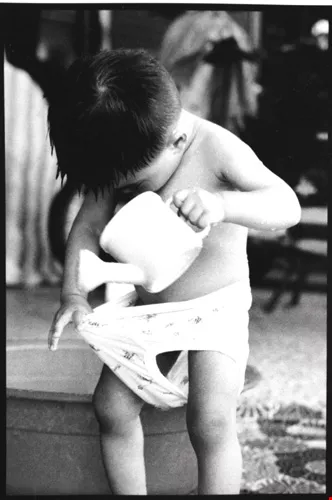
Chiu has snapped photos of some of nature's most prodigious sights, but his son's innocent smile remains the purest, most beautiful thing he's seen.
Abundant blessings
At work, Diago Chiu is an excellent photographer, but what kind of man is he when the camera is stowed away for the day? At home, what kind of husband and father is he?
For many years, Chiu worked in Taipei away from his family in Ilan, constantly going back and forth between the two places. He reckons that sometimes being a father felt like a part-time holiday job, and his son, now in the fifth grade, had long accustomed himself to seeing his dad come and go.
Chiu and his wife both appreciated Ilan's scenery and fresh air, not to mention the fact that his wife's media job was based there, so they decided that it was just the place to put down roots. They would live apart as Chiu continued to work in Taipei until the opening of the Hsuehshan Tunnel, which would allow him to commute daily between Taipei and Ilan.
The Chiu family lived according to this plan for a number of years, their son growing up with each passing day. Then, the Hsuehshan Tunnel was finally opened to traffic at the beginning of last year, but Chiu became ill and took leave of his work in Taipei to return to Ilan, ending the need to travel back and forth.
Chiu wasn't the kind of father who was home every night for dinner and to play with his child, but no one could doubt that his love for his son was anything short of profound.
He remembers clearly how affected he was when he was sent on assignment to Latin America for three weeks when his son was all but six months old, how acutely he felt the distance and how he, who was always so composed and carefree, would weep when thinking of his son. He returned from his roadwork with luggage crammed full of toys and clothes that he had picked up along the way to give to his little son.
When his son was three years old, he caught aseptic meningitis. To this day, the memory of the terrifying ordeal is as fresh as ever. It was a Sunday evening-fortunately, for Chiu was home for the weekend break-when he heard his son crying incessantly. When he discovered the little one was running a fever, he rushed him over to see a doctor. To his dismay, the doctors at the small hospital saw the boy's pupils were dilated, and they had him transferred to a larger hospital where he was given the shots that saved his life, but not without scaring poor Chiu half to death before the whole affair had ended.
Chiu's wife was always the stricter parent of the two, whereas Chiu himself was the jovial, tender dad. "When my son was little, his butt looked just like a little brown sugar mantou steamed bun, just waiting to be eaten up!" laughs Chiu. On more than one occasion, Chiu found that he just couldn't resist giving the infant's buns a little nip.
On holidays, he would take his son everywhere in his jeep on photography excursions. And on one of these trips-to visit rape flower fields in Hualien-Chiu, a man who has photographed some of nature's most prodigious sights as well as the creme-de-la-creme of society, experienced a moment of beauty purer than anything before. Seeing his three-year-old son asleep in the jeep, the sunlight gently illuminating his adorable face made him think: "Happiness is really such a simple thing, after all!"
Work aside, Chiu has taken more pictures of his son than any other subject. The pictures document his rapid growth from skinny little kid to the thoughtful, independent youth he is today. Over the years, the toys he has given to his son have changed from trains and airplanes to Polaroid and digital cameras.
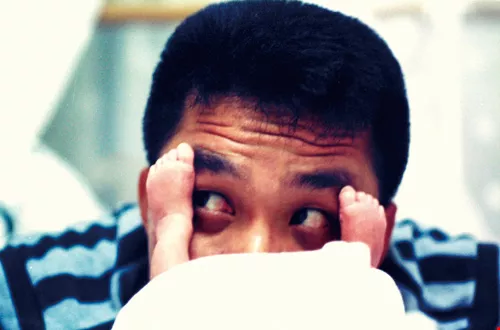
These little hands and feet belie their tremendous power! When a man becomes a father, his heart softens, but at the same time, his determination increases.
Learning to fight
"I think God must have been playing a big joke on me," quips Chiu. In June of 2006, while on assignment for the cover story of Common Health Magazine, "Beating Cancer," he and a journalist visited more than ten cancer patients-how ironic that their suffering would be his just one month later. Always physically active, Chiu's diagnosis was only made after he experienced acute abdominal pain while hula hooping: a 13-centimeter-long tumor had burst under pressure. Finding out that he, like so many other hepatitis B carriers before him, had stage III liver cancer shocked him into disbelief-how could this be happening to him?
Before the discovery of the tumor, Chiu had been struggling with depression and panic attacks for six months. He experienced heart palpitations, agitation, twitching eyelids, loss of sleep and appetite, and a general malaise of the soul. His thoughts were consistently dark and morbid, and on one occasion he contemplated leaving his life behind-via the eleventh-story window of his office. "I was restless all the time; it felt like my blood had been sucked dry. I would cry like a lunatic or just sit gazing off into space," he recalls. Recognizing the need for help, he visited a psychiatrist and began taking medication. Little did he know that something lurked just out of sight that would make his psychiatric troubles pale in comparison.
Chiu admits to the fear he felt when coming face to face with such a dreaded illness. In the beginning, he kept his terror private, crying furtively in the hospital bathroom. But after receiving encouragement from doctors, family, and friends, Chiu quickly managed to replace his negativity with optimism and courage. He even brought his camera to surgery to record his experience battling cancer, eventually posting the pictures on his blog to encourage other sick people.
Though Chiu's bravery earned him recognition in the first annual Cancer Fighter Awards from the Formosa Cancer Foundation, his illness continued its relentless onslaught.
Since Chiu's tumor had burst before it was identified, cancer cells had spread throughout his body. The first surgery removed two thirds of his liver and with it the 13-centimeter tumor, but the cancer reappeared just ten months later, eventually spreading to his lungs. To date, Chiu has undergone five surgeries, but a post-surgery checkup in May of this year disclosed over 30 tumors in the lungs, causing his doctors to eschew surgery in favor of chemotherapy. One Nexavar pill costs NT$1600, and the four that he is required to take every day produce a melange of unpleasant side effects: rashes, blisters on the palms of his hands and soles of his feet, burning in his throat and esophagus, stabbing pains and tingling in his hands and feet, and pain so severe that he can hardly move. Does he ever think of stopping treatment? "Not on your life," says Chiu. As long as there remains a sliver of hope, you won't hear him talk lightly of giving up.
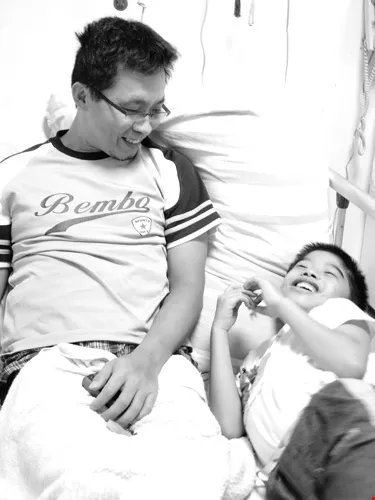
Even when in surgery, Chiu thinks only of leaving precious memories for his son, so that in days to come, thinking of his father will bring him joy, not sorrow.
Daddy's sick...
At ten years old, Chiu's son isn't a small child, but he isn't exactly ready to move out either. Though Chiu hasn't told his son that he has cancer, his son knows his father is sick, that he's had surgery, and that the surgery is painful. At times his son worries so much that he has trouble sleeping at night.
However, just as he maintains a jovial appearance for his friends, Chiu makes sure to be strong in front of his son. "I only let him visit me at NTU Hospital when I'm pretty much recovered," he says.
Chiu is able to face both his illness and his son with courage and resolve; he has all but given up on a tenuous marriage marred by bad communication.
"As far as my wife is concerned, perhaps I've always been an absentee father and husband," says Chiu, his steely optimism giving way to remorseful sighs. All the time spent apart led to constant quarrels over the vagaries of family life that ate away at the marriage until it existed in name alone.
"I don't know how long I have left, but I do know that I don't want to spend whatever it is wrapped up in unhappy circumstances. I want to put it all aside and focus on trying to achieve unfulfilled dreams. I want to have some time that is really my own." Though his wife has stood by him in his illness, Chiu clearly would like to be done with his marriage-he doesn't want to compromise anymore. But he does worry that marital disharmony may have caused irreparable harm to his son.
"Children have their own destinies, so it makes no sense to worry too much about what will happen," says Chiu. The ebb and flow of destiny ultimately puts an end to all life and all relationships. All he wants to do now is enjoy his days, and leave behind beautiful memories for his son.
If that day arrives, how will he bid his son farewell? How does he hope his son will remember him? Chiu responds curtly: "As far as I'm concerned, my time is pretty much spent. So what's the use of thinking about all that?"
"I'm going to leave my camera and all of my pictures to my son," he says. Though in sheer dollar value, that may not amount to much, for a father who is an avid photographer, they are the priceless artifacts of a lifetime.
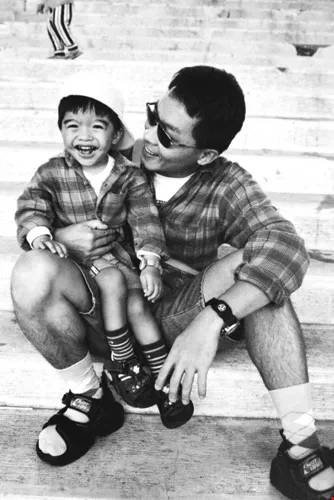
Though he may not be home every day, Chiu is a great "weekend dad" who loves to spend quality time horsing around with his son.
Photographing to the end
"I know that if I give up, I'll be beaten down before long," he says. He's not ready to give up fighting and be defeated-he's got too many places to visit, too many photography exhibits to put on. "I know by now that in this illusory world, I feel most alive in that infinitesimal moment when the camera shutter clicks," writes Chiu of his love of his art in a blog post called "The Photography Nut's Soliloquy."
Hsi Mu-jung's poem "Aria" is a favorite of his:
Whether I'm crying or laughing, / When we part, / I will feel blessed, / To have shared the same stage. / Life is a performance, / A comedy or tragedy I don't know, / When the lights come at the end, / I will play the most arduous scene, / Please listen with bated breath, / And give me full applause...
"However long my life is, that's how much photography I'll leave behind." As a fighter against cancer, Chiu is worthy of the challenge; as a photographer he is exemplary; and though not without regrets as a father, he hopes he has no cause to be ashamed.


