The Fashionable World of Sophie Hong
Chang Chiung-fang / photos Chuang Kung-ju / tr. by Phil Newell
May 2013


There can be no more ambitious dream for a clothing designer than to establish oneself in the world’s fashion capital, Paris. For Sophie Hong, that dream has come true.
In 2010, she opened her flagship boutique there, selling her own Sophie Hong label, on the rue de Richelieu, just next to the Palais Royal. In that corridor of elaborate and ornate 17th-century style, she is evoking the subdued, gossamer elegance of traditional clothing from the Orient in general and China in particular.
Sophie Hong’s success in the world of haute couture is a source of pride and inspiration to all Taiwanese. Speaking the language of fashion, one that transcends international boundaries, she has become a bridge linking Taiwan and France. In 2012, she was honored with the title “Chevalier de l’Ordre national du Mérite” in recognition of her years of dedicated effort and contributions.
Let’s set the stage (albeit a stage-that-is-not-a-stage): Late September 2012, Paris. A brisk autumn breeze, cloudy skies. Place Colette, just near the Palais Royal and the Musée du Louvre. The toney Café Bar Le Nemours. Twenty-six women and men of various shapes, sizes, ages, and skin tones.
Wearing Sophie Hong outfits made with her signature fabric “gambiered silk” and shod in geta (Japanese wooden clogs), the models—some holding umbrellas, others with coffee or magazine in hand—stroll or walk dogs in the vague early morning light, now and then crossing paths, stopping to pose, or embracing and exchanging kisses.
The clothes that these men and women are modeling—jackets with a geometrical, architectural quality; dresses, skirts, and pants with airy, flowing lines—are foretelling the future in the sense that they are a preview of the fashions for spring and summer of 2013. But as the models’ geta clack against the cobblestones, we also hear the echoes of history…. The melding of new and old, the traditional with the innovative, is at the core of the Sophie Hong aesthetic, and it clearly fascinates many passers-by.
Hong, who goes to Paris about once every two months, explains her choice of locale by saying that “daily life is a stage.” Nonetheless, this seemingly casual display of Hong’s attire was in fact meticulously designed by Juliette Deschamps, a highly accomplished stage director, and it opened only after three days spent on casting and rehearsals. Enveloped by the rich fragrance of coffee and the graceful sounds of a viola, models glide into view as if by happenstance, coming from all directions. The exposition is at once a deconstruction of and innovation on the traditional fashion show, a naturalistic but artistic scene unfolding on a fashionable Paris street.
One reason why Sophie Hong went to such lengths to unveil her clothing line was of course to raise the visibility and name recognition of her brand, now that she has a shop in the City of Lights where people can actually buy her works. She also wanted to add something unusual and exotic to the annual Paris Fashion Week.
But why did she set up a shop in Paris in the first place? And why choose the Palais Royal area? “Because here the whole world will see you!” is her reply. Although the boutique is tiny at only 11 square meters, it is the neighborhood that is the draw. Indeed, just to be able to get in here is an honor that you can’t just buy with money.
The Palais Royal, located near the north wing of the Musée du Louvre, was built in the 17th century by Cardinal Richelieu. The project took ten years to complete, and the effect is of power and beauty beyond words. For centuries it was a place where aristocrats, artists, and society ladies hob-nobbed. Today it houses offices of the Conseil d’Etat (the country’s highest legal authority) and the Ministry of Culture. The rue de Richelieu, just nearby, is saturated in art and culture, and is one of the most fashionable streets in contemporary Paris. Because this is an important historic district, anyone wishing to open a shop here must undergo a rigorous review process to get approval from the Ministry of Culture.
Since opening her boutique here more than two years ago, Hong has added her own definite color to her surroundings. “Just walking around in geta, maybe stopping in a café for a coffee, I’m a ‘scenic attraction’ all by myself!” she says with a laugh.
Sophie Hong was born in Hsinchu in 1956. She was a pretty girl even as a small child, and grew into a beautiful woman. The professional skills she acquired later allowed her to further enhance her natural gifts. With a doll-like haircut and refined features, set off by the high-collared apparel she favors, she impresses one as full of life, luminous, and fresh, much like the clothes she designs.
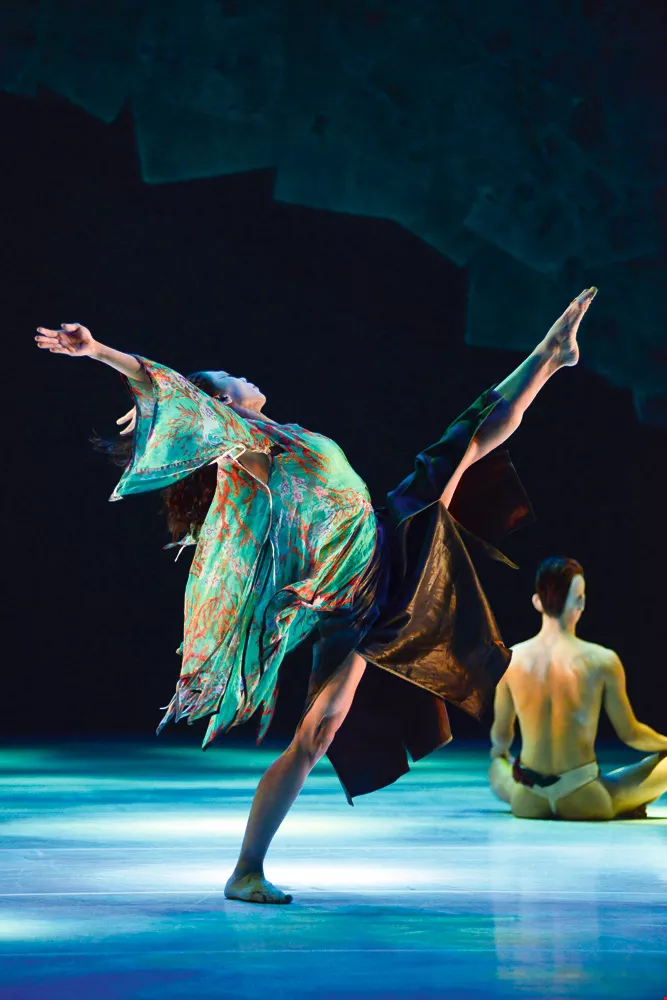
Sophie Hong has seemingly unlimited vitality and creativity, and is often asked to apply her talents to stage performances. For example, she did the costumes for Lament of the Exile, choreographed by National Taipei University of the Arts associate professor Zhang Xiao-xiong.
She happened to be born on the seventh day of the seventh month of the lunar calendar, which is Chinese “Valentine’s Day,” based on a love story whose heroine is a “weaving girl.” That’s why Hong jokes that she was destined from birth to be a clothier. Nonetheless, it would more accurate to say that Hong is an “artist” rather than merely an apparel designer, as she is skilled not only at high fashion but also at drawing, painting, sculpture, jewelry, and metalwork. In her combined workshop and storefront in the Yongkang commercial area of Taipei, you will find, stacked in a corner, dozens of paintings that she has done on different textile materials. In contrast to these, other objects—chairs, a coat-hanger, a hat-rack made of sculpted wire, or a thick and weighty door handle made of curved rebar—convey a steely stylishness.
After graduating from the Department of Fashion Design at Shih Chien College of Home Economics (now Shih Chien University), Hong founded her own company, striking out on her career in apparel design.
Hong says that designing clothes starts with “need.” “I need to wear clothes, and so do my family and friends. I just apply what I’ve learned.”
In her view, the way Taiwanese dress is entirely derivative, so they need a design form that can express local cultural features. Over the years Taiwanese have simply copied from neighboring Japan, or, more recently, from European designs from seasons gone by. But they have never had clothing that is their very own. In view of this, Sophie Hong has searched for themes from daily life, borrowing from Aboriginal weaving and the cultures of Taiwan’s Southern Fujianese and Hakka Han Chinese ethnic groups. She has digested all these influences, melded them together and upgraded them, and they have been expressed via the clothing she has designed.
The geta that Hong wears, and that she has her models wear during shows, are a perfect example of apparel drawn from life. “In the old days in Taiwan, people wore these in the fish markets because the floors were so slimy.” The reason she wears them today is simplicity itself: “High heels are too tiring, but you can still get that same ‘uplift’ effect from geta.”
Sophie Hong’s motto is, “The best designs are made for the right person on the right occasion.”
“A lot of people ask me, ‘What’s in style right now?’ But I always answer: ‘Everything!’” When it comes to good taste, she explains, there’s no need to change everything around every year. Just look at Chanel—they’ve always used the diamond pattern stitching and four pockets. Consumers don’t always need to be chasing after the latest craze, they need to simply choose what’s right for themselves as individuals.
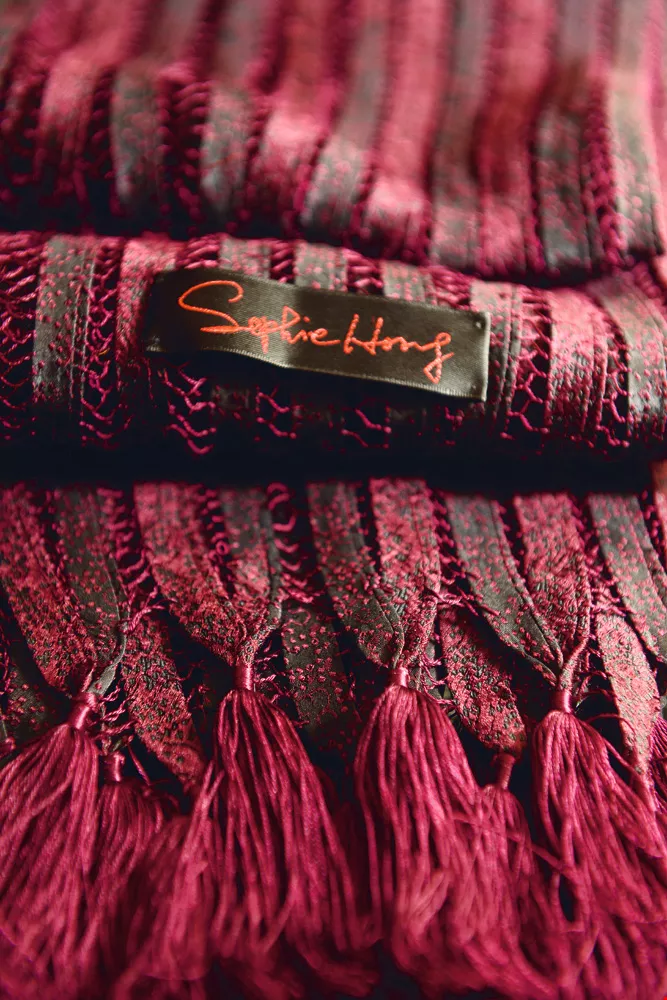
Sophie Hong attire is highly distinguishable from competitors. For one thing she has taken gambiered silk to a new level, refining and exploiting it to the maximum of its potential. For another, the loose-fitting and simple silhouettes of her clothes are instantly recognizable characteristics.
“Simplicity,” says Hong, “is at the core of my thinking about design; it’s a principle that has never changed and never will.” Apparel is a work of art that is meant to be used in real life, which means that in addition to having visual appeal it must be comfortable and easy to clean.
So what features are typical of her work? For one thing, she favors designs with high collars, because “when the collar is upright, the face becomes more prominent.” Also, she uses the “draping” tailoring technique to shape a woman’s shoulders, back, waist, and hips into an elegant line.
Commentators have described her clothes as having an architectural quality about them. They create a sense of flow as of passing through an extended space. Also, the writer Lin Qingxuan has said in an essay that whereas Oriental art emphasizes lines, Occidental art emphasizes depth and space, and that “Sophie Hong’s greatest achievement has been in employing a Western art sensibility to express Asian fashion traditions.”
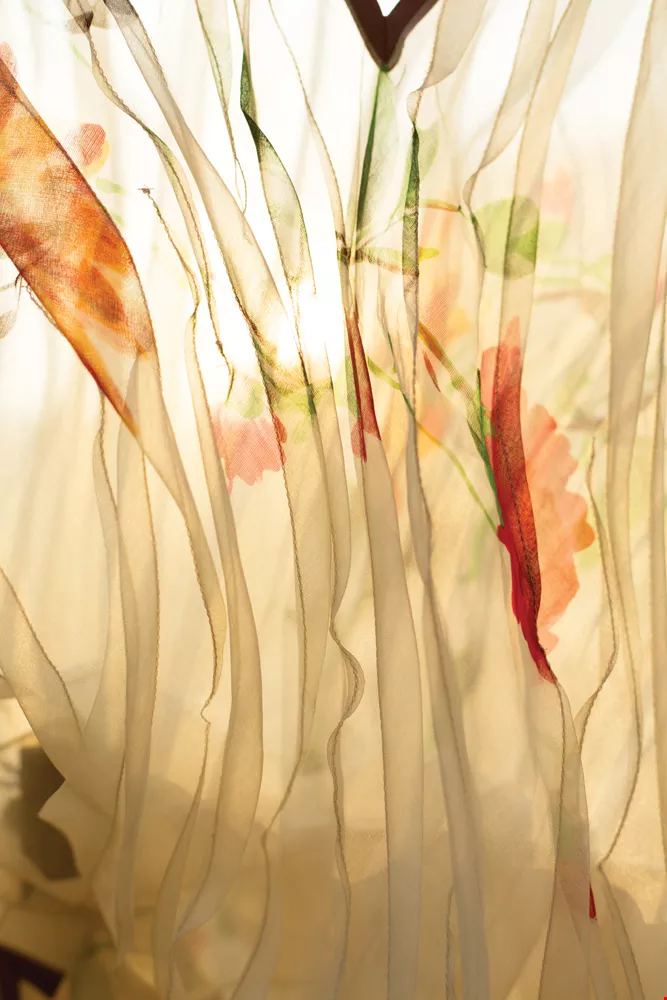
Even those people who don’t understand all this talk about lines and space can unfailingly sense the meticulous craftsmanship. Especially impressive is that every piece is reversible, i.e. it can be worn either side out, and people can put on the different layers in any way they like, making for kaleidoscopic possibilities.
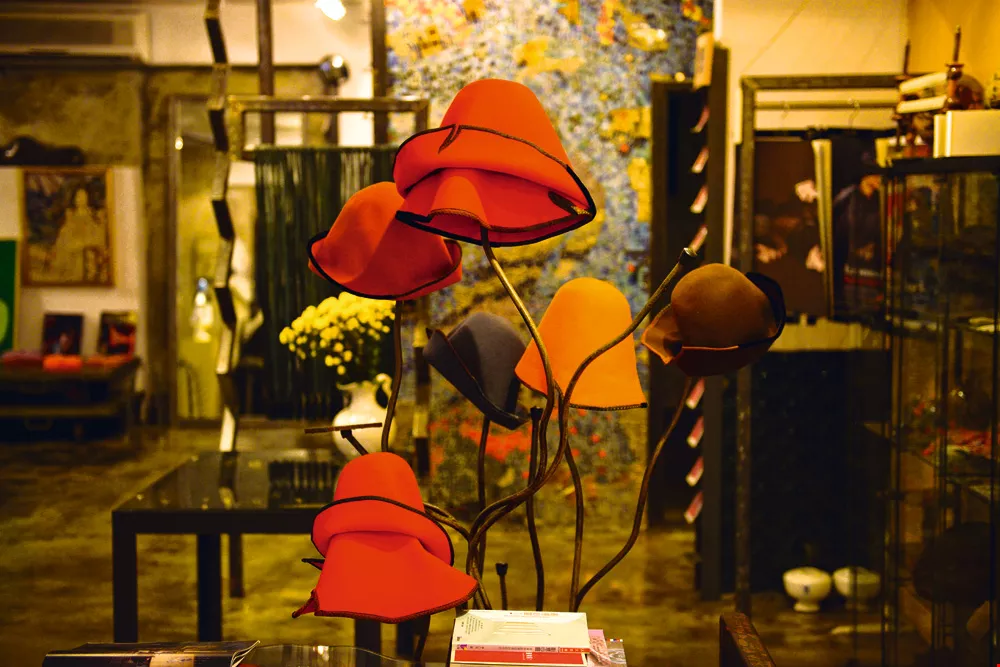
Sophie Hong’s shop in the Yongkang commercial area is far more than just a boutique for her trademark gambiered-silk fashions. You will also find many objets d’art including carved hand puppets, paintings, sculptures, and mosaics.
The year 1990 was a watershed for Sophie Hong in terms of both her personal life and her craft. It was in that year that she met Françoise Zylberberg, a professor of French at National Taiwan University and also founder of the Taipei bookshop Librairie Le Pigeonnier. This was Hong’s first “French connection,” a gateway to entirely new vistas for her. It was also in that year that she began to explore the possibilities of gambiered silk.
Gambiered silk (also known as gambiered Cantonese gauze, mud silk, or lacquered silk) is made with a traditional weaving technique—one that was nearly lost—that originated on the coast of southeastern China. The fabric is unique in combining leather-like durability with feathery softness. The first step in the complex process is to spread white-colored crude silk cloth on the grass and then pour liquid dye (traditionally made from yam juice) over it. The cloth is then sun-dried. This process is repeated again and again until the color is fixed. Finally mud dredged from a river bottom is rubbed over the cloth. (This is why the fabric is sometimes called “mud silk.”)
Hong’s resurrection of this craft started very simply, when she happened to see pictures in ancient texts of people wearing clothing cut from a material that impressed her with its glossiness and firmness. She became curious and searched everywhere for information about it until she finally discovered that it was gambiered silk. She then worked out a method to soften this traditional fabric, and also endowed it with a greater variety of colors. Her new and improved variety is known as “Sophie’s silk” or “Hong silk.”
Hong emphasizes that every step in the process must be done by hand. “If you use machines to apply the colors or the clay, the material won’t have a structured feel.” Sometimes she seeks multicolored materials, so she walks along a 50-meter swath of raw white silk and splashes on colored dyes from a bucket until she gets just the effect she wants. To apply the river clay, she uses a broom made of horse-tail hair and applies the mud to the material as if she were writing calligraphy.
While Sophie Hong did not invent gambiered silk, she certainly deserves all the credit for its revitalization. It is only right that today “gambiered silk apparel” is essentially a synonym for her work.
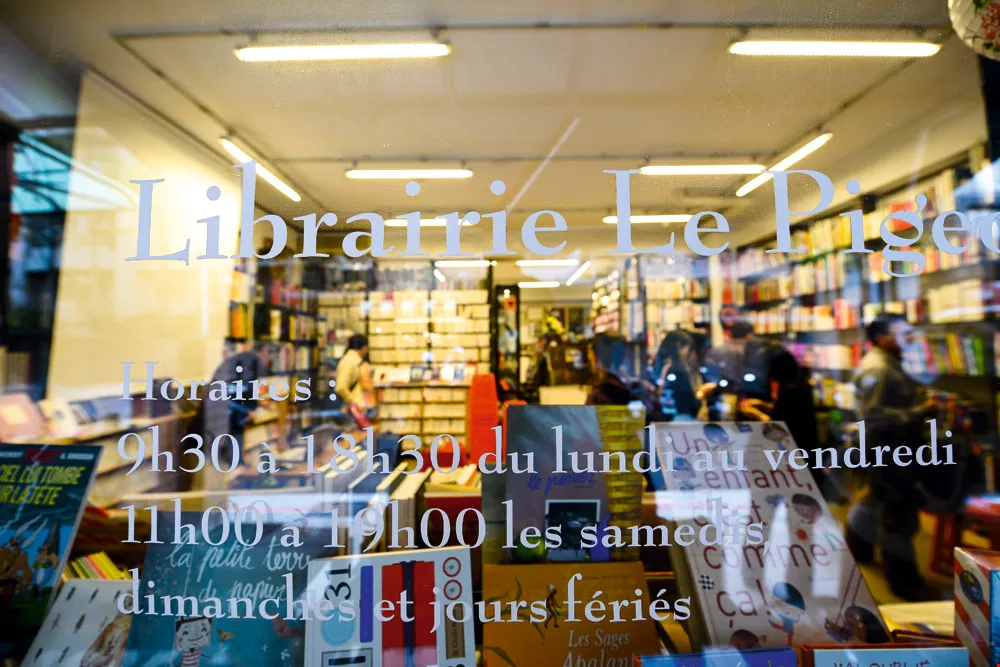
Hong owns the Librairie Le Pigeonnier bookstore, which she inherited from her late close friend Françoise Zylberberg, a professor of French at National Taiwan University, and she has been honored by the French government with the title Chevalier (equivalent to a British knighthood). She has been and will continue to be a bridge for interchange and communication between France and Taiwan.
Because Hong’s fashions are made entirely by hand with high-quality materials and meticulous workmanship, they don’t come cheap. Individual pieces go for at least US$1000 each. But there is no question about the enduring value of her products. In fact, some have been acquired for the permanent collection of the Paris fashion museum the Musée Galliera (Musée de la Mode), and she has a number of loyal “fans.”
For example, Christophe Gigaudaut, head of the Culture, Education, and Science Section of the French Office in Taipei—who Sophie praises as a great enthusiast for the culture of Taiwan—has written a brief but effusive essay that poetically evokes Hong’s aesthetic: inviting textures that “glide away and free themselves from our fingers”; material “with the smoothness of wood polished by the sun”; pockets “as ingenious as they are discreet”….
The creations of Sophie Hong have also graced many a celebrity figure at important events. Just to cite a few examples: Mainland Chinese movie star Zhang Ziyi wore outfits designed by Hong when she went to Japan to promote the Ang Lee film Crouching Tiger, Hidden Dragon, while her compatriot actress Gong Li did likewise when she attended the Venice Film Festival. And on the night producer Pai Hsien-yung closed an eight-year, 200-show run of The Peony Pavilion, he appeared on stage wearing a gambiered silk jacket that Hong specially designed for him.
Hong’s seemingly inexhaustible creativity and passion has also been displayed in attire she has designed for groups, plays, and even puppet theater.
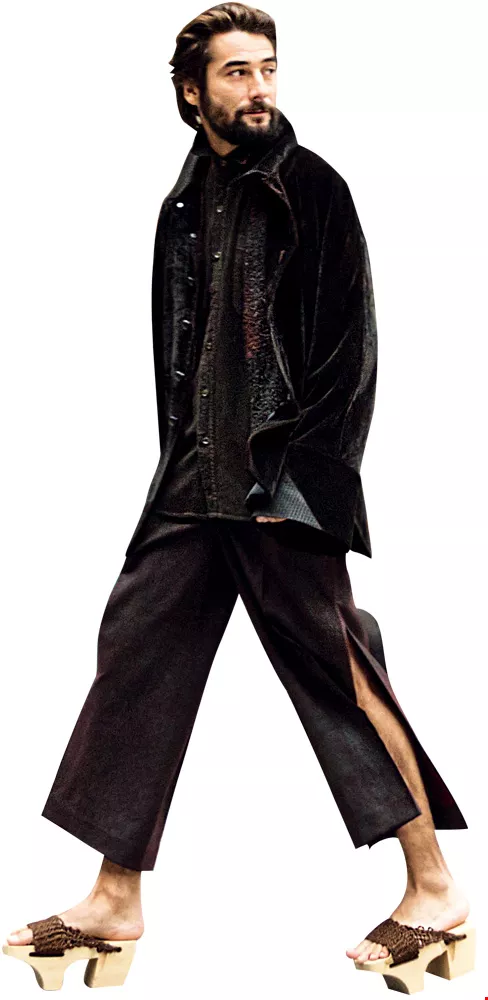
Last September Hong held a street-life fashion show in the historic Place Colette as part of Paris Fashion Week. In an atmosphere of elegant music and fragrant coffee, models paraded Spring and Summer 2013 fashions as if they just happened to be passing by.
Sophie Hong has no desire to mass-produce her designs for the general public. Unlike most designers and name brands, which set up counters and display areas in major department stores, Sophie Hong treats the clothes she designs as “works of art.” She has never coveted locations at the center of consumer bustle, but has always preferred quiet lanes off the beaten track.
But the fact remains that Hong, like all fashion designers in Taiwan, has never stopped pondering the question, “How can I connect to the world and market my products?” While creative work is something that can be done by relying on your own ideas and hard work, it is not so easy to master sales channels.
Since 1996 Sophie Hong has continually participated in trade shows including Prêt-à-Porter Paris, the New York Fashion Coterie Spring/Summer Collection, and JFW International Fashion Fair Tokyo. The opening of her own boutique in Paris in 2010 is of course her boldest advance yet onto the world stage. As she well understands, “The only way people will get to know you is if you interact with them.”
Although Sophie Hong has spent considerable time in Tokyo, New York, and Paris, she has never migrated away from the land where it all began—Taiwan.
The little boutique in the Yongkang commercial area is like an oasis of quiet surrounded by a sea of busy-ness, and she has now been there for more than two decades. And after the death of her friend Françoise Zylberberg, Hong inherited the Le Pigeonnier bookshop. While this may seem like she has crossed over into a completely different realm from fashion, she sees it as simply a kind of internal reorganization. Hong reveals that she is now planning to open a store in Taichung which will be a combination fashion boutique and bookshop, because communication and exchange is the road she is now on, and the one she will always travel in the future.
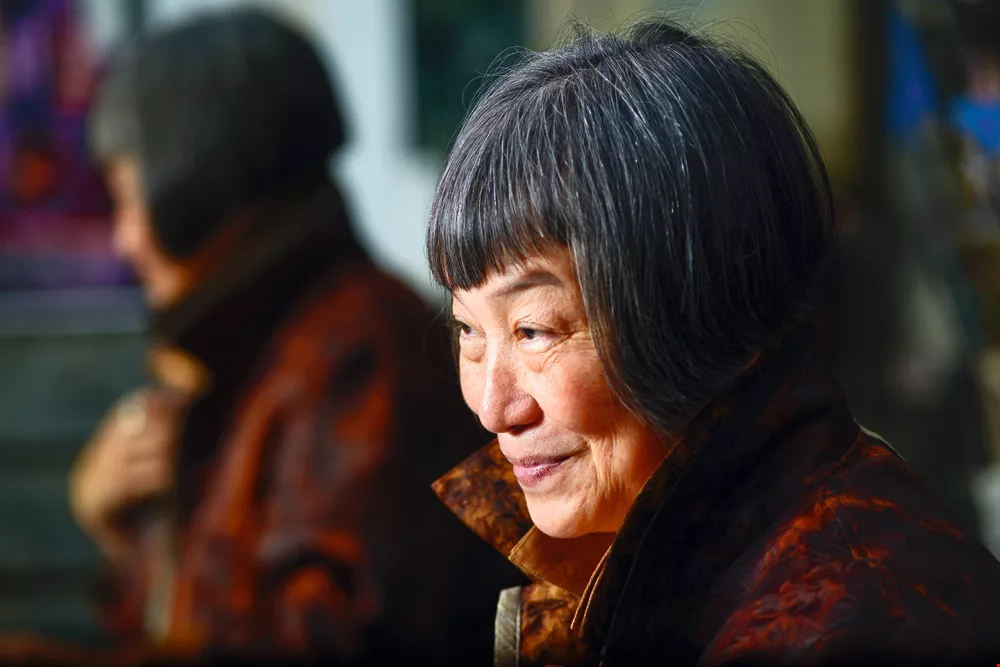
Hong owns the Librairie Le Pigeonnier bookstore, which she inherited from her late close friend Françoise Zylberberg, a professor of French at National Taiwan University, and she has been honored by the French government with the title Chevalier (equivalent to a British knighthood). She has been and will continue to be a bridge for interchange and communication between France and Taiwan.
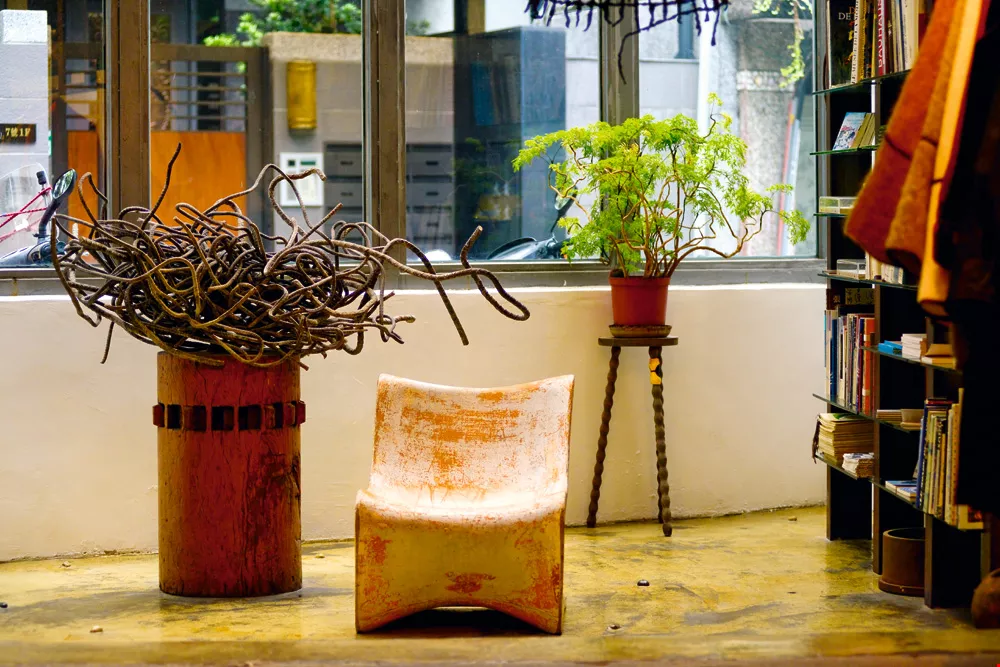
Sophie Hong’s shop in the Yongkang commercial area is far more than just a boutique for her trademark gambiered-silk fashions. You will also find many objets d’art including carved hand puppets, paintings, sculptures, and mosaics.
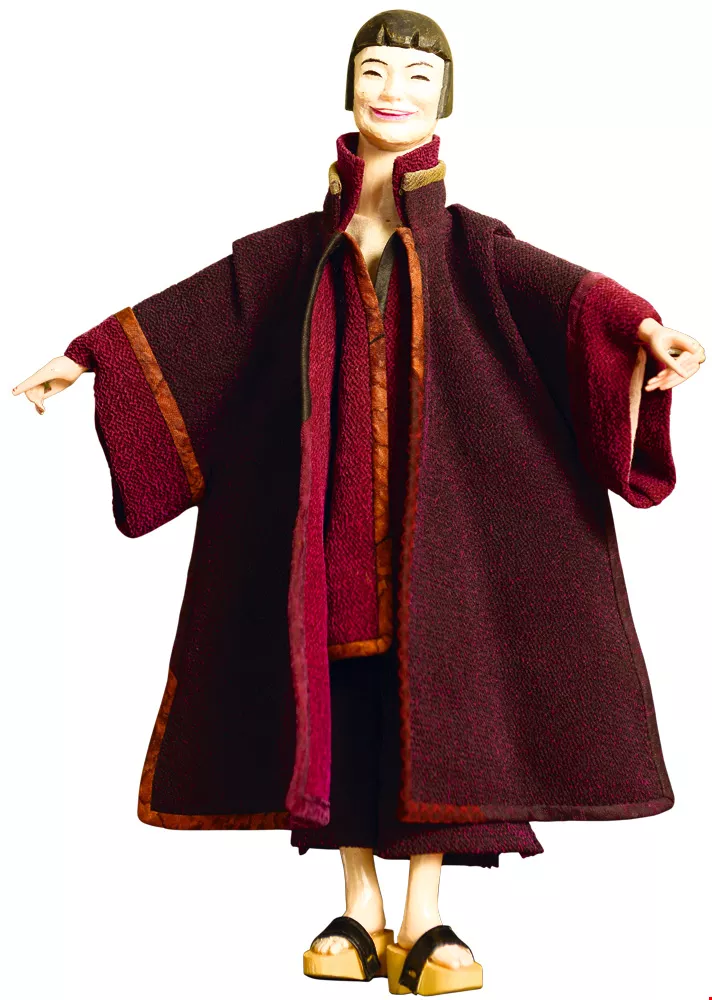
Sophie Hong’s shop in the Yongkang commercial area is far more than just a boutique for her trademark gambiered-silk fashions. You will also find many objets d’art including carved hand puppets, paintings, sculptures, and mosaics.
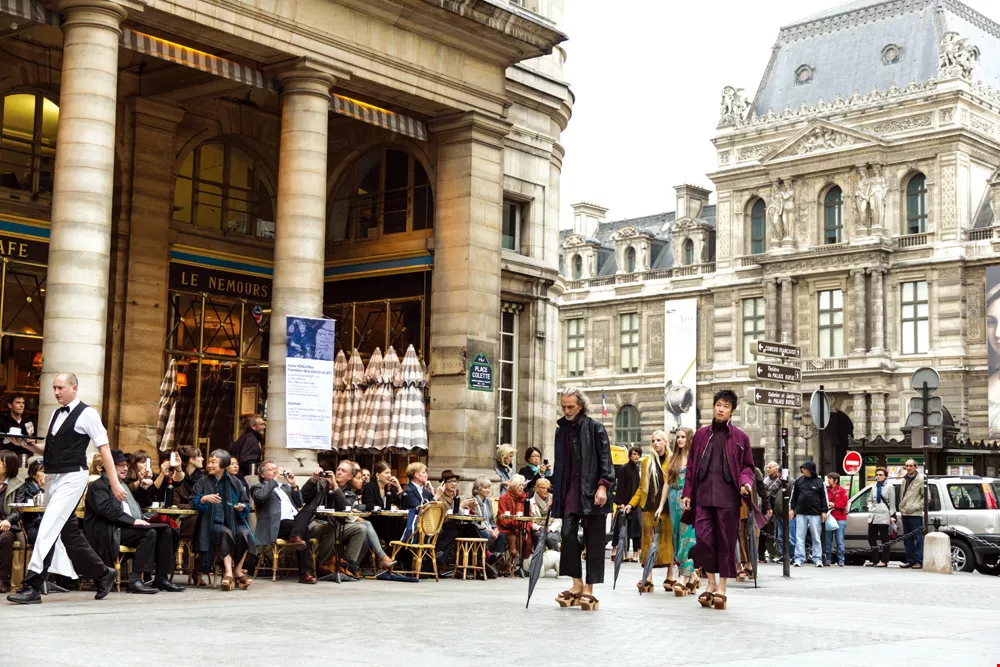
Last September Hong held a street-life fashion show in the historic Place Colette as part of Paris Fashion Week. In an atmosphere of elegant music and fragrant coffee, models paraded Spring and Summer 2013 fashions as if they just happened to be passing by.
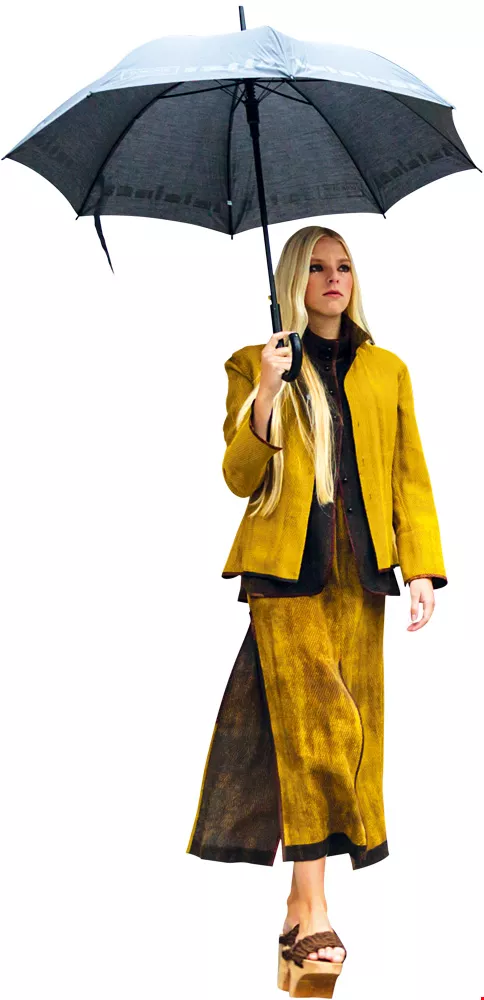
Last September Hong held a street-life fashion show in the historic Place Colette as part of Paris Fashion Week. In an atmosphere of elegant music and fragrant coffee, models paraded Spring and Summer 2013 fashions as if they just happened to be passing by.

@List.jpg?w=522&h=410&mode=crop&format=webp&quality=80)


@List.jpg?w=522&h=410&mode=crop&format=webp&quality=80)
@List.jpg?w=522&h=410&mode=crop&format=webp&quality=80)
