The Village That Came Back:Nanliao Salt Field Ecology and Culture Village
Tsai Wen-ting / photos Jimmy Lin / tr. by Jon Babcock
September 2003


Neither an old house nor an aban-doned factory quite compares in scale to the regeneration project that Lu Chien-ming, "head" of the Nanliao Salt Field Ecology Village, has been working on. The abandoned village that he is in charge of consists of 355 hectares of unused salt fields. His objective in renovating: To refill the area with the salt makers and the salt field culture that were abandoned along with the land.
There was a time when 120 households of salt makers made a living in Nanliao Salt Village in Tainan's Szutsao district . In 1998, however, all production at Nanliao's Anshun Salt Plant came to a halt. One half of Nanliao Salt Village was included in the new Tainan Technology Industrial Park, and the other half was designated an ecological conservation zone. The salt makers, who have always lived with "their feet in the ocean and their head in the sun," suddenly became a displaced people without any means of support. Furthermore, because Salt Village is below sea level, it is prone to frequent flooding. The villagers had to move out, leaving their houses and temples behind.
If you wander into Nanliao Salt Village today you will find an official "Do Not Enter" sign across the main door of Yungchen Shrine, the local temple. Yellow paper now hides the faces of the gods in the murals and door paintings, showing that the gods have left and the temple is empty.

Salt Field Ecology Village "head" Lu Chien-ming (right) with national treasure Ting Tsai-po, cleaning up the beach. They help turn debris into environmentally sound commercial products and give an abandoned village and people a new lease on life.
Ghost town
Sometime within the last year, signs of human activity began to reappear in Salt Village. The abandoned row of two-storied apartment buildings that face the vast salt fields are now designated as Tienyeh Workshop. Here people are hard at work scrubbing oyster shells that have been picked up from the beach. Others are busy salvaging bamboo tubes from abandoned oyster frames. Some operate sewing machines, making sunhats from old clothing, while others are occupied making artificial bird nests from silver acacia branches.
A group of old women, their faces hidden, with the direct sun beating down on their heads, are engaged in "washing the salt." They use special tools to break up and evenly spread out salt that is in the first stage of crystallization, in order to produce finer-grained salt crystals. Seventy-two year old Ting Tsai-po, Taiwan's sole remaining salt worker of national treasure status, spent his entire life earning a living on the salt fields. He is the only one left who understands the salt channel system and how to repair and maintain it. Wet with salty sweat, Ting is the one who can best speak of the history of Nanliao Salt Village.
"During the Japanese occupation, there were already salt fields in Nanliao. My father was one of the first generation of salt makers to come and develop them," Ting Tsai-po says. In 1919, the Japanese established the Taiwan Salt Making Company and began to develop the Anshun salt plant located in what is now Nanliao Salt Village. Because the salt fields were far from the nearest villages, they built a rectangular island district in the salt fields for salt makers to use as a place to live. It gradually became a village on the salt fields.
When the salt fields were initially developed, the lagoons and sand bars at Szutsao Lake in Anping were mainly employed. Using basalt and coral rock from Penghu for dikes, the seawater was first channeled into large evaporating ponds. After initial evaporation, the briny water was channeled into small evaporating ponds where it was further concentrated, and the resulting black brine was channeled into crystallization ponds where exposure to the sun yielded crystallized salt. The final sun-dried salt was transported on the canal from the dock to the headquarters of the Anping Salt Factory. At that time, this was the most modern type of solar evaporation saltern system.
After the Japanese colonial occupation ended, the function of Taiwan's salt fields gradually underwent a change from something that directly supported the lives of the people to grist for the mill of industry. During the 80s, in conjunction with extensive land development, the capital costs of salt making and the quality of the final product made it impossible to compete with imported salt for market share. Furthermore, those willing to do the backbreaking work of exposing the salt to the sun were becoming harder to find. Therefore, in 1991 the Ministry of Economic Affairs designated the Annan district as the "Tainan Technology Industrial Park." But due to the foresight of environmental groups who saw that the development in the industrial zone would heavily impact the ecology, the Council of Agriculture created the "Szutsao Nature Preserve" within the industrial zone. Thus half of the land was designated as an area for industry and the other half as a nature preserve. This left Nanliao Salt Village without any land for salt production. Over a period of ten years or so, the villagers gradually moved elsewhere, until the village became nothing more than a ghost town.
With the end of salt production and the salt makers gone, the abandoned village and salt company office, the vast salt fields and the lush old river canal, the docks, sluice gates, and other historical and cultural artifacts of the salt fields gradually disappeared.
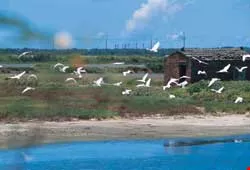
With their unequalled abundance of algae-rich seawater and many nearby fish rearing ponds, the salt fields make the Ssutsao district an important nature conservation zone for Taiwan.
Salt fields and the black-winged stilt
In fact, when Nanliao became "vacant space" it wasn't entirely vacated. The World Conservation Union (IUCN) listed it as one of Taiwan's 12 largest wetland bird habitats. Due to the fact that there are nearby saltwater fish hatching ponds, and since the salt content of the seawater in the salt fields is perfect for the growth of algae, the seawater storage pool (the big pool) in the salt fields is a primary nesting site for the black-faced spoonbill, which can number over 300. Each year from March through September, lovely black-winged stilts and the Eastern ring-necked pheasant take advantage of the the salt mounds to reproduce. This period conveniently falls during the slack time between the two periods of salt production, thus making for an elegant and unbroken dance of peace between the salt fields and the water birds for many years.
The industrial park, however, did not attract as many industrial tenants as expected. Meanwhile, salt production had come to an end and the fish hatching ponds were being used less and less. People began to move away and the area became a paradise for wild birds. The area began to see larger numbers of black-winged stilts, which use the salt mounds as their breeding ground.
The salt mounds are built from mud, logs, and pottery fragments, and are, therefore, quite transitory. They must be repaired extensively each year after the rainy season. If this is neglected, they soon go to ruin. After salt production stopped and the salt workers left, the salt mounds slowly disintegrated, endangering the black-winged stilts.

Producing gift items modeled on pied avocets and their nests, Salt Ecology Village is proving that there can be renewal after industrial decline.
Salt Field Village modernizes
In the spring of last year, lecturer Lu Chien-ming of the Kunshan Technology University Spatial Design Department (located in Tainan County) was commissioned by the Council of Agriculture to conduct a study of the buildings located in the Ssutsao Nature Preserve, and to formulate a plan for their utilization. As soon as Lu entered Nanliao Village, he was struck by the salt fields with their ceramic-shard linings, the docks, the canals, and the old offices of the salt factory, but as someone ever-mindful of ecological issues, he also recognized the rich abundance of flora and fauna in the salt lands. In this long-neglected place, he saw an unparalleled example of ecological balance, between the salt making industry and the natural environment, and he envisaged a flourishing Salt Field Ecology Village rising up there in the salt fields, free even of a perimeter wall.
"An industry that has bit the dust may yet be able to become competitive once again," Lu explained.
But thanks to Lu's work, the industry and culture of the salt fields will flourish together with a balanced ecology. The traditional salt fields will rise again, phoenix-like. After abandoning the traditional but no longer profitable way of making salt, the salt village culture will become a "Cultural Salt Field."
Don't underestimate oyster shells
Lu Chien-ming actually moved into Nanliao Village last year. He was able to obtain a certain amount of funding from Tainan City's Department of Public Works and the Council for Cultural Affairs to set up the Tianyeh Workshop. He invited 17 salt makers, ten shop workers, and nine administrative staff, including four students whose salaries were paid from funding provided to Lu for a historic preservation project in Pingtung.
In the salt fields, the middle-aged salt workers train under 72-year-old Ting. In the future these workers will become tourist guides for Salt Field Ecology Village. Lu, together with the staff and plant workers, observes how the wild birds construct their nests. They then use material from the silver acacia plant to develop lampshades, lantern covers, flowerpots, and other objects patterned after the bird nests. Furthermore, the materials used in the wood shop and in the weaving shop come without exception from flotsam and jetsam found along the seashore. In the late rays of the evening sun, they pick up along the banks systematically, gathering nuts from beefwood trees that were planted as windbreaks along the shore. They pick up discarded bamboo oyster frames and oyster shells that have been washed clean by seawater.
Back in the factory, the wood shop begins to plane smooth the bamboo tubes. Hsiu-chu, in the weaving shop, after looking over the materials that have been brought in, asks the woodworking shop to bore holes in the oyster shells, and then adds beefwood nuts and small cowrie shells, to string together a door curtain that exudes the salty atmosphere of the salt fields.
"This particular oyster shell, and this stick of bamboo are not your ordinary oyster shell and stick of bamboo. They have been worked over by the waves of the sea. This adds to them the concept of environmental protection. So for me, this is not simply a door screen, but a cultural product," Lu Chien-ming explains.
In Lu's estimation, both the production activity at the salt fields and the men and women who take part in it become cultural products. This group of "cultural workers" are not just those who contribute their labor, but are the vanguard in a campaign to protect the environment. Thanks to the promotion of this kind of thinking, workers who may have originally been drawn to the work for the money alone, now have begun to see their work here as a kind of "religion."
"I've lived all these years and only now do I realize what I'm really doing," says 40-year old Ah Hsiu, who undergoes dialysis three days every week but is still able to contribute his work to the Tianyeh Workshop
In the past, the salt-making process required intensive labor. Men, women, young and old-all pitched in. In addition to taking part in salt-related work, children of the Salt Village would go to nearby areas to learn other trades. Most of them learned woodcarving, and Nanliao Salt Village used to be called "Whittler's Nest" for a time.
Currently, Lu Chien-ming has called back two middle-aged master woodcarvers who model their works on the black-faced spoonbill, the black-winged stilt, and the Eastern ring-necked pheasant, all daily companions of the salt makers. These then become unique products of Salt Field Ecology Village. Other products unique to Salt Field Ecology Village include foot-powered water pumps, "pottery" made by gluing together ceramic shards from the salt pans, and Taiwan's only locally produced table salt.
Making a mountain of salt
After two years of preparation, at the end of last year the national Council for Cultural Affairs obtained a budget appropriation of NT$12,000,000 to fund the Salt Field Ecology and Cultural Village. This is the council's highest level of assistance given so far in promoting its "Local Cultural Facilities" plan. But visitors to Salt Field Ecology and Cultural Village may be forgiven if they wonder where the "facility" is. Lu laughs and responds, "The 350-hectare area you see before you is the site's 'museum facility.' The toiling, sweating salt makers, the leisurely high-stepping black-winged stilts of the salt fields, and the black-faced spoonbills that come in September-all these are our museum facility's 'collection'!"
It isn't that the Salt Field Ecology Village has no facility. On the contrary, its facilities are extraordinarily huge! As far as buildings go, the center is the Japanese-style wooden administration office near the docks. Starting in November, it will become the "Salt Field Museum."
Relegating the development of enclosed spaces to the last stage of the project is typical of Lu Chien-ming. "I hope the salt makers will start their work here first, get a handle on how to use their tools again, pass on their salt making techniques, and only then, as a last step, build a center. I believe that vacated land first needs people. Only when people put their energy into it can there be sustainable success."
In Salt Field Ecology Village, the product is culture, and culture is the "production" of daily life. As for a Salt Field Ecology Village lifestyle museum, so far nothing has been done.
In September of this year, Salt Field Ecology Village will stage its first big event. On Heritage Day, 10 tons of salt will be transported along the old canal to the former premises of the British trading company Tait and Co. in Anping, which was also the Great Nippon Salt Company head office during the Japanese occupation, and will be piled up there. Late this year, at the Salt Village docks, they will pile up a mountain of salt three stories high, 1000 tons of it, thereby creating a cultural landmark that will be visible from anywhere within the broad, flat Anping district.
The resulting salt mountain may be thought of as the sacred mountain of Salt Field Ecology Village. Ten salt makers rise at four o'clock in the morning to come to collect salt. This continues until noon.
An inanimate object only becomes animate as the result of human use. The ceramic shards lining the salt fields are at their brightest and most colorful when trod upon by the salt workers. They make for a curious parallel with the bright smile flashing forth from Ting Tsai-po's sun-burnished face.


@List.jpg?w=522&h=410&mode=crop&format=webp&quality=80)


