

Changhua City is the heart of western Taiwan, geographically speaking, but for years now has lagged behind Taichung in significance as the central region's second major city.
But the people of Changhua aren't bitter. Their city is greatly superior to its neighbors in terms of ease of living, and as soon as you hit the Sun Yat-sen Expressway, the Taichung-Changhua Highway, or Provincial Highway Number 1, you can get from Changhua to Taichung in as little as 30 minutes. Changhua City has everything you could want.
On top of this, strolling through this old city, you can find a number of amazing historical sites. It's incredible to think that this peaceful, simple city has had such a turbulent past....
Changhua City's history stretches back 281 years, to the days when Taiwan was under the rule of Ming loyalist Zheng Cheng-gong and his son. Being situated in a place where water is easily accessible, Changhua has long been considered a perfect place to settle. According to history books, things started like this: "Here Liu Guoxuan, a general under Zheng Chenggong, set up farmlands. Gradually, the area became an important trading post for travelers going between northern and southern Taiwan." In 1723, when Qing emperor Yongzheng ascended to the throne, the Zhuluo County government was set up in Changhua, and the city moved up another rung to become central Taiwan's major agricultural center.
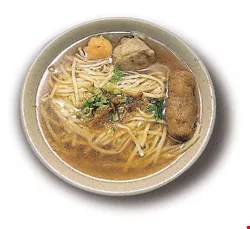
Cat and Mouse noodles The well-known "Cat and Mouse noodles" of Changhua do not, in fact, contain cat or mouse. Their name just comes from the nickname given to the original boss of the restaurant, and the name stuck. That restaurant is the only place in Taiwan that sells these noodles The soup is made by boiling clams, pork bones, and flounder bones. Above the boiling soup sit diced pork balls, let drain after frying, with their juice dripping into the soup. Then more flounder is added, along with onion and soy sauce, and the mixture is left to simmer. Then the noodles, which include a touch of soy flour to give them their unique flavor, are added. And because different people have different tastes, the restaurant offers unique variations on the meal, substituting chicken, mushroom, or shrimp for the pork. Cat and Mouse noodles, like Danzi noodles, can be a bit too much for people who aren't used to them, who might find that the fishy flavor overwhelming.
The fall of Changhua
But all good things must come to an end, and during the reign of Emperor Guangxu (1875-1895), provincial governor Liu Mingchuan decided that Changhua's port at Lukang was too silted and shallow, and gradually it fell into disuse. Liu chose to move the provincial capital to Taichung, thus laying the foundations for that city's future growth, while Changhua, which had depended on shipping through Lukang, lost its luster. During the Japanese occupation, Taichung continued to grow, while Changhua was gradually relegated to being just a satellite township.
In 1945, after the Japanese relinquished sovereignty over Taiwan, Changhua came directly under the control of the provincial government. At first, when this happened, the citizens of Changhua had dreams of finally catching up to the other major centers, but their dreams were hindered by a lack of land available for development. After five years, they were once again relegated to county-level administration, and ever since then Changhua has just been another city.
"Changhua City has good transport facilities and we haven't been suffering much of a population drain, but still our annual budget is NT$10 billion smaller than Chiayi City's. We're only 30,000 people smaller than there. It's really quite unfair, and makes developing the area harder," says Changhua City mayor Wen Kuo-ming. Wen sounds resigned to this situation, but still holds out hope that the central government will help Changhua regain her past glory.
As Wen sees it, Changhua City is a wonderful mix of classic and modern. "Our city has 11 national-level protected historic sites, as well as a vibrant cultural history. And in order to keep up with the times, we've found all kinds of new ways to integrate this history with modern society." One way Wen has encouraged this is through his establishment of the Taiwan Historical and Cultural Museum, and the Folk Arts Research Center. The idea is that by encouraging continuing creativity in these areas, local artistic culture can be kept alive and kicking.
Civil servant Chang Chien-fen-who also has 25 years experience as a local reporter-explains that the major cause of Changhua City's developmental bottlenecks has been the confined space they have to work with. "To the west we're blocked off by Mt. Pakua, and with the railway running straight through the city, the government is really limited in just how far they can develop the city."
Back in the days when cities relied on rail transport, train stations were catalysts for commercial development. But thanks to Changhua's geography, while the nice plain to the east of the station became a thriving commercial and residential area, the western side stayed so quiet you can just about see tumbleweeds roll past. To compound matters, the Sun Yat-sen Expressway now runs through that western side, basically knocking development there right on the head. With the limits imposed on development in the area surrounding the highway, that area has been left looking like rice paddies, and seems to be more or less a total writeoff in terms of development.
Although Changhua City has a low population density and there's no pressing need to develop the western area, the city government are still repeatedly frustrated in their attempts to plan for future development. Something always seems to block their way. So when the new high-speed railway plans showed the track winding its way through the mountains outside the city, without coming into the city proper, the residents were actually glad, like they'd just dodged a bullet.
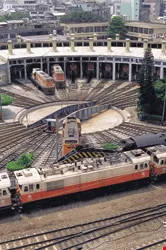
Tracks branch out on the northern side of Changhua station like branches of a fruit tree. In the middle is the turntable that lets the engines change direction and head into their respective maintenance sheds. The shed itself is designed to follow those tracks, laid out in a fan shape.
The "old fan shed"
Changhua City has a long history, but now it seems to have hit a wall, unable to get beyond its current population level or its geographical limitations, stuck running second to Taichung. But the past was different. Old Changhua once held the spotlight, especially its train station. A popular rest stop in the long north-south train journey, the station made a huge impression on all who visited it, and was the pride of Changhua.
Changhua Station is a connection point for the inland mountain lines and the coastal lines, and is a required stop for trips into the mountains of Nantou County. Back in the days of steam trains, the Kaohsiung-Taipei journey would take ten hours, and trains had to stop at Changhua to change crew before continuing their trip. On top of this, Changhua was a hub for the rail network, and all kinds of train ended up in Changhua at some point. Travelers came to Changhua City in droves. The selection of trains departing Changhua was huge, and the final run wouldn't leave the city until as late as 3 a.m. But the most surprising thing about the station is the fact that it never closed, even when restrictions around Taiwan were at their heaviest. Changhua really was Taiwan's own "city that never sleeps." And at this old "station that never sleeps" there is a building recently classified by the county government as an important historical site-the "Old Fan Shed."
After the Taiwan Railway Administration (TRA) changed to electric trains in 1978, steam engines died out. The maintenance sheds for the engines started to die off too. In the end, just the one in Changhua was left.
Director of the Changhua Station Maintenance Group Chen Te-an has worked for the TRA for 17 years. He explains: "The 'fan shed' was designed around the way the rail tracks spread out from it-from a bird's-eye view, it looks like an open fan. In total there were 12 tracks, and each could accommodate one locomotive. The trains would head into the sheds for regular maintenance or for any repairs that were needed at the time."
The Changhua shed was built in 1923, and is looking the worse for wear; the wooden window lattices are faded and chipped, the windowpanes are looking ready to fall if given a decent shake, and the roof is full of holes-although the holes were originally there to let the smoke and steam from the engines escape the building.
The old shed was originally scheduled to be pulled down and rebuilt, but the county government strongly opposed that plan. Changhua County executive Liv Wong said that if the building had been torn down, future generations growing up in the city would have had no way of really getting to know about that period of the city's history. So finally the shed was designated a historic site, with plans to eventually make it a rail museum.
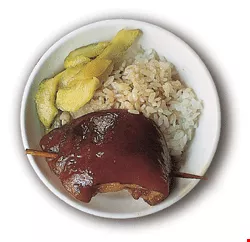
Stewed pork on rice Stewed pork on rice, one of the so-called "three treasures of Changhua," may sound pretty ordinary, but on any given morning if you head out onto Kuangfu Road and find a restaurant serving it, you'll find the entrance packed with people, with crowds of customers up at the counter placing their orders. A big hunk of pork, skin still on, is fried up, and then stewed in a large pot, infusing it with flavor. To stop the skin from separating from the meat while the brine soaks into it, the cooks use toothpicks to hold each piece of meat together. The flavor of Changhua stewed pork is fatty, but not greasy, and gets a big thumbs-up from everyone who tries it. That is why this simple meal has taken its place in the ranks of the "three treasures."
The two faces of Changhua
Changhua City has a long history. In the early Qing period, when the city was part of Zhuluo County, it was known as Banxian, a Chinese transcription of the name of the local Aboriginal tribe. Later the name was changed to Changhua.
Some people say that the name "Changhua" comes from a shortened form of the phrase "demonstrating the benevolence of the Emperor" ("zhang xian huang hua" in Chinese), but this is not the case. According to historian Kang Yuan, the real story goes like this: the city was founded in 1723, in the first year of the reign of Emperor Yongzheng. Three years later, a Confucian temple was built, and inside it was a plaque that read: "Establish learning and education, spread culture and refinement," or "She xue li jiao, yi zhang ya hua" in Chinese. It is from this that the name Changhua (alternatively spelled Zhanghua) came. The "demonstrating the benevolence of the Emperor" story comes from the Japanese occupation, when the Japanese wanted to focus on the power and prestige of their emperor as much as possible.
It is said that the people of Changhua put up an incomparable fight against the oppression of the "invaders," so much so that when the Japanese were discussing the problems of Taiwan, they would refer to Changhua as "O-hua" City-the "troublesome city." The city ended up getting special attention from the territorial governor, earning it a reputation as being "troublesome to administer." But for the people of Changhua, this was a huge source of pride.
Kang Yuan, historian, local author, and former curator of the Lai Ho Memorial Hall, says that in 1895, when Taiwan was ceded to the Japanese, the people of Changhua put up a spirited fight. Martyrs like Li Shibing, Wu Tangxing, and Wu Pengnian valiantly fought the Japanese army in the Pakua Mountains for three days and three nights.
During this battle, the Chang-hua side suffered heavy losses and injuries, while the Japanese prince Yoshihisa was shot and killed. The Japanese set up a memorial shrine to Prince Yoshihisa in the mountains, but a local covertly erased the word "Prince" from the tablet, sending the Japanese into a rage. They hunted for the culprit all over, but without success. In a virtual state of war, with all the fear and terror that entails, such an act was amazingly brave.
Lai Ho, known as the "father of modern Taiwanese literature," wrote a poem about this battle: "Black banners unfurled in the winds of the Pakua Mountains / Fighting the good fight. / Some witnesses remain today / Passing on the tales of the martyrs." During the KMT era the Yimo Memorial Park was established on Mt. Pakua to commemorate those heroes who defied the Japanese. These days, this part of history is slowly fading from memory, but those events still clearly demonstrate the rebellious spirit of the people of Changhua.
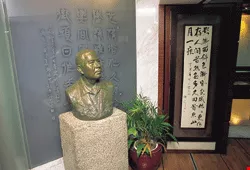
Lai Ho, the father of modern Taiwanese literature, was born in Changhua during the Sino-Japanese War. He devoted his life to creative writing in Chinese, reflecting the greatest desires of the common people of Taiwan during the Japanese occupation.
Taiwan's literary home
There can be no doubt that Lai Ho is one of the most important figures in Taiwanese literature. Born in Changhua during the Sino-Japanese War, Lai was educated thoroughly from a young age in classical literature and literary Chinese, and even kept the traditional Chinese queue hairstyle. Records say that "to his mind, he was upholding the traditional ideal that 'a man without a queue cannot be called a real man.'" As such, he was hesitant to enter the Japanese-established public school system to study. Eventually he could resist no longer and started studying Japanese at school and cut off his queue. But throughout his life he was dedicated to writing in Chinese.
When he was 16, Lai started studying at the Territorial Government School of Medicine (also known as the Taipei School of Medicine), and in 1916 he established his own practice in Changhua. Two years later, he left for Xiamen in mainland China, where he was taken on by a hospital on nearby Gulang Island. There he saw for himself the huge effect of the May Fourth literary movement on Chinese culture and society. The following year he returned to Taiwan and began actively working toward a modern Taiwanese literary style. Throughout his life, the theme of his works never strayed from that of the corruption and degradation caused by old-fashioned customs and traditions, the humiliation of the common people, and the struggles of the weak and underprivileged in society.
Rebellious spirit and modern Taiwanese literature aside, Mt. Pakua and the Changhua Big Buddha are the most common images people have of Changhua. Mt. Pakua in particular, thanks to its featuring in history so prominently, and the number of stories it's involved in: rebelling against the Qing dynasty, fighting the Japanese, being the site of a military base... the peak, over 400 meters above sea level, features in many a heroic tale.
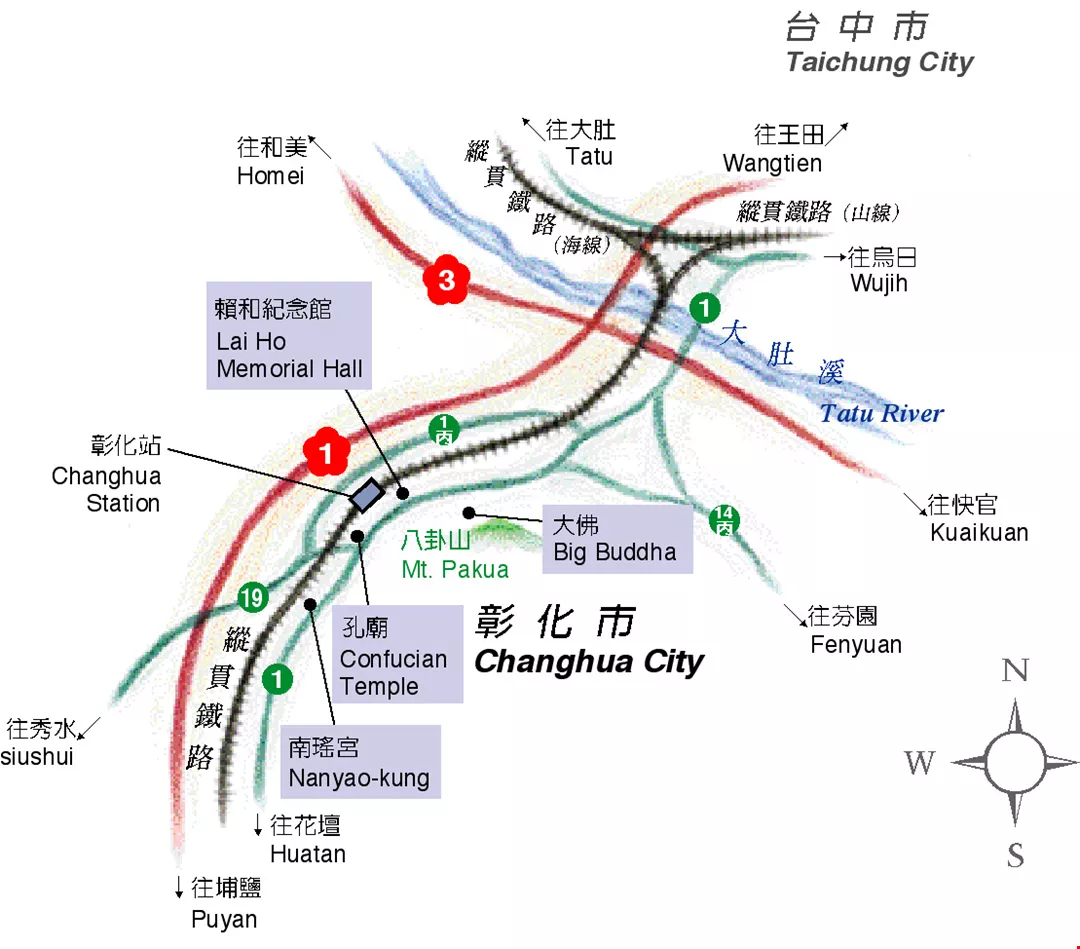
Changhua City Map.
The symbol of Changhua-Mt. Pakua
Mt. Pakua has long been an important strategic location. Historical records show that the mountain was originally called Mt. Wangliao-Mt. "overseeing the troops." In the Qing dynasty it was also known as Mt. Dingjun-"troop station mountain"-and had troops stationed there. Later, during the reign of Emperor Jiaqing, Cai Dehui-a scholar from Jinjiang-settled in Changhua and wrote a poem about Mt. Pakua: "Climbing Mt. Pakua at dawn / Returning home to study the Book of Changes / Wrapped up in thought / The mountain clear in my mind." The poem hints at the octagonal shape of the mountain's base when viewed from the peak, like that of the bagua (also spelled pakua), the Eight Trigrams that are the central symbols of the Book of Changes, when arranged as the eight sides of an octagon. Thus the mountain ended up being known as Mt. Pakua.
But Kang Yuan gives a different explanation: While Taiwan was still rebelling against the Qing Dynasty, all the main figures in the rebellion-Lin Shuangwen, Dai Chaochun, Shi Jiuduan, Chen Zhouquan, and others-all had some connection to the "Bagua Society." This Bagua Society was in fact an alias for the Tiandi Society ("Heaven and Earth Society"), the name coming from the fact that the first two of the Eight Trigrams represent heaven (tian) and earth (di), which are the first two characters of the society's name. During the reign of Emperor Qianlong, the Tiandi Society would hold activities using Changhua as their base, making Changhua Taiwan's most important place in the rebellions against the Qing. Because their activities were essentially shielded by the mountain, it earned the same name as the society-Bagua (Pakua). Then later, during the Japanese occupation, Mt. Pakua was, just as before, the most strategically valuable location for rebels.
As well as having been an important military location and a rebel stronghold, Mt. Pakua has become part of childhood memories for many Taiwanese, because of the many, many school trips that go there. It's virtually a required visit for schoolkids.
Right at the top of Mt. Pakua sits the Big Buddha, who has watched over the people of Changhua for nearly half a century, and has become Changhua's most recognizable symbol to people from outside the area. This statue of the Buddha Gautama, built in the style of the Big Buddha at Nara in Japan, was completed in 1961, as part of the county governor's plan to reconstruct the Pakua scenic area and spur tourism in Changhua. The statue is 22 meters tall, and is widely known as Southeast Asia's biggest Buddhist statue. The Big Buddha is surrounded by its "lotus seat," and has a doorway to let visitors step inside. The interior of the statue is divided into six floors, with sculptures illustrating the story of the Buddha, and places for visitors to worship and pay their respects.
Since Mt. Pakua sits in the city center, if you go up in some of Changhua's taller buildings you can look out and see the Big Buddha sitting proudly on the moun-taintop. People used to say that if you were traveling north on the highway, when you could see the Grand Hotel, you knew you were closing in on Taipei. When it comes to Changhua, in most people's minds the representative landmark like that would have been Mt. Pakua's Big Buddha. Lately Taipei's representative landmark has switched from the Grand Hotel to Taipei 101, but the Big Buddha still sits atop Mt. Pakua, watching over Changhua as he has for decades.
About Changhua City
Changhua City is located in northeastern Changhua County. To the northeast sit the Taichung County townships of Tatu and Wujih, separated from Changhua by the Tatu River. To the south, Changhua neighbors Huatan and Hsiushui Rural Townships; in the east, Fenyuan Rural Township; and in the west, Homei Township and Fuhsing Rural Township.
The city covers a total area of 65.69 square kilometers, with a population of approximately 230,000 in 73 neighborhoods. The city is the capital of Changhua County and is the second largest city in central Taiwan (Taichung, Changhua, and Nantou Counties).
Changhua City has a number of historical sites and rich and diverse culture. The city's traditionally built Confucian temple is a Grade 1 historical site, and the Taoist Yuanching Monastery is the only monastery of its kind in Taiwan, also serving as a shrine to the Jade Emperor. Outside the southern city gate sits the Nanyao-kung shrine to Mazu, which is constructed in a very distinctive style with Grecian columns.
Changhua is also famous for its cuisine, in particular the so-called "three treasures of Changhua"-Changhua meatballs, stewed pork on rice, and "cat and mouse" noodles-mouthwatering snacks with a distinctive local flavor.
(Kate Yang/tr. by Geof Aberhart)
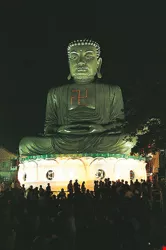
The repair work on that massive figure in many a person's childhood memories, the Changhua Big Buddha, was just recently completed, in time for the "Lighting-up of the Buddha" event, part of the Big Buddha Cultural Festival. The event and the repairs have given the Buddha, atop Mt. Pakua, a real power boost, and once again the statue's glory shines forth.
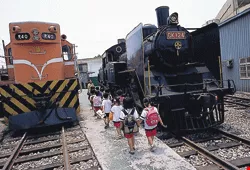
A steam engine stopped at Changhua Station, a reminder of Taiwan's earliest rail culture.
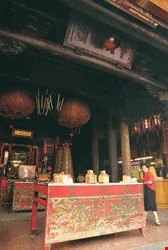
Locally known as the Mazu Shrine, Changhua's Nanyao-kung Shrine is an important location for local worshipers. The shrine has a 200-year history and is registered as a Grade 3 national historical site.
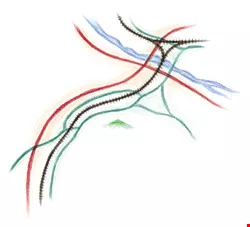
Changhua City Map.
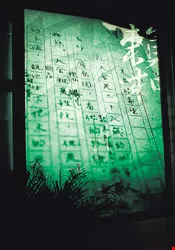
Inside the Lai Ho Memorial Hall is a collection of books, calligraphy, manuscripts, and other odds and ends from the life of Lai Ho.
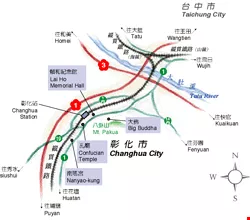
Changhua City Map.
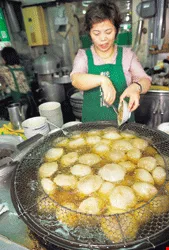
A firm favorite with local residents, Changhua's A-Chang Meatballs has been in business for over 20 years. Every day they sell nearly 1000 meatballs, and have gained an excellent reputation thanks to their top-quality ingredients.
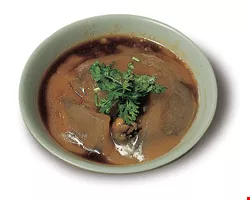
Taiwanese meatballs Most people say that when it comes to meatballs, people in the north of Taiwan prefer theirs fried, while southerners prefer their meatballs steamed. Changhua's meatballs fit squarely in the northern, fried tradition. Made from mushrooms, pickled mincemeat, bamboo shoots, and egg yolk, these juicy, spicy meatballs and their special sauce will leave you begging for more.

@List.jpg?w=522&h=410&mode=crop&format=webp&quality=80)


@List.jpg?w=522&h=410&mode=crop&format=webp&quality=80)
@List.jpg?w=522&h=410&mode=crop&format=webp&quality=80)
