Gold-Medal Chef Chang Kuo-jung
Tsai Wen-ting / photos Chuang Kung-ju / tr. by Jonathan Barnard
December 2005


Hailing from Hong Kong and with the same Chinese name as the late Hong Kong actor and singer Leslie Cheung, chef Chang Kuo-jung is renowned for his exquisite fusion cuisine that blends East and West. He also is well versed in Southeast Asian cuisine and Taiwanese snacks. Known for his inventiveness and breadth of vision, Chang is a mainstay on teams from Taiwan at international cooking competitions.
"My wife has given me a new name. She hopes that after the change, I will spend more time at home, instead of flying off all the time." Chang explains that he and his Taiwanese wife have been married for more than a decade, but as a leading chef for various hotel restaurants, he's not at home half of the time.
Tracing his ancestry to Shaoxing in Zhejiang Province, Chang was born in Shanghai, and his family moved to Hong Kong when he was a baby.
When he finished elementary school at age 12, he had an excellent record that had earned his admittance to an academic junior high school. Although his sister was willing to pay his tuition, "my family was poor, and the decision wasn't negotiable. My mother sent me to study a trade!"
Thus his apprenticeship began. He would leave for work early in the morning and return late at night. Although at first his heart wasn't in it, after about a month he began to enjoy the work.
Why? "Because I could eat my fill and view all sorts of fresh food," answers a smiling Chang without hesitation. Before he started working at the restaurant, the young Chang rarely had a full belly.
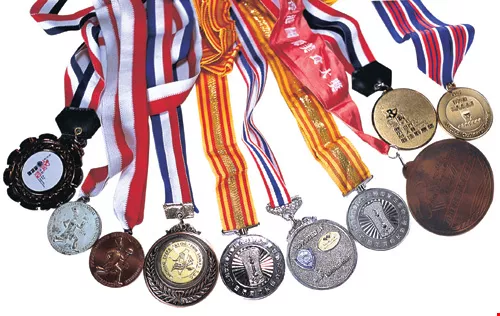
With no shortage of plaques and trophies to his name, Chang Kuo-jung's endless flow of new ideas has won him many a victory.
16-hour days
As an apprentice, he was expected to work from 9 a.m. to 10 p.m. But Chang was ambitious, so he would start work an hour early to learn new skills, and then hang around until midnight. What's more, he would stay in the kitchen during the free period in the afternoon. All told, he would spend 16 hours a day in the kitchen. "Only by devoting myself to my work and grabbing any opportunity to cook did I have a chance to learn cooking skills." Chang can't help but sigh when discussing the altogether different attitude of today's apprentices.
After a few months on the job, the master chef Yan Xingnian, who had once cooked at the famous Paramount Dancehall in Shanghai, began to notice--at first silently--Chang Kuo-jung's initiative and hard work. Then one day, during a break, Yan picked up a menu and asked Chang: "Do you understand it?" Naturally, since the menu was full of English words and Chang Kuo-jung had only graduated from elementary school, he didn't have a clue. Thenceforth, Yan began to teach Chang English whenever he had some spare time. Chang eventually built a good foundation in English and to this day reads widely from foreign cookbooks. His library at home contains several hundred English-language cookbooks.
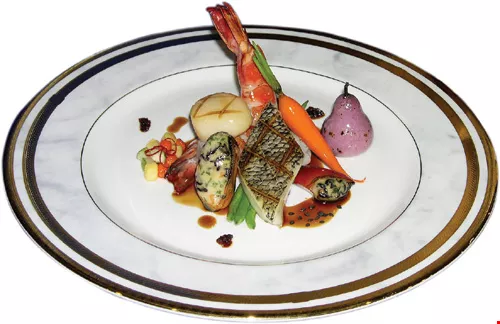
Seafood platter with purple yam and passion fruit sauce
An assistant head chef in youth
When he was 23 years old, Chang Kuo-jung began to work for the Maxim's Cakes and Bakery group in Hong Kong--in their Chinese cuisine, Western cuisine, Japanese cuisine and baking departments.
To cultivate his skills, the company sent him on internships in Japan and Thailand, and also to work in the company's Hunanese, Zhejiang, Chaozhou and Cantonese-style restaurants. As a result, he not only developed excellent Western cooking skills, but he also laid the groundwork for creating fusion cuisine by drawing from the eight main styles of Chinese cooking.
At 25 Chang was made a chef. At 28 he became a district chef responsible for four restaurants. And at 30 he became the vice general chef of the company, responsible for 18 restaurants.
But having attained success and fame, Chang felt the pride of youth and the desire to make it heroically on his own. Seeking a new challenge, he left his job.
In 1990, after leaving Maxim's, Chang went to Taiwan to relax and visit friends who had studied under the same master chef. On Christmas Eve, Chang made a cameo appearance at a restaurant to help out. His cooking that night earned the compliments of the hotel owner, who invited Chang to come to head up his kitchens. As a result, Chang not only ended up working in Taiwan but also ended up marrying a Taiwanese woman--becoming a "Taiwanese son-in-law" who put down roots on the island.
Back then standards and wages for chefs were higher in Hong Kong than in Taiwan. And with his heavy Cantonese accent when speaking Mandarin, Chang faced resistance in the kitchen. At first, the local cooks would fold their arms and give him cold looks. But over time they sensed his hardworking attitude, and he earned their tacit and explicit confidence.
"The Taiwanese word for it is dingjin--thorough. I feel that a good chef has to look after all the details," Chang says.
A gift from God
Having worked in kitchens for 30 years, seemingly always with a wok handle in one hand and a spatula in the other, Chang feels that, in addition to a detail-oriented personality, God has blessed him with an extremely sharp sense of taste.
Once, Chang Kuo-jung was serving as a judge of a licensing test for chefs of vegetarian Chinese cuisine. The sponsoring organization hadn't provided any MSG, but with just one bite he ascertained that one group's dish contained some MSG. And a small package turned up hidden in that group's refrigerator. In order to maintain his sharp sense of taste, Chang always drinks a lot of water and does his best to avoid tea or alcohol.
With his innately sharp faculties and careful cultivation of his sense of taste, Chang is extremely adept at making sauces that bring out the flavor of foods. Chang estimates that he can make some 3000 different sauces, and can taste whether the order of steps used in preparing a food was correct.
Take, for instance, the basic black pepper sauce used in Western cuisine. Traditionally, it is prepared by first frying onions, then adding garlic and pepper, stir-frying briefly before flambeing with brandy, so that the alcohol is driven off but the scent retained, and finally adding a broth made by simmering bones with spices for a day.
Chang's pepper sauce uses the exact same ingredients, but he adopts a different procedures: First he fries garlic and then adds onions, and before he adds the pepper he first roasts it briefly. In that way his pepper sauce is especially fragrant. Many cooks have now switched to his method.
Chang explains that Taiwan's onions have an especially high water content. Their water fills the pan, so that if you then add the garlic, no mater how you saute them, you won't be left with any aroma. Likewise, you've don't first bake the pepper, the fragrance will get caught in the steam and not be expressed in the food. Chang's methods aren't deep or complicated; they're just about fully understanding the foods of every place, and making adjustments based on this basic understanding of the special character of the ingredients, and working hard to get the most from every step.
Creating top quality food
Combining Chinese and Western cooking styles, Chang Kuo-jung is a master at creatively using ingredients. Every time he enters a competition, he always creates innovative cuisine that startles the judges.
In a 2002 competition, Chang cooked an old favorite of Taiwanese food: mullet roe. He first grilled it with brandy, then cut thin slices of apple and put them in vinegar. When they had fully absorbed the vinegar, he used them to wrap up the fish. Speaking perfect Taiwanese that betrays not a trace of a Cantonese accent, he put an whole new spin on this standby of Taiwanese cuisine and won a silver medal in the cold foods category.
That same year, ROC president Chen Shui-bian was hosting a visit from the president of Honduras, and Chang handled the cooking with 180 students under him. With the dull side of a knife he removed the bones from chicken wings, which he then stewed in soy sauce and stuffed with celery and carrots and tied up in the shape of a gourd to become the popular "gourd-shaped honey chicken wings." It's not only an excellent hors d'oeuvre, it also earned him a gold medal at the Fourth World Championships of Chinese Cuisine.
Over the course of his career, which has so far spanned more than 30 years, Chang has kept a habit of going to the dishwashing area to see what customers have left on their plates and thereby to gauge the strengths and weaknesses of the day's offerings. "A cook is like a doctor," declares Chang. "He must do a good job of protecting his client's stomachs, allowing his clients to eat safely, hygienically and healthily!"
"Cooking little fish is like ruling a big nation," says Chang, who wears his white chef's hat like a emperor's crown, exuding all the confidence and glory of a great cook.
Born in Shanghai in 1958. Raised in Hong Kong; now settled in Taiwan.
Nickname: The Scholar Chef, for his collection of nearly 1000 Chinese- and English-language cookbooks.
Current position: Head of food services, Summit Resort, Taichung.
Notable awards:
2005: Gold medal, Taipei Chinese Culinary Exhibition Invitational.
2002: At the 4th World Championship of Chinese Cuisine in Malaysia, the Taiwanese team took two Special Gold Medals for hot dishes.
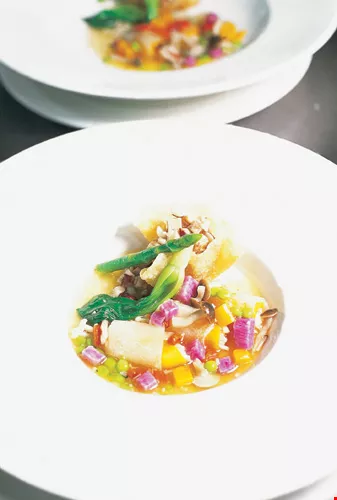
Chang Kuo-jung's Golden Cup Vegetable Wraps
Ingredients:
Gorgon fruit 5g; wax gourd 10g; purple yam 10g; taro 20g; pumpkin 10g; honshimeji mushrooms 10g; 1 wonton skin; enoki mushrooms 10g; sugar peas 5g; chopped garlic 5g; asparagus 10g; 5-6 Chinese wolfberry fruits; pinch of salt; baby bok choy 10g; pinch of pepper
Instructions:
1. Wash gorgon fruit and soak in warm water for around 20 minutes. Steam for around 15 minutes and set aside.
2. Skin and dice taro. Deep-fry in oil.
3. Deep-fry wonton skin in oil until golden, forming it into a cup shape.
4. Thinly slice wax gourd and pumpkin. Cut off stock of enoki mushrooms. Wrap together to form vegetable wraps. Steam for around 5 minutes.
5. Dice purple yam. Wash wolfberries and soak until soft. Cut off stock of honshimeji mushrooms. Scald sugar peas and remove from shells. Set aside.
6. Heat wok and add a dash of oil. Flash-fry garlic, add gorgon fruit and deep-fried diced taro, and stir-fry. Add salt and pepper to taste. Fill fried wonton skin with this mixture.
7. Place vegetable wraps in center of plate. Scald ingredients prepared in step 5. Flash-fry a little finely chopped garlic. Add vegetable stock and simmer scalded ingredients. Thicken with a little starch and pour over vegetable wraps.
8. Scald baby bok choy and asparagus in vegetable stock, then stir-fry briefly. Add salt and pepper to taste and arrange decoratively on plate.

@List.jpg?w=522&h=410&mode=crop&format=webp&quality=80)


