Twilight Time for Boiled Water
Chang Chung-fang / photos Vincent Chang / tr. by Jonathan Barnard
March 1993


Boiled water has no nutritional value and no calories, but no one can do without it. With water but no food, a person can still hang on for weeks. But if you lose 20 percent of your body weight in water, you're a goner.
The problem is that more and more people in this modern day and age are unwilling to drink water, replacing it with all variety of soft drinks. And it seems the more advanced and civilized a place is, the more of these sweet substitutes the people there will consume.
Could not drinking water really be a sign of progress and civilization? Is the sun setting on boiled water?
In the past, every time good friends and relatives came to visit, hosts would scurry off to boil some water for tea to give a gracious welcome. Today, the way to go is to offer a cornucopia of soft drinks--juice, soda pop, coffee, black tea--and let the guests choose for themselves. It's time saving and there's great variety, making both the guests and the hosts happy.
What happens if there's no time to prepare or you forget to buy drinks? Offering cups of boiled water as a last resort, embarrassed hosts will make repeated apologies for treating their guests so poorly.
And so if you are asked, "What would you like to drink?" and you reply, "boiled water," the questioner is liable to think you are either being polite or making a joke. Free-lance writer Teng Pei-wen, who has drunk boiled water since she was a child, says that her in-laws' refrigerator is packed with all assortment of soft drinks, but there's no drinking water. "Insisting on drinking boiled water," she says, "would make you seem a trouble maker."
Without our noticing, soft drinks have already replaced water as a necessity in many people's lives.

Is there a direct correlation between how civilized and advanced a country is and its demand for soft drinks? (photo by Huang Li-li)
A market with potential:
Just look at recent trends in the beverage market. According to statistics compiled by the Fruit and Vegetable Juice Industry Association, the amount of money spent on soft drinks in Taiwan rose from NT$13.65 billion in 1986 to NT$32.89 billion in 1991. If the average can costs NT$15, then we slurped down close to 2.2 billion cans of stuff last year.
These fat figures may startle people, but there's still ample room for growth. According to analysis of a survey carried out by the Food Industry Research and Development Institute and commissioned by the Ministry of Economics, "cold drinks" have the greatest potential for growth of all food products. Cheng Chu-ching, a researcher for that institute, says that the imbibing of soft drinks has become wedded to lifestyle not just in Taiwan but in all of the world's advanced countries.
Modern people, irrespective of nationality, demand soft drinks, and it seems the more advanced a country, the greater the demand. Coca Cola made a study comparing comsumption of its beverages (cola, other soda pop, fruit juice, etc.) in the 185 countries they are marketed. Kathy Ho, vice president for external affairs and human resources of Coca Cola Taiwan, says that last year the average American consumed 296 glasses, the average Australian 223 glasses, Japanese 122 glasses, Taiwanese 38 glasses and mainland Chinese 1 glass (at eight ounces per glass).
Putting aside possible differences in product acceptance and marketing methods, it seems clear that the more advanced a country, the more it can afford to consume and hence the larger its soft-drink guzzling population.
"The soft drink crowd" doesn't discriminate based on age. Its members fall into every age group.
Cheng Chu-ching, who specializes in researching food science, is a typical "soft drinker." He says that he almost never drinks flavorless boiled water. Based on considerations of safety and marginal utility, he tries soft drinks of all kinds. By so doing he both lowers the risks to his health and gives himself the pleasure of continually trying something new.
Sixty-year-old Tai Li-hsing became a cola fanatic because of his son's influence. But last year when he had surgery for a tumor in his leg, his wife made cola off limits and he went cold turkey. "Quitting cola is like quitting smoking," he says. "You're unhappy for a while."
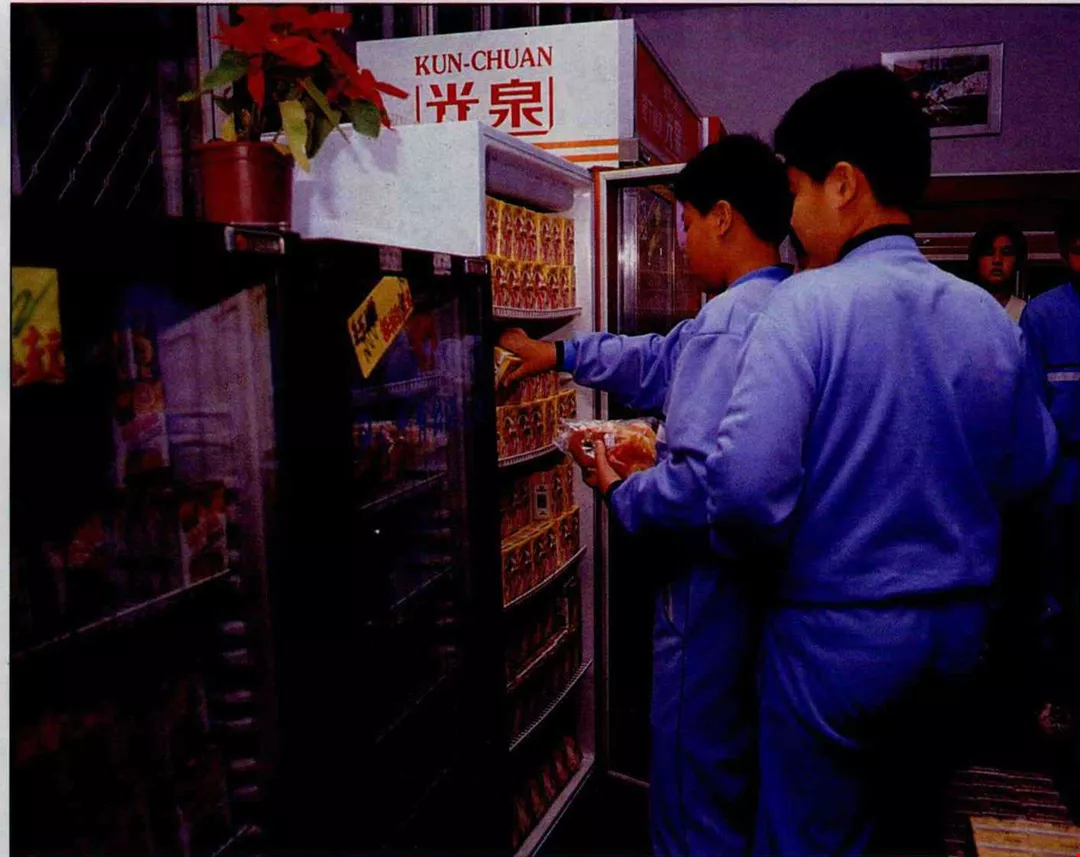
After phys-ed class is out, the students all run off to report at the food co-op. Choose your drink!
Convenient and Tasty:
Although soft drinks have enthusiasts in every age group, they find their widest acceptance among teenagers and children. Huang Song-yuan, the chairman of National Taiwan Normal University's Health Education Department, says that drinking and eating habits are among the most difficult to break. The older generation is used to drinking boiled water or tea, and so their drinking pleasures are naturally quite different from today's youngsters, who are growing up in age where drinking soft drinks is more convenient than boiling water.
At home just open up the fridge for a cold drink. Outside, every three steps and there's a convenience store, every five a vending machine, offering beverages whenever you get the urge. And it's no different at school. If perchance there is a water fountain, it may be out of order, but the drinks in the school store and corner vending machine are just waiting for you to study up a thirst.
According to statistics of the Department of Public Health of Taipei City, among the 291 schools in Taipei City, there are 123 schools with centrally provided drinking water (including both those where students go to the tea room to draw water and those where the water is piped out), 190 with drinking water machines installed, 14 with drinkable tap water and 16 that simply don't provide any drinking water.
Whether for sanitation, safety or convenience, few of these schools seem to make the grade. Huang Song-yuan, who is also president of the School Health Association of the R.O.C., says students going to the tea room to carry kettles of boiling water raises concerns about safety, whereas drinking water machines are not easy to maintain. "The filter should be cleaned once a week and changed every half year," he says. "How many schools can do this?" He isn't optimistic. Used improperly, these drinking water machines clog up and break down.
In years past, many people brought canteens to school, but the number of students doing the same is growing ever smaller. "If you don't even prepare a lunch box for the kids," Huang says in exasperation, "fat chance you'll provide them with drinking water." In such circumstances, buying soft drinks becomes the "best" or "only" choice.
Of course, the poor quality of drinking water has encouraged people to spend money on soft drinks. But those consumers who fork out to allay their fears may not realize that these beverages have the same source of water. Cheng Chu-ching points out that in the process of making these beverages there is only limited treatment of the water. To put it another way, the water quality of these drinks isn't necessarily any better than of tap water.

Students carrying kettles are an ever rarer sight to behold.
An irrepressible feeling:
And even if the school provides sanitary, convenient and safe boiled water, many students will still opt for drinking soft drinks. Take one junior high that has excellent water equipment (a central system which, after heating or cooling water, brings it by pipe to taps in every classroom). At mid summer, though there isn't any shortage of students drinking boiled tap water, every month the vending machines and school store sell more than NT$300,000 of cold drinks. Chang Tsung-yuan, the manager of the school store says, "We have encouraged students to drink boiled water but they're already used to soft drinks. It's a lost cause!"
"An irrepressible feeling" . . . "the taste of youth" . . . "a clear new idea" . . . "sharing good things with good friends": The media is constantly sending out messages of enticement. Coupled with such factors as ample spending money and peer pressure, they have turned today's youths into soft-drink addicts who are "water-free."
The question is, are these beverages really good for you?
Currently, new drinks are continually being added to the already great variety in the retail market. There are the following basic types: carbonates, fruit and vegetable juices, coffees, teas, sports drinks, mineral water, health drinks, etc.
In addition to water, their ingredients also include sugar, artificial flavorings and colorings, artificial sweeteners, caffeine, salt, preservatives, carbonate. . . . Can drinking this stuff affect your health? Chang Le-chi, the nutritional director of Veterans General Hospital, says that the permissible additives in these beverages shouldn't do the body any harm. But he emphasizes that drinking too much of these beverages can lead to problems with cavities and being overweight.

Is this the water we have to drink? Many people have switched to soft drinks because they have fears about water quality and pollution. They may not know that the water for these drinks and tap water may have the same source. (photo by Pu Hua-chih)
More little Fatsos:
If you stop and look, you'll notice that there are more and more fat kids. According to statistics provided by Hung Chien-te, the metabolism director of Taipei Muni-cipal Yangming Hospital, 25 percent of all elementary students are too fat, many because of what they drink.
These beverages may not have any nutritional content, but they've got sugar and calories. And so while they're quenching your thirst, your body is accumulating calories. One 355 cc bottle of cola has 137 calories. If you drink five or six bottles a day, it would be hard not to become fat.
If you drink too much of these beverages, these calories devoid of nutritional value can result in a nutritional imbalance. As the body grows fat, the risk of heart disease, diabetes, high blood pressure and other health problems increases. These are problems worth paying attention to.
And drinks with a lot of sugar are bad for the teeth. In October of last year, the Department of Health released figures on the rise of tooth decay among children in the R.O.C. The rate stood at 95.8 percent for first graders. Of course, this isn't entirely a result of their soft drink intake. Today's children are simply consuming too much sugar, and drinks are just one of the prime sources.
As far as the metabolism is concerned, Hung Chien-te points out that monosaccharides, disaccharides, oligosaccharides and polysaccharides all have calories, and the body needs to increase its production of insulin to metabolize them. This increases the chance of arteriosclerosis.
Such additives as caffeine, preservatives and artificial colors are more things the body doesn't need. While they all may leave the body quickly, Hung says, this does not mean that they don't do any damage. Some substances harm the body upon entering it.
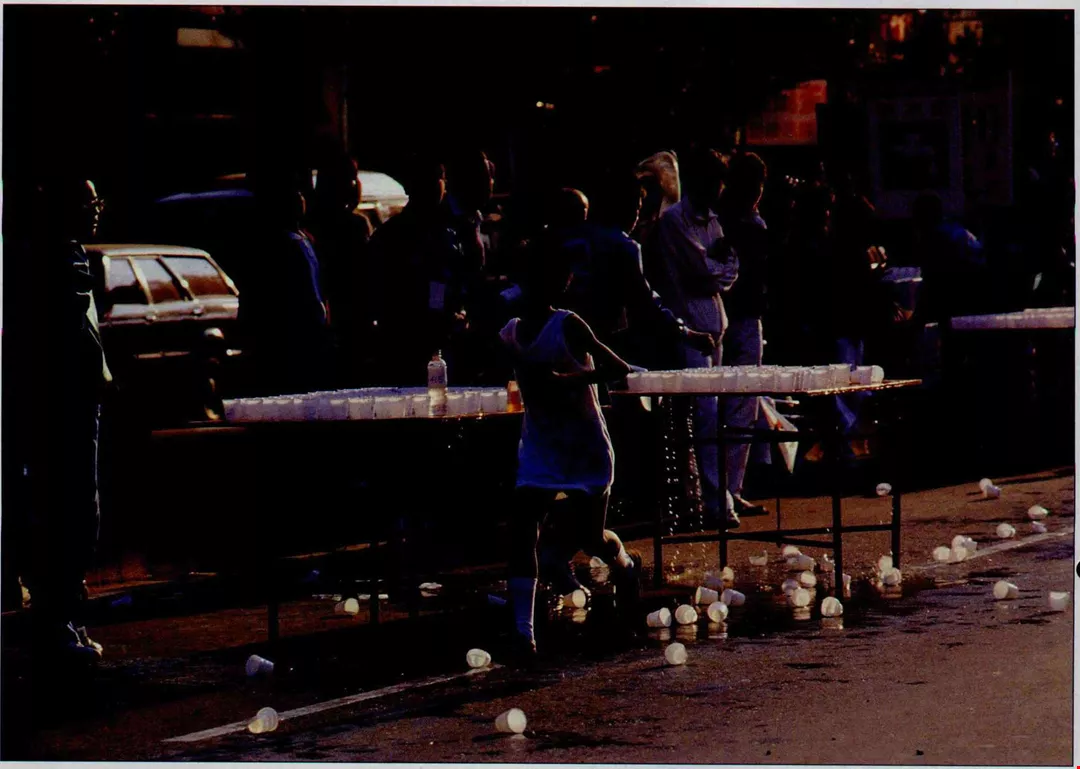
Sugar may affect the way that water is absorbed. When exercising strenuously, flavorless boiled water is the best beverage to imbibe.
A symbol of civilization?
And so modern people are flocking away from "tasteless" water to sweetened drinks, not knowing that the "colorless" and "flavorless" water is really the healthy way to go. Hung Chien-te points out that people need water for all the body's living activities. Every day you need from 2,000 to 3,000 cc of water a day, which can be absorbed from eating vegetables and fruits or from what one drinks. And colorless, flavorless and nutritionless water is a neutral PH drink both "economical" and "practical." It won't add to your calorie intake or do the ill any harm. It's of help if you're constipated, on a diet or have hemorrhoids. And it's free to boot.
Still, there is the problem of pollutants in tap water, and no one expects the "beverage crowd" to kick their habit at the drop of a hat. Cheng Chu-ching advises "controlling the amount" and Chang Le-chi suggests "using fresh milk as a substitute." These methods are perhaps worth a try.
Is swapping water for soft drinks really a symbol of civilization and wealth? The environmental problems caused by soft drink packaging and the growing number of little fatsos ought to make us stop and think.
[Picture Caption]
p.87
Just turn on the tap and you've got running water that is sanitary and convenient. It's just too bad that so few are interested.
p.88
Is there a direct correlation between how civilized and advanced a country is and its demand for soft drinks? (photo by Huang Li-li)
p.89
After phys-ed class is out, the students all run off to report at the food co-op. Choose your drink!
p.90
Students carrying kettles are an ever rarer sight to behold.
p.91
Is this the water we have to drink? Many people have switched to soft drinks because they have fears about water quality and pollution. They may not know that the water for these drinks and tap water may have the same source. (photo by Pu Hua-chih)
p.92
Sugar may affect the way that water is absorbed. When exercising strenuously, flavorless boiled water is the best beverage to imbibe.

@List.jpg?w=522&h=410&mode=crop&format=webp&quality=80)


@List.jpg?w=522&h=410&mode=crop&format=webp&quality=80)
@List.jpg?w=522&h=410&mode=crop&format=webp&quality=80)
