Pioneering, Nurturing, Crossing Boundaries: Women Dream Big
Chen Hsin-yi / tr. by Scott Williams
March 2010


Women living in wealthy, stable, democratic, liberal Taiwan have long been able to utilize opportunities and resources to realize their dreams and ambitions, regardless of their generation, age, class, or social setting. In Taiwan, more women than men now pursue higher education, the number of female managers and technology workers is growing, and women's purchasing power is rising in step with that of women in the world's advanced economies.
But while the mainstream media runs report after report on the success of women in the workplace, another new trend is quietly emerging. Women taking part in this trend don't "get" money, don't care about salaries, and aren't interested in comparing their husband's titles or their kids' grades with the neighbors. Uncorrupted by the world, they impress people they meet and talk to with their vibrancy and the centeredness and self-confidence that undergirds it.
Their self-confidence arises out of the knowledge that they are deciding the course of their own lives. Women aren't a "second sex," and they don't have to adopt the male view of what constitutes success to achieve gender equality. Women can and should have different dreams. Women liberated in this way are following an inner voice and bravely pursuing their dreams. In so doing, they are creating limitless new possibilities for both genders.
Born in 1955, Wu Shu-tzu spent the first half of her life working in the library of a national university, floating in a sea of books but reading only their jackets and catalogue numbers. "I spent every day looking up information for other people, telling students how to find treasures in the archives, but rarely dove for any treasure myself," she recalls, glossing over the drudgery and boredom of the job.
In early 2003, a coworker loaned her an old Huangmei-Opera film entitled The Love Eterne starring Ivy Ling Po. Wu was captivated by the old love story, and couldn't help but feel wronged on behalf of Zhu Yingtai, the female protagonist. "This woman devoted herself to getting an education, but her only option after completing was to go home and wait for someone to marry her," says Wu. "Tragically, her life ended before it even got started!"
Bothered by this part of the story, she had an idea: she'd write a version of the story in which Zhu and her love interest, Liang Shanbo, didn't die and were united again in middle age.
After picking up her pen and settling on the outlines of her story, her enthusiasm faded and she went back to busying herself with work and home. When the SARS epidemic struck Taiwan soon after, Wu stuck to her post. She protected herself by wearing a mask and making liberal use of antiseptic hand cleanser, but she was frightened. "If I had gotten sick and died," she says, "the unfinished story I had tucked away in my desk would never have seen the light of day."
The sense that she didn't want things to turn out that way compelled her to again take up her pen. "After work and on my days off, I'd take care of the housework, then sit there and write endlessly," she recalls. Within seven months, she'd scribbled out 200,000 characters, burning through 200 sheets of scrap paper and writing three pens dry in the process. Once she'd finished her draft, she put her library skills to work: she combed the stacks, took notes, borrowed books, made copies, then tidied up and organized her information to fill out her story with period-specific details involving places, customs, and turns of phrase.
Wu took early retirement in 2005 and, after publishing Liang Shanbo Didn't Die... and What Happened Afterwards at her own expense, gave copies to amazed friends, family members, and coworkers. Two years later, she put out a sequel in which Zhu Yingtai's daughter becomes a knight errant and founds a utopian commune for single women and women fleeing their husbands.
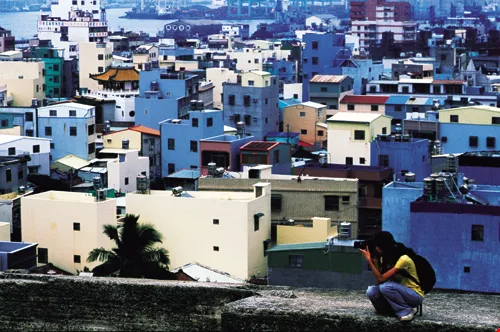
Everyone has a marvelous and achievable life map hidden deep in their heart. Open up your heart and embrace the world. You will gain a new perspective on life.
Having written two books and a long list of articles, Wu in 2008 achieved one of her goals for the second half of her life: she led writing workshops for women at the Kaohsiung Women's Center and at Taipei County's Xinzhuang Community College. She has also continued her non-stop writing.
When someone asks her why at 50 years of age she was suddenly struck by the desire to write fiction and why she now encourages other women to write, Wu says that it's probably because she's always been opinionated and has always expected a lot out of her own life. Her talents were simply waiting for the right moment to express themselves. She also admits that writing was something of a life preserver, helping her maintain her mental balance in spite of a chilly, depressing, uncommunicative marriage. Writing gave her an escape and let her spirit soar free.
Six months ago, Wu started a new chapter in her life. Though she'd always believed that "women only flourish when they have a husband and children," she made the decision to leave the "emotional violence" of her own marriage. Encouraged by the support and understanding of her youngest son, a high-school senior, she gained the courage not to return.
During a writing workshop at a women's bookshop, Wu asks herself, "Why would a homebody like me take up wandering?" The question compels her to clarify the definitions of "attachment," "loss," and "freedom" and write down a hope for the future: "Regardless of where I end up, I want to be able to feel the beat of my heart and the joy of rebirth!"
How many ordinary women with extraordinary dreams do we unknowingly rub shoulders with every day?
Life mapsHuang Chang-ling, an associate professor in political science at National Taiwan University who is one of the architects of the student women's movement and a former chairperson of the Awakening Foundation, says that Taiwan has been making progress on all aspects of the equal-rights agenda for many years. Taiwan ranks 22nd in the world (as of 2007) in terms of gender empowerment according to the Gender Empowerment Measure used by the United Nations Development Programme, well ahead of Japan (58th) and South Korea (62nd). In fact, within Asia Taiwan ranks second only to Singapore (16th).
However, even with the sharp rise in women's awareness, "The influence of patriarchal culture persists in some areas of life," says Huang. As examples, she mentions that household labor is still regarded as "woman's work," that workplace discrimination continues, and that childcare services and household allowances are lacking for women who choose careers.
"It's no wonder that more and more women are choosing to marry late, stay single, or even flee from patrilineal families," says Huang. "These choices may look natural or even dashing, but are actually tactics of resistance forced on modern women by patriarchal culture."
Yang Tsui, an associate professor with the Graduate Institute of Taiwan Literature at National Chung Hsing University, who is interested in the topic of travel in women's literature, has a more positive take on women's longing to "flee." She illustrates her point using the concept of the "life map," arguing that "settling down" and "moving" are two fundamental desires and that it is the continuous push and pull of these two poles that develops a rich life map.
"Women have a need to seek out places in their own spirits where they can feel settled and do things," says Yang. "They need a base near their borders from which they can easily fan out in other directions. Such a base allows them to constantly search for more beautiful and refined locales, enabling their inner and outer worlds to each make the other shine more brightly." Yang smiles and says, "One of the most terrifying things is to have a life map with only a single capital, to be locked up inside a single framework. If perchance that capital should someday be destroyed, then what?"
Yang also observes that women's proactive movements in their geographic neighborhoods can also "expand their subjective spirits."
As an example, she mentions the reason a young woman gave her for signing up for a writing class near her home. The woman had been a housewife for many years and her daily route to the market was a matter of habit. One day, she had an epiphany after buying the "fish that leaped the highest" from her fishmonger. While she watched him knock it unconscious, gut it, and gill it, the realization hit her: "No matter how high I used to leap, no matter how active and lively I was, I'm now just like this fish, gasping for breath after its gills have been plucked out." She decided she needed to change her routine if she was to bring herself "back to life," and she resolved to begin by expressing herself through writing.
Yang, who often finds herself moved by other women's "life stories," emphasizes that encouraging women to transgress not only involves transcending gender roles, but more importantly involves "transcending mainstream values discourse." "Women don't necessarily have to comply with existing authority, become rivals to men, or compete with men," she says. "Every subject is uniquely self-reflective and possessed of a unique sense of values; there's no comparing one to another. If women can grasp the true import of autonomy and freedom, and set out on their journeys, they'll encounter just amazing scenery!"
Women's journeysFor this feature, we deliberately chose to explore the inner yearnings and values of modern Taiwanese women by looking at women whose positions put them on the relative fringes of society. These women "just happen" to reside on Taiwan's east coast and include: a group of women determined to live free and unrestrained lives in Dulan Township, Taitung County (the location of the film The Most Distant Course), where they can maintain "critical distance" from mainstream political, economic, and cultural forces; Hsiao Jau-jiun, a university professor who every day engages in a creative discourse aimed at breaking down the gender barriers of traditional culture in the mountains around Hualien; and Ah-pao, a woman farming in rural Yilan who is encouraging farmers and consumers interested in protecting the land to experiment with means of living in harmony with Nature.
These stories share three characteristics which may well be common attributes of women's dreams:
1. Cherishing female camaraderie
In her groundbreaking research on single women, American social psychologist Bella DePaulo has discovered that economic autonomy, advances in obstetrics and gynecological medicine, and changes in family values are allowing today's women to remain single longer. She also learned that single women are rarely the lonely, resentful women depicted in the stereotype. Instead, they support one another at work, at leisure, and in crises, and easily bond with the people they meet in their everyday lives. "Single" does not equal "lonely." In fact, her research shows that singlehood enables women to have far more and far closer interpersonal relationships.
2. Expressing one's inner voice
The psychologist Carl Jung argued that in the male collective subconscious, and even in the myths and legends of different civilizations, there existed a respect for a feminine power that he called the anima. This figure sometimes appears as a wise goddess and other times as a graceful, charming femme fatale, either of which can bring ecstasy or grief. This force encompasses both light and dark, and is the wellspring of creativity and perception.
In Taiwan, this unruly spirit can express itself most fully along the east coast, far from the island's heart. Here, people question the line between life and work, push past the barriers separating art and life, and turn binary constructs like male/female and civilization/Nature on their heads. Here, women pursue humanistic and "whole person" oriented values.
3. Protecting diversity
Ecofeminism offers a useful perspective for understanding women's dreams of protecting the environment.
Ecofeminism holds that the preservation of biodiversity requires maintaining the entire ecosystem intact, that there are intimate connections between all the creatures of the Earth, that women have traditionally tended to pity the weak and vulnerable, and that women tend to maintain harmonious relations with all the members of the group. However, these feminine traits are denigrated and marginalized in capitalistic, patriarchal society, which tends instead towards competition and exclusivity. Advocates therefore hold that eco-politics and gender politics need to join hands if they are to bring about a radical revolution.
Vandana Shiva, an Indian woman who was invited to Taiwan in April to attend and deliver a lecture to the Asia Pacific Greens Network conference, is a case in point. A model ecofeminist, in the 1980s she encouraged Indian farmers (especially women) to plant tough native plant varieties, make use of organic fertilizers, and establish seed banks. She also helped farmers establish cooperatives. Her efforts not only revitalized the land, they also helped farmers resist pressure and exploitation by giant multinational corporations.
Conclusion: Getting underwayDo you have a sister who's busy building a dream? Are you in the process of realizing your own? If something is standing in your way, perhaps you can draw inspiration from these women's lives and make your own that much more brilliant.


@List.jpg?w=522&h=410&mode=crop&format=webp&quality=80)


