

At the beginning of 2005 "birders" from all over the world quietly arrived in Taiwan. At the recommendation of eight major British and US birding tour operators, they were heading for Taiwan's mountains and rivers in search of new birds. At the end of last year as the International Waterbird Conference took place here, many leaders in the international birdwatching community were publicly praising Taiwan's potential as a birdwatching destination, going so far as to compare it favorably with the eco-tourist paradise of Costa Rica.
Although the 15 unique and rare bird species of the island have their own terrific "sales appeal," Taiwan's attraction for birders stems from its location, for it is situated in the middle of a colorful chain of islands on the rim of the Asian continent that has become an important stopover point for East Asian migratory birds each spring and autumn. The many species that come are quite special. Among them the rare black-faced spoonbill and the Chinese crested tern add to the dazzling picture of Taiwan's waterbirds.
From a bird's eye view, the east and west coasts of Taiwan, from north to south--the capes and inlets, the coastal lagoons, the small islands, the man-made fish ponds and the paddy fields--seem studded with restaurants of various shapes and sizes offering a refuge for resting and feeding, and even for settling down and raising a family.
In mid-December of 2005, as blast after blast of cold air moves southward and the large influx of black-faced spoonbills arriving at the Tsengwen Estuary in Tainan County to spend the winter reaches its height, an intrepid group of conservationists, oblivious to the cold, form up into a team and trudge off together to survey every inlet from the Pachang River to the Yenshui River for the fourth time that winter. The team records a total of 803 of the birds, showing a steady yearly increase in the spoonbill population.
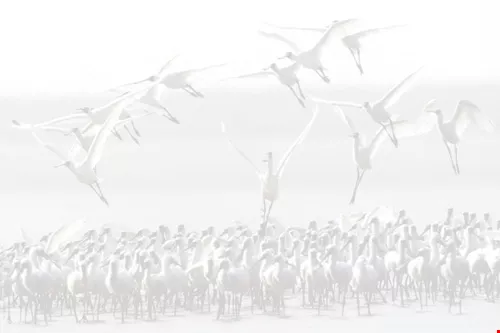
Group after group of bird lovers follows the dike on the northern bank of the Tsengwen River to the "Black-faced Spoonbill Sanctuary" in Tainan's Chiku wetlands, where most of the birds stay. This 300-hectare sandbar is the main roosting area for these beautiful guests from afar during their winter stay in Taiwan, and they gather there in the hundreds. Through a high-powered telescope one can see row upon row of snow-white forms stretching out over the water. Some walk around, others poke their beaks into the water in a leisurely search for food. At the end of the ranks two or three birds splash up water and take a bath. Having finished their bathing, they joust with each other and preen their feathers with their long black beaks.
Like the black-faced spoonbill, there are many birds from north China, or from even further away in Siberia, that make the long journey south to winter in this watery expanse. Groups of migratory Caspian terns, with black heads and red beaks, lounge near the spoonbills lending a bit of color to the gray and misty scene. Every now and then a great white egret flies in to take up a spot, calmly stretching out its long neck to survey the surroundings. On another shoal shorebirds, like the cute little common greenshank and the Eurasian curlew with its elongated, downward curving beak, wade into the water on their long slender legs and busy themselves poking the muddy bottom with their pointed beaks looking for something to eat.
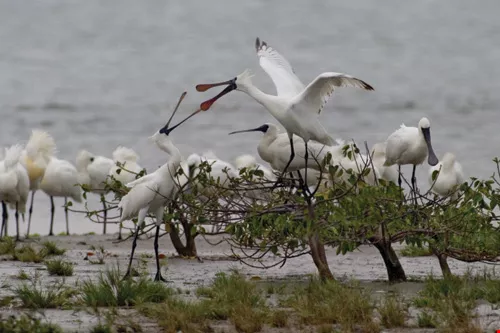
Two juvenile black-faced spoonbills at play. It is thought that this behavior is related to developing a quick and powerful beak.
Monochrome
"Where there is water, there is life." The birds rest and feed in the rivers and marshes, giving life to the peaceful natural surroundings, and the freedom of their soaring flight fills us with yearning. "They stand erect and solitary, now and then stretching their necks over the water."--Liu Changqing, Tang Dynasty. "I am like a sand-snipe in the wide, wide world."--Du Fu, Tang Dynasty. The graceful and elegant image of the waterbird with its undulating reflection on the water has been a favorite object of poetic imagination and expression through the ages, and the beauty evoked by the image of birds as they line up in rows has a special delight for poets.
Nevertheless, if the birds were aware of the image the literati or bird lovers had of them, they might well heave a sigh and ask, "Who can know how we really feel?!"
Following a long and exhausting flight south to winter over, the birds must find a watery location with the appropriate terrain and climate, and sufficient food. They must also be concerned about the safety of their roost and develop feeding strategies. As an example, the black-faced spoonbill when looking for fish in the water is well aware it is slow to react to natural enemies and often chooses to associate with the great white egret, letting the egret act as a sentry. But the egrets don't work for free. They can take advantage of the situation, gather in the fish and shrimp scared up by the spoonbills and thus save themselves some effort. Even the Chinese egret, which stands quietly by at the water's edge, is not really an innocent bystander. Its quiet demeanor is actually a strategy for making the fish let down their guard.
High and low tides set limitations for the many water birds that feed along the shoreline and in estuaries. The green-winged teal and northern shoveler, for example, can only feed on duckweed, seeds and tadpoles that float on the water. They have to take full advantage of the incoming tide to catch the food the seawater brings to them. Once the tide goes out, they are stuck even if they are still starving for something to eat. For the snipes and plovers that live in the same wetlands the situation is reversed. Because they eat shellfish and crabs and other invertebrates that are found in the mud, they must utilize the low tide period to do their feeding when the mud is exposed.
Taiwan owes its rich bird ecology to its location as the mid-way point for East Asian migratory birds. In addition, it has a complex topography, temperate to tropical climate, extreme variety of vegetation, and over 500 bird species on one small island--but none of this registered with Taiwanese society during the early years when everyone was intent upon making a living and no one was aware of the precious environment that surrounded them.
It wasn't until the 1960s, when the Migratory Animal Pathological Survey program began to examine whether migrating birds were spreading communicable diseases, that ornithologists coming to Taiwan were startled to discover the island was a natural "island of birds" and started the first birdwatching group, sowing the seeds for birdwatching in Taiwan for the next 30-some years.
Although the birdwatching phenomenon began later in Taiwan than in Europe and the US, its development has been energetic and vigorous. Birdwatching societies were established one after the other in each county and city, and in addition to birdwatching, these societies took on the important responsibility of conducting regional bird surveys, conserving the local roosting areas and engaging in public education activities. Were it not for the planning and management and public relations activities of society volunteers in recent years, it would most likely have been impossible to protect the many top waterbird roosting sanctuaries.
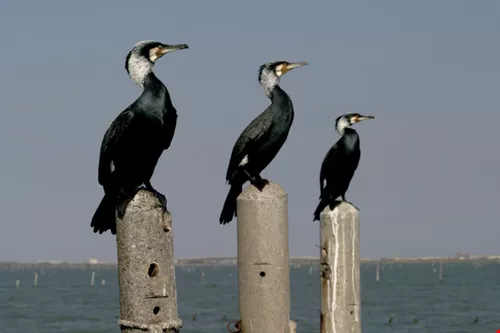
His head raised and still in the whistling ocean wind, the cormorant is a chief element of the scenery at Tainan's Chiku Lagoon. The cormorant is an underwater expert. He slips under the water and with a first class technique gets his catch.
Conserving a legend
The summering Chinese crested tern, the wintering black-faced spoonbill and the resident pheasant-tailed jacana are three waterbirds that can symbolize the success of conservation efforts in Taiwan over many years," points out Taiwan International Birding Association president, Simon Liao.
The Chinese crested tern, known as the "bird of legend," numbers less than 50 worldwide. When wildlife filmmaker Liang Chieh-te was shooting a documentary on a small, uninhabited island in the Matsu group in 2000, he unexpectedly discovered four adult pairs with four chicks among a flock of greater crested terns. The news shook the international bird-watching community, as it was the first record worldwide of the species reproducing.
The eight small islands near Matsu had early been established as a sanctuaries. After the "legendary bird" was discovered government officials requested the Coast Guard Administration to strengthen its patrolling during the May and June breeding season when the terns arrive, but they were still unable to prevent Chinese fishermen from the mainland who early in the morning or late at night would go onto the islands and collect eggs.
"We issued fines in accordance with the Wildlife Conservation Act but fishermen from mainland China didn't have the money to pay. If we locked them up, they didn't really care," says Chang Shou-hua, director of the Economic Development Bureau, which manages the sanctuary. This created a major headache. The breeding record over the following few years was also fairly unstable, and this was a cause of concern for the birdwatching community.
In 2005 the county government finally found a way to stop mainland fishermen from going onto the islands. Once a person was discovered violating the regulations by crossing the border and getting onto the islands, his fishing nets and equipment were confiscated in line with cross-strait agreements. "This deprived them of the tools for making a living and represented a very serious loss. After word got out, cases of Chinese fishermen landing on the islands decreased significantly," says Chang Shou-hua with a sense of enormous relief. Last August the former president of the International Waterbird Society, Dr. Robert Butler, made a special visit to Matsu in search of birds and was fortunate to get a firsthand look. After he returned home he made a report on the society's web site and within a short two to three months the site received over 800,000 hits from around the world.
As for the black-faced spoonbill, since 1991 when a worldwide survey by BirdLife International discovered only some 200 birds in existence and it was listed as a most endangered species, this old friend, whom the Chiku fishermen nicknamed "la bui" ("cup scratcher") in their local dialect, became an overnight sensation. Because Taiwan is home for the wintering over of 60% of the world's black-faced spoonbills, it is enormously important for conservation efforts. At that time the local government had marked off the Chiku wetlands as an industrial zone and planned to reclaim the land, but under pressure from international and domestic wild bird conservationists the land was kept as it was.
Later the Tainan birdwatching society assisted the academic community in surveying the roosting area and discovered that after dark the spoonbills all left the main roosting area and flew to the surrounding fishponds within a range of some ten kilometers to feed and take refuge.
In addition, because the migratons of the black-faced spoonbill cross national boundaries in East Asia, Taiwan gradually came to be included in cooperative international conservation plans. In 1998 and 1999, for example, Taiwan worked with Japan on satellite tracking and attached satellite transmitters on the birds to track them to their breeding grounds on a small uninhabited island in the Korean demilitarized zone, thus solving a long-standing mystery.
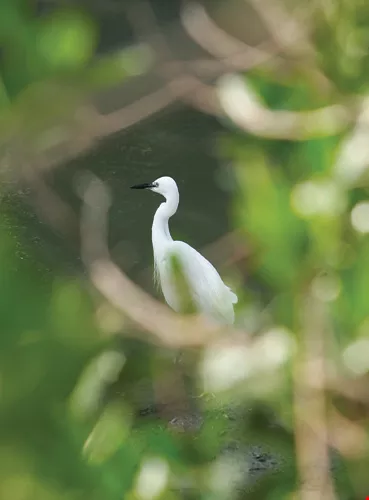
A little egret. Taking the work boat around Tainan's Ssutsao Wildlife Sanctuary you can appreciate the waters and mangroves on either side, and from the birdwatching hide you can also get a look at the many birds that live there.
Longterm monitoring
Professor Wang Ying of National Taiwan Normal University's Department of Life Science, a longtime researcher of the black-faced spoonbill's ecology and behavior, says although the birdwatching societies have continued to conduct regular surveys of spoonbill numbers and habitat, the frequency is not up to the standards for dealing with rare species.
"What fishponds and salt marshes do the spoonbills frequent most? How should these private fishponds be managed to guarantee the spoonbill's food source and safety?" For many questions relating to the spoonbill's life cycle there is only fragmentary data available due to a lack of government financial support. When a crisis occurs, such as the mass poisoning by avian botulism in the end of 2002, local conservation groups frequently are unable to make an effective, immediate response and can only stand idly by and watch as the spoonbills suddenly die en masse.
Taiwan's pheasant-tailed jacana, famously known as the "immortal water-walker," does not figure among the "stars" of the world's bird pantheon, yet Taiwan's experience in rehabilitating and conserving the species has been cited by BirdLife International as an example of the "first successful case in Asia of reestablishing a wild bird habitat as part of a major program."
The Taiwan pheasant-tailed jacana, with long, slender feet measuring some 15 centimeters, prefers to wade and feed in lakes and ponds with aquatic plants. For several decades freshwater wetlands in Taiwan have been filled in and converted into construction sites or farmland, thus forcing the jacana to move to water caltrop or gorgon fruit fields to live--and following a reduction in cultivated land the numbers of jacana have rapidly declined. Especially when the Hulupei and Teyuanpei areas, the primary breeding and wintering grounds for the jacana, were taken by the government for the building of the high speed rail line, the wild jacana was faced with a crisis of living space. In 1997 there were less than 50 jacanas spotted in Tainan County, leaving these birds that had lived for countless generations in Taiwan facing possible extinction on the island.
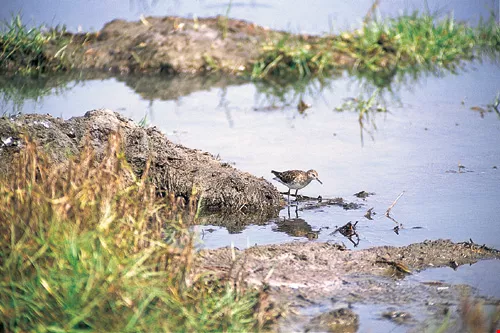
A sharp-tailed sandpiper. Taking the work boat around Tainan's Ssutsao Wildlife Sanctuary you can appreciate the waters and mangroves on either side, and from the birdwatching hide you can also get a look at the many birds that live there.
Rescuing the pheasant-tailed Jacana
In light of all this, in 1998 the 18 bird-watching societies on Taiwan and Wetlands Taiwan established a rescue committee for the pheasant-tailed jacana, joining hands to work on the jacana's behalf. They also set up a bank account for donations and began working on finding a new home for the birds. Ultimately they persuaded the Tainan County Government to rent 15 hectares of sugar cane fields in Kuantien Township, the jacana's original habitat, and turn it into ponds of various sizes to restore their roosting grounds; and also to commission several groups, including the Tainan City birdwatching society, to take over long-term management of the area. Rent and operating expenses would be shared by the Ministry of Transportation and Communications, the Bureau of Taiwan High Speed Rail, and the Taiwan High Speed Rail Corporation.
"Going from zero to a definite population in the rehabilitation area was the result of our feeling our way ahead step by step," points out Wu Jen-pang, the researcher in charge of managing the habitat. What aquatic plants should be planted in the ponds, and the effect of water levels on vegetation and fish ecology are all interrelated, complex questions. Researchers have made periodic trips to China and Thailand to investigate the jacana's natural habitat and make long-term observations allowing them to create a more appropriate habitat for the jacanas.
After several years of accumulating experience, a diverse ecology has been created in the rehabilitation area. Since 2003, the number of jacanas in the Kuantien area has been at more than 200. Looking out from the observation wall in the rehabilitation area, the pheasant-tailed jacana, with its gorgeous feathers and slim and graceful body, is easily seen wandering among the water caltrop leaves. In the marshes the moorhens take their leisure and numerous shorebirds wade in the water searching for food. It is a scene that teems with life, and in the spring the male jacanas can be seen taking their fledgling chicks on walks. The jacanas are among the small number of birds with a "matriarchal" family structure. Not only does one female have several mates, the males sit on the eggs and raise the chicks.
Wu Jen-pang says that previously Kuantien water caltrop farmers sprayed their crop with pesticides to kill off the moorhens and jacanas that fed on the caltrops, and the jacanas as well as other birds were affected. Later on, in order to encourage farmers to conserve these beautiful guests in their fields, the county government offered a reward every time a farmer would discover a jacana nest and a hatched chick. In recent years, after simplifying the procedures, applications for rewards from farmers have increased tremendously.
Although in recent years the treatment of Taiwan's bird population has shown clear improvement as a result of the spread of ecological consciousness, "land reclamation, river pollution and the neglect of wetlands have not really stopped," says Fang Woei-horng, vice president of the Wild Bird Federation, Taiwan and deputy chairman of BirdLife International, Asia Division. "Development" and "conservation" are locked in a long-term, seesaw struggle. The birding community in recent years has introduced the concept of the "important bird area" (IBA) popular internationally, has mapped out 53 IBAs in habitats classified as high elevation, low elevation, wetland, coastal, estuary and island and has sought recognition for this scheme from BirdLife International.
Fang Woei-horng says that IBA criteria are 1) endemic species, 2) degree of threat to survival and 3) population. Although at present only areas that overlap with the national parks and wildlife sanctuaries are protected by law, the announcement and promotion of the importance of the IBA concept will benefit the promotion of sanctuaries in the future. Fang says the second step for the birding community will be to work hard at promoting IBAs and having them listed as sanctuaries and on the basis of IBAs to pull together local interest groups to work together to protect bird habitats. Those in the birding community sincerely hope that if the IBA idea, mankind's well-intentioned response to the plight of their feathered friends, can call forth a sympathetic reaction from large numbers of people, then it will be possible that each spring and fall the sight and sounds of birds will fill the air and Taiwan will become a birdwatching paradise.
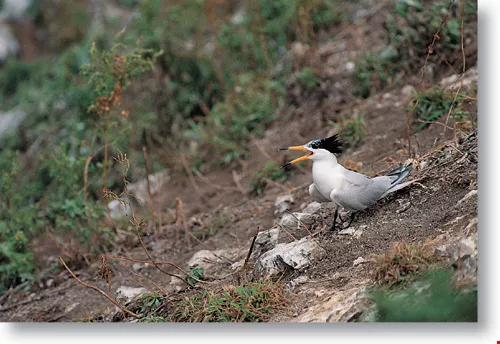
Ranked as "extremely endangered" by BirdLife International, the Chinese crested tern has appeared on Matsu in recent years. The local government and residents have gotten very deeply and carefully involved in conservation work.
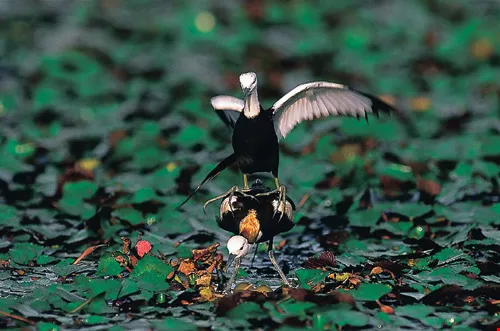
The jacana's foot can open to a length of 15 centimeters and is helpful in distributing its weight so it can walk on the floating vegetation.
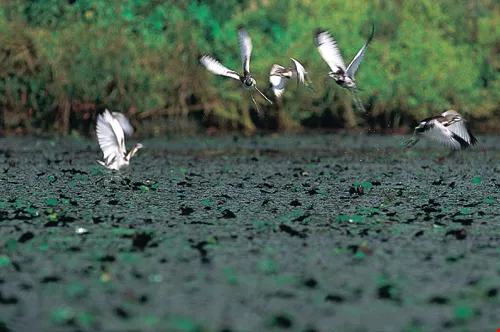
This water caltrop pool offers a safe refuge in Kuantien to the once endangered pheasant-tailed jacana.

Taking the work boat around Tainan's Ssutsao Wildlife Sanctuary you can appreciate the waters and mangroves on either side, and from the birdwatching hide you can also get a look at the many birds that live there.
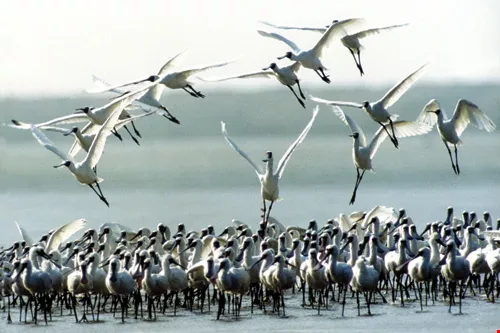
Every year the black-faced spoonbills gracefully fly in to the Tsengwen estuary in Tainan following their long journey from the cold north. Their elegant figures enliven the Taiwan seascape.
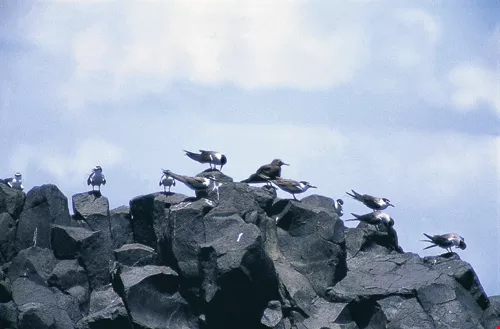
Crashing waves and high rocky reefs are the resting places for many gulls. A frequently seen summer bird--the tern--often constructs its nest on the island's cliffs or on the ground. The picture shows young terns on an uninhabited island of the Penghu group.


