Back to the Land... with a Cultured Twist
Tsai Wen-ting / photos Jimmy Lin / tr. by Jonathan Barnard
June 2003


Kungkuan Rural Township in Miaoli County can boast of many superlatives. It produces more of the pickled leaf mustard known as fucai than anywhere else in Taiwan. It was the site of Taiwan's first oil well. And it has the island's largest amount of acreage given over to the production of red dates.
Although agriculture in Taiwan is generally on the decline and rural areas have been losing their young people, many of Kungkuan's native sons and daughters who had left to pursue their educations or careers have recently been returning. In the same fields that their fathers and grandfathers tilled, they are now constructing European-style farms, traditional Hakka homesteads, and bright, modern farming villas. Apart from attracting tourists, they are recreating Kungkuan for themselves.
Located in the north-center of Miaoli County, between the Pachiaotung Mountains and the Houlung River, Kungkuan served as a bridgehead for the Hakka migration to the rich farmlands of the Holung flood plain.
To prevent incursions by Aboriginal tribes and to keep the Houlung from flooding, the Hakka pioneers made use of local materials to build gravel levees along the river. Inside the levees they carved out rice paddies. "These walls aren't just something that provided for the security of our ancestors," says Liu Tzeng-cheng, who handles media relations for the Miaoli District Agricultural Improvement Station, as he points to the remains of an old gravel levee. "They still serve to support the spirit of Kungkuan today."
During the era of Japanese colonial rule, the Japanese imperial government set up an office here, which is how the place came to be known as Kungkuan, which means "official residence." Kungkuan Rural Township spreads across more than 71 square kilometers and has a population of more than 34,000. The township is made up of 19 farming villages where the aromas of pickled leaf mustard, persimmons, and red dates float upon the air.
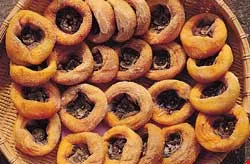
Persimmon cakes, just put out for sale, sure smell sweet.
The many forms of leaf mustard
The Hakkas, with a long heritage of preserving food, are especially excellent at pickling. And Kungkuan, on the alluvial plain of the Houlung River, has extremely fertile soil and excellent irrigation. As a result, the leaf mustard grown here has large leaves and is crispy and sweet. In November of every year, the fields are full of fat, juicy leaf mustard.
Miaoli County produces more leaf mustard than any other county in Taiwan, and Kungkuan accounts for the lion's share of the county's total. Kungkuan also has Taiwan's largest processing plant for leaf mustard, where various forms of pickled leaf mustard are produced, including fucai, suancai, and meigancai. In one year the township produces more than 1200 metric tons, which accounts for two-fifths of all production in Taiwan. It fully deserves the title: "The Land of Fucai."
"Depending upon how long leaf mustard is pickled, it either becomes xuelihong or suancai," explains Chan Yen-chin, director of Kungkuan's largest fucai production plant. "And if suancai is left out to partially dry in the sun, it becomes fucai. It becomes meigancai when it is totally sundried. The stems you use for caixin, either raw or pickled. And the roots, known as datou (big head), are pickled to become zhacai." From one head of mustard leaf, you can get a good glimpse of that traditional Hakka diligence and frugality and see how they made the most of their resources. They really went as far as they could developing pickling techniques for mustard leaf.
With well-aerated, sandy, fertile soil, and large differences between daytime and nighttime temperatures, Kungkuan became not only the homeland of fucai, but also Taiwan's leading source for dates, thanks to local resident Chen Pei-kai's forceful promotion of them during the 1950s and 1960s. Red dates have 100 years of history in Kungkuan, which now has 60 hectares given over to their cultivation. "The first red date tree in Kungkuan was planted 100 years ago by my grandfather, who brought it from Chao-an in Guangdong Province," explains Chen Pei-kai. "The date trees used to be very tall, so that you needed to use a ladder to pick the fruit." But now, with hard pruning techniques and the introduction of dwarf cultivars, the trees are lower. Many curious tourists come to pick the fruit and taste truly fresh dates. The activity has become a new driving force for the tourist farms in Kungkuan.
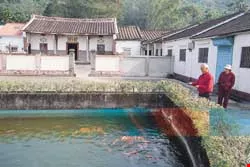
Kungkuan has a history with much cultural significance. This old building is notable for being the former residence of Liu Hsien-ting and son, both of whom were successful in the provincial-level examinations for those aspiring to become imperial officials.
Motherland of wine urns
Apart from having soil well suited to agriculture, the area also has clay suitable for producing ceramics. The clay used for ceramics in Kungkuan is better than the clay found in other areas, because it can withstand temperatures of more than 1350°C. The extreme heat magnetizes the clay, resulting in works that are fine and strong. When you flick your finger against them, they produce a clear and clean high-pitched sound. These are high-quality ceramics.
But there's more to Kungkuan's natural endowment. Apart from producing excellent ceramics, the town also has natural gas and coal. One hundred years ago, a man named Chiu Kou discovered geological evidence of oil, and so dug Taiwan's first oil well. For that reason, this place is also known as Chukuangken, which means simply "pits where you get minerals." Later, the oil gradually dried up, but then a vast amount of natural gas was discovered deep underground here. With clay excellent for ceramics and cheap and easily accessible fuel, Kungkuan became as famous for its ceramics as Yingko in Taipei County.
During the Japanese era, the Japanese enticed many ceramicists from Fuzhou, the capital of mainland China's Fujian Province, to come over and work in Kungkuan. They passed down clay coiling methods for creating large ceramic urns and jugs to store wine or water. "In the 1950s, Miaoli County had 20 to 30 factories just producing wine urns," says Hsu Chi-chuan. "Just look at the bottom of any Taiwan Tobacco and Wine Board urns from that era, and you'll see that they all have Kungkuan's imprint. There have got to be at least 100,000 of them." Hsu's teacher was his grandfather-in-law Li Wan-mu, who was one of the masters that the Japanese brought over from the mainland. Whether you want water jugs as tall as a man or big pickling urns for making fucai, soy sauce, or vinegar, Hsu excels at making all of them.
Bright-colored and delicious-looking strawberries add some color to Kungkuan's spring.
Taiwan's Provence
Like many Taiwanese agricultural towns, Kungkuan has an excellent natural endowment but has struggled to remain competitive and has lost many of its young people to jobs in urban areas. Agriculture and the once vigorous ceramics industry have been greatly weakened. But at least in recent years many of the younger citizens who had left the town have returned. They have served as its engine of economic revival.
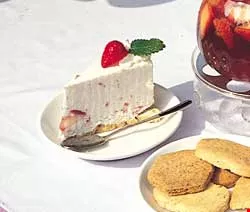
In springtime along Provincial Route 6 in Kungkuan, red raspberries, purple lavender, and yellow sunflowers hug the road, and the air is redolent with the aromas of 40 different herbs and spices, including lavender, rosemary, mint, and thyme. In the yard of a small white house with a red roof, travelers smell the floral aromas wafting on the wind. What with the roast pork chop with thyme, the cup of afternoon tea, and the freshest imaginable strawberry cake, you might think you were in Provence. This is the Joyful Farm, the creation of Lai Sen-hsien, a local of Hakka descent.
In 1990, Lai moved back to Miaoli from Taipei and began raising organic vegetables in Kuangkuan. But then insect damage got him into a lot of debt. Four years ago, Lai began to plant herbs that are naturally repellant to insects, riding the current fashion for aromatic oils and herbs. With his wife acting as cook, his son acting as pastry chef, and his daughter making pressed flowers, the family created the Joyful Farm and the Lavender Home Cafe. It was an immediate hit.
"I feel Kungkuan's pain," Lai says. "You know what? Kungkuan has glass and ceramics. Yet when you talk about glass, everyone thinks of Hsinchu, and if you mention ceramics, well, Yingko is much more famous for that." He holds that these industries are not enough-that Kungkuan will only make a name for itself if it injects these industries with culture.
Lai also knows that if you have only one draw, it will eventually become hard to attract people. And so he has organized more than 10 locals who share his ideals into an agricultural product marketing collective. Some of them specialize in exquisite ceramics, others in Hakka "thunder tea." Some of them plant sunflowers and strawberries, and others plant nothing but roses or cultivate ponds full of water lotuses. They make the entire two kilometers of Kunghsiao Road colorful all four seasons of the year, and they have also successfully turned traditional agriculture into a tourist industry. Last year Lai applied for NT$5 million worth of grants from the Council for Cultural Affairs in order to plant the irrigation ditches on either side of Kunghsiao Road with flowers and herbs, turning it into a most excellent bicycle route.
My home Kungkuan
Although you can say that they've been successful in creating a beautiful locale, as far as Lai Sen-hsien and his ten companions are concerned, they don't want Kungkuan to become nothing more than a place where city people come to ease their pressures-their "backyard" as it were. They emphasize that they have settled down here. It's where they live and work.
Currently restaurants imbued with a natural, relaxed style have shot up like mushrooms after a spring rain. Seeing how some of these restaurants have made enormous balconies and extended them out toward the mountain slopes, with the seats crammed so close together that there's scarcely room to turn around, Lai says: "They fail to live up to Kungkuan's excellent scenery-not to mention any sense of a leisure culture. All I see is the word 'greed.'"
The Ailiao Inn located on Kuanhsiao Road is a place where you can try your hand with pottery and enjoy the lotus blossoms. Its owner Chan Jung-tsai, 46, once worked for gas and security companies. Although elder relatives left him three pieces of land hereabouts, he had previously never considered returning home and settling down in these hills.
But with the recent wave of job losses and unemployment, he returned home. He discovered that all his father's tools were still there, and so he began row by row to clean up his father's garden, working from sunup to sundown for two years. Today, when you open the gate to his garden, you are confronted with the sight of a lotus pool, egrets taking flight, and the sound of frogs. The Ailiao Inn is still a work in progress, and every day after work Chan walks around the garden to take stock of his accomplishments. "I feel as if I've returned to the happiness and purity of childhood," he says.
Li Chin-ming, who took over the Gold Dragon Kiln ceramics factory from his father seven years ago, feels very much the same way. He holds that Taiwanese ceramics factories can't decide what they want to be: They want to do mass production, but also appeal to curio-collecting tourists; they want to hold onto their traditions but also keep up with the latest fashions. Therefore, Li holds, the industry here lacks an established identity and thus faces an uncertain future. "Yet I am actually filled with hope," says Li, who brims with confidence. "My Gold Dragon Kiln is an art village and also a place where my family and I can look after our elders."
Li comes from a family of ceramicists, and his father, two uncles, cousin, two brothers, and sister work there. They concentrate on making handmade water jugs, thus continuing with a product line that brings in certain revenue, and then they take the money they make, and put it into improving their environment: "Last year we built a platform at the side of the forest," says the 33-year-old Li Chin-ming. "Everyone enjoys it there. Come and see." Li points toward a very primitive-looking embankment, lacking cement, upon which sit two or three small brick structures. There's even a white swan on the river!
For hundreds of years, the people of Kungkuan have understood that the value of a farming culture isn't in the price of a pound of grain, but rather in the love of the land.
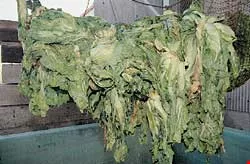
Persimmon cakes, just put out for sale, sure smell sweet.
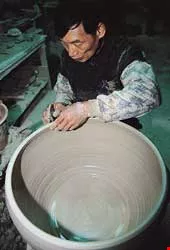
With good clay and ample fuel in the form of natural gas, ungkuan Rural Township is one of Taiwan's main towns for manufacturing ceramics and is particularly famous for its large water jugs and alcohol urns.
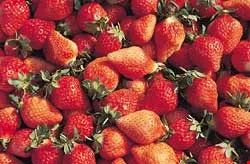
Bright-colored and delicious-looking strawberries add some color to Kungkuan's spring.
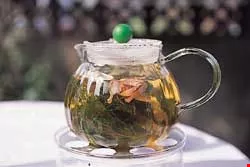
(right) The tastes of herbal teas and cake, decorated with strawberries and herbs from the garden, really linger in the memory.
@List.JPG?w=522&h=410&mode=crop&format=webp&quality=80)


