

April was an important month in terms of Taiwan’s relations with other countries.
In the realm of Taiwan–US relations, April saw the 35th anniversary of the US’s “Taiwan Relations Act.” To mark the occasion, the Taipei office of the American Institute in Taiwan held a variety of commemorative activities, while a number of high-ranking officials visited Taiwan. There was also a videoconference linking President Ma Ying-jeou with the Center for Strategic and International Studies, a think tank in Washington DC.
In terms of Taiwan–Japan ties, the month saw the first anniversary of the signing of the Taiwan–Japan Fisheries Agreement. This agreement, built on the foundation of the East China Sea Peace Initiative and its core concept “while sovereignty is not divisible, resources can be shared,” has brought clarity and certainty to maintaining maritime peace between the two sides and ensuring the safety of fishermen. At the CSIS videoconference, President Ma made a special point of saying that in the future the spirit of the East China Sea Peace Initiative can also be applied to the South China Sea.
On April 9, just one day before the 35th anniversary of the passage of the Taiwan Relations Act (TRA), President Ma Ying-jeou participated in a videoconference with Washington DC-based think tank the Center for Strategic and International Studies (CSIS). During the event President Ma delivered an address entitled “Soar on the Wings of Partnership.” Participants on the US side included CSIS president and CEO John Hamre; Christopher K. Johnson, holder of the Freeman Chair in China Studies; US Congressman Mario Diaz-Balart, co-chairman of the Congressional Taiwan Caucus; and Paul Wolfowitz, chairman of the US–Taiwan Business Council.
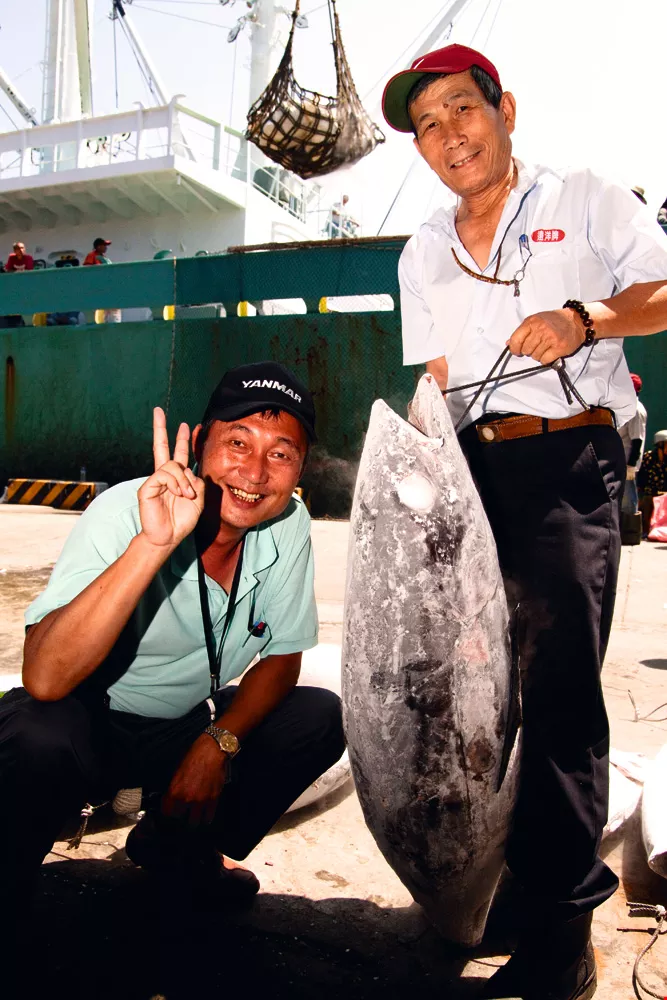
Building on the concept that resources can be shared, fishing boats from Taiwan have multiplied their catch in the area covered by the fisheries agreement by 3.56 times in just the past year.
In his remarks, President Ma stated that with the restoration of high-level mutual trust, “US–Taiwan relations are the strongest they have been in 35 years or more.” As part of the mandate of the TRA, Ma said, the US has continued its support for Taiwan’s participation in international organizations. He noted that in May of 2009 the ROC health minister attended the World Health Assembly in Geneva after an absence of 38 years, and that last September the director-general of the ROC Civil Aeronautics Administration was invited to a meeting in Montreal of the International Civil Aviation Organization, as a guest of that body’s president.
The TRA is a quite unique piece of legislation. In 1978, US president Jimmy Carter announced the withdrawal of US diplomatic recognition of the ROC, but sent a draft of the TRA to Congress in an effort to compensate. After the bill was amended extensively by Congress, Carter signed it into law on April 10, 1979, retroactive to January 1. One analyst said that it amounted to a “re-recognition” of Taiwan by the Carter administration. Ma also noted that in July of 1982, then-president Ronald Reagan issued the “Six Assurances” to Taiwan, in which the US “reiterated its continued commitment to Taiwan’s security.”
Today, the TRA has even greater significance. In recent years, Ma said, the relationship between the two sides has taken great strides forward, and trade and investment relations are increasingly close. In 2013, Taiwan was the US’s 12th largest trading partner in goods, with bilateral trade of US$57.7 billion. The US is also the single largest source of direct foreign investment in Taiwan, with total cumulative investment reaching, as of January 2014, US$23 billion. In March 2013, the two sides resumed talks under the 1994 Taiwan–US Trade and Investment Framework Agreement, and the eighth TIFA meetings wrapped up in Washington in early April of this year. Taiwan hopes to soon launch negotiation of a bilateral investment agreement, which, Ma concluded, would serve as “the beginning of a more robust and comprehensive economic relationship” between the two parties.
During the videoconference, Paul Wolfowitz commented, “I feel strongly that Taiwan should be more open to trade. It is critical for Taiwan’s future and for Taiwan’s democracy.” He added that the Ma administration’s approach to cross-strait relations has been helpful in terms of efforts by the US–Taiwan Business Council to attract more US companies to Taiwan.
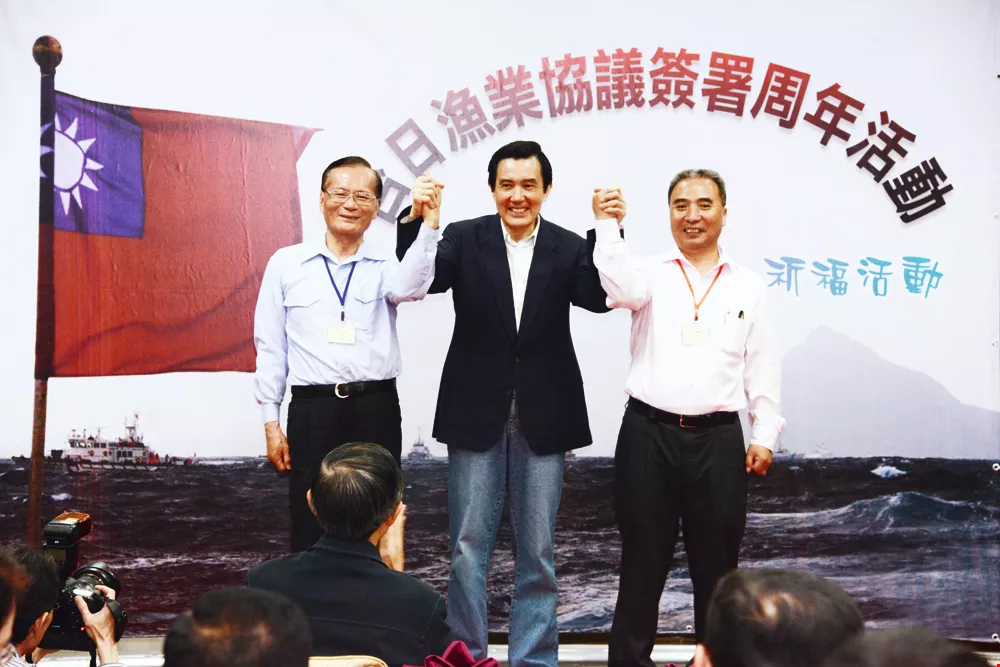
On the first anniversary of the signing of the Taiwan–Japan Fisheries Agreement, President Ma Ying-jeou, accompanied by ROC Coast Guard Administration minister Wang Ginn-wang (left), attended an event organized by the Su’ao Fishermen’s Association to mark the occasion.
There was a also great deal of positive activity in the period surrounding the 35th anniversary of the TRA.
First, the American Institute in Taiwan held commemorative events, drawing attention to the fact that the law has exceeded initial expectations. Although the US and Taiwan lack formal diplomatic ties, the friendship has remained very strong. Bilateral cooperation today covers a wide range of issues, including energy, security, environment, legal processes, and scientific research.
Second, there was a ceremony to mark the beginning of direct flights by United Airlines between Taipei and San Francisco.
Third, the Fulbright scholarship program held its Asia–Pacific meeting in Taiwan for the first time ever, and US officials from all over the Asia–Pacific region attended, as did US State Department official Susan Stevenson, deputy assistant secretary for public diplomacy in the Bureau of East Asian and Pacific Affairs.
Finally, there were a number of high-level visits to Taiwan by officials from the US executive branch, including: Gina McCarthy, head of the US Environmental Protection Agency (to exchange views on environmental cooperation and related issues); Holly Vineyard, deputy assistant secretary for Asia in the US Department of Commerce’s International Trade Administration (who attended the 38th APEC High Level Policy Dialogue and delivered the opening remarks at an APEC conference on participation by small and medium-sized enterprises in the global supply chain); and Nerissa Cook, US deputy assistant secretary of state for international organization affairs (who attended meetings in Taipei on issues related to the global economy and development).
Improved Taiwan–Japan relationsThe Taiwan–Japan Fisheries Agreement, which was a major step forward toward bilateral consensus on the diplomatic and fisheries fronts, also marked its first anniversary on April 10. During this year, it has made life much easier and alleviated concerns for fishermen from both countries.
Fisheries negotiations between Taiwan and Japan had in fact dragged on for 17 years with little progress. To permit the breakthrough in the signing of the fisheries accord last April, the two sides agreed to set aside their dispute over the Diaoyutai Islets. The agreement covers an area with 27º north latitude as its northern boundary and the Yaeyama Islets and Miyako Islets (both belonging to Japan) as its southern boundary, excluding waters within 12 nautical miles of the Diaoyutais. Fishing boats from both countries now enjoy guarantees to operate in this area free of any interference. This can be considered a concrete accomplishment resulting from the East China Sea Peace Initiative.
As another sign that Taiwan–Japan relations continue to progress, treasures from Taipei’s National Palace Museum will go to Japan in June for an exhibition. The friendship between the two sides is deepening in a variety of areas, and in very tangible ways.


