Remaking Our World—Outstanding Taiwanese Women in Science
Chang Chiung-fang / tr. by David Smith and Scott Williams
August 2014


They say that behind every successful man is a great woman. The late, great female nuclear physicist Wu Chien-shiung, who was often called “the Chinese Madame Curie,” is a case in point, as she was arguably the driving force behind Nobel laureates Lee Tsung-dao and Yang Chen-ning.
But times have changed, and women are less and less resigned to being just the wind beneath someone else’s wings. Women nowadays take full advantage of every opportunity, and in recent years have risen to prominence in even the formerly male domain of the sciences.
These prodigiously talented women, toiling away unnoticed by ordinary folks like you and me, are changing the world.
This year is turning into a big one for Taiwan’s female scientists. Many have led or taken a prominent part in research published in internationally renowned scientific journals, earning “pride of Taiwan” designations for themselves in the sciences.
In January, 30-year-old Assistant Professor Chou Yi-chia of the National Chiao Tung University Department of Electrophysics published a paper entitled “Atomic-Scale Variability and Control of III-V Nanowire Growth Kinetics” in Science magazine.
In late January, Dr. Hsueh Yi-ping, a research fellow with the Institute of Molecular Biology (IMB) at the Academia Sinica, discovered a potential cause and treatment for autism. The culmination of nine years’ work, her research earned publication in the academic journal Nature Neuroscience.
In mid-March, L’Oréal Taiwan, the National Women’s League of the ROC, and the Wu Chien-shiung Education Foundation presented their seventh annual “Outstanding Women in Science Awards,” a set of prizes created specifically to honor Taiwan’s leading female scientists.
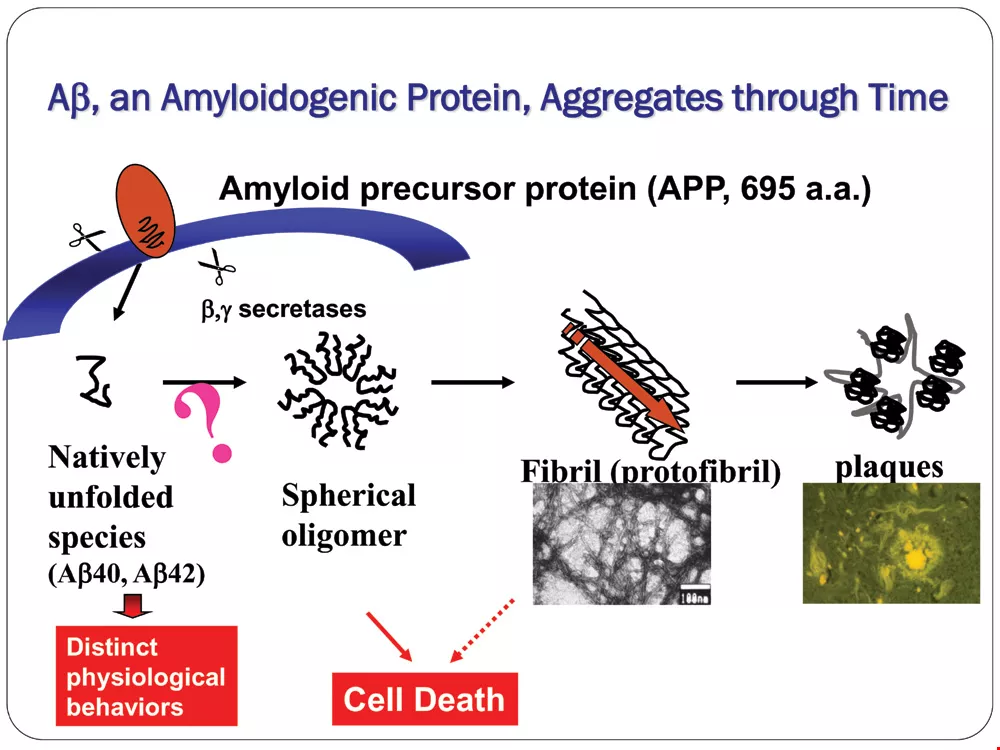
Over time, beta amyloid (Aβ), an amyloidogenic protein, clumps together to form the plaques characteristic of Alzheimer’s disease.
While some have argued that establishment of an award specifically for female scientists points to the intractability of gender imbalances in the sciences, the relative rarity of women in science is a global phenomenon. In fact, only 5% of all the Nobel prizes ever awarded have gone to women. The percentage of scientific Nobels awarded to women is lower still.
Men still far outnumber women in Taiwan’s present-day scientific community. According to Dr. Yan-hwa Wu Lee, president of National Chiao Tung University, male faculty outnumber female faculty at her university by a ratio of ten to one.
Though still relatively few in number, Taiwan’s female scientists are proving to be just as ambitious as the men and are earning standing in their respective fields of research.
Academia Sinica academician Jacqueline Whang-Peng is a case in point. The first winner of the Outstanding Women in Science Award in 2008, Whang-Peng conducted pioneering research on the role of chromosomal abnormalities in carcinogenesis. In fact, her contributions to the treatment of cancer are virtually second to none in Taiwan.
This year’s awards focused on the biological sciences, with the outstanding scientist prizes going to Dr. Yu Su-may, a distinguished research fellow with the IMB, and Dr. Chao A. Hsiung, director of the Institute of Population Health Sciences at the National Health Research Institutes.
Both Yu, who studies rice genomics and is known as the “godmother of paddy rice,” and Hsiung, who has analyzed factors causing lung cancer in non-smoking women and is actively involved in research on healthy aging, have a clear record of outstanding achievement.
Born to a farming family in Waipu District, Taichung, Yu says her entire life has been connected to paddy rice. She’s been working with paddy rice gene transfers for more than 20 years, looking for genes to help rice cope with adverse conditions such as drought, cold, and soil salinity. These efforts have increased the crop’s resistance to poor conditions and raised yields by 40–50%.
To that end, Yu has also established the Taiwan Rice Insertional Mutagenesis (TRIM) database, which has decoded 60,000 genetic mutations, the third highest number in the world. Made available to scholars worldwide, TRIM’s results have already surpassed those of similar databases in Japan and South Korea.
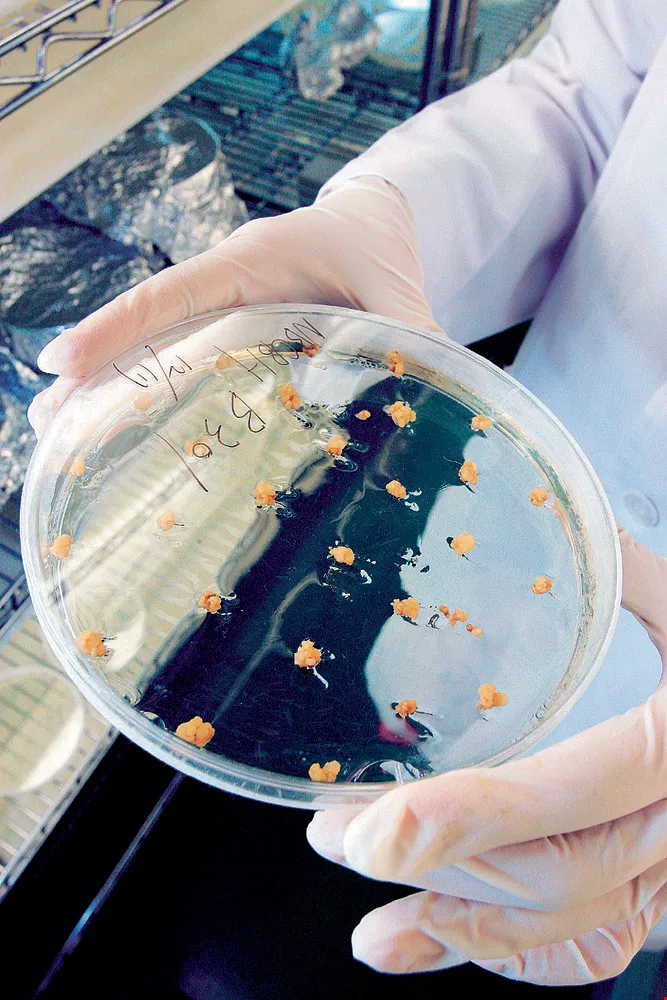
Yu Su-may’s laboratory in the Academia Sinica’s Institute of Molecular Biology cultivates transgenic grain tissues in Petri dishes.
The awards for women in science recognize the outstanding achievements of established female researchers, while also encouraging up-and-comers. This year’s Promising Women in Science Award went to Denise H. Wu, an associate professor with the Institute of Cognitive Neuroscience at National Central University, and Chen Yun-ru (Ruby Chen), an assistant research fellow with the Genomics Research Center at the Academia Sinica.
Chen comes from a family celebrated for their contributions to medicine and public health. Her father, Chen Ding-shinn, is an academician with the Academia Sinica known for his work on hepatitis. Her mother, Hsu Hsu-mei, is a former director of the Bureau of Communicable Disease Control at the Department of Health and an educator in the Department of Public Health at National Taiwan University.
Perhaps because her parents were always so busy, Chen says, she grew up with minimal parental “interference,” and was instead largely raised by her grandmother.
What prompted her to go into the sciences, a life path few women choose?
Chen’s grandmother began to lose her faculties while Chen herself was still in high school. Saddened by the experience, she resolved to go into research to unravel the mysteries of Alzheimer’s disease.
Nowadays, Chen’s nine-person lab investigates protein folding mechanisms and diseases caused by misfolding.
She explains that most amyloidoses (diseases involving deposition of amyloid proteins) are related to neurodegenerative diseases, her grandmother’s Alzheimer’s being a case in point. By focusing her efforts on the disordered proteins that cause neurodegenerative diseases, she hopes to unearth information that could lead to early diagnosis and treatment.
She has also extended her research to the newly discovered TDP-43, a protein linked to diseases such as frontotemporal dementia and amyotrophic lateral sclerosis (ALS). Her lab has developed a TDP-43 antibody that may be helpful in future biomedical research and applications.
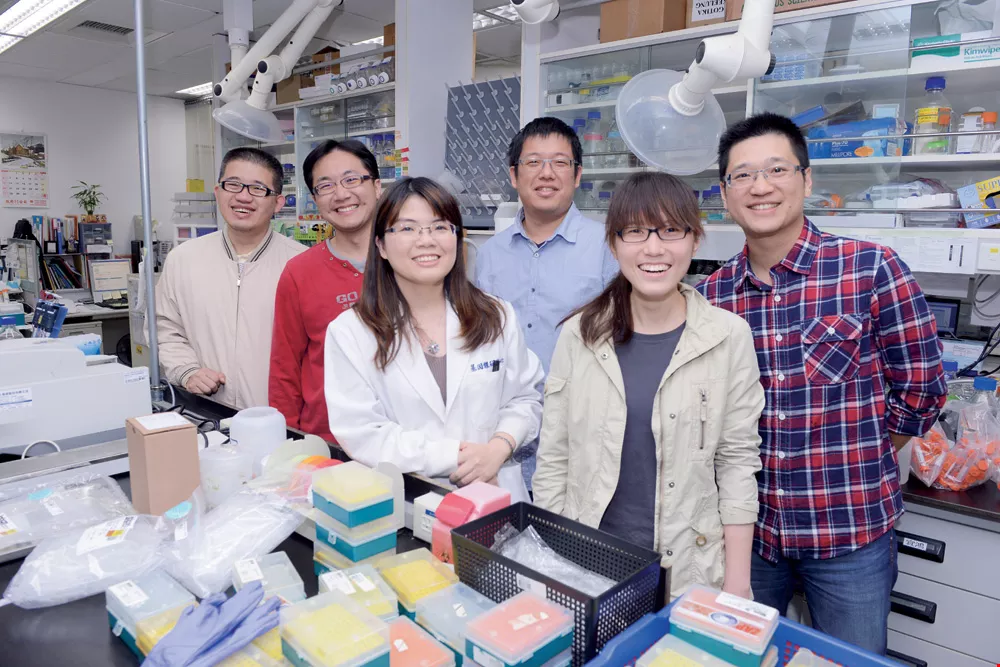
Chen Yun-ru (third from left) leads a lab in the Academia Sinica’s Genomics Research Center that studies protein folding mechanisms, as well as diseases caused by misfolding.
Chen’s entire family attended the Outstanding Women in Science awards ceremony, her husband bringing their five-year-old and seven-month-old daughters. The couple were adorable holding their baby girl, creating an image totally at odds with the usual picture of the unemotional and career-focused scientist. But seeing them like that couldn’t help but raise questions about how women in the sciences balance work and family.
Chen, whose youngest is still in diapers, has had a time of it managing all the demands of work and family. Her husband used to teach in the Department of Photonics at National Cheng Kung University, which placed them in different parts of Taiwan and left her managing her job and the kids on her own. “I’d often have to dash out to pick up the kids in the middle of experiments.”
Fortunately, her husband was hired by the Research Center for Applied Sciences at the Academia Sinica in February and the family now lives together.
“You can’t take maternity leave in the sciences,” says Chen. She explains that you can’t just suspend a research program. Your lab can’t just sit around doing nothing awaiting your return.
Luckily, as grueling as it is to raise children while also pursuing a career, that period does eventually come to an end. With the support of a husband and extended family, most women in the sciences can grit their teeth and pull through.
The cutting-edge research of established women scientists like Jacqueline Whang-Peng, Yu Su-may and Chao A. Hsiung, and the brilliance of younger-generation scientists such as Chen Yun-ru and Chou Yi-chia, prove beyond doubt that the era of outstanding Taiwanese women in the sciences has arrived.


@List.jpg?w=522&h=410&mode=crop&format=webp&quality=80)
@List.jpg?w=522&h=410&mode=crop&format=webp&quality=80)
