A Lotus Blossom Rising From the Mire--Kuanyin Transforms Itself
Chang Chiung-fang / photos Hsueh Chi-kuang / tr. by Christopher J. Findler
September 2001


Dusk/ A cool breeze/ Swallows dart/ The sun sinks in the west/ Gently I embrace the flower/ The blossom so shy/ Shy and blushing/ I want to go to Kuanyin to see the lotus flowers. ("I Want to go to Kuanyin to See the Lotus Flowers," Cheng Chiu-hsuan)
Each year between June and August, visitors flock to Kuanyin to view the lotuses and water lilies.
It is interesting to note that Kuanyin, the location of the new lotus industry, is named after the Bodhisattva Kuanyin, who is almost always represented standing on a lotus.
The story of the ugly duckling can be seen in the lotus wonderland of Kuanyin as it transforms itself from an industrial zone to a tourist mecca.
This is the third year of the Kuanyin Lotus Festival. On any given holiday or weekend morning, tourists from all over flock to Kuanyin in Taoyuan County to enjoy the lotus blossoms.
Over 40 hectares of land in Kuanyin is dedicated to lotus cultivation. In a dozen-odd farms of various sizes can be found a wide assortment of water lily and lotus varieties, ranging from the ornamental to the fragrant to the edible. Kuanyin's lotuses are thriving this year thanks to the lotus farmers' accumulated experience, and the fact that this year's typhoons have so far spared northern Taiwan.
Kuanyin's story
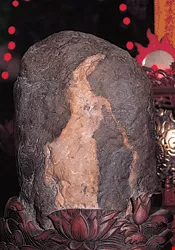
It is said that during the Xianfeng reign (1851-1861) of the Qing Dynasty, a farmer returning from the fields found in a river an unhewn stone shaped like the head of the Bodhisattva Kuanyin. He enshrined and worshipped it, calling it the Stone Kuanyin, and the local area was dubbed Shih Kuanyin Chuang (Stone Kuanyin Town). This was changed under Japanese rule to "Kannon Sho" (Kuanyin Town), and again to "Kuanyin Rural Township" in 1946 after Taiwan returned to Chinese rule.
In addition to inspiring the name for Kuanyin Rural Township, the stone likeness is the symbol of the Kuanyin community. Local residents built Fulung Temple to venerate the stone Kuanyin. In 1895 they found a gushing spring beside the temple. The crystal-clear water of Kanchuan Ching (Sweet Spring Well) is said to cure a multitude of ailments. The nearby Kanchuan Temple (Sweet Spring Temple) is the pulsating heart of the town. Tseng Hsien-pin, general secretary of the temple's management committee, points out that the people of the area look to Kuanyin for propitious days for planning important events such as weddings and funerals. Unmanageable or poorly behaved children are brought to Kanchuan Temple where the Bodhisattva Kuanyin is made their "godmother." Today she has tens of thousands of "godchildren."
Kuanyin Rural Township has prospered economically, but the cost has been high-industrial pollution has seriously degraded the environment of the area.
Kuanyin is a microcosm of the history of Taiwan. Years ago, Kuanyin, with its many agricultural ponds, was known as the granary of northern Taiwan. With just about one pond for each of the 23 hamlets in the area, the ponds are important parts of the collective memory of the local residents. Chung Tien-long, the director-general of the Kuanyin Cultural Work Team, says that many locals remember fishing and swimming in the local ponds when they were young.
Kuanyin is also well known for growing crisp, sweet watermelons. 75-year-old farmer Wu Shui-jung, the first person to grow watermelons in Kuanyin, explains that the local sandy red soil is ideal for big watermelons.
In 1977, Kuanyin experienced a dual disaster. The windbreak trees died, and then the rice harvest failed. The trees' death was caused by pollution-presumably from a coal-fired power station at Linkou.
Wu Shui-jung says that in the past, rice crops were watered by showers from the northwest. Locals believe that with the death of the windbreak trees, the northwestern showers stopped coming and agriculture declined. But industry stepped in to take its place.
Lee Wen-kuei, a county legislator at the time, explains that then-premier Sun Yun-hsuan personally inspected Kuanyin following these disasters and instructed the Ministry of Economic Affairs to set up an industrial zone in the coastal area near Kuanyin. As a result, Kuanyin Rural Township hopped on board Taiwan's train to prosperity, transforming this quiet little agricultural region into the largest industrial township in northern Taiwan.
Key industrial region
Factories started sprouting up in the Kuanyin Industrial District in 1981. According to town hall statistics, the Kuanyin Industrial District has 497 factories of various sizes.
It is difficult to say just how much damage the Kuanyin Industrial District has brought to Kuanyin Rural Township, and opinions differ as to whether the pros of development exceed the cons.
Li Wen-kuei, the mayor of Kuanyin for eight years beginning in 1986, says that industry brought prosperity to this poor agricultural area. When industry first came, roads that were little more than paths grew into a network of 30-meter wide roadways. Real estate prices (in NT dollars) jumped from six-digit sums per hectare to eight-digit amounts.
Development brought prosperity, but not necessarily job opportunities. Chen Wen-hsi, currently 20-something and working in Chungli, says that he always knew that when he grew up he would have to leave his hometown to find work. From his point of view, you would never notice that Kuanyin is the largest industrial zone in northern Taiwan. The majority of local residents feel that the industrial zone has done little for the local area but brings in droves of workers bussed in each day. It hasn't brought things like hospitals and schools.
Meanwhile, the amount of land being farmed in Kuanyin has been shrinking, with some farmers simply opting to throw in the towel. Residents have experienced a series of problems as a result, including illegal gravel extraction, trash dumping, and building-spoil dumping.
Because of the seriousness of the situation, Kuanyin environmentalists organized the "Kuanyin Cultural Work Team" in 1994 to try to arrest the devastation. The head of the team, Wang Chao-yi, points out that the high quality pebbles found underground in the Kuanyin alluvial plain have been disastrous as idle farmland has drawn illegal gravel mining, and the gravel pits have then been used as landfills, leaving behind a ravaged landscape.
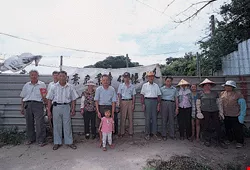
Since 1994, residents of Paochang Village in Kuanyin Rural Township have been trying to protect the environment by blocking off coastal roads to gravel and garbage trucks. Unfortunately, new problems keep cropping up. The county government once again roused the ire of Paochang citizens by permitting private landfills to be set up in Paochang. Since March 1999, citizens have been manning roadblocks in front of the dumps. Newspaper headlines in February of this year stated that dump owners have begun hiring gangsters to break through blockades.
Creating a Gold Coast
The land gouging and garbage dumping problems have yet to be resolved. On May 28 of this year, work commenced on the Kuantang Industrial Zone and its affiliated port, both located in Kuanyin.
Township mayor Kuo Jung-tsung explains that Kuanyin issues such as idle land and illegal gravel extraction will be resolved as the Kuantang Industrial Zone is developed. He envisions hope for Kuanyin in the form of a "Kuanyin Gold Coast" and a prosperous industrial town. With today's Kuanyin Industrial District, and the future Kuantang Industrial Zone, Taoyuan Science and Technology Park, and Taoyuan Harbor, he sees this as a dream that can be realized.
Kuo asserts that in the end, locals will have to choose between pollution and prosperity. Kuanyin is the largest industrial zone in northern Taiwan and its residents enjoy the best social benefits in Taiwan. He explains that Kuanyin residents are granted NT$3,000 for hospitalization of three days. Families receive NT$5,000 if a loved one passes away. Women are granted maternity allowances of NT$3,000. The township government pays the insurance premiums of farmers over 60 years of age. Residents also receive NT$1,000 bonuses on each of the three major annual holidays. Finally, grants of NT$2,000, NT$3,000, NT$6,000, and NT$10,000 per semester are available to local students studying in high schools, junior college, universities and graduate schools.
Li Wen-kuei scoffs and says, "What we want is the advancement of Kuanyin as a whole. We don't need this new form of vote buying!"
Wang Chao-yi, director general of Kuanyin Cultural Work Team, says that the Kuantang Industrial Zone and its harbor are being built partly to land natural gas for Taipower's new Tatan Power station. It is a far cry from the international commercial harbor that local residents are hoping for.
Some suspect that not only is the "Gold Coast" scheme unfeasible, but that the design of Kuantang Harbor will also damage the environment. Wang Chao-yi explains that the development of the Kuanyin and Tatan industrial zones has already destroyed most natural windbreaks. The few trees and sand dunes still left will be torn down when they construct the Kuantang Industrial Zone.
New land for the Kuantang Industrial Zone is to be created by reclaiming land from the sea. This would probably be especially disastrous to the Kuanyin coastline. The planned design for the Kuantang Industrial Zone Harbor would produce silting to the north and erosion in the south. In only a few years, the Kuanyin White Beach ocean resort to the north would become sand dunes. The dream of local residents for a commercial port to inject money into their community is unfounded.
Saving Kuanyin
As they struggled to save the environment of Kuanyin, residents stumbled across a way to save Kuanyin economically.
Five years ago, environmentally concerned individuals of Kuanyin organized the "Save the Taku River League" demanding that factories dumping waste into the Taku River improve waste disposal methods or move their factories. Two years later, residents tested the water quality, banned fishing, released fish into the river, and planted lotus plants. They had no idea that the plants would flourish so well and become a new local industry.
Kuanyin's lotus farmers have their eyes set on developing tourism. Kuanyin is doing its best to bring in tourists with attractions like the lotus ponds, lotus banquets, camping, barbecues, historic buildings, Kanchuan Temple, Paishachia Lighthouse, and the mudskippers, Kandelia mangroves and fiddler crabs around the mouth of Hsinwu Creek.
This unexpected windfall has brought hope to the people of Kuanyin. Why not let the cool springs and beautiful lotus blossoms of Kuanyin give you a reprieve from the muggy heat of the crowded city? Plan an unforgettable trip for the children to the Land of Lotuses.
Profile of Kuanyin
Kuanyin Rural Township is located halfway along the coast of Taoyuan County. With an area of 87.79 square kilometers, it weighs in as Taoyuan's fourth largest township. It is divided into the Kuanyin, Hsinpo, and Tsaota Districts, and has a population of over 53,000 people.
Getting there: Take the Tayuan off ramp and drive toward Tayuan. Take Highway 15 through the Kuanyin Industrial District and turn right onto Chungshan Road. Go straight until you reach Kuanyin. You can also take the Chungli off ramp and drive towards Chungli. Turn left onto Huanpei Road. Turn left again at the first traffic signal and drive straight until you reach Kuanyin.
Kuanyin Rural Township is currently the largest lotus producing area in northern Taiwan. The lotus season lasts for three months beginning in June.
Points of interest: Kanchuan Temple, Paishachia Lighthouse, the historic Chuang Family house in Taku Village, Tsaota Sand Dunes, and the many lotus farms-Shangta, Taku, Lin Family Historic House Holiday Farm, Wutsuo Yangchiachuang, Tatung, Lotus Country, Lotus Winds, Hsinwu and Tsaota-each of which has its own character.
For more information, see www.tyhg.gov.tw.
p.091
The arable land of Kuanyin Rural Township, one-time breadbasket of northern Taiwan located halfway along the coast of Taoyuan County, is dwindling because of the development of local industry. In recent years, Kuanyin residents have been pressing for reforms in an effort to reclaim the past beauty of their land.
p.092
Locals frequently protest the serious chemical pollution from Kuanyin, northern Taiwan's largest traditional industrial zone.
p.093
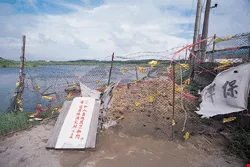
In March of 1999 Paochang Village residents set up long-term road blocks at waste disposal site entrances to protest county government sanctioning of private dumps.
p.094
Kuanyin is abuzz with a carnival-like atmosphere due to lotus season activities held there over the past few years. The area is studded with lotus ponds, and the scent of lotus pervades the industrial zone.
p.095
Kuanyin Rural Township is named for its tutelary god, the Stone Kuanyin in Kanchuan Temple.


_DSC2938@List.jpg?w=522&h=410&mode=crop&format=webp&quality=80)

@List.jpg?w=522&h=410&mode=crop&format=webp&quality=80)


