Wushu and Archery
The Way of the Gentleman
Lin Hsin-ching / photos Chuang Kung-ju / tr. by Geof Aberhart
November 2013


Where the Western sporting tradition emphasizes physical strength and quantifiable development, the martial arts of the East place as much focus on developing the character and spirit as the body.
Two schools, Nantou County’s Yongxing Elementary and New Taipei City’s Dapu Elementary, have begun integrating these traditional concepts into their physical education classes. How exactly are they using the wisdom of the ancients, and what effect is it having on the younger generation?
Yongxing Elementary is located in a historic part of Nantou, deep in the mountains in an area that in the late 19th century hosted an academy founded by renowned Qing general Wu Guangliang. Today, the school has just around 40 students, but each and every one is earning a reputation as a “mini Ip Man” for their skill with fist, staff, fan, and spear.
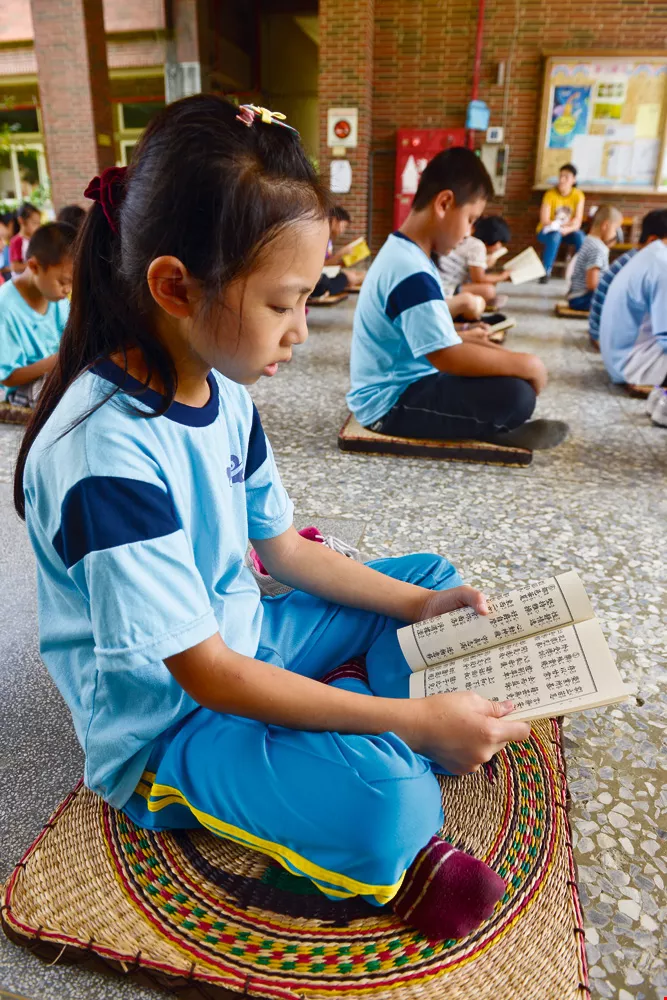
Meditating and reading scripture before starting wushu practice helps the children train calmness and concentration.
Beneath the six-decade-old mango tree that serves as a school landmark, a few dozen children give the characteristic wushu salute, right hand clasped in a fist, pressed against the palm of a left hand with the fingers extended. The salute symbolizes their respect for the martial arts and their commitment to using them in friendly competition. Moments later, the grounds are alive with students practicing moves like the “tiger–swallow routine” and “power split” from the Northern Praying Mantis style.
The looks on the faces of these “mini Ip Mans” are full of focus and determination, their movements agile and powerful. But the path to becoming a modern-day master is not an easy one—these youngsters have been practicing wushu every Tuesday, Wednesday, and Thursday morning. In first and second grades they begin by practicing fan-style tai chi, moving on to more combat-oriented fighting styles in third and fourth grades. In fifth grade, the students advance to weapon styles like the Shaolin staff, and then in sixth grade, the more challenging “six harmonies spear.”
Even more impressive is what comes before all the sparring. The children sit still, legs crossed and eyes closed, meditating with their teacher’s guidance. Like little buddhas, the children sit on a journey into themselves, into the world of the mind and soul.
Once their meditation is over, they move on to reading ancient texts, the words of the “Thousand-Character Classic” reverberating around the school grounds. A passerby could be forgiven for thinking they’d stumbled into mainland China’s Shaolin Temple.
So why the meditation and readings for a kung fu class? “If their bodies and minds are not both in order, then all the children will learn is to be rowdy; training body and mind at once is the true essence of the martial arts,” says Yongxing Elementary’s director of academic affairs and martial arts teacher Jiang Hongsheng, who also previously chaired a tai chi association in Nantou.
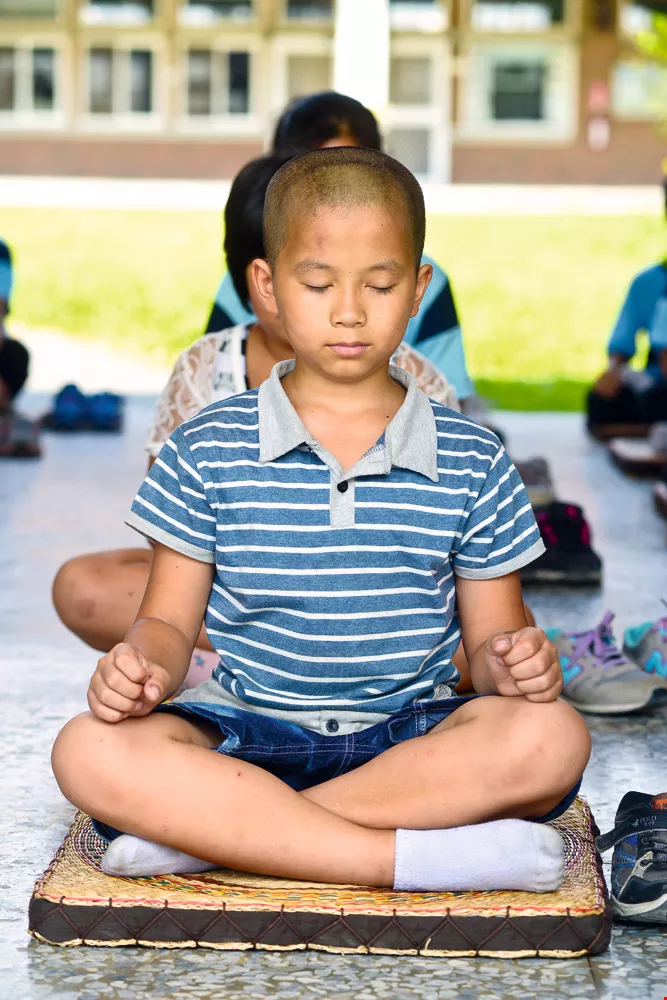
Meditating and reading scripture before starting wushu practice helps the children train calmness and concentration.
The teaching of wushu at Yongxing Elementary goes back some 20 years to an experiment by former academic affairs director Chen Hanyu, who himself had a background in wushu and traditional Chinese medicine. He introduced wushu to the PE curriculum, but in those earlier days the school’s approach was less systematic.
When the Jiji earthquake of September 1999 struck, the school was seriously damaged, and for nearly three years afterward the students had to use prefabricated classrooms and the local community activity center for their classes.
It was in these dire circumstances that the teachers and students returned wholeheartedly to the idea of practicing the martial arts.
Principal Chen Wenyuan explains that they made the choice in part because the school lacked dedicated sports facilities, and wushu can be practiced virtually anywhere.
The school opted to take an approach that combined the martial arts with building the children’s character; basic stances like the horse and crane stances are used to train their stamina and willpower, after which they move on to more advanced training, including sparring both with and without weapons.
Jiang notes that students who have excelled in their studies of wushu also tend to excel in terms of their grades, as wushu can train not only physical fitness, but also endurance, mental calmness, and concentration. Many of their students have gone on to test into respected colleges like National Cheng Kung University and National Tsing Hua University.
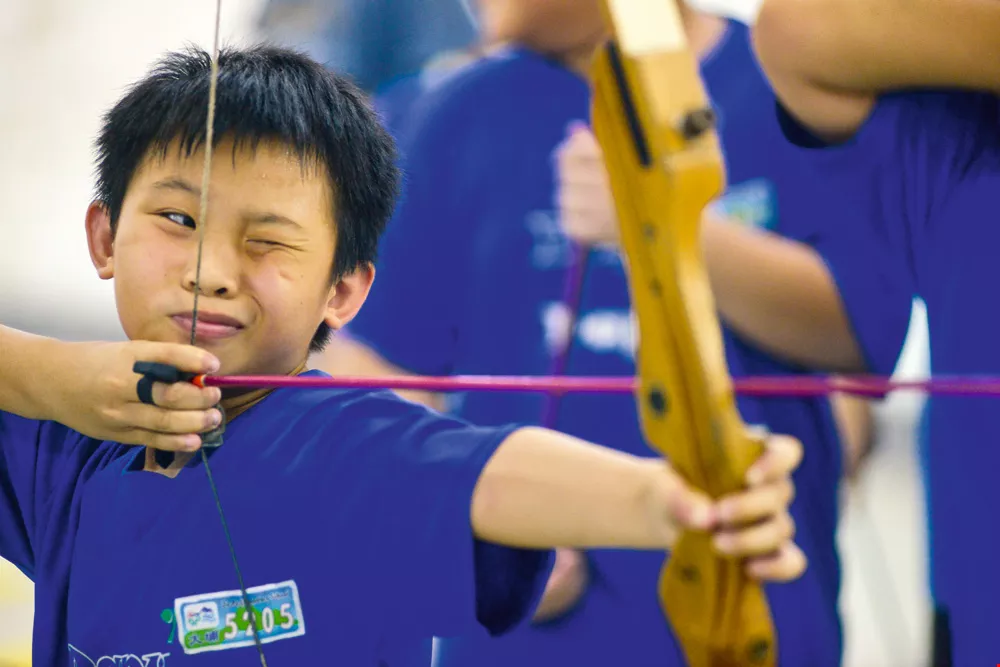
Archery is a challenging sport, requiring competitors to stay calm and collected in the face of the pressure of competition.
Another traditional sport that similarly emphasizes mental training is archery.
Archery is one of the few sports in which Taiwan has achieved at the highest levels internationally, and Dapu Elementary in Sanxia, New Taipei City, has become home to some of Taiwan’s best archers.
Dapu’s archery program has been running for 20 years. Originally it was only an attempt to give the school a distinctive selling point, but as it turned out, the students loved it. The school sought funding from the Ministry of Education to pay for training and equipment, and then hired a national-level archery coach. Since then, Dapu’s students have gone from success to success in all the major archery competitions, inspiring a passion for the sport throughout the school.
Starting in fourth grade, students at Dapu Elementary all take one archery class a week. Before they start the class, they have to sit and meditate, learning to focus before doing stretches and practicing their stances and draws. Then, finally, they can step up to the mark, nock an arrow, and set it flying at the target.
Archery training can sometimes get repetitive, so to keep the kids interested, coach Guo Qixian designed a variation for them—a balloon is tied to the target, and if a student can burst the balloon with a shot, a buzzer sounds, signaling their triumph and inspiring them to continue challenging themselves.
Only clear minds hit the targetGuo notes that archery is a tremendous kinetic challenge—the weight of an arrow is mostly concentrated at its metallic tip, while the power that propels the arrow is concentrated at the other end. When an arrow is loosed, it tends to wobble for the first 10 meters before finally straightening up.
Whenever an archer prepares to shoot, they have to go through all kinds of physics calculations in their head even before they draw the bow. On top of that, archery is usually a one-on-one competition, so neither competitor can afford to let nerves get in the way. Only the competitors with the clearest minds and who handle pressure the best will stand a chance at victory.
Guo notes that the children who do best at archery tend to be cool, calm, and collected by nature, because they’re the ones best able to handle the pressure of competition. Children who are easily distracted or overactive, meanwhile, often learn to control their emotions and focus better through the repetition of archery training.
Both wushu and archery alike place as much emphasis on mental training as on physical training. While young children may find both occasionally boring, ultimately these sports provide them with resources that will last them a lifetime.


