Pulling Back to Take the Lead
Tug of War in Taiwan
Lin Hsin-ching / photos Chin Hung-hao / tr. by Geof Aberhart
January 2013


In what sport is Taiwan most competitive internationally? Taekwondo? Golf? Baseball? No: it’s tug of war.
Since 2004, Taiwan has competed in quite a number of first-class international tug-of-war competitions, taking home dozens of gold medals. Women’s indoor tug of war has been the standout, with women’s teams walking away with five straight Asian Cup championships and four straight World Cup titles.
But behind the glitz of gold are tales of blood, sweat, and loneliness from competitors and coaches.
As the starting buzzer sounds, the teams take their positions, looking like half-fallen dominoes packed into tight, opposing lines. Their youthful faces drenched in sweat, their bodies bent to their limits, and their hands thickly calloused, they grasp tight onto their hopes for success.
As the grounds echo with the cheers of the crowd, the rope looks taut and unmoving, but in fact it is carrying the full force of the two teams as they test each other’s limits. A few seconds later, the feet of some of the other team start to slip, and the coach seizes the moment, exhorting his team to start pulling back.
They go on the attack, pulling with the rhythm of their shouts of “Heave! Ho! Heave! Ho!” as their opponents are dragged forward by the force, their feet less and less coordinated. At last, with a final cry, the team with the upper hand makes one last, desperate strike, and their opponents, overwhelmed by an irresistible force, slide involuntarily across the centerline.
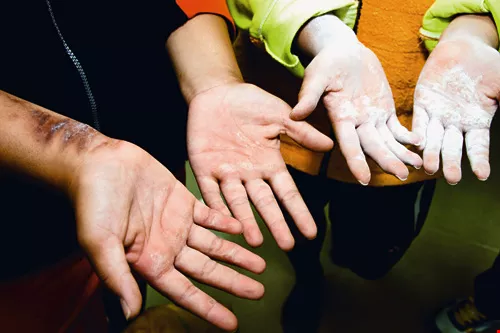
The calluses that cover their hands and the friction burns across their wrists are considered proud trophies by tug-of-war competitors.
It is the finals of the 2013 National Sports Affairs Council Cup tug-of-war tournament, and more specifically, the much anticipated women’s 540-kilogram weight class. The contestants are two school teams that have won multiple international titles, Taipei’s Jingmei Girls’ High and Taichung’s Dali Senior High, making this final something of a battle of the titans.
Tug of war is an extremely draining sport, especially so several matches into a tournament. At this point, the girls’ physical and mental strength, and the teams’ offensive-defensive rhythms, face a harsh test. In the end, the Jingmei team seems to weather the test best, defeating Dali 2:0 to win the tournament and earn the right to represent Taiwan at the 2013 World Games.
“The pressure’s immense!” A virtually mute bundle of nerves before matches, it isn’t until after the competition is over that coach Guo Sheng finally lets his smile show.
“Jingmei’s already won four World Cup championships [both indoor and outdoor competitions at the 2010 and 2012 World Cups], but this is our first time at the World Games, and we’re hoping we can make this a record third straight win for Taiwan,” says Guo.
Frequent international competitors and victors, the Jingmei Girls’ High tug-of-war team has become widely known as “the Pride of Taiwan.” But even before Jingmei stepped into the spotlight, Taiwan was already well established as a formidable force in the world of tug of war.
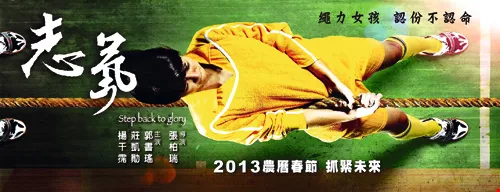
The experiences of the Jingmei Girls’ High tug-of-war team have even been made into an inspirational film entitled Step Back to Glory, to be released for Chinese New Year 2013.
If you want to find the origins of tug of war in Taiwan, you must first look at the evolution of the sport.
Tug of war has an incredibly long history for a competitive team sport: the earliest known historical evidence dates back to at least 2500 BC, in a mural in the Merera-Ku tombs in Egypt.
In China, the sport dates back to the Spring and Autumn Period (722–481 BC), originating as a wartime technique practiced by sailors called “hook pulling.” Over time, this evolved into a land-based way of training pulling strength, and then into a popular entertainment during folk celebrations.
During the Tang Dynasty, the emperors Zhongzong and Xuanzong both held “thousand-man tug of war” competitions, which were used to demonstrate the empire’s power to foreigners who had come to pay tribute.
Since then, tug of war has remained popular with the ordinary people, including those who brought it with them to Taiwan. Thanks to the relative simplicity of the sport, its ability to quickly get people focused together, and the speed with which a result is reached, it became a popular sport for friendly competitions between agricultural communities. Several variants even grew out of it, such as the two-man-team contest that was particularly popular in rural Taiwan.
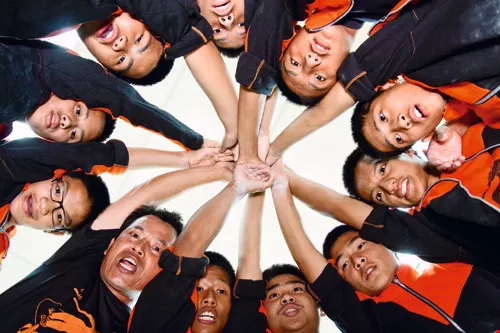
Tug of war emphasizes teamwork, and every team has their own particular war cry. This photo shows the winners of the junior-high boys’ 500-kg class at the National SAC Cup, the Hongren Junior High School team.
However, given its usually being played by farmers and at school sports days, as well as its use as a team-building exercise, tug of war came to be considered a recreational activity, and so there were no strict regulations on number or weights of participants, and few people thought of it as “real” sport.
This wasn’t the case in the West, however. As far back as the 15th century, tug of war had become an incredibly popular sport in France, and later became a frequent subject of tournaments in Britain.
Today, eight-man tug of war is the form used in formal competition, and through strong advocacy on the part of the United Kingdom it even became an event at the 1900 Paris Olympics; however, with the rules of the sport so widely variable, there were frequent disputes, and ultimately it was removed from the Olympic roster in 1920.
Fortunately this didn’t put off lovers of tug of war worldwide, and in 1960 14 European countries, including the UK and the Netherlands, formed the Tug of War International Federation. The TWIF formalized the rules of outdoor tug of war, setting the number of team members at eight and dividing the combined team weights into 10 weight classes ranging from 400 to 720 kilos.
In 1980, the Japanese took this once only outdoor sport indoors, and since 1990 both indoor and outdoor formats have been part of international competitions, vastly improving the visibility of and level of competition in tug of war.
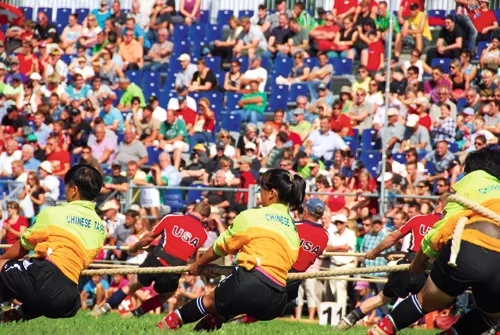
The Jingmei Girls’ High School tug-of-war team has already taken four golds at the World Championships. This photo shows them competing at the World Championships in Switzerland in September 2012.
Eight-man tug of war was introduced to Taiwan in 1992. One of the strongest proponents of it here has been Wu Wenda, respected elder statesman of Taiwanese sport and promoter of Japanese-Taiwanese sporting exchanges.
When the sport came to Taiwan, Wu considered it perfect for the Taiwanese people; with its clear rules and quick matches; lack of restrictions on age, place, or class of competitor; and strict regulations on weight classes that guarantee fair fights. He saw tug of war as a sport in which Taiwanese competitors could stand up against their more physically imposing Western counterparts. Thus inspired, Wu founded the Chinese Taipei Tug of War Association and began promoting the sport around Taiwan’s cities and counties, and particularly at elementary and middle schools.
In 1997, with the sport blossoming, the Taipei City Government and the Taipei Culture Foundation joined together to challenge the Guinness world record for tug of war, even giving the event an air of ancient times by consulting writings from the Tang Dynasty on the competitions of that era. However, not long after the contest started, the rope gave way, injuring several participants, and even severing two people’s left arms.
Explaining the incident, Chinese Taipei Tug of War Association general secretary Zhuo Yaopeng explains that in tug of war, the rope is placed under tremendous stress, which is why there are strict regulations on the materials used for international competition ropes, along with their length and thickness. However at that point few in Taiwan took tug of war seriously enough to worry about safety precautions, and that is what led to such a terrible accident.
Sisters are doing it for themselvesHaving learned from that lesson, in 1998 the Ministry of Education strongly encouraged adherence to international standards for tug of war. In addition to organizing the annual National All-Levels Schools Tug of War Competition, the ministry also began promoting training for umpires and coaches. Eventually eight-man tug of war began to make its way into Taiwanese schools, and today, hundreds of school teams take part in tug-of-war competitions nationwide every year.
As tug of war’s popularity grew, people began looking toward the next stage—international competition.
Cai Sanxiong, former Taiwanese national team coach and trainer of both Guo Sheng, coach at Jingmei Girls’ High, and Chen Jianwen, Nantou Senior High coach, notes that at first Taiwan’s results were less than fantastic, but the coaches and the teams never gave up, using these frustrations as chances to gain experience.
In 2000, the Taiwanese women’s indoor team took sixth place at the World Cup, finally making a name for the nation on the international stage. In the years that followed, Taiwan’s “strongwomen” developed their tactics and grew in experience, not only becoming World Cup and Asian Cup champions, but even turning in back-to-back top-of-the-table performances in the 520-kg class at the 2005 and 2009 World Games.
Team Taiwan’s surprising staminaMany wonder how it is that Taiwan has managed to succeed so well internationally, given the far more physically imposing competition it faces from Europe and America.
“Tug of war is much more about defense than offense,” remarks Zhuo. During matches, the two teams may look stock still, but in reality the competitors are focusing all of their energy into their feet, desperately working to keep their bodies in balance with the rope. However, as time crawls by, eventually someone’s muscles will give, their steps or posture slackening ever so slightly; this weakens the whole team’s grip on the rope, and offers the opposition a chance to strike.
“Tug of war is a game of stamina, not brute force! Physical strength is more about natural gifts, but stamina is more about tough training, and that’s where Taiwan shines,” says Zhuo. By way of example, he points to the World Cup performance of the Jingmei Girls’ High team. At first, they may have looked to be at a disadvantage, but their opposition often found that once they got Jingmei to just 10 centimeters from the centerline, they just couldn’t get the girls to budge any further no matter how hard they tried. And while they heaved and heaved as Jingmei stood firm, their own energy was slowly being sapped. Then, their opponents weakened, Jingmei would seize the opportunity to counterattack, often turning the tables completely in one pull.
Another part of the superlative success of Taiwan’s women’s teams has been their determination to test themselves against physically stronger men’s teams; this way, when matched against the imposing teams from the West, they remain unfazed.
“The men’s teams, though, find it immensely difficult to find someone tougher than themselves,” says Zhuo, “so their results haven’t been nearly as impressive as the women’s teams.”
Zen and the art of tug of warAs many as 80% of Taiwan’s tug-of-war representatives today come from underprivileged families. With less-than-outstanding academic records and physical abilities a little shy of letting them break out as stars of ball sports or athletic events, they often throw themselves into tug of war, seeing it as the only way to get into good schools.
However, if it’s more about getting into a good school than it is about passion for the sport, they’ll most likely not have the fortitude to keep going down the tough tug-of-war path: “How many girls in the flower of youth are going to put up with calloused and cut-up hands, or with the constant demands to bulk up or slim down to get to competition weight?” asks Zhuo.
Jingmei Girls’ High coach Guo Sheng adds that tug of war can be a very monotonous kind of sport, without the kind of instant feedback that, say, basketball gives when you sink a shot. But what it does have is a powerful emphasis on teamwork, so team members often develop much closer bonds than people in other sports.
In fact, tug of war is a very philosophical kind of sport. It doesn’t create individual superstars, instead putting the team above all; it is a sport where sometimes the best way forward is backward, where defense is more important than offense. Tug of war is in many ways a Zen sport.
And perhaps it is some kind of Zen enlightenment that enables Taiwan’s tug of war competitors not only to continue to test themselves in one heated battle after another, but to come out victorious.

_DSC2938@List.jpg?w=522&h=410&mode=crop&format=webp&quality=80)

@List.jpg?w=522&h=410&mode=crop&format=webp&quality=80)


