Taiwan's Braveheart--Social Activist Chou Sheng-shin Learns to Look on the Bright Side
Kaya Huang / photos Jimmy Lin / tr. by Christopher J. Findler
December 2007


"In a meeting of PeaceWomen Across the Globe in late 2005, I met an environmental warrior who collects expended batteries, a woman who has dedicated her youth to educating children, and one who organized a drama troupe that travels around advocating women's rights. These Chinese women have no qualms about pulling out the stops when it comes to realizing their ideals," stated Chou Sheng-shin in a speech she gave in late 2006 at the Taiwan International Peace Conference. This also explains why she is unwilling to just sit on the sidelines and do nothing.
The paths to civil society and democratization are long and difficult for any emerging nation. It's even tougher for the women of these countries. Chou, 44, knows that if things are going to change, someone needs to raise the level of awareness of the injustice that exists in society. Over the past 16 years, therefore, she has taken part in educational reforms, advocated the establishment of community colleges, and spoken out against arms purchases. In April 2006, she received a new title-executive director of the planning center for the Thousand-Mile Trail project. This project is concentrating social forces in Taiwan to create a trail that can rival Taipei 101 in terms of fame.
In contrast to Taipei's steady drizzle, the morning of October 13th is met by fresh, glorious sunshine in Hsinchu County's Neiwan. A group of bicyclists prepares for the next leg of their trip. They have been riding for three days and are eager to face the final and most challenging day, which entails traversing the two mountains between Neiwan and Miaoli County's Nanchuang.
Over the course of four days, this vanguard, with an age difference spanning 60 years, bikes from Taipei to Nanchuang in Miaoli, passing Lungtan, Tahsi, Kuanhsi, Mawutu, and Neiwan along the way. Among their number, they count a retired gentleman of 70 and an eight-year old, as well as two women who have never ridden before. This group of courageous, strong-willed, and sometimes wobbly riders is working to link together the 200-kilometer western stretch of the Thousand-Mile Trail. This is a group of middleclass Taiwanese with a mission to change Taiwanese society.
"The direct purpose of this particular activity is to create a beautiful round-the-island trail for people to walk and bike on. We would like the government to establish laws mandating the areas on either side as protected scenic areas to help preserve the natural and cultural beauty of Taiwan's mountains and coastal regions," says Chou, explaining the objective of the Thousand-Mile Trail project.
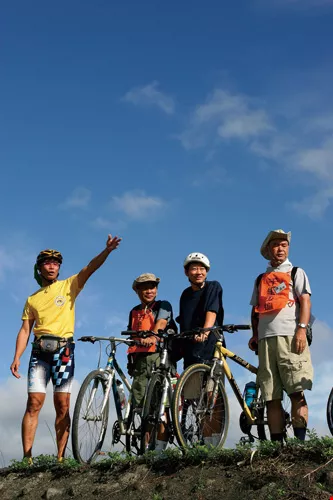
Each individual and each community is a point. The Thousand-Mile Trail will serve to connect point to point, person to community. The most beautiful scenery lies in areas inaccessible to motor vehicles. Tien-jen's Stone House, in the outskirts of Nanwan in Hsinchu, is the central rest point for the four-day, three-night Taipei-Taoyuan-Hsinchu-Miaoli biking trail.
Exciting times in education
The petite Chou Sheng-shin is no stranger to social activists in Taiwan. She's been a Humanistic Education Foundation teacher and community college promoter as well as an anti-arms and anti-war activist. Over the past 16 years, she has been involved in such public affairs policies as compulsory education, corporal punishment, and advanced educational opportunities for adults. The longhaired and poised Chou was a "late bloomer" when compared to others that started their activist careers as university students.
Born in 1963, Chou is a pastor's daughter. She grew up in a beautiful and remote area on Taiwan's eastern side. After graduating from Fu Jen Catholic University's Chinese Department, she opted to return to her hometown to teach. She wanted to do her part to help kids in rural areas get a good education. To help children during her career as an educator, she maintained close contact with the grassroots of society.
"I witnessed kids in all kinds of situations. For example, a child with an old veteran for a father who was bedridden with a grave illness and a mentally challenged mother. Due to poverty, ignorance, and lack of resources, if the kid became sick, he couldn't get to a doctor. His life was in the hands of fate," Chou Sheng-shin explains with pain in her voice. Back then, she had to focus on her role as educator and couldn't offer any substantial assistance. The sense of helplessness this gave her planted in her the idea of working to help form public policy.
"Society is an integral unit. If the overall environment is bad, you can't ignore it simply because you think you're doing okay yourself," confides Chou. Driven by this belief, at age 27 she joined the Humanistic Education Foundation, the first NGO in Taiwan to advocate educational reforms. The decade that she was with the HEF was a busy time for educational reforms in Taiwan and it laid for her a foundation in social activism. For eight years, she gladly put up with the meager pay she received (NT$25,000 per month), but unfortunately, she preferred focusing on her work to dealing with people. She gradually found herself alienated from her superiors and was later left crestfallen when her boss asked her coldly, "So when do you plan on leaving?"
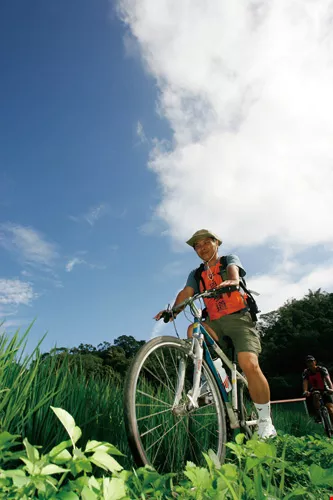
Each individual and each community is a point. The Thousand-Mile Trail will serve to connect point to point, person to community. The most beautiful scenery lies in areas inaccessible to motor vehicles. Tien-jen's Stone House, in the outskirts of Nanwan in Hsinchu, is the central rest point for the four-day, three-night Taipei-Taoyuan-Hsinchu-Miaoli biking trail.
Change your raison d'etre
It's not easy to be a doer and stick to your guns in today's complicated society, but Chou has managed to do it. Many believed that because she had given so much of herself to the foundation, leaving would tear her apart. Others were concerned that the tranquility she exuded was actually a facade and that she was keeping a lot inside. But Chou, who is passionate about what she believes, says calmly, "Looking at the bright side comes naturally to me. When I run into problems, I instinctively look for ways to turn the tide, to minimize damage, and search for new ways. Mine is a heart filled with optimism," she says as she divulges the key to her stick-to-it-iveness.
In 1998, at the invitation of Huang Wu-hsiung, a maths professor at National Taiwan University, Chou joined the ranks of those working to set up a community college in Yungho, Taipei County. Once more, she lent her voice to education in Taiwan-this time for adults, not children. In the nine years since the first community college opened in Yungho, other community colleges have sprung up in cities and counties around the island, becoming a shining example of lifelong learning in Taiwan.
Chou Sheng-shin successfully played the role of idea promoter. Many middle-aged mothers, their lives centered around their families, find they are spinning their wheels at home. They don't have the opportunity or the courage to chase their own dreams. After receiving training, many are transformed into new women aware of their own importance. They've changed and Chou has changed with them. Still determined, she is now more caring and softer.
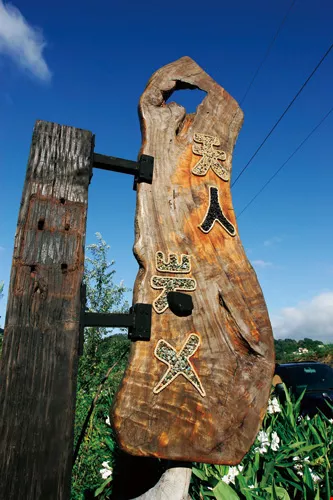
Each individual and each community is a point. The Thousand-Mile Trail will serve to connect point to point, person to community. The most beautiful scenery lies in areas inaccessible to motor vehicles. Tien-jen's Stone House, in the outskirts of Nanwan in Hsinchu, is the central rest point for the four-day, three-night Taipei-Taoyuan-Hsinchu-Miaoli biking trail.
Joining up the island-wide trail
On 23 April 2006, Huang Wu-hsiung, Chinese Television System manager Lee Yuan and Hsu Jen-hsiu, founder of the Society of Wilderness, proposed the idea of the Thousand-Mile Trail project to rebuild environmental ethics, return to our values, and to develop a new culture for Taiwan. Chou Sheng-shin, who admits she's "not a big fan of biking or walking," was asked to serve as volunteer executive director of the planning center to drum up public support and use the power of the people to build a round-the-island trail.
To prevent trail construction from inadvertently impacting the natural ecology, movement leaders proposed what they refer to as "natural right-of-way" which entails connecting existing trails (such as pathways in the mountains and near the coast) whenever possible then giving some of the right-of-way taken by motor vehicle drivers back to walkers and bikers. Only in a very few areas will new trails be laid.
The project planning center brought together community colleges from all over Taiwan, community planning organizations, environmental and cultural groups, academia, and non-profit organizations. Over some 500 days, they surveyed over 700 kilometers of trails from Taipei to Taitung on Taiwan's east side as well as paths stringing together Taipei, Taoyuan, Hsinchu, and Miaoli on the west. They hope that the planning, surveying, testing, and any necessary amendments for the three sections that will make up the trail will be finished by late 2007. They will eventually provide a report to the government to be used in the planning of a trail. As of now, this has only been accomplished for the section between
Taipei and Ilan.
"Some say that the purpose of the Thousand-Mile Trail will actually be to link communities in Taiwan and to connect each individual with his community." Regardless of whether the true purpose of the trail is to link Taiwan physically or in spirit, Chou's dream is that in a few years, Taiwan will have a round-the-island trail free of concrete barriers and blazing mercury lights, a path on which you can backpack or bicycle as your heart desires and enjoy the beautiful scenery on the way.
"The Thousand-Mile Trail can be another symbol of Taiwan in addition to Taipei 101." Chou Sheng-shin, who speaks with passion when social activism and civil issues come up, believes that the atmosphere of pessimism and anger that presently envelops society is temporary and that the power of Taiwan's people will come out none the worse for wear. Chou is no longer the young helpless teacher of years ago. She has been transformed into a champion for civil rights and social activism.

Each individual and each community is a point. The Thousand-Mile Trail will serve to connect point to point, person to community. The most beautiful scenery lies in areas inaccessible to motor vehicles. Tien-jen's Stone House, in the outskirts of Nanwan in Hsinchu, is the central rest point for the four-day, three-night Taipei-Taoyuan-Hsinchu-Miaoli biking trail.
@List.JPG?w=522&h=410&mode=crop&format=webp&quality=80)


