Who's Afraid of Y2K? Taiwan Business Takes on the Millennium Bug
Laura Li / photos Pu Hua-chih / tr. by Phil Newell
April 1999


Information technology has infiltrated every cranny of life, carrying the Y2K time bomb with it. Is no one safe?! (drawing by Lee Su-ling)
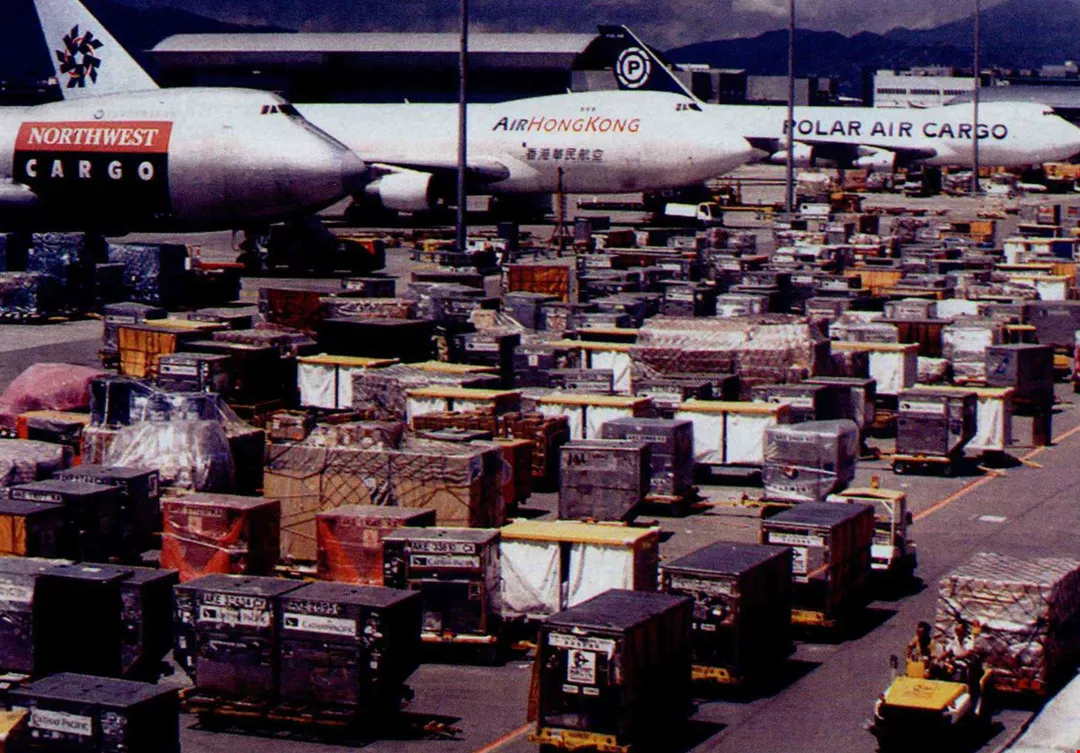
Passengers couldn't board, luggage control was a mess, cargo shipping ca me to a complete standstill. . . . The chaos at Hong Kong's brand new international airport last July drew attention to just how serious a "computer glitch' can be. Was this a preview of what we can expect from Y2K? (courtesy of Agence France Presse)
At the end of last year more than 100 countries participated in a special United Nations conference which decided to establish a "Y2K international crisis team." Some people say "it's a war out there." But there's no enemy out for blood. Rather we're up against an accident of technological history-Y2K. Most worrisome is that, for most people, it is already too late to stay out of the line of fire.
The Y2K war will affect the productivity of industries in countries around the world. Some countries are "high-risk areas," from which investors are fleeing for safety. Others can look forward to getting through the crisis rather smoothly, or even enjoying an upsurge in orders.
Will Taiwan industry be one of the losers, or one of the beneficiaries?
"I hope that in the early hours of the morning on New Year's Day of the year 2000, the sparks in the air will be from fireworks, and not from a factory exploding." This was the concluding comment made by Austin Lin, manager of the Year 2000 group at IBM Taiwan, during a Y2K seminar held for information personnel from the commercial world. His audience appeared to be in a state of shock from his speech.
Over the past half year or so, Y2K has become an increasingly hot subject in the media. Nevertheless, sample surveys conducted by the Industrial Development Bureau (a division of the Ministry of Economic Affairs) and by industrial associations reveal that many entrepreneurs are sceptical: "Is it really that serious?"
The Gartner Group, a well-known international economic institution, has released an assessment of how well more than 60 of the economically most important countries are handling Y2K. They divide these countries into four categories (see Table 1). Those in Category 1 are doing the best in coping with Y2K, yet an estimated 15% of their enterprises will suffer serious operational impact from Y2K. The proportion of affected firms doubles for Category 2 countries, to one in three. Taiwan, Korea, Singa-pore, and Hong Kong are in this category. In Category 3 countries, half of enterprises will be seriously affected, and in Category 4 countries the figure will be two-thirds.
Shocking, isn't it? However, Austin Lin believes that even this is too optimistic, because it does not include the "domino effect" on other enterprises. W.P. Wang, deputy director of the Systems Engineering Division at the Institute for Information Industry, who has been running himself ragged the last two years to assist industry with its Y2K problems, emphasizes that the Y2K crisis is even more serious than the recent financial meltdown. He adds, "The more you know the more frightening it is, and the more you do the more out of control it seems!"
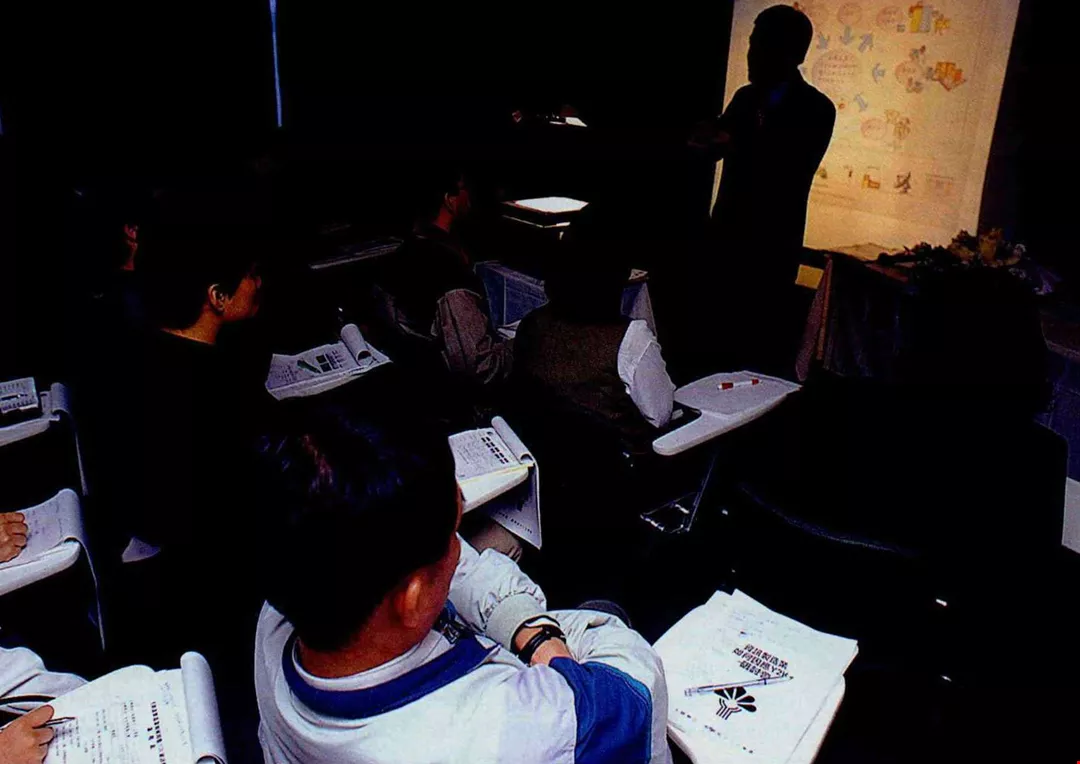
Austin Lin of IBM, who has been busy for three years lecturing on Y2K, finds he can't get to sleep thinking about the possible effects of this problem.
What is it about Y2K that makes information technology veterans blanch at its mere mention? Return to 1900
There is no dark plot underlying Y2K. Rather, it is an accidental byproduct of technological history. In the early days of computer development in the 1960s, every bit of memory was precious. To save space, engineers abbreviated years by using only the last two digits. Little did anyone expect that a design which at that time appeared to be reasonable would, with the coming of the year 2000, become a major problem.
Jack Chen, chief engineer in the marketing division at Syscom Computer Engineering Company, explains: "After this year, the year indicator in computers will turn to 00. I ask you, how is the computer to tell whether this means 1900 or 2000?" The problem is complicated by the fact that some computer programmers routinely used 99 or 00 to indicate special meanings like "largest value" or "terminate program." And don't even mention the fact that 2000 is one of the rare century years which is also a leap year, making the computer trans-millennial dating problem even thornier.
Computers are fundamentally calculators. Many of their calculations and procedures are connected to the date. Because of this connection, strange things have started to happen in recent years. Credit-card-issuing banks found that they could not issue new cards which could be used beyond 1999. Airlines were unable to accept reservations for 2000. And periodical subscribers received bizarre notices like "your subscription will expire in 1901." Governments and enterprises began to take notice.
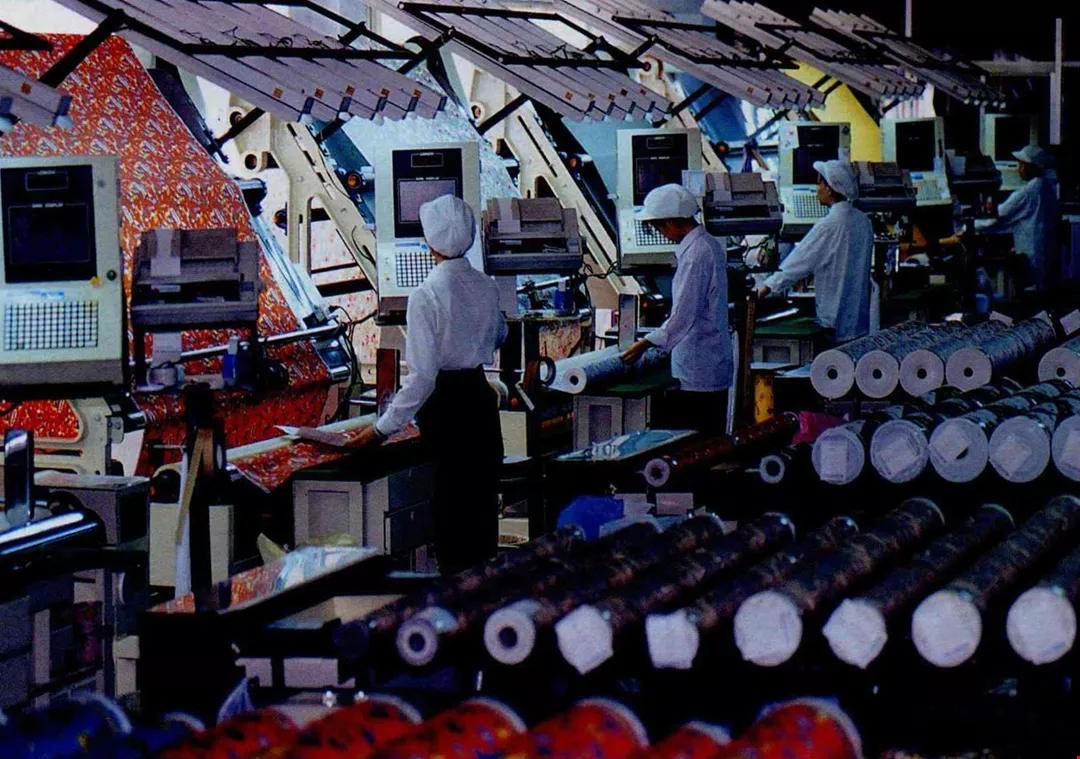
Textiles, a traditional industry, lag behind in coping with Y2K. Computer systems like the one that monitors decorative printing on textiles need to be thoroughly checked out. (photo by Diago Chiu)
For business, the possibility that a small computer design error can lead to a major breakdown of the production line might seem a little hard to believe. Nevertheless, that is exactly the nightmare that happened to Kang Chih-cheng, an engineer at the Taoyuan plant of the multi-national firm Unilever, who has for the last two years been trying to draw attention to this problem in Taiwan. "Sorry boss, but the factory is down."
Kang says that his department's engineers did complete machine-by-machine checks of all their equipment, and discovered nothing unusual. But when he received notification from the Anglo-Dutch parent company that their tests had found Y2K problems in similar equipment, he began to worry. After discussions with the production department, it was agreed that on a certain day, just before the end of the workday, the date in the main computer in the production department control room would be changed to December 31, 1999, and then they would see the next morning what had happened.
The next morning, when Kang walked into the control room, all the engineers looked as if something bad had happened. Not surprising, considering that the whole factory was about as lively as a morgue. Not a mechanical creature was stirring, not even a mouse. This was moreover not a problem that could be resolved simply by pressing the reset button and entering a new date into the computer. The factory suffered serious losses and Kang was blamed.
It's bad enough when everything grinds to a halt. But it's even scarier when everything appears to be running normally on the surface, but things are quietly going awry. Perhaps files are mysteriously disappearing. . . .
When conducting its own overall Y2K tests, China American Petroleum Company, which accounts for one-eighth of the world's production of the material PTA, was shocked to discover that all the diagrams and lines on the computer screens appeared distorted. It turns out that the scale got completely screwed up by Y2K. "It's a good thing we checked ahead of time!" exclaims Bill Lin, CAP's information service manager and Y2K task force director.
Kang Chih-cheng adds that when the factory that makes Ponds cosmetics products for Unilever did Y2K tests, they experienced problems, such as excessive acidity or alkilinity, or uneven consistency, with many products. Women who are concerned about their looks might go pale at the very thought of what might happen if their beauty products come from a factory that doesn't take Y2K seriously.
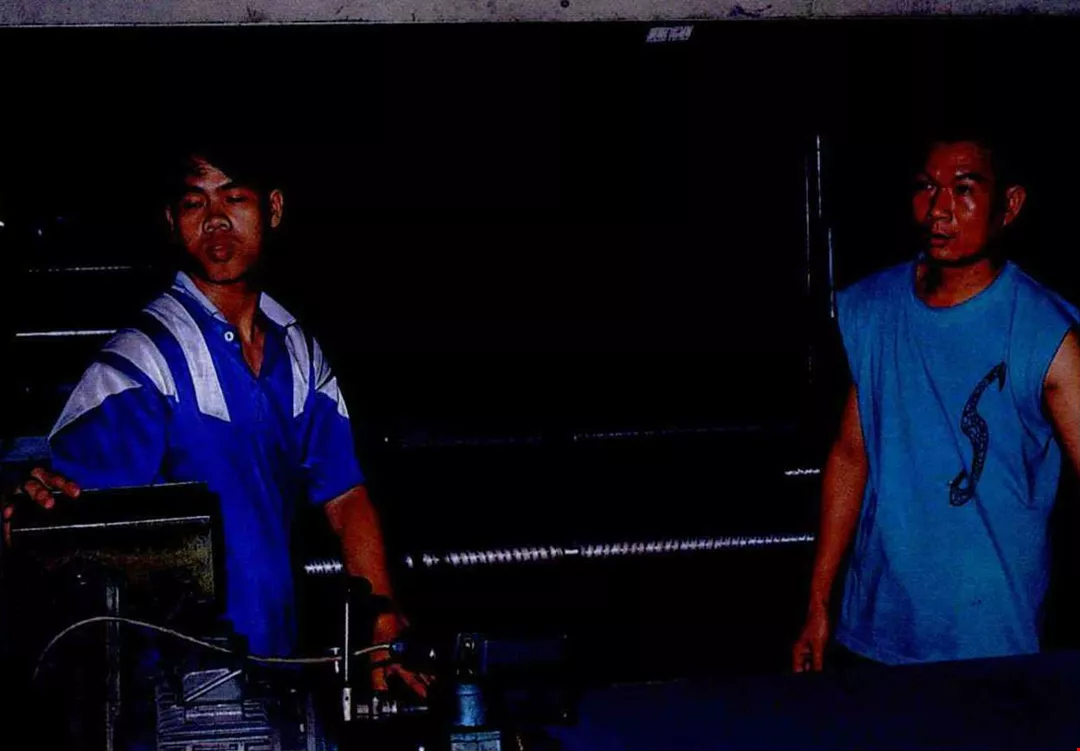
Small firms don't have the manpower, capital, or information of larger firms. How will they cope with Y2K?
Mobile mayhem
Wu Tseng-feng, business manager of Software Services and Support at Hewlett-Packard Taiwan, divides the Y2K problem into two parts. The first involves data systems, such as financial affairs, personnel, and customer orders. Because the data is stored in computers, the target is obvious. Everyone knows that Y2K could be lurking, so they can protect themselves with software and hardware upgrades.
But all kinds of equipment and machinery other than computers might also be harboring Y2K.
Wu states: "You name it. Any product that uses advanced technology-machine tools, air compressors, kilns, instruments, elevators, printers, faxes, time card machines, cash registers, and even mobile phones and pagers-could have an embedded microprocessor." If these chips have internal dates, or if their functioning is connected to time, they might come down with a bad case of Y2K at the turn of the century.
An estimated 2% of the chips produced in the past decade are connected in some way to the date or the year, and may experience Y2K problems. That seems like a pretty small number. But, says Chiang Shu-shang of the Corporate Synergy Development Center, in the 1990s an average of more than seven billion chips a year were produced worldwide. Thus several hundred million chips could have Y2K problems. The number is even larger if you add on chips made by factories themselves for special in-house purposes. It is estimated that in a factory with a fairly high degree of automation, approximately 10-15% of the equipment could be affected by Y2K. The threat is not to be underestimated.
In highly automated factories, the entire production process is monitored and controlled by computers. For example, in some food processing factories, computers automatically produce product formulas and production schedules based on incoming orders. The warehouse provides raw materials based on the schedules. If the computer deciding the schedules and deliveries experiences problems, even if not a single machine on the production line has a Y2K bug, the line could still end up in chaos.
For businesses, Y2K poses a much bigger threat on the production line that it does in the office. This is because most embedded chips cannot be read or altered. If there's a problem, forget about the factory itself, even computer geeks would be unable to help.
Most factories are dealing with Y2K by sending queries to their suppliers: "Does the machine you sold us face a Y2K problem? If so, is there a replacement chip to upgrade the unit?" If there is not, companies may have to replace the whole machine.
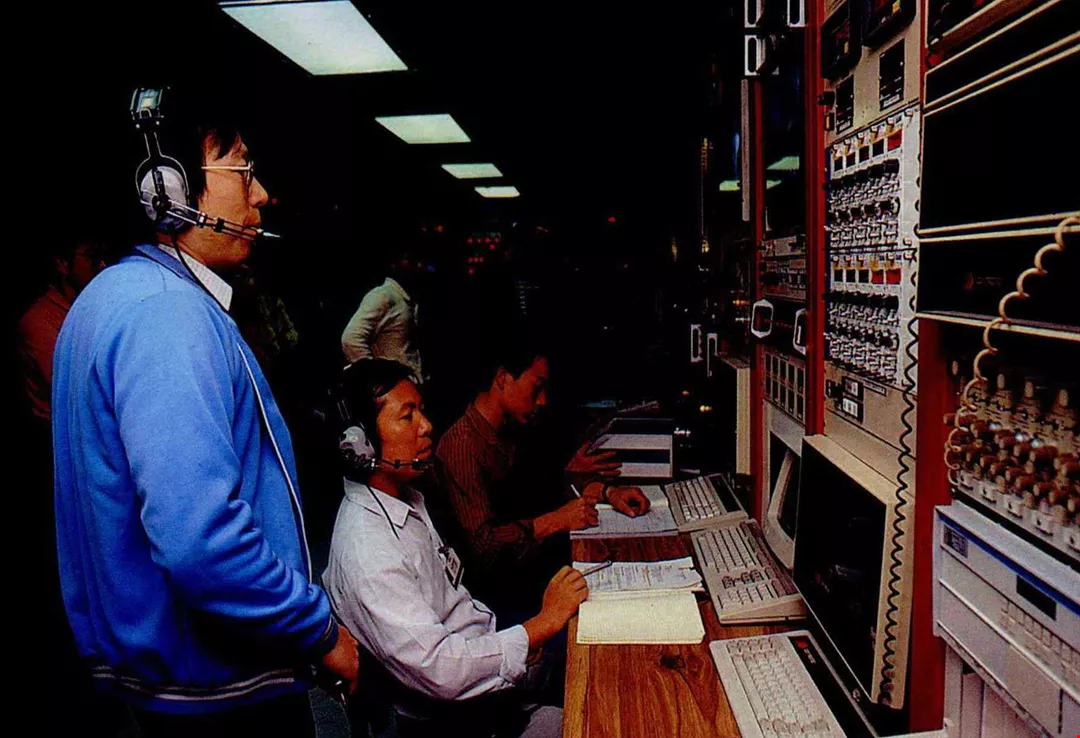
Y2K poses a serious threat to the heavily computer-dependent airline industry. Fortunately Taiwan got an early start, and is nearing completion of its airline-related Y2K adjustments. (photo by Diago Chiu)
Don't believe it!
Will original manufacturers take responsibility?
"It shouldn't be a big problem for us," says Hung Shih-li, manager of Taiwan's largest pharmaceuticals firm, Yung Shin. Their equipment has been purchased from large well-known international makers in places like Italy and Japan. These manufacturers have good reputations, and value long-term relations, so they are unlikely to evade their responsibilities.
However, the information manager at another company is not so optimistic. His experience has been that many factories are demanding high service fees to take back their software, and continually hint that the only real guarantee is to replace the whole machine. He is stuck between a rock and a hard place.
Many domestic and foreign equipment manufacturers are perfectly willing to supply forms "confirming" that their product is "Y2K compliant." But the Institute for Information Industry's W.P. Wang advises: "The faster they are to put their hands on their hearts and swear up and down, the more dubious their promises are. On the other hand, you can probably put a little more trust in those factories that consider for a long time before finally issuing a confirmation." Kang Chih-cheng, who has been "deceived" by domestic manufacturers before, never tires of warning: "Don't readily believe the guarantees given by manufacturers. It's still best to test things yourself."
Of course, not every machine has a "parent." Some are "orphans" whose manufacturers have gone out of business. Businesses have to test these themselves.
Regardless of whether or not there is a manufacturer around, it is vital to remember this: Don't test haphazardly. Bill Lin cautions, "Never test without proper preparation." If data has not been properly backed up first and testing goes ahead, the originally installed parameters in the chips could be wiped out, and at that point there would be no going back.
Lin offers a case in point. The programmable logic controller (PLC) is widely used in all kinds of equipment. It can check and correct all kinds of numerical operations. Depending upon their needs, factories will set basic values (parameters) into a PLC. For example, a PLC in a kiln could be set for the range of normal temperatures. If the kiln gets too hot, the PLC will automatically lower the temperature. If the chip were to be damaged by testing and the temperature ran wild, the kiln would certainly be ruined and there could even be a lethal explosion.
Small and out of the way?
So far, industry leaders have been the main players discussing Y2K in detail. These large enterprises have money, manpower, and information. The ones in the best position of all are those enterprises with a high degree of internationalization or who rely on international parent companies for their technology. For example, China American Petroleum's major stockholder, the US firm Amoco, not only requires monthly progress reports on Y2K, it has even sent people to Taiwan to consult.
Things likewise look OK for computer and semiconductor makers, Taiwan's leading exporters. Most of these companies do OEM or ODM work for multinational corporations. If they do not do well, they will immediately lose their orders. Moreover, foreign customers, to keep tabs on their sourcing, periodically send people to Taiwan to check on things. From the standpoint of government industrial policy managers, these are "model students" in the Y2K game, and they should be able to get through the crisis smoothly.
Nevertheless, as Chiang Shu-shang says, "these types of firms are a small minority, no more than 5%." Taiwan has more than 80,000 manufacturers, most of which are low-tech SMEs (small and medium-size enterprises). Formerly the crack troops in Taiwan's economic miracle, in the Y2K crisis they may be the highest risk group.
Although there are only about 200 days left before 2000, most SMEs have little idea about Y2K, and some even scoff at it. Austin Lin, who just before the Chinese New Year completed a two-and-half-circuit tour of the island lecturing and consulting on Y2K, estimates that no matter how much attention is devoted in the public discourse to this problem, an estimated 10-20% of enterprises will still have closed minds about it.
On the other hand, one entrepreneur in the information service industry who is a commercial adviser for the ROC Junior Chamber of Commerce and often does gives advice to SMEs, finds the attitude of many SME bosses understandable.
This businessman argues that it is mainly large enterprises that face serious Y2K problems, because they are the only ones with a high degree of automation, using computer networks to control everything. SMEs, meanwhile, rarely have integrated process control systems. At most they may have to replace a few machines. "If they have to replace them, they'll replace them, anyway it's just a few hundred thousand NT dollars."
He argues that, even assuming that on New Year's Day 2000 some machines crash, it wouldn't be the end of the world. "The commercial cycle at an SME, from ordering their materials to shipping their product to collecting the money, takes about two or three months. Who uses trans-millennial production schedules? Anyway, they are used to stop-and-go production. Also, their finances are simple, so if they have to count on their fingers for a month or two, what difference does it make? When all of their operations finally emerge from "99" and become "00," then everything will be back to normal, right?"
"Relax," he advises. "Only big enterprises with a high degree of automation have to worry. Why should we smaller businesses worry about it? This is all something cooked up by a small number of foreign firms who like to make a big show, so they are talking as if the sky is falling. I think they just want to sell more machinery!" he says with disgust. Management crisis
In theory at least, firms with a lower degree of automation are indeed less likely to experience a serious shock from Y2K. But SMEs have limited resources, and thus a correspondingly lower ability to withstand shocks. Says Chiang Shu-shang: "How many machines will go down in a given medium-sized factory? Until testing and inventory have been done, no one can say for sure."
Take for example a ready-to-wear clothing factory. Y2K problems have been detected in many of the machines used in such factories. But how many factory operators know that these machines have hidden dangers? If they wait until a machine crashes before they rush off frantically to buy a new one, will they have enough cash on hand to get through? Will their customers be willing to wait?
Many SME bosses admit knowing little about Y2K, but say it isn't their job anyway: "Since the problem is with the computers, let the information systems people take care of it." Unfortunately this overlooks the important problem of manufacturing process control.
The vice manager of the information department in a listed petrochemicals firm moans: "We information department people know computers all right, but we don't know production!" Although he is in charge of the Y2K problem at his company, he has no staff, and no authority.
"It's nothing but an empty title!" says this vice manager. He repeatedly emphasizes: "I don't understand a thing about the process control in our production department, I'm completely out of the loop!" If testing is really to be done, then the production line will have to be shut down. How can a relatively unimportant vice manager of information systems get the production department, with its hundreds of employees, to cooperate and stop work?
In contrast to this panicked information manager, the production manager at the same company is completely at ease. But the reason is comic: "There shouldn't be any effect on our production process, because our information department people have been looking out for this problem for a long time. They've been following up on it, and I haven't heard of any problems. . . ."
Another information department director, this time at a machinery company, states that their information systems have already been completely taken care of, and although he is not familiar with the production operations at the factory, he is "confident" that there won't be any problems: "Our machines are only concerned about temperature and humidity, and don't have anything to do with the date!" He insists that there's absolutely no need for testing. "If nothing is wrong, what's the point of going and plugging in the date? Even if when the time comes, the date is wrong in the machines, what difference will it make? Anyway we don't stamp the date on our products!"
In fact, there's only one real way to tell whether the chips in the instruments are connected to the date, and that is to read the program codes. Otherwise there's no way to tell just by the appearance.
Bosses, get involved!
Having seen the difficult position that the information personnel in many companies are in, Wu Tseng-feng of Hewlett-Packard emphasizes that Y2K "is not simply a computer technical glitch, but involves the entire management structure of the firm." Only if the top-ranking officials coordinate things can full capability be brought to bear in the war against Y2K.
This is precisely the secret of success at China American Petroleum, a "model student" in the Y2K game.
CAP has done extremely comprehensive testing, from an audit (identifying all the equipment which could in some way be affected) and initial adjustments to systematic tests on each machine (individually and then in sets) to a full-scale "flow test" under normal operational conditions. Bill Lin explains: "We had to coordinate these tests with the production department, using the annual repair period of each of the five factories in turn, in order to avoid disrupting normal output."
Particular attention was focused on the "flow test" at the first factory, because this was the first time it had been done anywhere in the world. The whole factory was down for 15 days, which was a day or two more than had been anticipated. This was only possible because there was careful evaluation and full support from high-level management.
Management foresight has been the moving force behind aggressive strategies to cope with Y2K in other companies as well.
David Lin was formerly Y2K coordinator for Yulon Motors. Now the general manager at a different firm, he notes that Yulon began tackling Y2K as early as a 1997. Moreover, unlike many firms which have simply passively waited for problems to crop up, Yulon seized the opportunity to fully upgrade its computer systems. "Of the 22 computer systems in the company, 21 have been completely overhauled, while the last has been repaired," says Lin. Already 14 of the revised systems are online, and work is being rushed ahead on the other eight.
Survival
Besides the technical and management angles, one can also look at the Y2K problem from the point of view of enterprise survival.
"The company can close its doors and kill all the Y2K bugs inside. But if the environment is a mess, you can't survive even if you are taking the proper steps," says Austin Lin.
For example, Y2K could affect the reliability of water, power, transportation, communications, and customs services. Upstream there are raw materials providers, satellite factories, and subcontractors. Downstream are customers, sales networks, and distribution systems. Can each and every link in the chain safely cross over into the year 2000? If they can't, what will be the impact on business? These are all variables that need to be considered.
"Sales is the foundation of a company. If the channels are clogged, products can't be sold no matter how good they are," says David Lin. Yulon took this threat seriously right from the start. They provided free Y2K training to more than 130 sales outlets across the island, plus gratis software upgrades, and then kibitzed over the shoulders of their outlets to make sure that each one was acting to cope with Y2K.
Yulon could be this strict because its retailers specialize only in its product. But they felt powerless faced with their 100-plus large and small subcontractors, producing such things as paint, seat covers, and screws.
As David Lin explains, "There are 13 auto manufacturers in Taiwan, and subcontractors don't just work for Yulon alone." Each factory wanted the subcontractors to do something different to adjust to Y2K, and with so many chefs spoiling the broth, the subcontractors didn't know where to begin. Fortunately, just after the Chinese New Year, the Industrial Development Bureau (IDB) brokered an agreement within the Transportation Vehicle Manufacturers Association, with five major manufacturers each agreeing to "adopt" specific subcontractors and guide them through Y2K. Yulon was assigned 61 subcontractors. Though time is short and there is much to do, at least things are better than when everyone was paralyzed.
Lin says that since every firm was only looking out for itself, it was very helpful that the IDB, which manages industrial policy, stepped in. In fact, since last year the IDB, working with other institutions which have close ties to business-such as the Industrial Technology Research Institute, the Institute for Information Industry, and the Corporate Synergy Development Center-together have created an atmosphere of cooperation in industry. Many firms which are handling Y2K very successfully, such as the notebook computer manufacturer Inventec, have been setting up Y2K "intelligence branches" or websites and making their own experiences available to others.
Full mobilization
The IDB has also been working through industrial associations to build up horizontal linkages between firms, especially SMEs.
"Firms in the same line mostly use the same equipment. If every firm were to make available the results of tests it has done on specific brands and models of machinery, then SMEs wouldn't have to muddle through blindly on their own. This would be tremendously helpful," says Chiang Shu-shang.
Austin Lin stresses that Taiwan's firms are very interdependent. He concludes: "Businesses can fight all they want about anything under the sun-except for Y2K. They have to cooperate to solve this problem."
Looking, then, at the overall production chain, "the weakest link is Taiwanese-owned firms overseas," according to China Productivity Center chairman Hsu Chieh-kwei.
For one thing, overseas Taiwan firms are concentrated in areas that the Gartner Group considers "high-risk"-mainland China and Southeast Asia. Water and power supplies could be even more dubious after Y2K kicks in. Also, those areas are relatively closed to outside information. Most overseas Taiwan firms in Asia are traditional labor-intensive assembly operations, with only a moderate degree of automation and much outdated equipment. It will be difficult for them to get past 2000 unharmed. If Taiwan firms in the PRC are hard hit, what will become of Taiwan's annual US$20 billion surplus with the mainland? What will the impact be on companies in Taiwan proper? Nobody can say for sure.
Crisis or opportunity?
From a global perspective, says Hsu Chieh-kwei, "Beginning in the second half of this year, foreign buyers will begin withdrawing orders from high risk areas and high risk firms, and switch to safer suppliers." Y2K could spark a complete reshuffle in the comparative advantage game.
"Taiwan is doing OK, and can aspire to be doing better than anyone else in Asia," says Austin Lin. Taiwan has adopted the correct strategy, with the government first focusing on core infrastructure, then large firms, and finally going to full mobilization involving various types of organizations and firms of all sizes.
Recently APEC held a summit in Manila which deemed Taiwan's manufacturing sector to be relatively unprepared. But Austin Lin, having followed the research reports coming out of the US, feels that Taiwan is not putting up a poor showing. Though time is short, there is good reason not to be pessimistic about the situation, considering that Taiwan SMEs have a long-standing and solid relationship with government agencies and that SMEs have a relatively low degree of automation.
In contrast, "though Hong Kong and Singapore are doing very well with Y2K, the hinterlands on which they heavily rely-mainland China and Malaysia-are facing serious problems," avers Lin. Taiwan has the comparative advantage, so it can seize this opportunity to pick up more international orders.
Is Y2K a threat or an opportunity? The next half year will be decisive. Can Taiwan's businesses face the challenge with confidence?

@List.jpg?w=522&h=410&mode=crop&format=webp&quality=80)


@List.jpg?w=522&h=410&mode=crop&format=webp&quality=80)
@List.jpg?w=522&h=410&mode=crop&format=webp&quality=80)
