

Recently, several books and videos about Taiwan's dragonflies have joined the multitude of publications which fill the island's bookshops. Lacking "commercial value," in the past dragonflies were researched far less than some of Taiwan's other common insects such as butterflies, bees or beetles. Only recently have people begun to make an effort to tell the natural history of the dragonfly. Why are they so eager to write about and photograph dragonflies? What is special about Taiwan's dragonflies? And what has research into them revealed?
"Fly! Fly! Look at that red dragonfly flying in the blue sky, playing in the wind, chasing its dreams forever. . . ." On the Internet, a Taiwanese emigrant to the USA writes that whenever he hears the popular song "Red Dragonfly," it draws his thoughts back to the countryside of his native Taiwan.
Spring in winter
As spring gives way to summer along Taipei's Neishuang Creek, countless pairs of dragonflies dance in the sunshine above the water, their gossamer wings glistening, amid the fragrance of the flowering rice plants. This display, which is repeated over ponds and paddy fields throughout Taiwan, is the island's liveliest wetland scene. But in winter, dragonflies disappear almost without trace after laying their eggs, except for a few stragglers left loitering around ponds trying to snatch fleeting rays of winter sunshine.
For Wang Liang-jong, a doctoral candidate at NTU's Graduate Institute of Entomol ogy who has been collecting and studying dragonflies since he was a child, observing the dragonflies of Neishuang Creek is a different experience. Apart from wanting to know whether the damselfly Aciagrion migratum can survive the winter cold, his greatest interest is in studying the larval stage of dragonflies' life cycle-dragonfly nymphs.
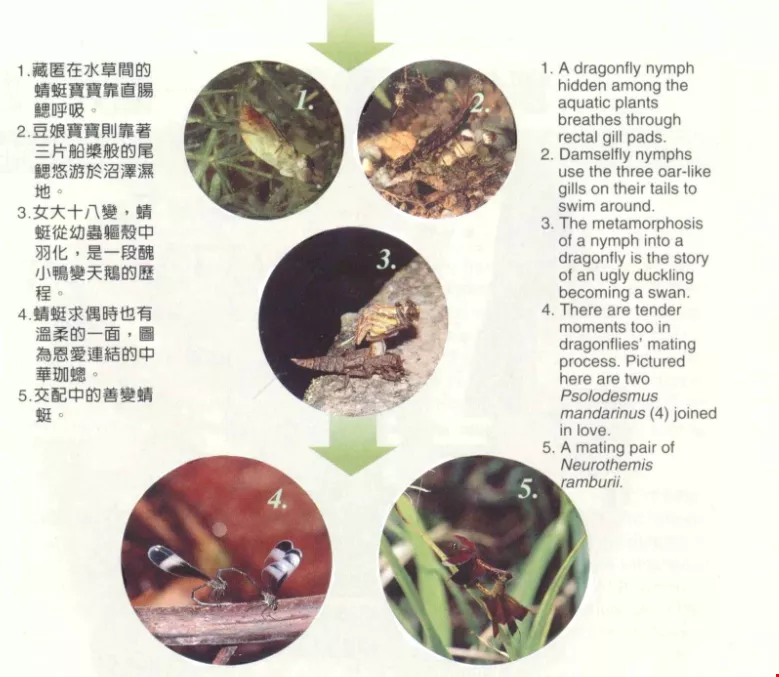
Squatting down among the thick layer of dry twigs and fallen leaves beside the mountain creek, Wang brings out a net which he sweeps lightly through the clear water. Out of the bottom mud which it stirs up, the net plucks several wet brown bugs which try to flee from the light. Wang quickly identifies them: The smallest is a nymph of Polycanthagyna erythromelas; one which looks like a small cricket is the nymph of Taiwan's largest dragonfly, the giant spiketail (Anotogaster sieboldii), and can grow up to six centimeters long; the one waving the sharp spine on its tail in attacking postures is Orthetrum triangulare. At a spot where the water begins to flow more rapidly, Wang's net scoops up nymphs of another damselfly, Psolodesmus mandarinus. Along their bodies are three prominent egg-shaped organs-rectal gills, with which damselflies breathe. Away from the rapidly flowing mountain stream, the bottom of a nearby pool is alive with nymphs of species which prefer still water, such as Rhyothemis triangularis and Anax panybeus.
The seemingly deserted winter pools are actually teeming with life. In the little valley, the nymphs of 40 to 50 species of dragonfly form their own marvelous world, and one can imagine how lively the air above the water will become when spring arrives.
Trapeze artist
Though dragonflies now share the Earth with humans, they entered the world stage way back in the warm and humid Jurassic era. This is why the more than 5,000 species of dragonfly in existence today are mainly concentrated in tropical and subtropical regions, and why little Taiwan is home to 145 dragonfly species. Taiwanese children have vivid memories of Orthetrum sabina sabina and Orthetrum triangulare, which fly over paddy fields; of Epophthalmia elegans and Pseudothemis zonata, which are often seen over ponds; and of the wandering glider (Pantala flavescens) and Orthetrum pruinosum, which gather in the air over grassland and woodland before and after rain. Even in the cold of winter, Taiwan's residents can still see the brightly colored Sympetrum eroticum ardens.
The reason dragonflies leave such clear impressions in people's minds is because they are among the most accomplished fliers of any insect. The muscles which join their wings to their thoraxes are well developed, and they can beat their front and rear wings separately to control their direction of flight. Most dragonflies can perform the highly difficult maneuvers of flying backwards or straight upwards, and a few of them can even fly across oceans to make long-distance seasonal migrations. Agile wings, and compound eyes with good near and far vision, also make the carnivorous dragonflies into excellent natural hunters, welcomed by farmers as beneficial insects.
One can easily get the impression that dragonflies do almost everything on the wing. They mate in flight, and dip only their tails in the water to lay their eggs; male dragonflies fight airborne battles over females, beating each other with their flexible wings; and they stand guard in the air at the females' sides as they lay their eggs. The male Tramea virginia even tightly clasps his partner as she lays her eggs, holding onto both female and eggs like a flying trapeze artist.
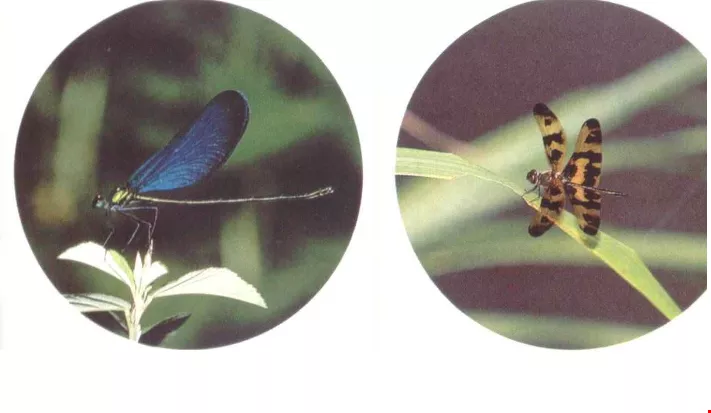
Dragonflies' wings combine power and beauty. "With delicate wings, slender waists, they lightly dip into the water," wrote an ancient Chinese poet. Their gossamer wings are decorated with brilliant colors and all kinds of patterns. The characteristics by which we distinguish damselflies from dragonflies also start with their wings. Damselflies and dragonflies both belong to the order Odonata, but damselflies' two pairs of wings are of equal size, with bright, colorful patterns, and when at rest they fold them over their backs. Dragonflies, meanwhile, have narrow forewings and broad hind wings. They flap their wings faster than damselflies, and fly faster. When at rest, they fold their wings horizontally.
Part-time researchers
With their powerful wings, insects of the order Odonata can spread far and wide. Hence, compared with other insects, which have differentiated in response to specific environments, the proportion of endemic species among Taiwan's dragonflies is not high. The island has only a third as many dragonfly species as butterfly species, and most were recorded by the middle of the 20th century. Lively dragonflies are easy to spot, but observing their lives in detail is more difficult. Over many years, says Wang Liang-jong, "the number of people publishing research papers on dragonflies was less than 1% of the number writing about butterflies." Apart from early foreign adventurers, the first modern local researcher of dragonflies was famous mosquito expert Lien Jih-ching, who, although mainly studying two-winged flies, also collected and classified dragonflies.
As a child, insect enthusiast Wang Liang-jong watched dragonflies of every conceivable hue fill the skies, but lacking a field guide he never knew their names. After entering the plant pathology department at NTU, he was finally able to fulfil his heart's desire by getting involved in dragonfly research himself. Through many years of field surveys, Wang has gradually clarified the distribution of Taiwan's dragonflies, and has traveled islandwide to photograph them. The photos are collected in his recently published Dragonflies of Taiwan, which describes 127 dragonfly and damselfly species and is currently Taiwan's most complete field guide.
Wang Liang-jong hopes that with an attractive and comprehensive field guide available, people will no longer be put off by the difficulty of identifying dragonflies, and more will want to study them. All the more so since although the identity of Taiwan's dragonflies is more or less clear, there is a great lack of information about the ecology of individual dragonfly species.
For instance, in the past it was generally thought that mating among dragonflies amounted to little more than rape. But researchers have now discovered that the damslefly Matrona basilaris has a remarkable set of mating rituals. The male flies in front of the female, beating its wings in a special way, and then leaps strenuously upwards, lifting its abdomen to expose its male sex markers-yellow spots on its belly, in the hope of enticing the female to the egg laying site which it has previously selected.
As for dragonflies dipping their bodies into the water, some entomologists also suspect that apart from laying their eggs, they also do so to cool off, drink, wash, and even to rid their wings of parasitic insects.
"Amphibious" insects
Most people know still less about dragonfly nymphs than about their airborne parents. After dragonflies lay their eggs, just what is the natural history of their offspring?
For the last seven years Yeh Wen-chi of the Taiwan Forestry Research Institute, who is an enthusiastic photographer, has also been studying dragonflies on an amateur basis. To record the insects' life, Yeh rears many species of dragonflies in an aquarium in his office. He constantly hatches mosquitoes from eggs to feed his guests-much to the consternation of his colleagues, since the mosquitoes fly everywhere. Yeh's book Waterside Sprites is a dragonfly photo book aimed at middle school students.
Dragonfly nymphs spend their entire lives under water. When the adult insects lay their eggs in autumn or winter, they glue them to the river or pond bed. In terms of appearance, the nymphs which later hatch really are "ugly ducklings," with mud-brown bodies and coarse contours. Before they turn into "swans," they live happily in their watery world, eating their fill of tadpoles, mosquito larvae and water snails-unless they themselves fall prey to fish, predaceous diving beetles or adult dragonflies. Together all these organisms form a biological chain which enriches Taiwan's wetlands.
Once the cold of winter has passed, the dragonfly nymphs crawl out of the dark mud and onto the banks, and slowly climb up onto tree trunks to undergo metamorphosis. After the adults take to the air in the sunshine, they may live from one to several months. Yeh Wen-chi emphasizes that the natural history of each dragonfly species is unique, and it is hard to generalize. For instance, the protected giant spiketail only breeds once in three years. It does not fit the general pattern of insects which live fleeting lives and may produce several generations a year.
River deep, mountain high
The detailed research into dragonflies' natural history carried out by enthusiasts will form an important basis for future conservation work. The film The Dragonflies of Taiwan, released in late 2000 by the Taiwan Endemic Species Research Institute, documents TESRI researcher Lin Ssu-cheng's study of Aeshna petalura taiyal.
A. petalura taiyal is a genuine Taiwanese mountain dweller, found only at elevations above 1500 meters. Its close cousins, the other members of the genus Aeshna, are distributed across the temperate regions of North America and Europe, much further north than Taiwan. The ancestors of Taiwan's A. petalura taiyal moved here from the Himalayas in the ice ages. Formosa is at the southern limit of A. petalura's range.
The diversity of Taiwan's dragonflies reflects the complexity of the island's geological origins. The dragonflies of northern Taiwan are similar to those of East Asia, especially Japan, but the relatives of Potamarcha congener congener and Cratilla lineata assidua of Kenting in southern Taiwan, and of Agrionoptera insignis similis of Orchid Island, live at the subtropical southern tip of the Ryukyu Islands, and in the Philippines.
Over the past two years, with topographical map in hand Lin Ssu-cheng has sought out the little pools in Taiwan's sparsely populated high mountains. His survey of A. petalura taiyal has revealed much about its natural history. It turns out that not all Taiwan's dragonflies lay their eggs in water. The female A. petalura taiyal deposits hers on bryophytes, or occasionally among fallen leaves. When temperatures in the high mountains fall below freezing point, lakes and ponds may easily freeze. But plants remain moist and give protection against the cold, so they make the best nursery for baby dragonflies. Down in the lowlands, mother dragonflies also have variety of amazing tricks to protect their offspring. Many damselflies cut narrow slits into plants and push their eggs into them. With this foolproof protection, they needn't worry about the pool drying up or the eggs being eaten by predators. The giant spiketail, on the other hand, has a sharp, spade-shaped ovipositor (egg laying organ), with which it carefully buries its eggs in the mud as if planting seeds.
Save the marshes
The world of the dragonflies is remarkably diverse, but this diversity depends on a vibrant wetland ecology, and threats to wetland areas are a common topic of concern for dragonfly lovers.
This is especially true since some less numerous species are found only in small areas; if their only home is destroyed, these populations will disappear. In 1930, a Japanese entomologist recorded Nannophya pygmaea, which is only one centimeter long, for the first time in Taiwan, at Mingtan. Sixty years later, Yeh Wen-chi again discovered N. pygmaea in an area of marshland in Ilan County. Because of its small size, N. pygmaea cannot easily compete with the larger dragonflies. "In marshy areas with little sun there are few dragonfly species, and therefore fewer competitors, so this is Nannophya pygmaea's preferred habitat." Yeh believes the continued existence of this single marshy area may be crucial to the survival of N. pygmaea.
Dragonflies need a varied wetland environment, with dry twigs and fallen leaves, a mud layer, aquatic plants, and surrounding woodland to maintain a reliable supply of water, giving them places to climb, hide, feed, lay their eggs, and grow.
Sadly, development is causing the diversity of Taiwan's wetlands to decline rapidly. Since the banks of the small lake in the Tatun Nature Park in Yangmingshan National Park, formerly overgrown with lush aquatic plants, were tidied up, and visitors released turtles and koi carp there, in a short time the number of dragonfly species in the area has fallen from over 20 to only five or six. Taiwan's beautiful mountain lakes have also become places where religious believers set animals "free." Island ecologies are fragile. The place Wang Liang-jong worries about most is Orchid Island's Tienchih Lake. Every holiday, the lake is left covered with spirit money and garbage. Orchid Island's 20-odd species of tropical dragonflies may soon succumb to the ravages of this type of inappropriate tourism.
As the red dragonflies disappear from your life, to become nothing more than a beautiful but distant memory, the dragonflies from the childhood dreams of Wang Liang-jong, Yeh Wen-chi and Lin Ssu-cheng are still clear. The books and videos now finding their way onto city bookshelves represent nothing less than their attempt to fulfil a dream of dragonflies not being distant.

@List.JPG?w=522&h=410&mode=crop&format=webp&quality=80)


