

"One bay, two streams, three claims to fame/ Rippling waters, ships' shadows, a good solid name/ Seafood dishes, snacks delicious, enough to go around,/ Come to Tungkang, all hail Tungkang, that grand old town." So runs a local rhyme passed down by the residents of southern Taiwan's Tungkang Township. Tungkang is a fishing village famed not only for its "three treasures"-bluefin tuna, oilfish and banded coral shrimp-but also for its Tapeng Bay National Scenic Area. Here in Tungkang, tourists and locals rub shoulders on streets scented with the damp smell of the sea, while out on the sea a few speckled boats pitch and roll as they sail slowly towards China.
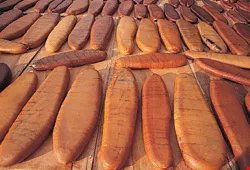
Tungkang in the daytime is quite a sight. The streets are full of the ocean's bounty, set out on racks to dry. Delicious oilfish roe glistens in the sun-drenched lanes, winking back at old Sol. But the dour expressions of the local fishermen seem impervious to this bright scene. "The fishermen are having a rough time of it. Times are tough and they can't compete with China." As mainland Chinese fishermen have improved their equipment, fewer fish are making it back out of China's fisheries. As a result, catches of the migratory fish on which Tungkang depends for its livelihood have declined sharply in recent years. A few old fishermen stand by the side of the road sighing as they look at some NT$2,000-a-pound oilfish roe. "Things are just getting worse," they say.
However, even with the economy in the dumps, Tungkang remains Taiwan's second largest fishing harbor in terms of annual catch. The township also retains its history. Aborigines of the plains tribes inhabited the area 300 years ago. The town was also the landing point for most of the early settlers brought to Taiwan from Fujian by Zheng Chenggong at the end of the Ming and in the early Qing dynasty.
Before Kaohsiung was founded, Tungkang was southern Taiwan's primary commercial harbor. But World War II devastated the wealthy sections of the town. Tungkang was left a virtual ruin, and no trace of the town's Japanese-occupation-era prosperity remains. Arriving from Pingtung or Kaohsiung, all one sees is a typical fishing village-a harbor populated by a few boats, a great deal of fishing tackle and betelnuts.
In an effort to help the town reclaim its earlier prosperity, Mayor Wang Hsien-chao has dedicated himself to rebuilding the business community. Wang hopes to expand the town's tourist attractions beyond the triennial boat-burning ceremony, a ceremony which grows out of local folk religion. In Wang's view, a revival of the township depends upon interesting tourists in Tungkang's culture, its politics, and its local delicacies, as well as in the nearby Tapeng Bay National Scenic Area.
Taiwan's Hawaii
The Chingchou Swimming and Recreation Area on Nanping Beach is perhaps Tungkang's best-known scenic spot. The recreation area itself is on the beach at the mouth of the Nanping harbor where it is protected by a windbreak of Australian pines. According to the older residents of the area, Chingchou used to be called the Hawaii of Taiwan for the palm trees that dotted the beach and the people who frolicked in the waves.
To get to the recreation area, visitors must first get to Chialienli, then cross Tungkang's famous Chia-nan Bridge. From the bridge, they can look down on the channel leading from the Tapeng Bay lagoon to the sea. Crouched behind the endless onslaught of the waves, the lagoon has the air of a shy young girl. She gazes out at a tall prince standing alone on the sea, the island of Hsiao Liuchiu, flirting coyly as the sun sets.
The beautiful Tapeng Bay is the only bay with a lagoon on Taiwan's west coast. During the Japanese occupation, the Japanese air force used the lagoon as a base to support Japan's forays southwards. After Taiwan's return to ROC rule, the lagoon was used for artillery training by all three branches of the armed forces. In fact, the military maintained a base at Tapeng Bay until it was declared a National Scenic Area, at which point the military relocated its facilities to Fangshan.
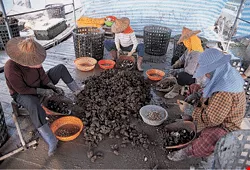
Originally proposed for National Scenic Area status by the Ministry of Transportation and Communications in 1992, 1,438.4 hectares around Tapeng Bay were granted that status in the winter of 1997. While the sack-shaped scenic area extends out 500 meters from the high-tide line, the whole of Tapeng Bay covers an area of about 532 hectares and ranges in depth from five to six meters. The racks of oyster trays and "Oyster Island," as the pile of discarded oyster shells at the center of the bay is known locally, testify to the lagoon's suitability for oyster farming. The lagoon is also home to flourishing mangroves, and magnificent coconut palms imported from the South Pacific more than 20 years ago. The sparkling waters, the coconut palms, the bright sunlight and the soft sands of the beach give Tapeng Bay the feel of a South Pacific island, as well as making it a haven for many bird species.
Development at last?
The marine ecology and topography of Tapeng Bay are rather unusual. As such, development plans for the Tapeng Bay National Scenic Area focus on bringing together the natural environment and local culture. According to the staff of the management office, there's enough to see and do at Tapeng Bay to keep visitors busy for two to three days-just right for a weekend getaway. Staff members speculate that if Taiwanese begin to gravitate towards spending their holidays at one spot rather than touring, and if more resort hotels are built in Tungkang, the township could become a vacation hotspot connecting Kaohsiung, Kenting and Hsiao Liuchiu Island.
Lin Li-ju, manager of Tungkang's Chinsheng International Hotel and a partner in Tungkang's BOT projects, believes that Tungkang has tremendous potential as a tourist destination: "The key is that we have an 18-hole golf course here. We could bring in visitors by promoting an international sporting event. Tungkang has the potential to bring in international tourists."
But a lot of local residents have doubts about the plan. They recall hearing adults talking about developing Tungkang when they were children. Over the last 20-30 years, these children have themselves grown to adulthood, and have yet to see crowds of tourists materialize at the Tapeng Bay National Scenic Area. They can't help but feel a little anxious. And those residents who have traveled in China are still more concerned, noting that construction takes far longer in Taiwan than on the mainland. "They have an easier time getting projects going in China. Here in Taiwan, the distribution of benefits from a project is very contentious, policies change and major projects drag on forever. I hear that the Tapeng Bay development plan is supposed to take another 20 years. Who can wait that long?"
Liu Chia-lang, head of the office of civil affairs, also has strong feelings on the future of development and industry in Tungkang: "Only Japan and Tungkang produce banded coral shrimp, which is one of the main seafood products of the town. And Tapeng Bay abounds in natural resources. Tungkang has what it takes to develop. But Taiwan's entry into the WTO is going to be a heavy blow to Tungkang's fishing industry."
Tungkang's three treasures
Heavy blow or not, Tungkang does have an ace or three in the hole, specifically, three kinds of seafood which draw visitors from all over Taiwan for a taste. At the Huachiao Market, a local fishmonger declares: "Tungkang's three treasures are bluefin tuna, banded coral shrimp and oilfish roe."
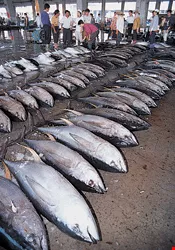
The first of these, bluefin tuna, is sometimes referred to as the king of the tunas and is prized by sushi lovers. Giving a big thumbs up, the fishmonger demonstrates, "Just dip it in a little wasabi, pop it in your mouth and enjoy!" He smiles proudly and asks, "Do you know how good this is?"
Tungkang's second treasure, banded coral shrimp, are small and rather cute with a cherry-blossom coloring that earns them their Chinese name, "cherry-blossom shrimp." This coloring, along with the fact that they are sold to the Japanese market, has made the shrimp famous. Only shrimpers from Japan and from Fangliao in Tungkang Township catch banded coral shrimp, making them very expensive. Local shrimpers limit their catches and have agreed not to shrimp in certain seasons, to prevent overfishing and to protect the local ecology.
The third treasure, oilfish roe, looks a little like mullet roe, but is larger and thicker. It is prepared by marinating, pressing then drying. Thinly sliced and served with garlic oil and daikon, the roe makes a delicious treat that is slightly gelatinous in texture.
Born beautiful
Tungkang is also known for its boat-burning ceremony. The ceremony, which takes place every three years, involves enticing the spirits of disease onto model boats, which are then launched into the sea and burned. It begins by calling Wang Yeh, a god of pestilence, out from his Tunglung Temple. Later, the boats to be burned are placed in the water with their sails raised. When the east wind picks up just before dawn, the boats are launched. The spectacle of the burning boats never fails to stir and excite the thousands of visitors who come for the ceremony.
But those who are working to develop Tungkang's cultural attractions believe the town needs more than just the boat-burning ceremony to attract visitors. Chen Hsiu-chu, who directs the Tungkang Township Literary and History Society and writes guides to Tungkang, suggests that Tungkang should be attempting to "culture its industry and industrialize its culture." In her view, the best approach to developing Tungkang involves marketing the town's natural scenery together with its "three treasures." She also feels that the town should establish an ice-carving exhibition to revitalize the fishing community's unique ice-making tradition. She further suggests an ice-carving festival so that visitors to Tungkang will have something to see whenever they come.
But Chen knows that it will require cooperation between elected officials, the fishermen's association, the travel industry, the media and historians to keep Tungkang economically and culturally viable.
"I really hope Tungkang can pull it off and make itself over into Pingtung's shopping center. If it can, the satellite villages like Linpien and Kanting should be able to ride its coattails to revival." Walking through the Tungkang sunset, I overhear some local residents talking over a meal. "Are direct links with China going to be good for us or not?" The rough-looking older man who owns the restaurant can't help diving into his regulars' urgent discussion on Tungkang's future as he serves them their meal.
Looking into the distance, past the ebb and flow of the local residents' heated debate, I see the natural beauty of Tungkang curling up for the night cocooned in the warm ocean breeze. Meanwhile, Tapeng Bay listens drowsily to the tides of change washing over Tungkang once again.
Tungkang Facts and Figures
Tungkang Township lies in Pingtung County on the shores of the Taiwan Strait, to the north of Linpien Rural Township. Tungkang covers 29.4 square kilometers and has a population of approximately 49,000. Tourist attractions include Tapeng Bay, the Huachiao Market, Jenhai Park and the Seawatch. Two bus companies, South Central Transport and Kuokuang Transport, provide public transportation to the township, each running buses every 10-15 minutes. The Pingtung Bus Company also serves the township from Kaohsiung and Pingtung on its Kaohsiung-Tungkang-Hengchun line. The township also boasts a number of hotels, including the Hwa-an Hotel, the Sheng-you Hotel, the Yu-ta-li Motel, the New Tungkang Hotel, the Tai-chueh Hotel, the Chin-sheng Hotel and the Fu-ta Hotel.
Source: Tungkang Township Administration; Tungkang Township Literary and Historical Society.
For more information see: www.pthg.gov.tw/pt15/downtown/ptt17/default.asp (in Chinese).
p.092
Long famous for its fishing industry, Tungkang's annual catch is Taiwan's second largest.
p.093
The streets of Tungkang are filled with glistening oilfish roe drying in the sun. The tasty roe is one of the town's "three treasures."
p.093
Often called the "king of the tunas," bluefin tuna is a favorite with gourmands.
p.093
Tungkang's large oysters are another important seafood product.
p.095
Folk religion plays a big part in Tungkang's famous boat-burning ceremony. (photo by Yang Hui-min)


@List.jpg?w=522&h=410&mode=crop&format=webp&quality=80)
