Mainland Experts Talk Cuisine
Tsai Wen-ting / photos Chuang Kung-ju / tr. by Anthony W. Sariti
December 2003
When it comes to food, the older generation thinks wistfully of famous old restaurants and is most particular about authenticity while the younger generation go for the out-of-the-ordinary restaurants that have a creative flair and style. Some say we live in an age where everyone can sample the best of world cuisine-others lament the passing of an age of fine food. In mainland China a "hundred flowers" are blooming in the restaurant business. What do the restaurant-goers and gourmets of Peking and Shanghai have to say?
Aside from taking pictures at Tiananmen, eating Peking duck at the Quanjude restaurant next to the Qianmen Gate is just about a must for any travel group, domestic or foreign.

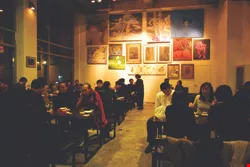
Combining contemporary art and style, the avant-garde restaurants are the favored locale for middle class patrons. The photo shows the "Tea Horse Road" restaurant run by contemporary artist Fang Lijun.
The old restaurants are no more
As patrons pile into the Quanjude, hanging lanterns greet them and they all stop at an open area to watch the ducks being prepared and roasted. During the height of the tourist season on a recent day in October, an electronic board announced that the duck then on its way out of the oven, with its glistening and crispy skin, was number 101,800,102 in a long line of ducks that stretches back to the restaurant's opening day in 1864.
But popular and busy old line restaurants like Quanjude are few. After communist society came to the mainland all the fine cuisine of the past, which had a certain economic base, was "leveled out and acquired a popular and mass character. Authentic fine cuisine was gone," says Zhu Wei, editor of SDX Joint Publishing's Lifeweek and author of On Food. Fine old restaurants have either become all but deserted or have turned into pedestrian eateries serving every kind and manner of food. "The younger generation feels no sense of pride going to a fine old restaurant," says 40-year-old Zhu. Most of the "in" restaurants now are of recent vintage and owned by private individuals.

"Hot" countrywide
There are basically two schools of thought on the mainland with regard to food. One breaks the mold of regional cooking and favors spicy and hot. One minute every restaurant is offering Sichuanese hot pot, the next minute everyone is eating hot and spicy crab and steamed fish. Beijing has a street, Guijie, that is called the "Food and Beverage Street." Right now the big item is hot and spicy small lobsters.
Liu Yiwei, host of CCTV's Everyday Cuisine, says of this copycat mentality when it comes to popular foods, "In the past, northerners never touched hot and spicy food but now with the influence of the mass media, hot and spicy food has become 'hot' all over the country. Regional cuisine has gone national."
The second school of thought is to go against the tide, to pay close attention to special characteristics. And the different generations have quite different interests in this regard. Shen Changwen, a 70-year-old publisher well known on both sides of the Strait, has always been an engaging and humorous intellectual with an appreciation for fine food. There is an entry in his online journal that deals exclusively with gourmet restaurants, to which he adds his own notes. If you would like to enjoy some authentic cuisine, he offers up a secret: provinces and cities each have their own "Beijing office." Most of these offices have restaurants attached to them, and the cooks all come from the home area. The food is far more authentic than most of the regional cuisine sold in the street. "Among these restaurants, the lower level the office, the better the food. The cuisine at a city-level Beijing office, for example, is more authentic than that found at a provincial office."
Shen Changwen's journal makes you want to go right out and do some sampling, but the young yuppie Zhu Wei doesn't agree. "Our SDX Joint Publishing editors don't deign to eat in the small hutong eateries primarily because of the poor sanitary conditions."
And where do mainland white-collar workers like to eat? "Oh, if you want to find some mainland intellectuals, go to restaurants like the Flour Warehouse, the Noodle Warehouse, the Monk's Warehouse or the Tea Horse Road and Three Men from Guizhou. Your Taiwan intellectuals are also frequent guests there." A self-styled "senior delinquent," Shen Changwen regularly follows the young people to stylish, out-of-the-ordinary theme restaurants.
The Tea Horse Road restaurant, opened by well-known mainland artist Fang Lijun, is filled with artwork suspended high in the air, giving it the look of an avant-garde museum. In the Monk's Warehouse the waiter, dressed up like a chief jailor, leads guests into a cell with iron bars where the various dishes are given names in tune with the environment, like "Death of a Thousand Cuts." "Modern restaurants depend on novelty to win customers. Some really get pretty bizarre," laughs Shen Changwen.

Admitting he has been affected by the "pernicious influence of the capitalist class," intellectual Shen Changwen enjoys most going to the restaurants attached to the various provincial and city "Beijing offfices," where the regional cuisine is authentic and substantial.
More people enjoying good food
Although mainland Chinese are avid restaurant-goers, "what we have right now are a lot of people who regularly eat out, and are big eaters, but this doesn't mean they are gourmets. If we have any gourmets it's because people feel a need for such a thing and they just 'fake it,'" says Liu Yiwei.
"Being a gourmet not only requires money, it requires a refined taste. This is all related to a person's overall qualities. It is not just a question of eating food," adds editor-in-chief Zhu Wei. There is no lack of outstanding novelists on the mainland but to date they haven't been able to produce a good food critic. The specialized books on food found in bookstores, whether we're talking about the older or the younger generation, all come from Taiwan.
"During my father's generation the Cultural Revolution obliterated all distinctions and made everything the same, so there aren't any standards any more. It is our generation that must begin the slow accumulation of knowledge about food," says Liu Yiwei.
But Liu, the son of a famous Shanghai artist and a man who considers himself a "dinosaur" on the verge of extinction, is pessimistic. He says nowadays everything on the mainland is driven by money. Anything expensive is considered good. "Heaven knows, quality and the ability to pay have no relationship to each other. Today's cuisine is in no way better than that of the past," the dinosaur says.
"As for basic ingredients, production used to follow certain natural cycles. Today, if there is a demand from the public, production has to be increased. In the old days you could only eat Dazha crabs in the autumn. You had a few then and the rest of the year you depended on your imagination. How different now when you can eat them every day-and completely ruin your taste buds."
"Everything is richer, bigger, brighter, more exciting-but it's monotonous, really, there isn't any taste. Good things are neglected, bad things are overvalued," laments the dinosaur. For example, in publishing, it's all show and no substance. The technology of the printing has outstripped the content of the books. Restaurants are the same: the emphasis is on form rather than substance. "I'm afraid to say that some of these bad habits have come from Taiwan."
As for the restaurant business on the mainland, where the economy is booming and business rules all, there is a great opportunity to break new ground. Nevertheless, amidst all the hubbub, "has a real hero been created, or have we just been presented with a bunch of flashy stars?" Is it all smoke and mirrors, or are we really eating fine cuisine? As consumers spend large sums of money for an evening of dining pleasure, they may well ask themselves these questions.