A Love for the Land--Farmer Ah-pao Comes Down from the Mountains
Chen Hsin-yi / photos Hsueh Chi-kuang / tr. by Scott Williams
March 2010


In 2004's A Female Farmer's Notes on Life in the Mountains, Lee Pao-lien, a headstrong woman who yearned to get back to the land, speaks of the powerful, abiding love that led her to farm on Mt. Li. "I fell in love with landscapes," she writes. "The great joy to be had trekking alone across summits or along riverbanks made my flesh hunger for it again and again, took me ever deeper into the mountains and to ever more remote spots...."
Women filled with blazing passions are bolder and more determined to turn their dreams into reality than the average person....
Born in 1965, Lee Pao-lien (who goes by the nickname "Ah-pao") was the second-youngest of seven children from an ordinary Yilan family. After graduating from Soochow University with a degree in Chinese literature, she went to work for a Taipei photographic studio, where she earned a living while learning photography. She then went on to work as a guide in Taroko National Park.
At the age of 29, Lee, whose mother called her "a heroine unafraid of death," made a year-and-a-half-long trip cycling, hiking, and riding a donkey through Tibet, Nepal, and India. She later spent seven months cycling around the Scandinavian peninsula.
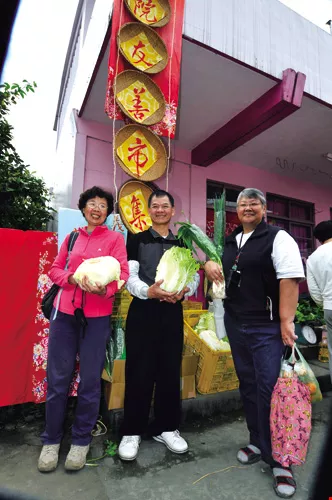
"Eat seasonally. Eat locally. Support Earth-friendly farmers. Support diverse community values." The Big House Earth-Friendly Market welcomes those who are so inclined to join in the jostling and enjoy themselves.
However, as her longing for the wilderness grew, so too did her sense of the conflict between humanity and the natural world. She was pained at what she saw as the ROC government's shirking of its responsibilities vis-a-vis afforestation policy. Unable to bear to criticize those making their livings from the forest, she turned to self-reflection. As she wrote in her book: "I do my utmost to get deep into the wilderness to feast on Nature's incomparable bounty, to experience the ultimate in spiritual sublimation. But what supports me [in these endeavors] is a massive and complex civilized society. This society has unimaginable power to impact nature, spews clouds of destructive particles. I depend on these very destructive particles to place me in the position of standing before Nature asking for nothing...."
Seeking a way to relate to Nature that would allow her to continue to live well and with peace of mind, Ah-pao ascended Mt. Li in late 1999 to test out her plan to "give something back" to the mountain. Having raised and borrowed a total of NT$1 million from friends and family, she leased a 0.7-hectare orchard on the mountain's slopes. Running the farm and maintaining the trees in an earth-friendly manner, she used income from the sale of her fruit to pay off her investment and to purchase the land. Over time, she "abandoned" the orchard and began working towards her ultimate goal of restoring the natural landscape by planting Taiwan incense cedar, Formosan cypress, and other native tree species.
Ah-pao's metamorphosis from traveler to farmer took 11 years. By her third year on the mountain, she had sold enough Asian pears and peaches to fully repay her debts, and had earned the respect of neighbors by building a two-story bamboo home with her own hands. By her fifth year, the popularity of her book was enabling her to sell out her annual harvest even before it began.
Luminaries such as National Taiwan University geography professor Wang Shin, former Taiwan Forestry Research Institute director King Hen-biau, and Society of Wilderness founder Hsu Jen-hsiu praised her book as Taiwan's Walden and said it perfectly captured the spirit of the idealist.
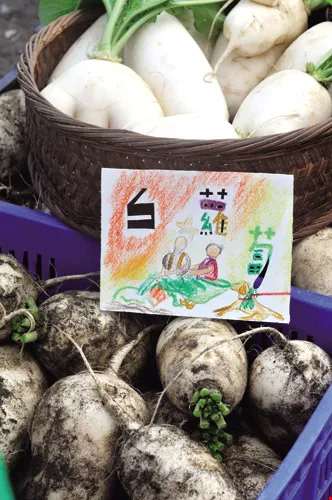
"Eat seasonally. Eat locally. Support Earth-friendly farmers. Support diverse community values." The Big House Earth-Friendly Market welcomes those who are so inclined to join in the jostling and enjoy themselves.
Just as the philosopher Henry David Thoreau continued writing and lecturing on civil disobedience and on the coexistence of humanity and the natural world after returning from his two years in solitude in the forest, Ah-pao was a different person when she left the mountains in late 2007. She first rented a home in her hometown in rural Yilan for her mother, but continued spending a good deal of time doing agricultural work in the mountains. One year later, she "planted" herself back in Yilan, where she leased half a hectare of rice paddy and went to work igniting Yilan's agricultural revival movement through her efforts to found Yilan's Earth Friendly Small Farmers Alliance and Farmers Market.
When asked why she came down from the mountains, Ah-pao purses her lips, smiles, and says that she's never been very good at career planning. All the big changes in her life have come about as a result of an "inner predicament." Her decision to leave the mountains was entirely a response to the need to care for her aging mother. Who would have guessed that by interacting with people and searching for a home and land, this daring, discerning woman would also gain a fresh perspective on the decline of Taiwan's agricultural communities and hear the call to take up a new mission.
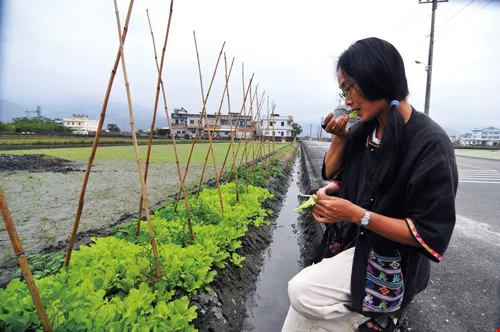
Earth-friendly small farms grow a more diverse array of produce than commercial farms. "This keeps the labor on small farms from becoming alienated or mechanized," says Ah-pao. "It feels powerful and beautiful." Ah-pao reflects while harvesting her produce. She then washes the fresh, tender leaves and pops them into her mouth for a taste.
Ah-pao has felt even more pressure since the publication of her book brought good reviews and opened sales channels for her fruit. "The support of the general public shouldn't mean success only for me," she says. "I feel that I have to utilize the name and resources I've acquired to help other small farmers break out as well."
As she met the Ko Tong Rice Club's Lai Qingsong (her most important comrade in arms) and came to know many other outstanding small farmers who were fighting for survival on their own, Ah-pao's ambitious blueprint grew ever larger. Her goal became the construction of a sustainable local support network among small farmers using an earth-friendly approach to growing.
Ah-pao says that a "small farm" is one on which an individual or the family provides the bulk of the labor; there are no long-term employees. In Ah-pao's eyes, the lifestyle of the small farmer, someone who must almost by definition be well-rounded, is something Taiwan urgently needs to preserve but is rapidly losing.
She uses "earth friendly" rather than "organic" because it's something she wants society to think about. She says the organics movement was originally intended to be a "whole life" movement, but was sidetracked by government and consumer focus on organic product certification guidelines. That focus, she says, effectively steered Taiwan's emergent organics movement down a narrow "formalistic" path. She notes, for example, "Some 70% of the organic products on store shelves have been flown to Taiwan from halfway around the world. Such 'organics' are extremely unfriendly to the environment and to farmers!"
Ah-pao also linked the preservation of agricultural communities to the long-term focus on wilderness conservation. She explains that Taiwan grows only about 30% of its own food, and almost none of its grains and pulses. Taiwan has demand for agricultural products. "But government policy looks the other way when low-priced imports are dumped into the local market. And since agricultural goods grown on the plains do not receive reasonable protections, farmers have little choice but to abandon good farmland and grow the kinds of alpine vegetables we can't import. This in turn is resulting in the loss of environmentally sensitive land."
The Earth Friendly Small Farmers Alliance therefore advocates preserving agricultural communities and using earth-friendly farming practices such as minimizing pesticide and chemical fertilizer use. The alliance is also working to build strong ties to schools and communities to facilitate direct group purchases of its farmers' produce.
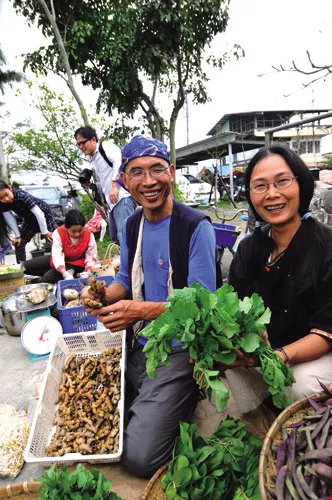
"Eat seasonally. Eat locally. Support Earth-friendly farmers. Support diverse community values." The Big House Earth-Friendly Market welcomes those who are so inclined to join in the jostling and enjoy themselves.
Ah-pao and her partners have been working diligently since last April and recently brought their community college course to a satisfying close. Though Ah-pao and Lai have had to suspend the course, which they were teaching together, to take care of necessary work on their farms, they had already succeeded in getting their students to attempt "cooperative farming of one mu of land." In addition, with the support of parents of students at Yilan's Ci-Xing Waldorf Kindergarten, Ah-pao has found an adorable permanent home for the small farmers' market she established. The growing number of people who visit it every other week are sharing in and spurring local dreams and passions....
Ah-pao's journey has taken her from living in solitude and creating her own lifestyle to working with groups and learning about "collective farming." She says she still misses the time she spent living alone in the mountains. These days, when she needs to find balance, she either throws herself into the embrace of the mountain forests or walks out into her own nearby fields to till the earth, look up, sigh, and note that another heron has come back to the farm.
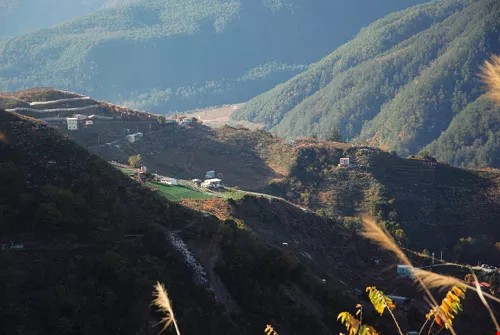
In the second half of 2009, Ah-pao created a "holistic health and Earth-friendly farming" class for Yilan Community College and took her students on an overnight trip to her orchard on Mount Li. Over the last decade, Ah-pao and her younger brother Lee Wan-sheng have used 1.5 hectares of leased land to develop Earth-friendly farming techniques,switched to the use of no-till farming, and begun returning the land to Nature. (right photo) A view of the mountains from Ah-pao's orchard.
@List.JPG?w=522&h=410&mode=crop&format=webp&quality=80)


