Modern Primitives:Life at the Yushan Weather Station
Kuo Li-chuan / photos Cheng Heng-lung / tr. by Andrew Wilson
July 2004


How many people would consider a job offer that involved working on the top floor of the world's tallest building, Taipei 101, for a month without a break? Not to mention a further condition stipulating that employees have to carry their own food and drink up the stairs and lack modern conveniences for the duration?
That's the life of employees at the Yushan Weather Station-they need the strength and endurance of worker ants. Yushan's north peak is seven-and-a-half times higher than the 101 building, with parts of the route so precipitous it is still very dangerous even if you use both your hands and feet. With this in mind, it is hard not to feel admiration for the men and women who have worked for any length of time at the weather station.
This reporter made the journey up Yushan (Mt. Jade) with a replacement weather station team just as spring was warming the air and the flowers were starting to bloom. Hsieh Hsin-tien, a technician who has been working on the mountain for a decade, informed me that every time he makes his way up to do a "shift" he does so as part of a group of three (one technician and two assistants). Technicians work shifts of one month, and assistants two weeks. When the time comes for them to set off they are required to carry with them everything they need for a two-week period, including food, paper to record weather data, equipment and personal items. Generally speaking, each team member is expected to carry some 30-40 kilograms, though young Aboriginal assistants often carry as much as 50 kilos.
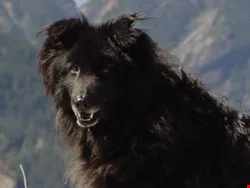
In 1995, three-year old Hsiao Hsiung was brought to the Yushan Weather Station. Because of the lack of resources, colleagues occasionally argued over what to feed him. Only in the second year did Director Lai include his expenses in the budget, with a monthly stipend of NT$500 awarded for dog food. Usually Hsiao Hsiung patrols the area around the weather station with great authority. He is also everyone's best friend when they are feeling lonely.
Toiling like worker ants
As we climbed ever higher, the oxygen grew thinner and my swollen feet made the going even harder. Hsieh's voice, explaining the sights along the way, came to me in fragments over my own panting breath. "Are we almost there?" I asked, I don't know how many times. Only with great difficulty did I complete the 8.5 kilometer route to Paiyun Lodge where we rested for a while before continuing upwards another 4.3 kilometers towards our destination, the Yushan North Peak Weather Station.
Sitting outdoors in front of the weather station, it took some time before we caught our breaths properly. At around 1,000 meters above sea level there is something like 10% less oxygen in the air. At 3,858m, the height of the north peak, the air contains only 62% as much oxygen as at sea level. Even sitting down and resting I felt dizzy.
Because all supplies have to be carried up the mountain one step at a time, when selecting assistants, preference is always given to fit, healthy Aborigines familiar with the mountain trails. At the same time, limited storage space restricts the selection of food. Fussy eaters might find themselves moaning at the sight of the selection, but individuals who have spent years working at the weather station are used to the hardship of eating whatever is available.
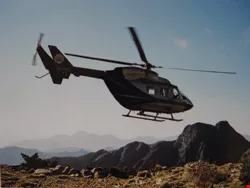
Once helicopters began to supply Yushan Weather Station by helicopter in 1997, assistants were no longer required to collect firewood from nearby gorges. As a result, tensions between colleagues over whose firewood was being used were also reduced.
Getting warm, heated tempers
A few extra charcoal blocks are thrown on the fire to boil water and provide heat. Although the temperature in Taiwan's plains can go as high as 30oC in late May, when night comes, it falls to 4-5oC on the north peak and there is often a strong cold wind. Sweaters, hats and thick socks are basic requirements all year round. "Not until November 1997 did a helicopter bring the first load of charcoal to the Yushan Weather Station," says Hsieh. "Before then we had to collect firewood ourselves."
In modern society, we take electricity and gas for granted, so it is difficult to imagine that in the 1990s those working at the weather station found themselves arguing over how best to light the firewood they collected. At that time, the station had its own annual budget and employed workers to carry 12 canisters of gas up the mountain per year, which meant each team was restricted to the use of one 20-kilo canister per month. Generally, this was reserved for cooking, but that also meant that collecting firewood to cook rice, boil water or keep warm in winter was the responsibility of the assistants.
Two assistants from each team usually either cut down branches or picked up dead wood in a mountain gorge approximately 200 meters from the weather station, at the bottom of a roughly 1,000 meter long, 60-70 degree slope, a round trip of two kilometers. Because sometimes in the snowy season it is impossible to go outside, assistants had to work especially hard before the snow arrived to ensure enough wood was stored at the station. Insufficient firewood in the winter months meant those working at the station ran the risk of frostbite.
In addition, each team's assistants were only allowed to use the firewood they had collected themselves. As a result, every time a fire was lit, there was friction and bickering. In order to cool tempers, it was decided that the station chief would decide when the fire was lit and put out. Later charcoal was purchased and transported up the mountain, finally laying to rest the problems caused by the previous arrangement.
Other than at a barbeque, few people use charcoal in their daily lives, and so are unaware of what it costs. At around NT$10 a kilogram, a year's supply of 3,000 kilos costs a total of NT$30,000. Using a helicopter to carry it to the north peak costs NT$220,000 per 700 kilo, or a grand total of around NT$950,000. Add to that the cost of getting the charcoal to the helicopter, and the total is over NT$300 to transport just one kilo of charcoal to the north peak. With such a major outlay, staff at the weather station still use charcoal sparingly, so as to prevent waste.
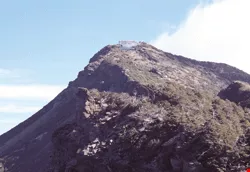
Yushan, the highest peak in East Asia, calls to mind the words the Japanese explorer Kano Tadao wrote on reaching its summit: "Far removed from the world, what makes me happiest is that this untouched forest embraces me with its warmth, allowing me to enjoy its eternal peace." This photo shows A distant view of the Yushan Weather Station, on the mountain's north peak.
Reading by candlelight
Li Tai-chun, who has worked as a technician at the Yushan Weather Station for over 20 years, recalls: "In the early years the station had no electricity so we had to use a gas generator to charge the batteries used to send dispatches. At night we relied on moonlight or candlelight. At the time I was taking courses at Open Junior College, and every night I read by candlelight until very late."
It was in 1989 that the Central Weather Bureau (CWB) commissioned the Industrial Technology Research Institute's Energy and Resources Laboratories to evaluate and plan the installation of a solar power system to be used at high altitudes. The Ministry of Transportation and Communications asked the Ministry of National Defense to dispatch an S-700 helicopter from the ROC Air Force's 455 Wing to assist with the transportation of a set of huge photovoltaic panels, batteries and accessories weighing in excess of 20,000 kilos. A total of 39 journeys were needed to complete the task, with the new apparatus up and running by the end of 1990.
Because the power output of the solar system was very variable, and weather station equipment was given priority, staff only got what was left over. They could watch snippets of the news but then had to turn the television off to conserve energy. What's more, because the power equipment was very sensitive to the weather, in the winter months station personnel had to endure freezing temperatures to clear rime from the solar panels on a regular basis.
Rime builds up when the water particles in thick fog condense. If it is not quickly cleaned away from the windward side of any solid object, it accumulates until even a small piece of wire can become a pillar of ice. In addition, if just a thin layer of rime settles on a solar panel, it is unable to collect sunlight to generate power. In other words, whenever thick fog was encountered during winter, staff stationed at the weather station had to clean the equipment a minimum of three times a day: "Cleaning away rime is extremely hard work," says station director Lai Ching-hsiang. "During the foggy season the windspeed is very high and outdoor temperatures drop quickly, so that your hands become so numb you can barely move them."
In 2000, the Yushan Weather Station expansion project was finally completed, with the original 100-square-meter wooden hut expanded into a 160-square-meter steel frame structure with a sheet-metal roof. At the same time, new equipment, such as a live video feed system, was added. The number of photovoltaic panels and power storage batteries was also increased, as a result of which the power supply was improved. Nevertheless, accustomed to scarcity, the weather station teams continue to conserve wherever possible. In fact, when visitors, observation groups or researchers drop in, often the first thing they do on arriving is turn on the lights and then forget to turn them off when leaving. Station staff get things back in order once such "guests" have departed.
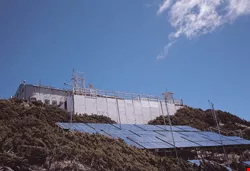
In 1990, the Central Weather Bureau commissioned the Energy and Resources Laboratories to install a solar power system at Yushan Weather Station. With the installation of more hardware, the power storage capacity was increased to a level that roughly meets the increasing demands of modern meteorological equipment. The blue panels in the foreground are the system's photovoltaic panels.
The battle to conserve water
After walking around Yushan's north peak and drinking a cup of hot soup one of the staff was kind enough to give me, I suddenly felt completely exhausted. After making the eight-hour-plus journey all I wanted to do was have a hot shower and go straight to bed. It was only then that I learned hot showers are regarded as an extravagance.
On the very highest point of the north peak, the weather station is almost entirely dependent on rain and snowfall for its water. When the Japanese first built the station in 1943 they constructed a water storage tank in the basement, designed to hold ten tons of water. Unfortunately, the tank is now old and cracked, and leaks so badly it can only hold two or three tons at a time.
Despite leaking so badly, it was at least designed to store water, unlike the water collection apparatus used outdoors. Despite being covered with a lid, Formosan weasels or mice scavenging for food often accidentally fall into it. Station personnel often have to remove the bodies of dead animals from their drinking water before boiling it.
Difficulties of this nature continued until 1996, when Lai Ching-hsiang was appointed director and funding was found to purchase 12 galvanized iron barrels. With each one able to hold one ton of water, they significantly improved the water storage situation once they had been transported up the mountain. Later, when the weather station was expanded, the old water storage tank was also increased in size in order to hold enough water. But personnel were still careful: "Even if we have a bigger water storage tank, what are we supposed to do if it doesn't rain or snow for six months?" says Hsieh, remembering one Chinese New Year's Eve when all the weather station had left was a 60-liter barrel of mineral water. As a result, the staff had to go down the mountain and fetch more water. Events like this mean that strict controls remain in place.
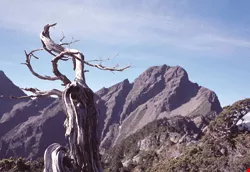
Yushan, the highest peak in East Asia, calls to mind the words the Japanese explorer Kano Tadao wrote on reaching its summit: "Far removed from the world, what makes me happiest is that this untouched forest embraces me with its warmth, allowing me to enjoy its eternal peace."
Preparing for bed
As night deepened, and this sweaty, unwashed reporter could no longer keep her weary eyes open, I opened the door a fraction and felt a gush of cold air, as if from a freezer. Could this be where I was sleeping for the night?
Before going to bed, one of the assistants had said to me half jokingly that they once housed a researcher who had applied to do work on Yushan at the weather station, only to watch as he rushed out from his room at night saying: "My duvet is frozen, how on earth am I supposed to sleep?" The station staff looked at each other all thinking the same thing: "What do you mean your duvet is frozen? This is how we sleep every night. Just get used to it." In this situation, such a sentiment is the only psychological preparation one gets before bed.
At the end of last year, the Council for Cultural Affairs invited a number of figures renowned in the world of art and culture to climb Yushan. On reaching the halfway point at Paiyun Lodge, one female writer was heard to ask for a room with a bathroom, while others wanted a hot shower or to eat hotpot.
"Over the last few years there have been more reports in the media, and climbing Yushan seems to have become an ambition for people across Taiwan. But most think of strolling romantically through a mountain forest, and have absolutely no idea about the difficulties of living on a high mountain," says Hsieh, who jokes that a friend once presented him with coffee beans as a gift, even though there is no way of grinding them or indeed even a coffee pot on the north peak.
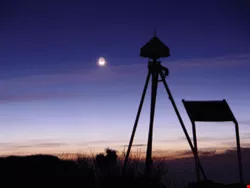
To promote automated weather reporting, the Central Weather Bureau has installed extensive high-tech devices. This picture shows a GPS receiver on Yushan at dusk.
All hands on deck
A day in the life of a weather observer starts before 5 a.m. The technician, responsible for recording the meteorological data, gets up at around 4:50 a.m., and half an hour earlier in winter, because it is necessary to clean off the overnight rime that has coated the equipment, with hot water. Imagine, the temperature under the duvet close to 40oC, and then having to go outside where the temperature is -10oC to record the required data. That is a temperature differential often in excess of 50oC. Needless to say, getting up in the morning is one of the hardest tasks of the day at the Yushan Weather Station.
According to standard international meteorological practice, visual observations must be made once every three hours, but because the Yushan Weather Station is grouped among the smallest "grade-four" stations, it only has to make eight manual readings from 5 a.m. to 9 p.m. For the rest of the time, observations are made and recorded automatically by the various meteorological apparatus.
Director Lai Ching-hsiang says: "All observational data is first input into a computer and then transmitted by wireless modem to the Central Weather Bureau. The bureau's report center collects information from observation stations across Taiwan, enabling it to analyze the data and make forecasts." Every day the work is simple and fixed, changing only in the event of a typhoon: "When a typhoon is coming we need to be on alert 24 hours, and an observation is necessary once an hour.
In order to ensure there is no break in the data output from high mountain weather stations, it is important that station staff have a background in basic repairs. Hsieh points out that Yushan is in a "lightning zone" and that in summer lightning is particularly frequent. The most serious incident took place in April 2003, when 90% of power and communications and meteorological instruments were taken out by a strike. Then the repair skills of the station team came into play. They managed to make sufficient repairs to transmit a message requesting specialist repair staff be dispatched immediately.
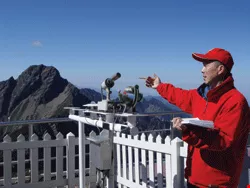
As a grade-four weather station, the limited staff on Yushan are only required to take readings from 5 a.m to 9 p.m. Each day they transmit eight observations to the Central Weather Bureau. The picture shows technician Hsieh Hsin-tien taking a routine recording in front of the sunshine recorder.
Amazing images of avalanches
Before climbing Yushan I had been told there were several professional photographers staying at the weather station. One of them, Li Tai-chun, discussed his photographic experience with me. In 1990 CWB chief Tsai Ching-yen visited Yushan, where he saw a particularly stunning sunset over a sea of clouds. This made him consider the possibility of producing an Yushan calendar filled with such breathtaking vistas, and Yushan Weather Station was put in charge of the project. It was with this in mind that Li took up photography.
Standing on the balcony of the station it is easy to understand what attracts the photographer. Directly in front towers the mountain's main peak, hemmed in by the east and west peaks. In the early morning, looking towards the east, it is possible to catch the first light of sunrise, and in the early evening, turning west, one get to see the sun setting over a sea of clouds. Viewed from the north, it almost looks as if the main peak and east peak, on either side of the north peak, are there to protect the weather station. In the words of one writer, Yushan is a peak for all seasons, whether shot through with red on a spring dawn, or sparkling with winter snow, and on a clear night it offers vistas of all Taiwan, from the four chimneys of Taichung's gas-fired power station to the lights of Makung on the Penghu Islands and of the north and east coasts.
As I climbed back down the mountain, there were budding azaleas waiting to bloom on either side of the mountain pathway. The white flowers of mountain clematis looked particularly beautiful in the sunshine. The Taiwanese firs at the side of the road sprouting goose-down-yellow shoots, brought to mind the words of John Muir: "Whenever one finds oneself alone in this cold forest, the silence immediately fills one with awe and solemnity, as if every leaf is alive" At a turn in the path, a cloud slowly moves in the direction of the weather station, shrouding the mountain in mystery.
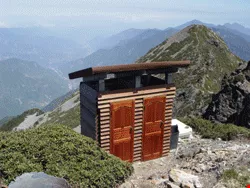
In response to the demands of an increasing number of mountain climbers, work on this public toilet, known as the highest in Taiwan, was completed at the end of last year. It has a steel frame and brown wooden walls. Located amid the hills and clouds, from a distance it could be mistaken for a holiday cabin.


@List.jpg?w=522&h=410&mode=crop&format=webp&quality=80)


