Old Hakka Homes of Southern Taiwan
Chang Chiung-fang / photos Vincent Chang / tr. by Scott Williams
March 1999


In Hakka communities such as Pingtung's Neipu and Kaohsiung's Meinung, much traditional Hakka architecture remains. These old homes clearly reflect the traditional Hakka way of thinking and being.
But many Hakka are concerned about the state these homes are in. Though they belong to three different generations, Ku Te-fu, Chung Chao-yan, Hsieh Ying-chun, Chen Pan and Lee Yun-fei all possess strong feelings for their culture, and are doing their utmost-whether by means of the spoken word, the artist's brush or the architect's ability to design traditional Hakka elements into modern buildings-to preserve the Hakka's architectural heritage.
Ku Te-fu, from Kaohsiung's Chishan, is a banana and pineapple farmer who also happens to love to talk to folks. Over the years, his amiable garrulity has turned him into something of an expert on Hakka traditions. The old Hakka homes of the Meinung area are a specialty of his; he knows them all like the back of his hand. When visitors come down to Meinung hoping to see the place with more than a tourist's eyes, Ku volunteers his services as a guide.
Chung Chao-yan is a painter of "decrepit buildings" who lives in Neipu. For the last 10-odd years, his work has focused exclusively on Hakka themes, and his paintings of traditional Hakka architecture have a character all their own. Interestingly, not long ago someone came to Chung to buy a painting of his own old home, which now exists only in one of Chung's works.
Among the younger generation there are Hsieh Ying-chun, a young architect; and Chen Pan and Lee Yun-fei, both active in efforts to preserve Hakka culture. Not only have these three done a great deal of research into extant Hakka architecture, they are also involved in the design of public buildings for Hakkas, working to incorporate Hakka motifs and Hakka spirit into such projects.
Although their methods may be different, Ku, Chung, Hsieh, Chen and Lee are all contributing to the effort to preserve the spirit and values reflected in traditional Hakka architecture.
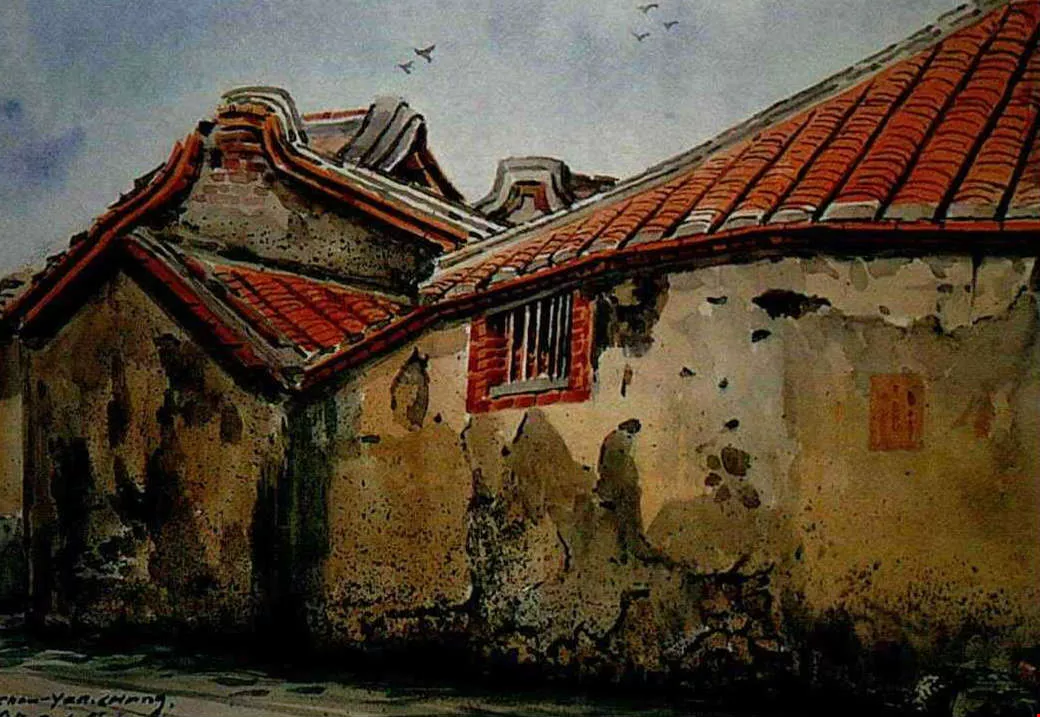
(right) Faced with decrepit old homes, Chung Chao-yan is moved to action. The picture shows one of Chung's paintings--the old Hsiao family compound. His skillful brush has brought a kind of immortality to some of these old southern Taiwanese homes.
Taiwanese homes built in a Hakka style come in several different forms. There are, for example, the "dragon style," the "enclosed-courtyard style" typified by the ancient Hsiao-family home in Chiatung, and the weilung wu of the Tseng family's home in Neipu. But it is the "semi-enclosed-courtyard style" of the huofang that is the most common.
Hsieh Ying-chun points out that building a weilung wu, a compound that expands outward in layers of buildings from a central courtyard, took the kind of manpower which only very large families had available. As most of the first Hakka settlers on Taiwan did not arrive as whole families, but were rather groups of individuals working cooperatively, weilung wu were not very common. Similarly, although a typically Hakka style of building known as the yuanlou, a round building so designed for defensive reasons, appears in the more remote, mountainous regions of the mainland, it was not appropriate to the Taiwanese environment and is not found here.
In Taiwan, traditional Hakka architecture tends to be concentrated in Pingtung and Kaohsiung, which were among the first locations where Hakka settled in Taiwan. But that was long ago, and the Hakka communities have dispersed. Now many of these traditional buildings stand empty and in disrepair. Some have even crumbled away over the years.
"Seeing these crumbling buildings, I'm pricked by a peculiar impetus. I fear I won't be able to capture them, that I won't be able to finish painting them," says Chung Chao-yan, pointing at his paintings on the wall.
In order to devote himself to painting, Chung retired from his position as an arts teacher at Neipu Middle School four years ago. "These Hakka buildings have around a hundred years of history. They are being rapidly eroded by time. I must grasp this last moment." Chung says that the only thing he can do on seeing these buildings toppling or being torn down is to paint them. "Sometimes I see one, and when I go back the next day to paint it, it's already gone." Chung is adamant about painting from life. Unwilling to paint from photographs, he must race against time to complete his paintings before these buildings disappear.
Chung's favorite subject is an ancient gate built in Neipu's Fungtien Village in the 26th year of the Guangxu reign of the Qing dynasty (ca. 1901) and recently declared a historical building. But in his paintings the gate differs somewhat from the way it looks today. "I paint it in the colors it had when I was a child. The houses have been repainted several times since then and have lost their original feeling," says Chung, who grew up in Neipu.
At one time, Neipu's Changli Temple was also listed as a historical building, and as such received an annual budget for repairs. But a few years ago, those responsible for the temple used this maintenance budget to rebuild the temple. Not only did the temple sacrifice its original appearance, it also lost its standing as a historical building. Now if you want to see how the temple used to look, you have only Chung's paintings.
The situation is much better in Kao-hsiung's Meinung and Chishan, where many Hakka huofang have been preserved. It is rather startling, however, to see these old houses holding their own pinched in among modern buildings.
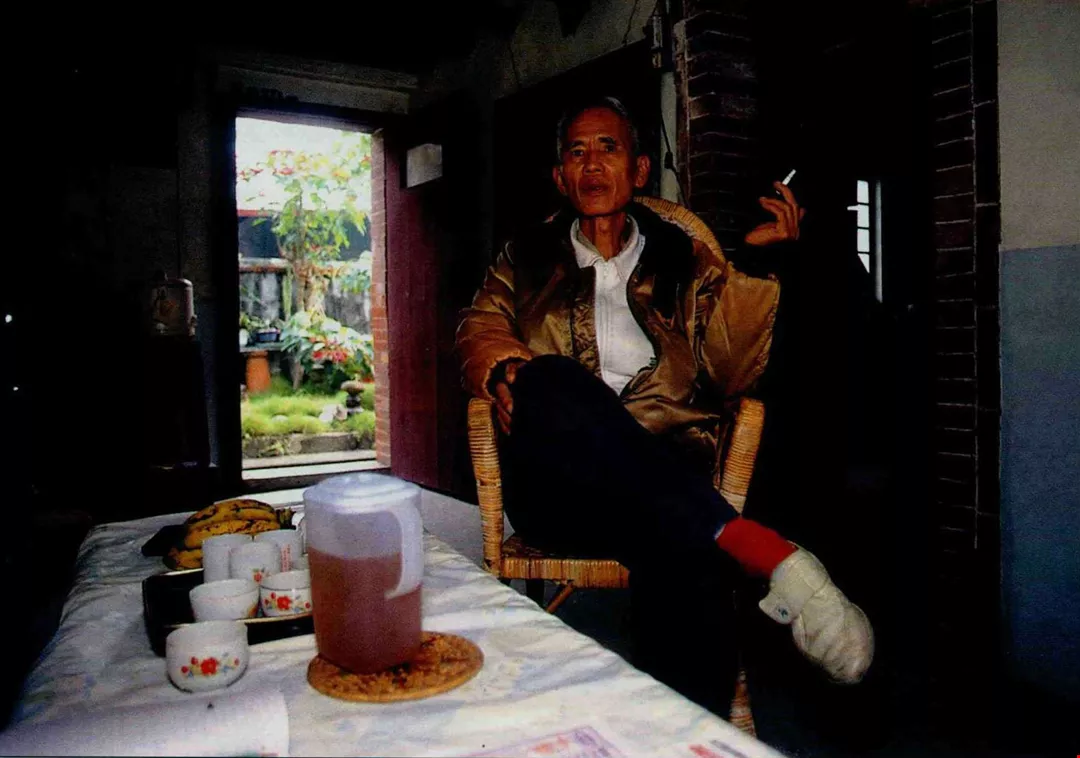
Sitting in the lang of his own home, Ku Te-fu speaks about the old Hakka homes of southern Taiwan. For him, these old homes are not only living spaces, but also bastions of the Hakka spirit.
Many people might ask, "What's the difference between Hakka architecture and Southern Fujianese architecture?" [The Southern Fujianese are Taiwan's largest ethnic group.]
Lee Yun-fei, who was born and raised in Meinung and studies architecture, says, "The first time you look at Southern Fujianese architecture, you feel that the wings aren't very smoothly integrated with the central hall. It's different from Hakka architecture."
If even experts can't define any major differences, you can imagine how hard it is for the average person to tell them apart. Generally speaking, both the Hakka and Southern Fujianese architecture seen in Taiwan are mainland imports and follow the same general lines.
Chen Pan points out that since Hakka in Taiwan were living in the same environment as the Southern Fujianese people, and possessed the same building materials and ideas about courtyards that they did, it is not surprising that Hakka houses differ only in the details. "In mainland China, Southern Fujianese and Hakka architecture vary according to region. In Taiwan, buildings differ based on ethnicity."
There is no "standard" form of Hakka architecture. Lee Yun-fei says that the Hakka, as a wandering people, were continuously learning, imitating and innovating in their travels. For this reason, the forms of their buildings were also changing continuously.
For example, there are some small differences between the homes of Hakka in Taiwan's northern and southern regions. Chen says that each region has its own style. Differences in environment and building materials mean changes in building forms and ideas about geomancy.
In general, the architecture of the Hakka in southern Taiwan preserves some of the look of mainland architecture while incorporating some new elements appropriate to the local environment. In the north-Hsinchu and Taoyuan, for example-the mutual interactions of Hakka and Southern Fujianese architecture are more apparent. Lee Yun-fei believes that the fact that these northern Hakka grew tea necessitated more frequent interactions with Southern Fujianese people. This, in turn, influenced the architecture of the northern Hakka. In the south, there was less interaction between the two groups and relations are more tense.
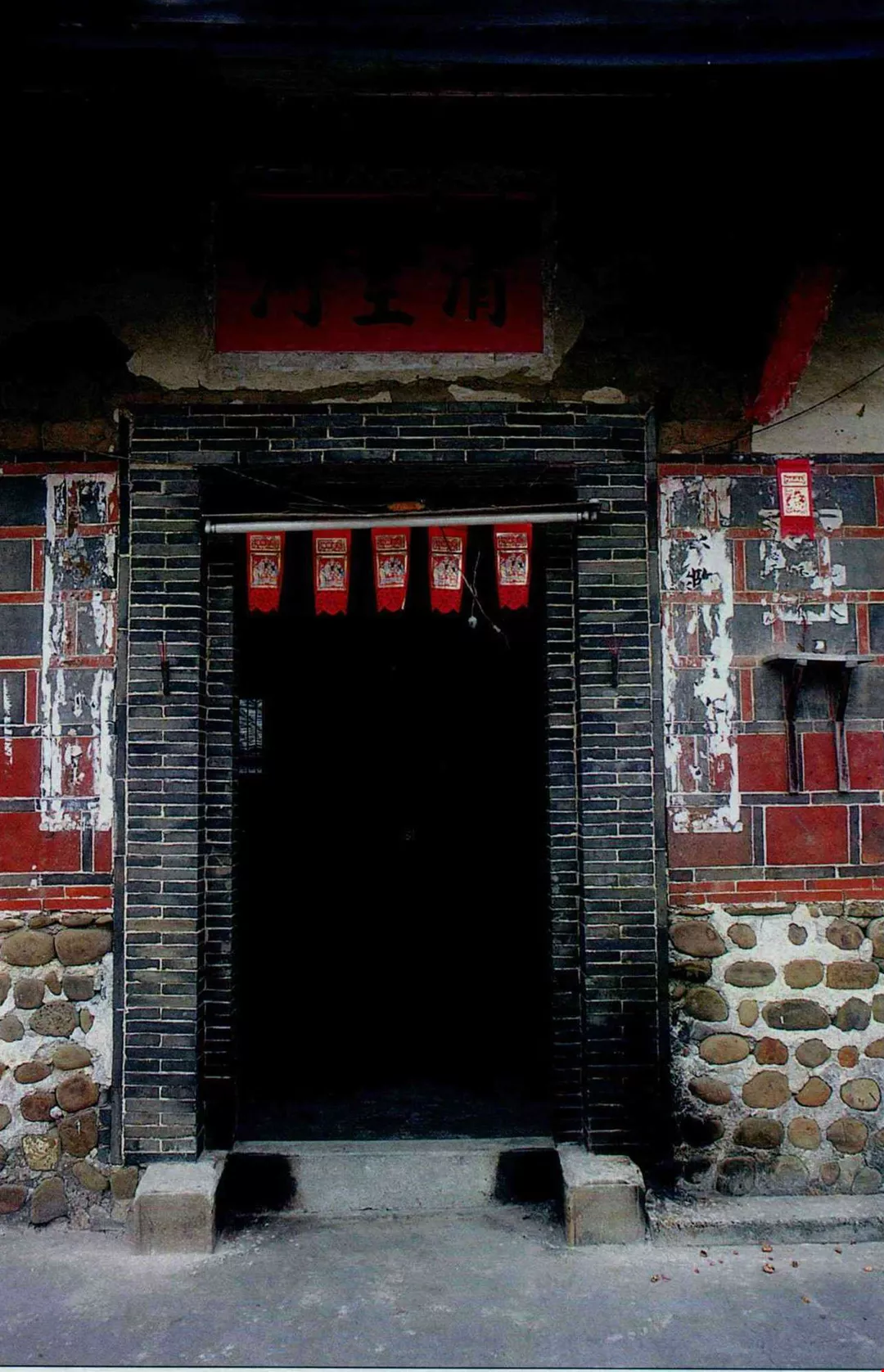
Characteristic features of the Hakka homes of the south include: the name of the house above the door; the two menzhen protruding out in front of the door; and the three-sectioned wall, constructed of white-painted mud bricks on top, earthenware tiles in the middle and stones at the bottom.
It is the main hall sitting at the center-rear of the courtyard which most obviously displays the characteristics that mark a home as Hakka.
In a Southern Fujianese home, the main hall usually contains an altar for praying to the gods. The Hakka main hall, on the other hand, contains the ancestral altar. The characters for "good fortune" and "prosperity" appear one each on small blocks hanging from the lintel of the main door of the hall, while the character for "longevity" is pasted on the wall facing these doors. Collectively, these characters represent a wish that one's ancestors may enjoy good fortune, prosperity and longevity.
"When Hakka pray to the gods, they go to a temple. The main hall is for praying to one's ancestors," says Ku Te-fu. Whenever Ku brings visitors to see a Hakka home, he is careful to inform them that the main hall is a place of great sanctity, especially among the Hakka of the south. It is used for the worship of ancestors and nothing else, whether it be eating, entertaining guests, chatting or putting on plays.
Ku Hsiu-fei, supervisor of Taipei City's Hakka Cultural Center, grew up in Meinung, and still remembers how her grandfather and uncles used to go to the main hall every morning and evening to burn incense for their ancestors. Starting in primary school, she was made responsible for lighting the stove and boiling the water every day for her grandfather's bath. "After Grandfather finished his bath, the first thing he would do was go to the main hall to burn incense."
Another trademark of the Hakka resides in the main hall-an altar to the Earthgod. "If you see [an altar to] the Earthgod in the main hall, 90% of the time, it's a Hakka home," says Chen Pan.
The altar to the Earthgod is located under the table on which the ancestral tablet sits. It is flanked by a couplet which reads, "May one's good fortune be as thick as the earth" on one side, and, "May one's virtue be as broad as the land" on the other. In the center it says, "Incense Altar of the Earthgod."
Chen Pan says that Southern Fujianese pray to the Earthgod when they finish the construction of a home, but only the Hakka continue to burn incense for him after that. As such, the altar to the Earthgod is unique to Hakka architecture.
There are also differences in the way these two peoples worship the King of Heaven.
Southern Fujianese hang the vessel for burning incense to the King of Heaven from the lantern beam in the main hall, but Hakka custom dictates that this vessel be located where it is exposed to the sky, therefore outdoors. But some Hakka place theirs just outside the entrance to the main hall, while others put it on the front wall of the compound, and still others place it in the center of the courtyard. There is no definite location.
Lee Yun-fei relates that it used to sit on the ground in front of the entrance to the main hall. But children don't really understand the meaning of such an object. They jump around and behave in a manner that is extremely disrespectful. It was therefore raised up higher. Still later, when people began to own cars, this placement interfered with getting them in and out of the courtyard, and people moved the vessel onto the front wall of the compound. But placing it here exposed it to the rain, and some families moved it once again, this time putting it on the outside of the front wall of the main hall.
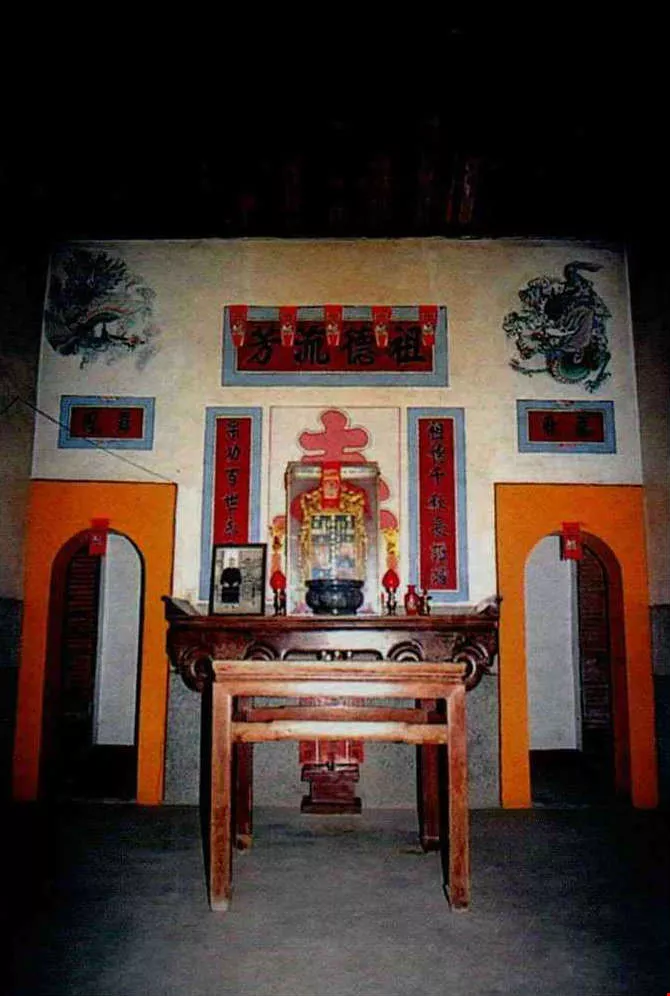
The altar in the main hall most readily identifies a home as Hakka. In the center is the ancestral tablet (left, top.
The hierarchy of relationships is important to Hakka. Thus, the main hall of a home, where the ancestral tablet is kept and the ancestors are worshipped, is always built somewhat higher than the rest of the home. The wings, where later generations live and carry out their affairs, are at a lower level.
In Chung's paintings of broken down old homes, one also sees the different materials used in the three levels of the walls: the lowest section is made of stone; the middle section is constructed out of brick or faced with earthenware tiles; and the topmost section is built from mud bricks covered in plaster. Lee Yun-fei explains that stones are used for the bottom because they are less susceptible to erosion from the rain.
Ku Te-fu, in his role as tour guide, typically explains the walls more symbolically: "The white upper wall represents the white hair of the elders. The red middle section represents the coursing blood of those in their prime. The gray bottom section represents the never-ending future generations." Ku says that the division of the walls into levels reminds youngsters that even while carving a place for themselves in this world, they must remember to respect their elders and provide for future generations.
There are two holes in the front wall of the main hall, one on either side. Because these resemble eyes, they are known as the "hall eyes." Ku says that these "eyes," which look out onto the central courtyard for drying and threshing rice, also have a meaning: "The ancestors in the main hall can look out and see the children at play in the courtyard; it lets them see their descendants."
Behind the main hall, there is a _x (huatai, "flower bed") of raised earth in a half-moon shape. It is also called the 否_L (huatai, a homophone which means something like "conception") and functions as the "backrest" of the house. From the perspective of geomancy, it symbolizes stability. It also represents the existence of future generations, and is something of a prayer that all of these future generations will excel.
Hakka architecture not only reflects an age-based hierarchy, but also makes clear distinctions between the sexes. In Hakka architecture, men are associated with the left (when you stand inside a room facing the main entrance) and women with the right, and these associations are reflected in both the interiors and exteriors of Hakka architecture.
Bags are hung from the central roofbeam of the main hall. The bag on the left holds the five metals, while the bag on the right holds the five grains. This represents men working in the world and women working in the home, hence halls full of gold and jade, and a bountiful grain harvest.
A dragon is painted on the left wall of the main hall with the characters "flying dragon" nearby. On the right wall, there is a phoenix and the words "whirling phoenix." The outside of the left wall is inscribed with the words "clean wind," while the right reads "bright moon." According to Ku Te-fu, this means: "The men of the family who serve as government officials should not be corrupt, with the 'clean wind' blowing through the sleeves of their robes [indicating that they haven't slipped any bribes inside]. The women of the family should follow the appropriate social conventions, marry well and live a happy life." It's an interesting explanation.
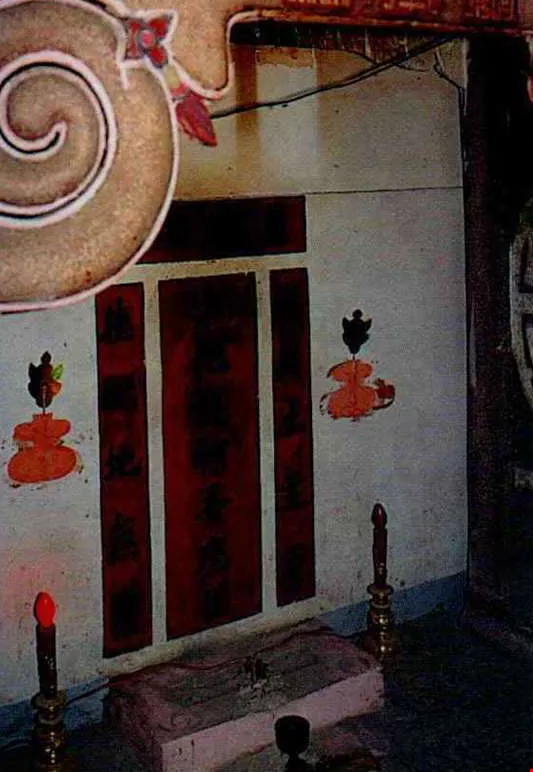
Below the table is a place for offerings to the Earthgod (left).
The incorporation of words into Hakka architecture is one of its distinguishing characteristics. Not only does the name of the main hall appear above its main entrance, this entrance is also flanked by a couplet which voices the motto that the family has lived by for hundreds of years. At Ku's home, this couplet reads, "Our line begins in the days of Kings Yao, Sun and Yu" and "Our origins are in Yue [modern Guangdong]."
Another couplet, which usually records the family's travels and achievements, appears on two sides of the main hall's central roofbeam. Lee Yun-fei points out that while such couplets appear only in the homes of high government officials or wealthy families among the Southern Fujianese, they are ubiquitous in Hakka homes, whether they belong to farmers or officials. Moreover, since the Hakka have long been wanderers, these couplets often extend to 50 or 60 characters.
The main-beam couplet in Ku Te-fu's home describes the family's origins and the difficulty of listing their early achievements. It continues, telling of their hard work on coming to Taiwan and the numerous occupations they took up here. It concludes with a wish for the continuation of their line. Forget about memorizing such a long couplet. Even getting it out all in one breath is an achievement.
And some homes have still another couplet on the left and right sides of the "lantern beam." Surely no other architecture can match that of the Hakka for long-windedness.
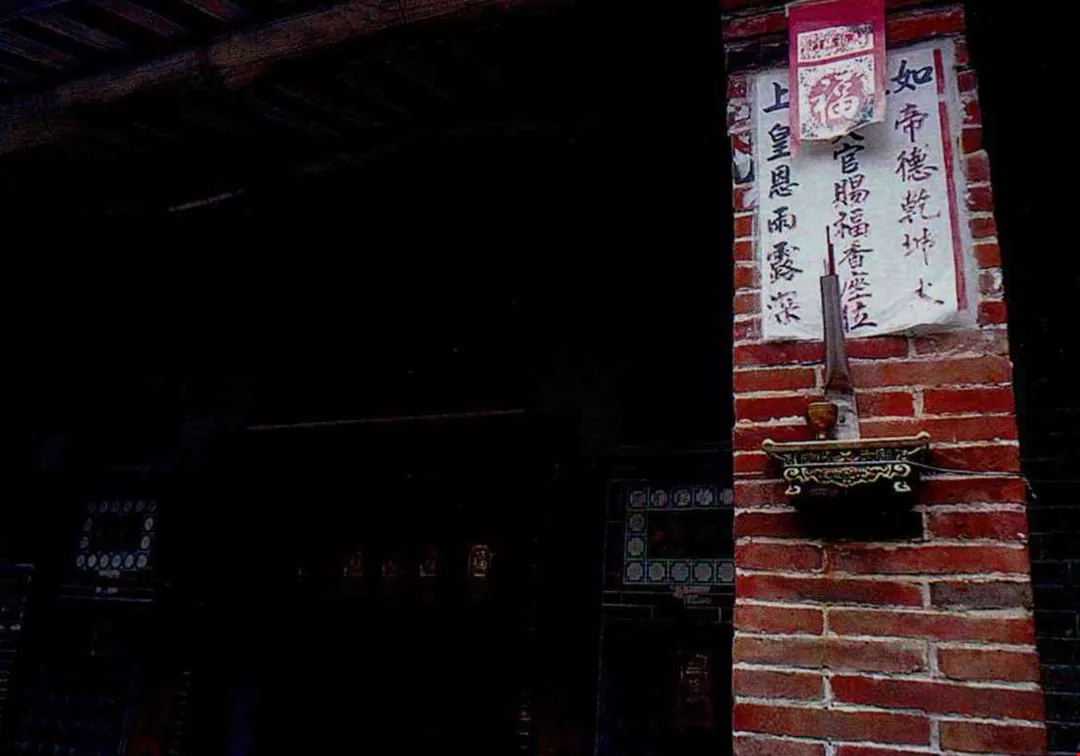
The vessel for burning incense to the King of Heaven hangs on the wall outside where it can "see" the sky (above).
In Chung Chao-yan's paintings, one also encounters one of the most distinctive features of the architecture of the Hakka of southern Taiwan-its lang.
The lang is an interstice or "chatroom" that sits between the central hall and the wings of a traditional house. To the Hakka of southern Taiwan, it is the "warmest" part of the house. Ku says, "Tradition dictates that visitors must be hosted in the lang" because the main hall and bedrooms were generally off-limits.
The lang connected with everything, the front and back gardens, as well as the main hall kitchen and bedrooms. Because it had so many doorways, it was also known as the "three rooms and eight doors."
Then there are the passages, which differ with region. In the southern part of Taiwan, Hakka homes are built around exterior passages, contrasting with the interior passages seen in both Southern Fujianese and Hakka homes in northern Taiwan.
"It's only a hallway, but it determines the way people live." Li Yun-fei points out that in homes with an exterior hallway, each room has its own entrance. In homes with an interior passage, rooms have no front wall, instead being separated from an interior corridor by a curtain or screen.
"The interior hallway is like a vein in the human body. It is a style shared by the Han Chinese." Li notes that the exterior hallway of the Hakka of southern Taiwan carries on a Hakka tradition from the mainland. In contrast, the closer interaction of the Hakka of the north with the Southern Fujianese has influenced Hakka architecture, and in the north both interior and exterior hallways are seen.
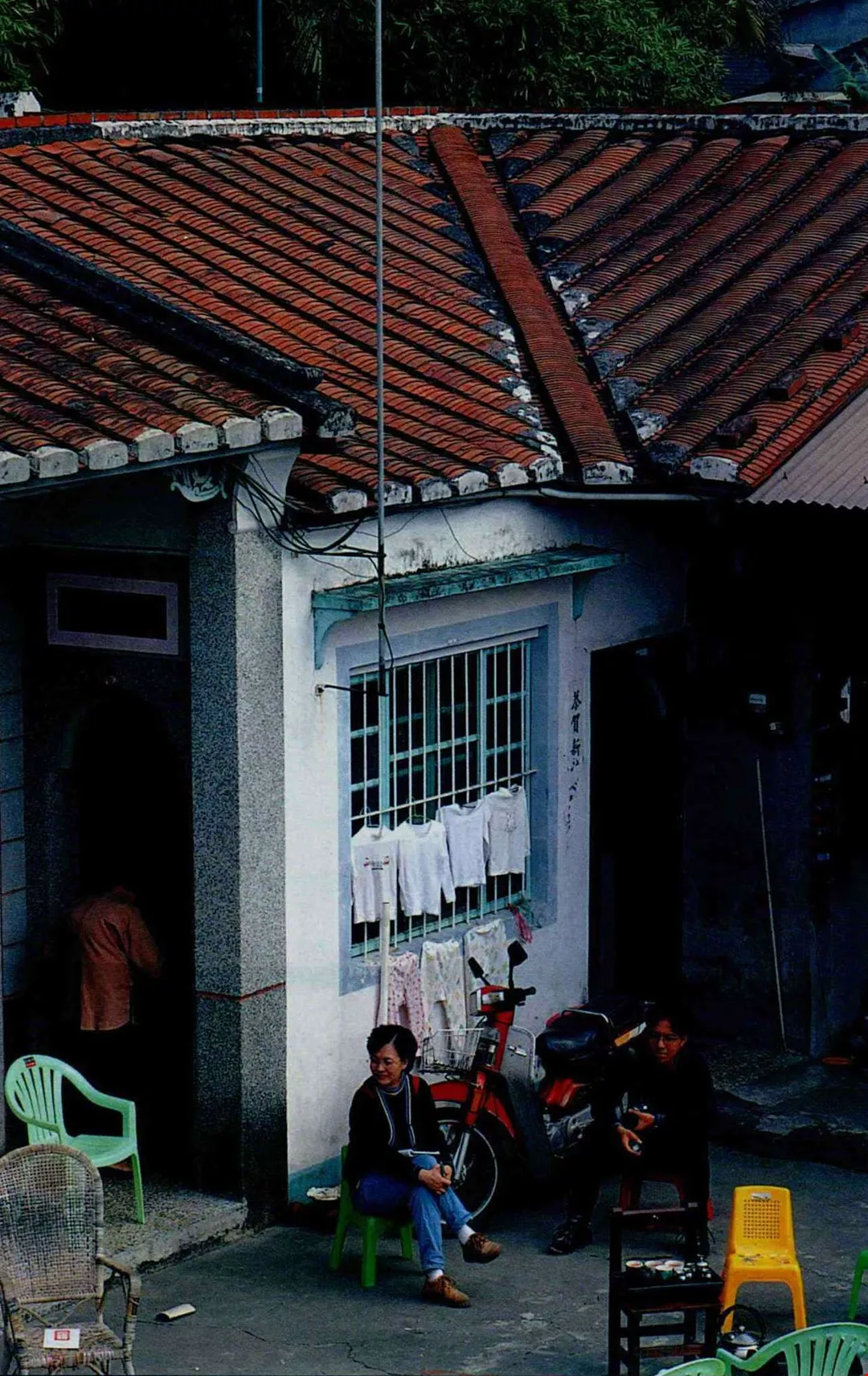
The lang, characteristic of the homes of the Hakka of the south, is situated between the central hall and the wings, and functions as something of a living room.
The younger generation tend to feel somewhat nostalgic about the huofang they lived in as children. But the older gen-eration's feelings are a little more complicated.
In Chung Chao-yan's case, he can paint these old buildings, but he can't bear to face them every day. Pointing to a painting of a stoop on which he daydreamed as a child, Chung says feelingly, "I don't dare go back too often to look. Every time I go back, I'm hurt again by the decrepit state of the place."
Then there are the insoluble problems of the huofang-the leaks, the sparrows which bore holes in the roof tiles to build their nests, the bird-droppings everywhere.
Li Yun-fei further points out, "The huofang is a patriarchal building." The kitchen where the women worked was always a dark and damp place.
And the lack of running water meant backbreaking work carrying water. Ku Te-fu says that the closer the well was to the kitchen, the better. The ideal was to have a well built into the kitchen, otherwise the women would exhaust themselves carrying water. He frequently tells visitors of two extended families in Meinung which had five generations living together: "Because they built their wells near their kitchens and had bamboo pipes to carry the well water into the kitchen, it was easier for the menfolk of these families to find brides." And at the old Hsiao house in Chiatung, an enormous enclosed-courtyard-style home, the well was actually in the kitchen, making for unbeatable convenience.
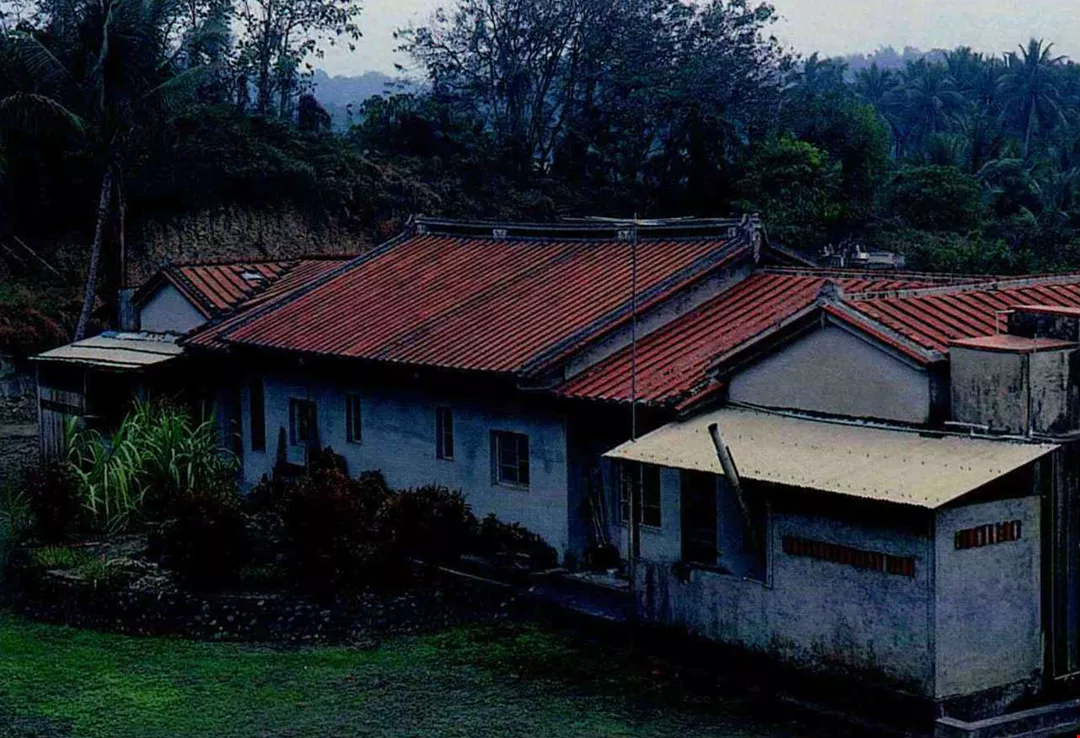
Behind the central hall is a raised, half-moon shaped pile of earth. Called the huatai, it is usually planted with flowers.
In terms of comfort and convenience, the old semi-enclosed-courtyard homes don't fare very well when compared to modern homes. And for many who live in such old homes, their one thought is to build a modern, multi-story home.
The Ku family home was built in Chishan 74 years ago, and was one of very few "palatial" homes in the area. The ends of the roof ridge turned up like a swallows' tails, and the roof itself was made of traditional black tiles. So exceptional was the home that when Ku Te-fu's grandfather built it, people asked him if he had sold the farm to do so.
When Typhoon Thelma struck Taiwan in 1977, it ripped the roof off the house. The tails was lost, and the black roof tiles (no longer being produced) had to be replaced with red ones. But in spite of numerous repairs and renovations, the Ku home remains a huofang. Ku Te-fu says, "This is a keepsake left by our ancestors. I don't want to change it."
Ku Hsiu-fei, Ku Te-fu's youngest daughter, says, "The huofang gives me a wide-open, happy feeling." She says her strongest memories of her childhood are of running about, playing baseball and playing hide-and-seek in the courtyard. "At the Lunar New Year everyone used to come back home. There would be 20 or 30 kids running around; it was a madhouse."
For children living away from home, the family huofang provides an emotional anchor. "Whenever I encounter frustrations in my life or work, I'm overcome by a strong desire to come home." Ku Hsiu-fei says that only a short visit to the family home in Chishan recharges her batteries and gives her the courage to face life's difficulties.
But land is valuable. These days it's becoming harder and harder for families to hold on to their traditional homes and keep them intact in the way the Ku's have done.
In Pingtung's Neipu, modern multi-story homes are springing up all along the streets. Multi-story detached houses and apartments are becoming popular. It is only far off the main drag, deep in the alleys and lanes of the town, that one can still see the old-style homes. Even here there aren't many left intact. Some have kept the ancestor's hall while building multi-story wings. Others have simply torn everything down and rebuilt from scratch.
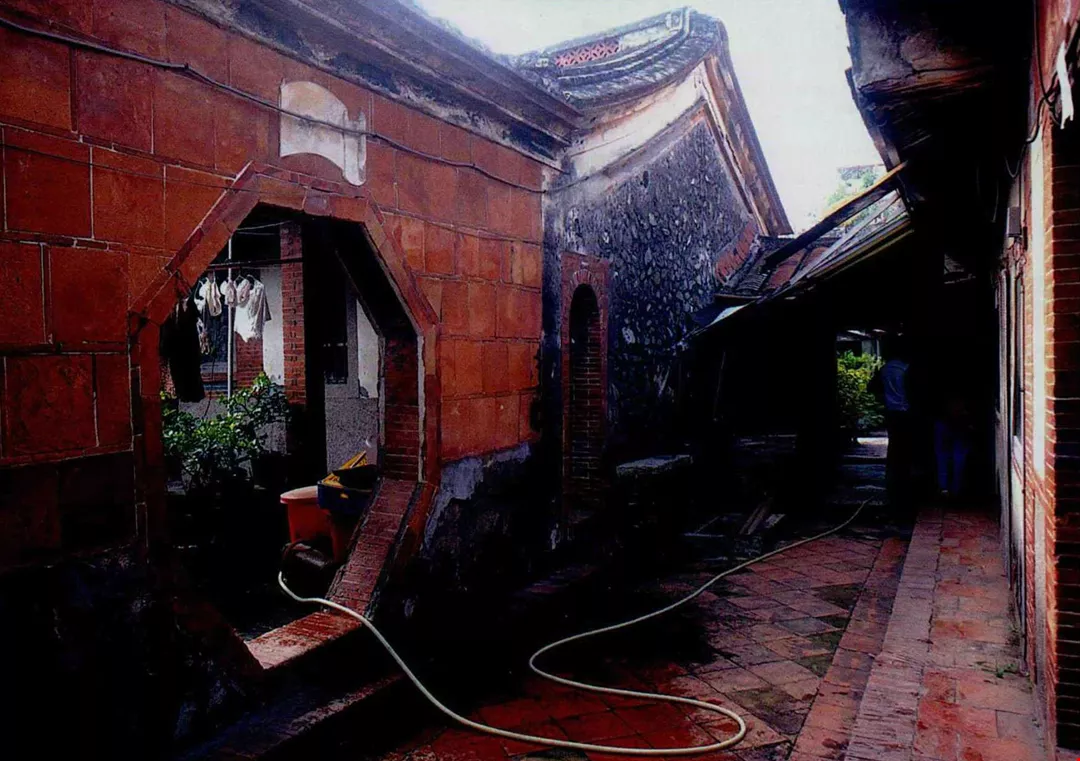
The Hsiao family compound in Chiatung, a class-three historical building, is one of Taiwan's few very large, enclosed-courtyard-style compounds. But the home has long gone unrepaired and most of it is empty.
Over the last few years, Meinung has seen the construction of a few new and improved buildings. The old outward expansion of a home across the ground to bring more land within the scope of its walls has changed. Now homes are growing skyward into multi-story edifices. The Zheng family's Yingyang Hall is an example of one of these rebuilt old homes.
Yingyang Hall is a palatial new three-story home that retains a Hakka ambiance. The main hall is on the top floor, and has all the features of a traditional Hakka main hall-a name, "hall eyes," a lantern beam, a main-hall roofbeam, two bags hanging from this beam, an ancestral tablet, a place for offerings to the Earthgod and a vessel for burning incense to the King of Heaven. There is a huatai behind the house and the lang between the main hall and the wings have been retained. The only things lacking are the tangyin, the small inscribed blocks which sit below the lintel of the door to the main hall and the menzhen, two small cement blocks on the ground immediately on either side of the door to the main hall.
In addition to homes of this kind which combines new and old, architect Hsieh Ying-chun has designed two public buildings-the Hsinchu County Cultural Center and the Meinung Hakka Museum-which are thought to be representative of modern Hakka architecture. Hsieh subtly incorporates traditional Hakka elements-the round-house shape, the courtyard-home shape, white walls, black tiles, huatai-into his buildings, thus maintaining their modern feel while infusing them with the simple Hakka spirit.
Hsieh says that you rarely see carved beams and painted columns in traditional Hakka architecture. Instead, it is generally economical and functional. He says that this Hakka spirit is the basic idea underlying all his work. Most of the schools and factories he has designed have been simple and unadorned, built with unpainted brick or cement walls. At first glance these buildings look old and unremarkable, but they become more and more interesting on further examination.
Hakka homes are much the same. To those who grew up in a huofang, the memory of the old house is not simply a spiritual anchor, it is also a source of strength in facing the challenges of the future.
The Hakka have long been searching for the true spirit of Hakka culture and their place in larger society. Maybe these old homes hold the answer to their quest.

Traditional elements of Hakka architecture include white walls and black roof tiles. Unfortunately, black tiles (left) are no longer produced, so today they are replaced by red ones.

Unfortunately, black tiles.
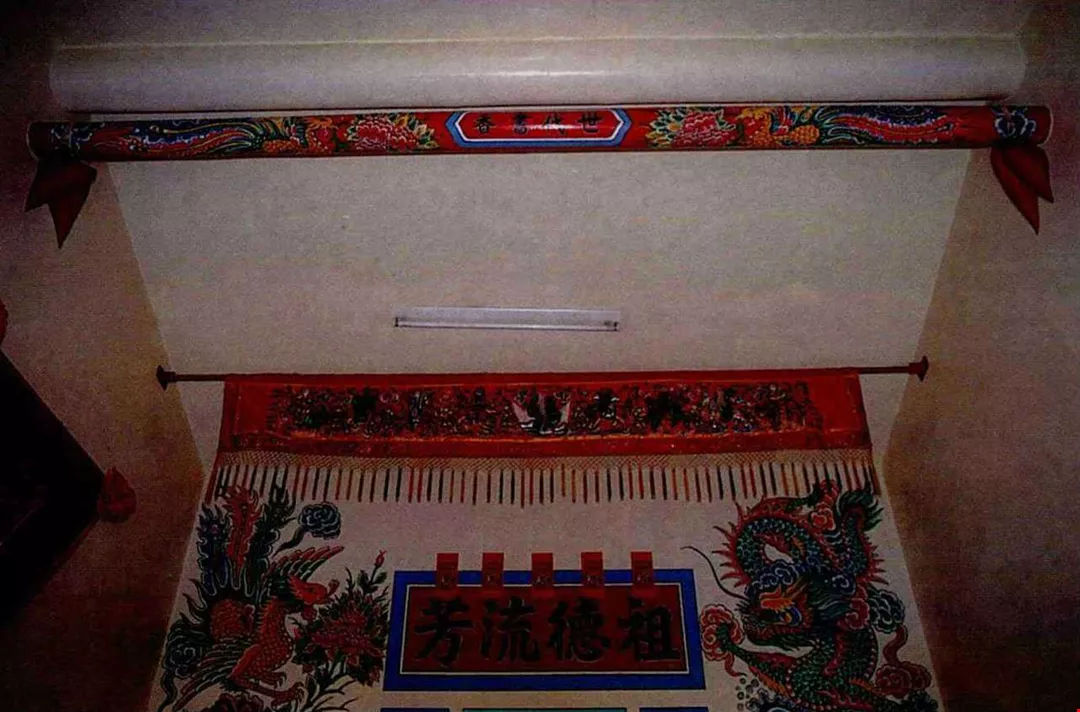
The red bags hangings from the central roofbeam of the main hall represent prosperity. The left bag contains the five metals, while the right contains the five grains.
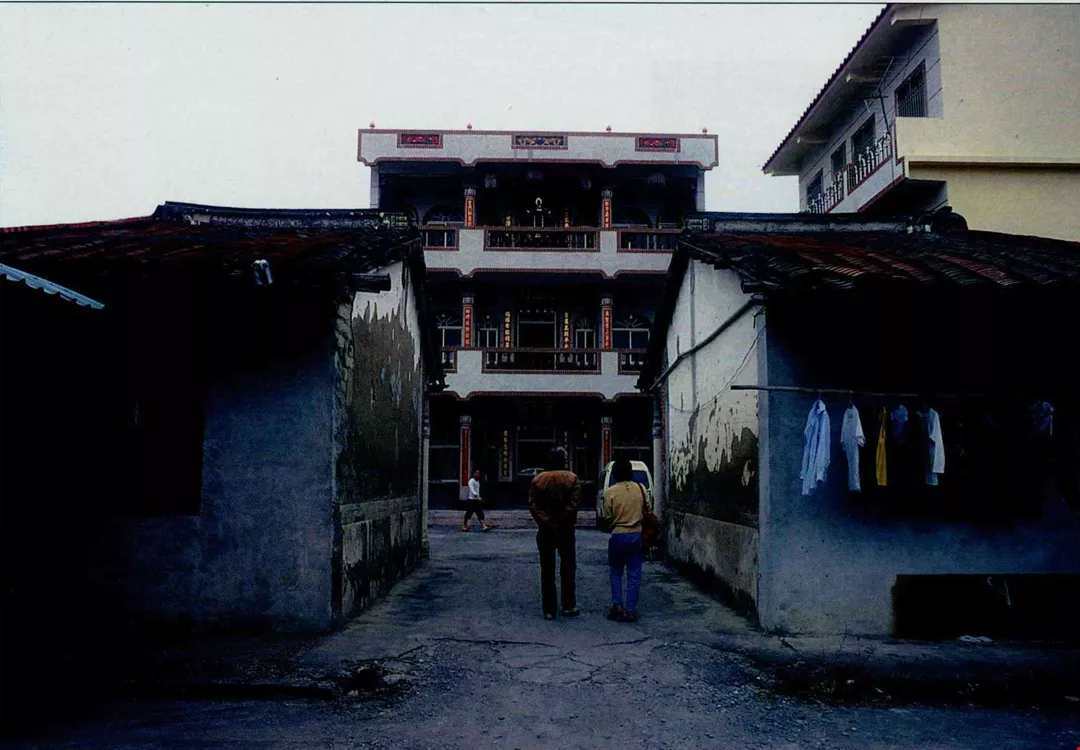
As urbanization has raised the value of land in Taiwan, there has been a trend to tearing down traditional homes and replacing them with more modern multi-story buildings. An issue of concern is how to infuse these new buildings with the traditional Hakka spirit. (The central roofbeam and the bags depending from it in the photo above have been placed on the top floor of this new building.)


@List.jpg?w=522&h=410&mode=crop&format=webp&quality=80)
