Takin' It Off the Streets--Youth Activism in a New Age
Lin Hsin-ching / photos Jimmy Lin / tr. by David Smith
January 2010


Mention student movements or youth activism in Taiwan, and most people think back to the Wild Lily student movement of 18 years ago, when 6,000 students gathered for a sit-in at the Chiang Kai-shek Memorial to make four demands: dissolution of the National Assembly; repeal of the Temporary Provisions Effective During the Period of Communist Rebellion (i.e. martial law); the convening of a National Affairs Conference; and adoption of a timeline for political and economic reform. Even after all these years, the courage displayed by the students in challenging political taboos and demanding democracy and freedom, lives on vividly in collective memory.
Today's youth, in contrast, live in a different world. Now that authoritarian control is a thing of the past, they have no clear-cut target to protest against. Higher education, moreover, is now accessible to all, and competition has ratcheted up considerably, so it is perhaps inevitable that young people today should be more self-focused, devoting their energy first of all to the pursuit of fun and personal success. Taiwan's "me generation" has come to be thought of as "having no goals, lacking in passion, quick to wilt under pressure, and uninterested in public affairs."
But how closely does the stereotype actually match up with reality? Are today's youth truly so selfish, apathetic, and indifferent to public affairs? No, not really. Reflecting the diversity of the times, they simply focus these days on a broader range of concerns, and this in turn has diffused their strength. And as issues have grown more complex, youth activism has evolved toward a finer-grained division of labor based on specialized skills. There are still many young people out there, beyond the field of view of the average observer, working hard for the public good.
At exactly 11 o'clock on November 6, 2008, 600 youths dressed in black and wearing facemasks assembled outside the main entrance to the Executive Yuan.
The group was composed of college and university students from throughout the country, and they were quite the mild-mannered bunch. They shouted none of the passionate chants one normally witnesses in a street protest, and there was no tense standoff with the police. Instead, they simply sat silently in an area where the law does not allow public gatherings, and raised placards calling for "human rights" and "freedom." Others leveled criticisms against "police brutality" and the use of "martial law tactics" when Chen Yunlin, the head of mainland China's Association for Relations Across the Taiwan Straits, came to Taiwan for a visit on November 3.
On the second day of the protest, the peaceful students ended up getting hauled away by the police and were forced to regroup at Liberty Square, where they continued their protest for two months.
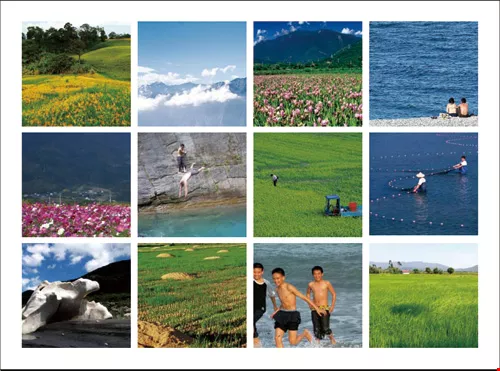
The Su-Hua Cake Shop took the soft-sell approach in publicity materials that pointed to tourism as a reason for opposing the Su-Hua Expressway. The group succeeded in getting the public concerned about the expressway issue.
The movement arose on the spur of the moment when students were angered at police tactics used during the mainland official's visit. The organizers came to dub themselves the Wild Strawberries, a name that was both a nod to the Wild Lily movement of 18 years before, and a self-deprecating reference to the "greenhouse strawberries" moniker with which the youth of today have been disapprovingly labeled (the idea being that, like greenhouse strawberries, they lack toughness).
The students later made three key demands: "President Ma Ying-jeou and Premier Liu Chao-shiuan must apologize to all citizens," "National Security Bureau Director-General Tsai Chao-ming and National Police Administration Director-General Wang Cho-chiun must step down immediately," and "the Legislative Yuan must immediately amend the repressive Assembly and Parade Act." The students organized via the Internet to stage six large sit-ins simultaneously in Taipei, Hsinchu, Taichung, Tainan, and Chiayi, and the total number of participants exceeded 2,000 at the height of the movement, making it the largest student movement since the Wild Lily student movement of March 1990.
Over the last 18 years, however, political and economic conditions in Taiwan have undergone huge changes. The oppressive authoritarian order dissolved into disorder, then society returned once again to stability. Ruling power has now switched hands twice. There is no way the Wild Strawberries' demand for amendment of the Assembly and Parade Act could possibly have the same explosive impact of the Wild Lily movement's calls for "an end to dictatorial abuse of power by the organs of state." And beyond that, the students in the Wild Strawberries movement lacked activist credentials. Both the government and the news media pooh-poohed the movement even though it had put its finger on some very worthwhile causes, and the movement gradually petered out as a result. The students withdrew from Liberty Square on January 5, 2009.
The Su-Hua Cake Shop took the soft-sell approach in publicity materials that pointed to tourism as a reason for opposing the Su-Hua Expressway. The group succeeded in getting the public concerned about the expressway issue.
But even though the Wild Strawberries participants did not achieve what they had set out to do, neither did they vanish without leaving a trace, as had been predicted by some talking heads who criticized the movement as being "too closely identified with the opposition camp," "under the influence of a few professors who had been active in the Wild Lily movement," and "unrepresentative of the times." On the contrary, a year later we find that many of them continue working away within their fields of specialty in support of the human rights, freedom of expression, and justice that they had protested for.
A group of a dozen or so students, for example, formed an "Anchor Team" during the movement that covered sit-in activities and posted reports online at the Wild Strawberries website, and since the movement came to an end they have continued to lug their cameras, recording equipment, and notebook computers around Taiwan to report on matters of interest, including the Labor Day march on May 1st, public hearings on the draft version of a law to govern reconstruction efforts following natural disasters, protests by the Association of Taiwan Journalists and media reform groups against the illegal firing of employees by Era Communications, a press conference on calls for repeal of the Assembly and Parade Act, a long-distance march to call for more public input in the conduct of cross-strait relations, the "Autumn Struggle," and other news events in an effort to train a spotlight on disadvantaged groups and public concerns that tend to get ignored or downplayed by the mainstream media.
The programs produced by these students, none of whom has majored in broadcast journalism, regularly have more than 100 viewers on the website at any one time watching them, and the TWAction1106 website has become an important liaison platform for a broad spectrum of activist organizations.
"Little P," a member of the Anchor Team and recent graduate in law from National Chung Cheng University, frankly admits that she herself used to be the stereotypical university student with no interest in public affairs, but taking part in the Wild Strawberries movement broadened her once-narrow world view.
"When we were doing the sit-in, lots of activist organizations came by to show support. I was a blank slate, and that was the only way I could ever have had the opportunity to come in contact with such issues as the tearing down of Lo Sheng Sanatorium, forced relocation of indigenous communities, and the plight of Tibetans in Taiwan. I discovered that there are a lot of people out there who deserve our attention but who get ignored because of the nature of mainstream social values. That was the main reason I got involved in the reporting."

The Su-Hua Cake Shop took the soft-sell approach in publicity materials that pointed to tourism as a reason for opposing the Su-Hua Expressway. The group succeeded in getting the public concerned about the expressway issue.
In answer to those who dismiss the Wild Strawberries as "insignificant," no few observers point to Little P and others like her, who previously knew nothing of the hardships of everyday people, but were inspired by the movement to take an interest in social issues. The list of those taking this view includes such notables as Li Dingzan (professor at the National Tsing Hua University Department of Humanities and Social Sciences), Wu Rwei-ren (assistant research fellow at the Academia Sinica's Institute of Taiwan History), Chen Hsin-hsing (assistant professor at the Shih Hsin University Graduate School for Social Transformation Studies), and Kuan Chung-hsiang (assistant professor at the National Chung Cheng University Department of Communication and Graduate Institute of Telecommunications).
These academics point out: "The only way to understand the power and the limitations of a social movement is to take part in one. It's an education in democracy that you can't pick up in a hundred classroom lectures."
In addition to the Wild Strawberries, who continue to exert an influence long after their movement wound down, idealistic youth are also working on a number of other fronts in pursuit of their goals, including environmental protection, the labor movement, opposition to forced relocations, and digital culture.
The Wild Strawberries may not have the personal charisma of the leaders of previous student movements, or the same ability to mobilize crowds, and they certainly haven't carried on with the tradition of hurling eggs, unfurling white protest banners, and engaging in bloody street conflict. Instead, they've gone in for a specialized division of labor and a low-profile approach, taking one small step at a time in a determined push for progress in areas of concern. They receive less media exposure, and have to score a big success somewhere before people will suddenly take notice and realize that there are still many idealistic young people working away in obscurity.
When Typhoon Morakot struck in 2009, for example, the Association of Digital Culture Taiwan and the Taiwan Bloggers Association, whose members average less than 30 years of age, kicked immediately into action. Some 100 netizens made use of Plurk, Twitter, Google Maps, and other online resources to establish websites such as the "Morakot Disaster Map" and the "Disaster Information Center." The volunteers worked with astounding efficiency and drove home to a larger audience just how powerful a tool the Internet can be in mobilizing people. (See "Attack of the Nerds! Cyber-Activism Comes of Age," p. 20.)
Another outstanding example of youth activism is a website called the "Su-Hua Cake Shop," which was handed an Award for Public Participation in the category of Citizen Media. It was established by about 100 college and university students concerned about plans for construction of the Su-Hua Expressway down the rugged east coast of Taiwan from Su'ao to Hualien. Using their expertise in fields including law, environmental engineering, animation design, and documentary film making, the group secured financial support from such luminaries as film director Hou Hsiao-hsien and Stanley C. Yen, president of The Landis Taipei Hotel, to familiarize the public with the Su-Hua Expressway. They ran a petition campaign and produced television ads, publicity materials, and a lesson plan that teachers could use in school. Their low-profile work considerably raised public awareness of the Su-Hua Expressway controversy, which was selected as one of the 10 issues of greatest public concern during the 2008 presidential election campaign.
In one of the biggest victories in recent years for environmental activists, a decade-long fight over the Su-Hua Expressway environmental impact study was finally resolved in 2008 with a decision not to go forward with the project. The outcome was due in part to the efforts of Su-Hua Cake Shop and other environmental groups.
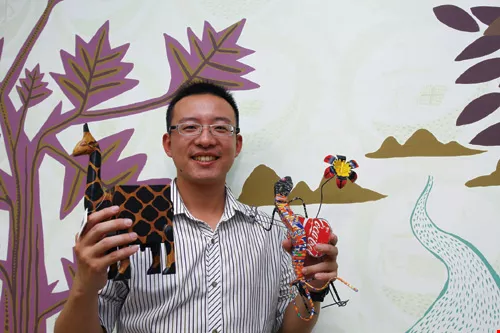
After gaining fame for his part in the victorious fight against the Su-Hua Expressway proposal, Gavin Lee then set up the Youth Environment Tank, a think tank focusing on issues ranging from global warming to fair trade. The fair trade trinkets he is shown holding here are all knick-knacks picked up at international conferences.
A lot of young participants have also been involved in debates over many other public policy issues, including opposition to legalized gambling as well as Phase IV construction of the Central Taiwan Science Park and the Eighth Naphtha Cracker plant, the latter two of which are currently very hot topics.
There is also the Youth Alliance for Lo Sheng, which has been fighting for over five years to prevent demolition of the Lo Sheng Sanatorium, a leprosy institution built in 1930. The issue has been on the back burner for the past couple of years, but dozens of students continue devoting themselves to the cause today. On weekends and holidays, they gather at Lo Sheng Sanatorium no matter what the weather to chat with the old folks there, and also hold regularly scheduled lectures and tours of the facility to break down the prejudices of local neighbors against the Lo Sheng residents and rally people to their cause. Over the years, the sanatorium has grown into a unique community.
In the view of Wu Rwei-ren of the Institute of Taiwan History: "The involvement of youth in public issues has never flagged. The form of their participation has simply changed in response to changing social conditions."
Wu comments that people in Taiwan have a short historical memory. The mention of student movements prompts recollections that go no further back than the Wild Lily movement, but in the 1920s, during the Japanese colonial period, Lin Xiantang and other members of the educated elite launched a movement to demand that the Japanese authorities allow the establishment of a Taiwanese legislative body. Hundreds from the Taiwan Sotokufu Medical School, the National Language School, and the Normal School took part. And thousands of students risked their lives in responding to the February 28 Incident in 1947, and the students of National Cheng Kung University in Tainan even formed a "students' army" to fight against armed oppression of the Chen Yi government.
And in the 1970s a wave of patriotic fervor was triggered by the movement to protect the Diaoyutai Islands, which coincided with an outpouring of social issues-oriented folk music. Students were in the vanguard on both of these phenomena. Then in the 1980s, as a result of Taiwan's single-minded pursuit of economic growth over many years, problems such as pollution and exploitation of labor came to the fore, fueling an explosion of social activism. Key roles were played by scholars with the boldness to borrow from Western thought, local residents with a high level of self-awareness, and large numbers of students.
Says Wu: "In my case, for example, as a student in 1986 at National Taiwan University I went together with others from the UniNews Club down to Changhua County to join in with local residents in their protests against plans by DuPont to build a chemicals plant down there.
The Su-Hua Cake Shop took the soft-sell approach in publicity materials that pointed to tourism as a reason for opposing the Su-Hua Expressway. The group succeeded in getting the public concerned about the expressway issue.
He also notes that in student movements throughout history, both East and West, those with a connection to the issues of "nationalism," "democracy and freedom," and "class struggle" have always been the ones that most strongly stirred students' sense of justice and empathy. Students in Taiwan certainly have not sat on the sidelines of any of the political or social movements that have swept the island over the years.
Prior to the early 1990s, however, the ultimate enemy was always the authoritarian KMT state apparatus, regardless of whether the movement was concerned with freedom, human rights, gender equality, locally rooted culture, the environment, or the interests of farmers or laborers. Because it was so clear who the protests were against, it was naturally much easier to mobilize people. It was also much easier to elicit public support.
With the institution of direct presidential elections in 1996, however, and especially the regime change of 2000, Taiwan had achieved its goal of establishing a formal democracy, and this was followed up by the passage of numerous pieces of human rights legislation, while some leading activists took key government positions after the Democratic Progressive Party (DPP) swept into power. These developments blunted the confrontational nature of social movements. Activism went dormant for a number of years, creating a crisis where an older generation of activists had little chance to pass the baton.
Today a new wave of student activism has arisen, and in addition to mainstream labor and environmental issues, they have broadened their focus to take on a range of new concerns, including the rights of such marginalized minorities as gays, indigenous peoples, and foreign spouses. Some have also been spurred to activism by their own personal experiences, concentrating on things like high tuition fees, youth poverty, and the digital divide.
They have also discovered that despite the gradual lifting of the heavy-handed state oppression of the past, the civil society that earlier activists had looked forward to has remained elusive, replaced by an equally enormous capital structure that is even more cunning than what preceded it. This new "enemy" is not so clear-cut and easily understood as the authoritarian oppression of yesteryear. Today's adversary is diffuse, with conflicting interest relationships. Activists must now put a lot more thought into their enterprise in order to thoroughly understand the complex threads of the issues at hand. This homework must be done if they are to propose concrete, forceful solutions.
Wu explains: "This progression from calls for an abstract democracy toward specialization in social activism is similar to what has happened to activism in the advanced nations of the West. Here in Taiwan we have made a gradual transition from political and social authoritarianism to the cacophony that characterizes democracy."
The Su-Hua Cake Shop took the soft-sell approach in publicity materials that pointed to tourism as a reason for opposing the Su-Hua Expressway. The group succeeded in getting the public concerned about the expressway issue.
Since the 1990s, with the big political and economic changes that Taiwan has gone through, the leaders of today's student movements have come up with a style of their own.
The biggest difference is that activists no longer put themselves up on a pedestal as "intellectuals," nor do they pride themselves as an "enlightened vanguard" in charge of introducing the latest thinking from abroad. Today's activists are more empathetic toward the downtrodden, and more respectful of the latter's ability to speak for themselves.
Chen Hsin-hsing, a Shih Hsin University assistant professor who was one of the five "commanders in the square" during the Wild Lily movement, attributes these changes mainly to the fact that, over the past 20 years, information technology has made very rapid progress, the public has become much savvier, and higher education has become accessible to all.
When Chen was in the student movement, for example, only about 30% of all high school graduates went on to university, and university students were seen as the future heavyweights of society. Those returning with a degree from abroad, in particular, wore halos as "the cream of the cream."
In that environment, all university students considered themselves "a cut above the rest," and this elitism naturally manifested itself in the movements they joined. They regarded themselves as spokespersons for the masses, while overlooking the real needs of the disadvantaged and discounting their ability to speak for themselves. As a result, the plans they made were often unworkable.
National Tsing Hua University professor Li Dingzan points to the example of the community development movement of the 1990s. A lot of idealistic youth fanned out into rural areas to work for a better world, but their efforts generally went for naught due to a wide gulf between the students and local residents.
The Xingang community development plan is a particularly well known case in point. The Hsin Kang Foundation of Culture and Education that spearheaded the movement originally intended to plant greenery along the road running by Fengtian Shrine in a bid to spur increased tourism, but they hadn't considered the parking needs of tourists or the space used by roadside vendors, and thus ran into furious opposition from local residents. Repeated efforts to iron out their differences ended in failure, and the plan was aborted.
Now that nearly 100% of those seeking to enter university are able to do so, however, students can no longer hold themselves out as elites. Even when they do participate on the front lines, they see themselves as simply a part of the people, not the leaders or saviors.
Youth Labor Union 95, for example, enjoys an excellent reputation in the labor movement. Established three years ago, it has already won numerous victories in fighting for the rights of some 100 young part-time workers and temps. One reason for their success is that the activists or their friends all share the experience of being exploited and are thus able to identify with the travails of those they're working to help. They regard themselves as partners of the workers as they help the latter to understand their rights and, when necessary, provide them with legal assistance, but they don't make decisions on behalf of the people coming to them for help, nor do they pressure the latter to join in their activities. (See "Youth Labor Union 95: A Voice for Young Disadvantaged Workers," p. 28.)
Chen opines that this transition from "leading" to "serving," and from "enlightening" to "empowering" was the only way for the activists to strike a responsive chord, and has been key to their success.
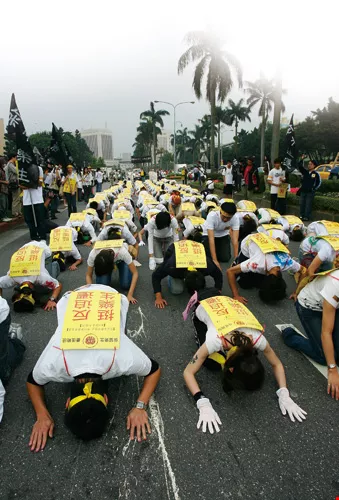
A big march to "protect the Lo Sheng Sanatorium" in April 2007 attracted thousands of students from around Taiwan. The marchers dropped to their knees every six paces to protest plans for forcible relocation of the sanatorium residents.
The flip side to the distaste of today's youth for exercising leadership over others, however, is disorganization and a lack of leadership. This is another prominent feature of today's youth activism.
In Li's view, the dangwai activism of the 1970s, the golden decade of social activism in the 1980s, and the Wild Lily movement of the early 1990s shared the commonality that the leaders from childhood had all lived under authoritarianism. The father was all-powerful in their homes. Teachers reigned supreme at school. And the larger society was tightly controlled by the heavy-handed machinery of state. While fighting against oppression, they themselves were nevertheless influenced by the circumstances of their upbringing, so the social movements they joined had a clear-cut hierarchy, and the views of the leaders carried a certain weight of authority. When divisions of opinion arose, it was often impossible to work them out, and factionalism was common.
Beginning with those born in the latter half of the 1970s, however, things changed. Most in this generation grew up in nuclear families where the views of children were respected. Society was more liberal, but the early stages of democratization featured vicious struggle between the blue and green camps. Political leaders long treated as celebrities entered into the government, and one after another became tainted with corruption. Many ended up in prison for it.
News of scandal has affected how today's youth go about their activism. They are happy to debate ideas, and respect others' opinions, but see little need for hierarchy, and no one likes to step forward to take overall responsibility for success or failure.
The clearest example is probably the Youth Alliance for Lo Sheng, which has fought for five years to preserve the Lo Sheng Sanatorium. At first the alliance was composed primarily of medical students, who approached the issue as a chapter in the history of public health. Later the movement attracted more and more students from the humanities, and the group's interests broadened to include a focus on historical preservation, opposition to forced relocation, and medical human rights.
Youth Alliance member Wang Hao-zhong, who majors in sociology at Soochow University, comments that the alliance is a group enveloped in personal attachments. A lot of people originally spent time at Lo Sheng simply because they liked the atmosphere and enjoyed the old folks there, and it was only their frequent presence there that eventually brought them into contact with the many issues connected with the Lo Sheng community. An organization like this, based on personal ties, is naturally not amenable to the establishment of a traditional hierarchical structure.
Wang feels that the advantage of the lack of structure is flexibility. Even if one person drops out, the organization can keep operating, and each person has to know how to contact and mobilize all the others, write up press releases, and speak to reporters, so there aren't many marginalized members who don't know how to carry off the group's activities.
The drawback is that subtle power relationships still exist beneath the seemingly egalitarian surface. People who are more popular or joined the group earliest, for example, may have more influence over the direction of the movement, yet these de facto power holders are unaccountable for their policy decisions because they don't have any official title. This fuzziness of authority and responsibility has sometimes led to internal conflict.
Nevertheless, despite the shortcomings of unstructured organization, it is what these students are used to and feel most comfortable with. Members have popped in and out of the Youth Alliance, but there has never been any lack of new faces. In the face of the government's strong-arm tactics and little expectation among the public for the group's success, this seemingly rag-tag bunch has not been defeated. Their ability to keep on fighting despite suffering setbacks time and again has won effusive praise from many leading activists from earlier generations. It certainly counts as one of the biggest surprises of recent social activism in Taiwan.
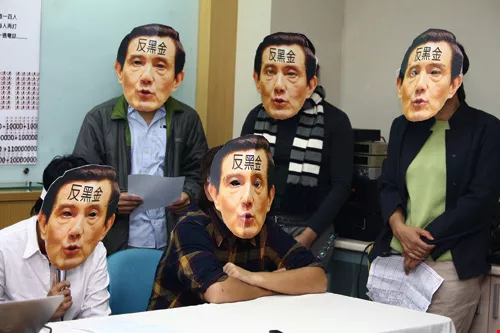
Prior to the elections for county magistrates and city mayors in December 2009, a group of students from Hualien put on "Down with slush fund corruption!" masks in the likeness of President Ma Ying-jeou. The students called upon Hualien natives residing in other parts of Taiwan to return home and vote against county magistrate candidate Fu Kun-chi, who was embroiled in an ongoing criminal case.
In addition to an aversion to structure, the current crop of activists is relatively weak at expounding on theory, which makes it difficult for them to set goals and action plans. They often just grope their way one step at a time, responding passively to issues as they impinge.
Chen Hsin-hsing says that campus publications and dissident groups in the past were very popular, and young people with a mind to be a part of public discourse were all adept at writing essays, shouting slogans, and leading movements. They liked to go to campus events to chat and debate, and nearly every one of them could reel off a cogent set of arguments on leftist theory or democratic thought.
Since the 1990s, however, government oppression has eased, and post-modern deconstructionism has undermined all grand theories. The rise of the Internet, moreover, has made information much more easily available, and campus publications, reading clubs, and dissident organizations have declined in popularity, to be replaced by BBS discussion boards and blogs. Young people now lack opportunities to set out their thoughts before an audience, so it is difficult for them to work out a fully structured theoretical system when they take part in a movement. Needless to say, they are not in the habit of adopting a priori goals for their movements.
During the Wild Strawberries movement, for example, the students were sharply divided on the question of when to arrive at a protest and when to leave. In the Wild Lily movement, by way of contrast, before anyone even showed up for a sit-in, the movement's leaders were already thinking about when they would be finishing up.
And some members of the Youth Alliance for Lo Sheng in recent years have shifted their focus to other concerns, including the Wild Strawberries, gay rights, cultural issues, and opposition to forced relocation. "But these young people have seldom been able to say how the new concerns are related to the concerns of their existing movement," says Chen. "The only way they can mobilize people is through personal connections, where an upperclassman gets an underclassman, friends contact friends, and the like. This is not good for the larger movement."
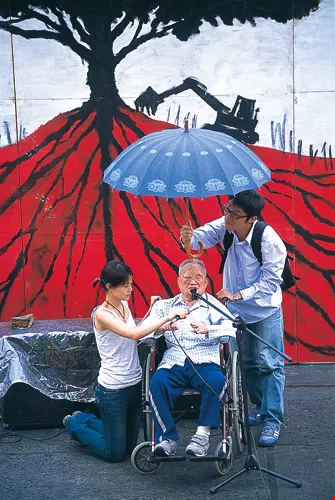
The Youth Alliance for Lo Sheng has been fighting for five years to keep the government from tearing down the Lo Sheng Sanatorium. They don't want to see the loss of a meaningful historical site, or the forced relocation of the old residents there who suffer from Hansen's disease (leprosy).
The changing times are the main reason for the lack of structure and poor ability to expound on theory among current youth activists. And another feature of recent activism is that, now that the days of epic struggle over issues of monumental significance have passed into history, the people of the "me generation" have begun paying attention to working their ideals into their life and career planning. They no longer feel that their activism should have to entail painful sacrifice. Gavin Lee, the force behind the Su-Hua Cake Shop, is a notable example of someone who has been able to keep an eye on his career while working on public issues.
A graduate of the Department of Law at National Taiwan University and the Institute of Technology Law at National Chiao Tung University, Lee was invited in 2008 to serve a three-month stint as a visiting fellow at the Harvard Law School's East Asian Legal Studies Center. Of all the people to receive this honor, Lee was the youngest (25 years old at the time) and had the lowest level of education (master's degree in progress).
In addition, Lee has also been invited to take part in numerous international conferences. In 2008, for example, he was invited to represent Taiwan's environmental NGOs at the 14th United Nations Framework Convention on Climate Change Conference of the Parties, and in 2006 served on the environmental sustainability working group at the Youth Employment Summit in Kenya. Although still doing his military service with the Coast Guard Administration, Lee has already been tapped by the Massachusetts Institute of Technology Media Lab as a member of its Smart Cities group, where he will work together with leading researchers from around the world to develop an electric bicycle for in-town transportation.
Lee isn't terribly good at foreign languages, and has never ranked very high in terms of scholastic achievement, so why have so many international bodies and research organizations been so impressed? It has been the outstanding successes that he has scored as an environmental activist.
In addition to his experience with the Su-Hua Cake Shop, Lee has also joined forces with National Taiwan University's Conserve Nature Club to prevent the building of a highway in an important watershed in Wulai, rural Taipei County. He also gathered a team of graduate students from National Taiwan University, National Chengchi University, and National Chiao Tung University to study a three-story-tall stack of 349 environmental impact assessment specifications put out by the Environmental Protection Administration since 1998 and published a research report entitled Today's Environmental Impact Assessment System Has Become a Rubber Stamp for Development Projects. The report hit like a bombshell at the Environmental Protection Administration, and has had far-reaching impact.
"People used to think that participation in social activism would affect students' academic performance and even hinder their career advancement, but for young people in my generation, involvement in public policy issues is one of the most valuable types of education that you can get," says Lee. "It's an opportunity to build up resources and momentum that you can't come by in any other way."
Away from the limelight, many young people continue to carry the activist torch on social issues. Their motivations, attitudes, organizational preferences, operating styles, and concerns may differ from those of earlier generations, but today's youth are still full of passion and a sense of justice, and are willing to put personal interests aside and devote themselves to their chosen causes.
Wu Rwei-ren, a long-time observer of youth activism, says that "young people don't change; it's the times that change." No matter how the world evolves around us, young idealists, not yet tainted by the tawdry concerns of a self-interested world, will forever power Taiwan society in a quest to be better than it is!
The Su-Hua Cake Shop took the soft-sell approach in publicity materials that pointed to tourism as a reason for opposing the Su-Hua Expressway. The group succeeded in getting the public concerned about the expressway issue.
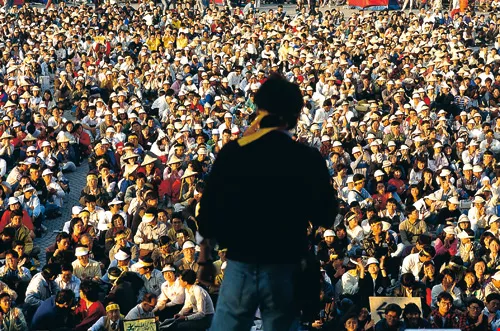
As we approach the 20th anniversary of the Wild Lily movement, a look back at that earlier time inspires a welter of emotions.
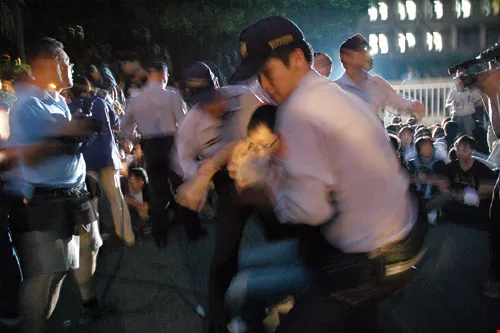
Wild Strawberries protesters had to move their sit-in to Liberty Square after they were forcibly removed by police from outside the front gate to the Executive Yuan. The move to a new location marked the start of a new phase in the protest.
The Su-Hua Cake Shop took the soft-sell approach in publicity materials that pointed to tourism as a reason for opposing the Su-Hua Expressway. The group succeeded in getting the public concerned about the expressway issue.
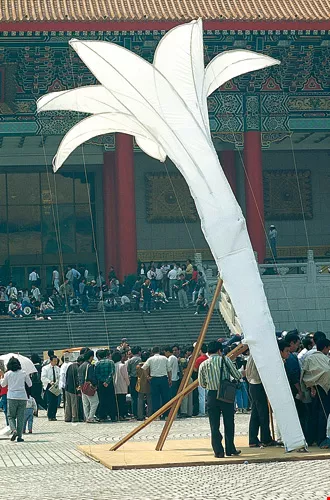
This huge wild lily "blossomed" in Chiang Kai-shek Square as a symbol of the Wild Lily movement.
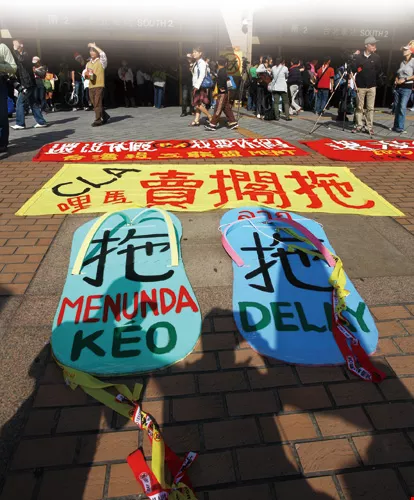
Young people always take the side of the disadvantaged. Foreign laborers are shown here in mid-December marching for the right to take time off work.
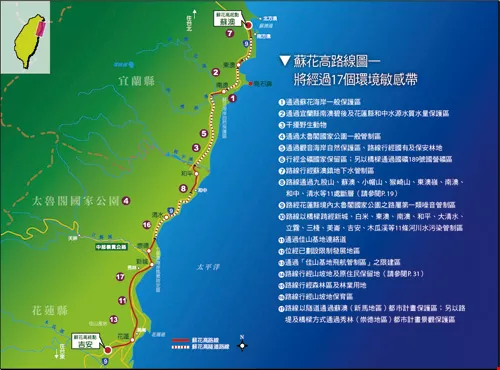
The Su-Hua Cake Shop took the soft-sell approach in publicity materials that pointed to tourism as a reason for opposing the Su-Hua Expressway. The group succeeded in getting the public concerned about the expressway issue.
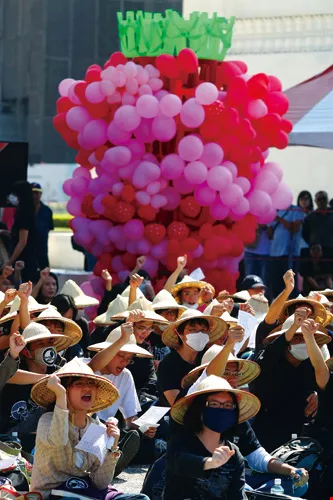
Just as a huge figure of a wild lily graced the protest venue of the Wild Lily movement, the Wild Strawberries movement used colorful balloons to symbolize strawberries. Shown here is Liberty Square on November 15, 2008, where movement participants from throughout Taiwan converged for a gathering.
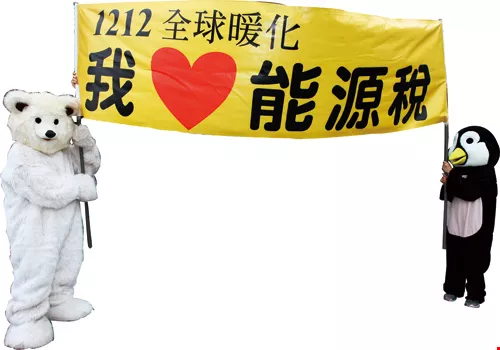
Environmental activists in December 2009 held an "I Love the Energy Tax" flash mob event where youths dressed up as polar bears and penguins to make their point.


@List.jpg?w=522&h=410&mode=crop&format=webp&quality=80)


@List.jpg?w=522&h=410&mode=crop&format=webp&quality=80)
@List.jpg?w=522&h=410&mode=crop&format=webp&quality=80)
