

Forces that are marginal in Taipei as a whole have been transformed in Wanhua into the mainstream source of the much of the district's charm, interest, and vitality! The Red House shopping area in the city's Ximending area, considered the flagship project of the municipal government's urban renewal program for the older districts of western Taipei, has experienced a renaissance due in large part to entrepreneurship in the gay community, testifying to the diversity of Wanhua today and making Taipei a richer city-culturally and commercially.
It is three hours from midnight on New Year's Eve of 2010, and everywhere Taipei City is thronged with crowds in a party mood. In the plaza in front of the Red House theater in the Ximending area, the self-proclaimed biggest gay New Year's party in all of Asia is in full swing, with sounds of music and laughter filling the air. Go-go boys and drag queens parade across the stage, and the open plaza is as packed as a subway train at rush hour. When the countdown hits 12:00, fireworks light up the night sky, and happy gay couples embrace, enjoying a celebration all their own in front of this historic building that has witnessed so many changes over time.
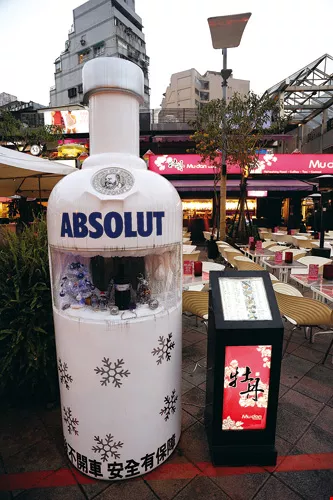
Signs of boldly varying hues and furniture of contrasting styles create special character that makes it possible to tell one outdoor coffee shop from the next.
The man with the original inspiration behind the party, Alvin, who runs the "Cafe Dalida" bar hereabouts, says that this year's New Year's party was the third of its kind, and he estimates that more than 5000 people have attended each year. Indeed, with Taipei being the most gay-friendly city in all of Asia, the gay shopping area around Red House has even become internationally famous, and gay men from Japan, Singapore, mainland China, and other nearby countries make a special point of coming here. In fact, it's not only at the New Year-it is hard to get a room in any nearby hotels when even an ordinary weekend rolls around.
Huang Yung-chuan, head of the Ximen Market Administrative Committee, which is in overall charge of planning these events, reminds us that the New Year's party is a cooperative effort among all the surrounding shops, though it is true that media has, with its usual prejudice against homosexuals, given the event something of a dubious reputation. For example, the first year the nearby police station was on high alert, and additional officers were assigned to the area. However, having seen the last couple of years that there is just a lot of harmless fun and there have been no incidents of any kind, this year the police just took the party in stride.
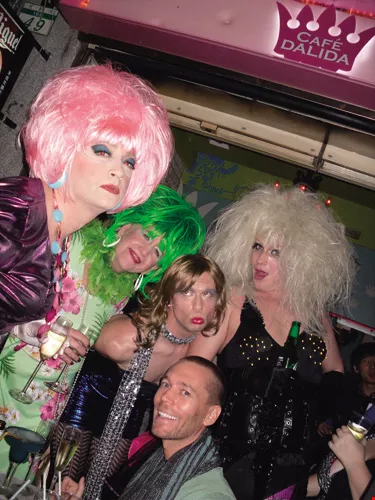
The Red House New Year's Eve party has become a major event for gays, and dressing to the nines has become almost de rigueur.
The Red House is located at the entrance to the Chengdu Rotary in Ximending, at the interface of Taipei's oldest districts: Bangka (Wanhua), Dadaocheng, and the former walled area of the city. The building is renowned for its unique form, with an octagonal structure in front connected to a cruciform structure behind. In former incarnations it was a department store, a live theater, and a movie house. Then in 1997 the building was declared a Grade 3 Historic Site by the Council for Cultural Affairs. After a fire in the rear part of the building and surrounding shops, followed by reconstruction, in 2002, the Red House Theater was formally opened to the public, operated by the Paper Windmill Theater under a commission from the city government.
The first floor of the octagonal structure combines an exhibition space with a coffee shop, while the second floor, which retains a traditional live-theater ambience, offers a stage and also up-to-date audio-visual equipment for film screenings. The celebrity appearances, children's theater, and other events that are staged there have greatly increased the visibility and name recognition of the Red House Theater.
In 2008, when the five-year contract with Paper Windmill Theater expired, the Department of Cultural Affairs of the Taipei City Government, aiming to facilitate overall planning and coordination, decided to expand the scope of its redevelopment efforts to include the cruciform structure and the surrounding plaza, with the goal of offering a home to creative and cultural enterprises. The city took back operations of the theater, and management of the whole area was turned over to the Taipei Culture Foundation.
Many of the shops now located there specialize in handmade or unique work by Taiwanese designers. For example, 16 cozy "workshops" in the cruciform structure bring together local Taiwanese creative brands, such as Georgia Tsao handmade silver jewelry and 0416 T-shirts; there is also a regular weekend arts and crafts market in the plaza. In addition, in 2008, Riverside, one of Taipei's most important venues for live indie music, opened a branch here.
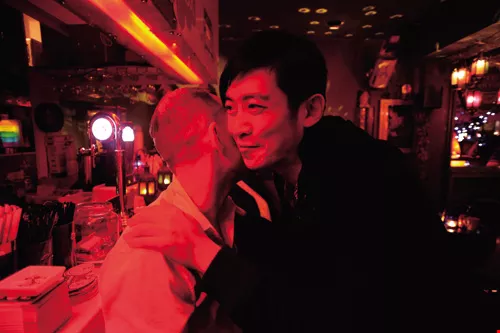
Alvin (right), the personable owner of a landmark local bar, as well as the man who came up with the inspiration for the annual New Year's party.
Located around the periphery of the Red House plaza is the Ximen Market, which was Taiwan's most fashionable commercial district for daily-use products back in the Japanese occupation era, and was also once the biggest wholesale food market on the whole island.
However, in the 1980s and 1990s, with the rise of hypermarts and changes in popular consumption patterns, the tide of people that once enlivened the Ximen Market was on its way out. Despite the designation of Red House as a historic site and redevelopment efforts, there was a long period of stagnation.
Huang Yung-chuan says that when the government decided to put cultural and creative industries at the center of the area's future, more mundane businesses-noodle restaurants, fruit and vegetable stands, and the like-could feel that they no longer fit into the scene, and they elected to take the compensation offered and depart. However, the businesses that came in afterwards did not perform as well as was hoped, and despite two waves of reshuffling of shops from 2002 to 2004, consumers and profit-making opportunities still failed to return.
Completely unexpectedly, about three-and-a-half years ago, the arrival of the first business whose main clientele was gays-the Bear Cafe-sparked a wildfire of change, and gay entrepreneurs and consumers began to arrive in large numbers.
"The atmosphere here is open and fashionable, and it is very accessible from mass transportation but also is very discreet, which are all reasons that have attracted gay shops to the area," is the analysis offered by Cafe Dalida owner Alvin. The people disgorged by Exit #6 of the Ximen MRT station mainly move off to their right, toward the pedestrian area and movie theaters; if they even bother to look left at all, they only see the old structure of the Red House, and may not even be aware of the spacious plaza just next to it. But the area's target customers are well aware of where to go.
Another factor may be that, as Alvin mentions, the connection between Red House and gays goes back even farther. Back in the 1980s, when society was much more conservative than it is now, and gays had to suppress their desires, Red House, experiencing marginalized days of its own, turned into a soft-porn theater, becoming a venue where the older generation of homosexuals could find an outlet for their feelings. You could often see men leaving the theater in couples.
Alvin himself, before hanging out the Cafe Dalida shingle, was the manager of the well-known gay bar Fresh. Thanks to his experience in the food and beverage industry and his connections in the community, Cafe Dalida has had a steady stream of customers since it opened.
As Cafe Dalida got up and running, other entrepreneurs, informed by word of mouth in the gay community, began moving in. Besides an open-air coffee shop and bar, there are now restaurants, clothing stores, photo studios, and more. Gay men congregate here without shyness or fear, in an atmosphere of openness sharply different from older gay shops, which were scattered in isolated, shadowy corners of the city where they were often virtually invisible.
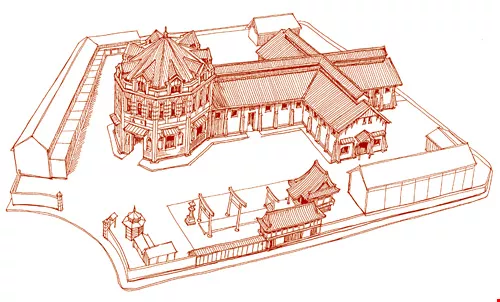
This combination of an octagonal structure with a cruciform structure linked in one building is very unusual. The drawing shows the area surrounding the Red House in the Japanese occupation era, known then as the Shinki-cho Market. On the northern side is a Shinto shrine, which was destroyed by US bombing near the end of World War II.
Of the 56 shops along the Red House periphery, roughly 70% have a gay connection to one extent or another. But if you come to the Red House plaza on a weekend, you can also see many parents with kiddies in tow browsing the flea market or stopping in a cafe for a relaxing coffee.
"A lot of our customers are totally 'clueless,' and come purely because of the fame of Red House as a historic site, or are people who have gotten tired out shopping in Ximending and just drop in to have a coffee," says Alvin with a laugh. But whether they are aware of the undercurrents or not, it is a good thing for everyone, regardless of gender or sexual orientation, that people who come to enjoy the shopping district may also find that their feelings of fear and alienation toward gays are dispelled.
When you talk about the success of the gay shopping area around Red House, besides its simply being in the right place at the right time, Huang Yung-chuan has also played a pivotal role.
"In the past, although we co-existed peacefully with the ordinary shops established here, we had virtually no interaction at all, and the Ximen Market Administrative Committee couldn't really play its role as effectively as it should have," Alvin explains. "But after Chairman Huang came into office, he was very pro-active about calling meetings and giving everyone an opportunity to get to know and accommodate each other, thereby allowing a collective consciousness for the whole Ximen Market to gel."
In particular it was necessary to get the old and new shops to communicate to work together to express the area's boldness and creativity while not adulterating the dominant cultural atmosphere. The dexterity required to pull this off is nothing to sneeze at.
Huang's family has had a florist shop here since 1950, and three generations of the clan currently live behind Red House. In addition to being current chairman of the Administrative Committee, back in 1997 he also founded a workshop focused on the history and culture of Ximen. Huang, whose mission in life has always been to carry on the Red House traditions and promote the market area, says with amusement in his voice, "My wife has been buying clothes for me around here for so many years, when owners of the shops see me they laugh and say, 'Chairman, your style is getting more and more gay all the time!' It won't be long before I'm completely assimilated!"
It's OK to take all this rather lightly. But in the not-too-distant future, there may come a day that, when people speak of can't-miss gay sites like the Castro District in San Francisco, the Red House area of Taipei City will also come to mind!

@List.jpg?w=522&h=410&mode=crop&format=webp&quality=80)


@List.jpg?w=522&h=410&mode=crop&format=webp&quality=80)
@List.jpg?w=522&h=410&mode=crop&format=webp&quality=80)
