Salt: Crystallization of Sweat and Seawater
Chang Chiung-fang / photos Jimmy Lin / tr. by Jonathan Barnard
September 2016
In 2002 Taiwan’s last salt pans were abandoned, and the island’s 338-year history of producing salt from the sea by solar evaporation ended. Today, apart from a few salt pans that have been revived for tourism purposes, the beautiful scenery of jade-like salt fields along the southwest coast is nowhere to be seen.
Since the salt is no longer drying under the sun here, where do we get it? That’s a good question. Let’s visit Taiwan’s sole manufacturer of salt to gain a deeper understanding of the history of salt in Taiwan.
Have you ever wondered: “What would we do without salt?” It may not look all that impressive, but for seasoning food and making it tastier, salt is an absolute essential.
Salt (i.e. white sodium chloride crystals) has always been an important part of people’s lives.
There are four kinds of salt: sea salt, lake salt, rock salt, and well salt. Surrounded by the ocean, Taiwan inevitably has turned to it for its salt.

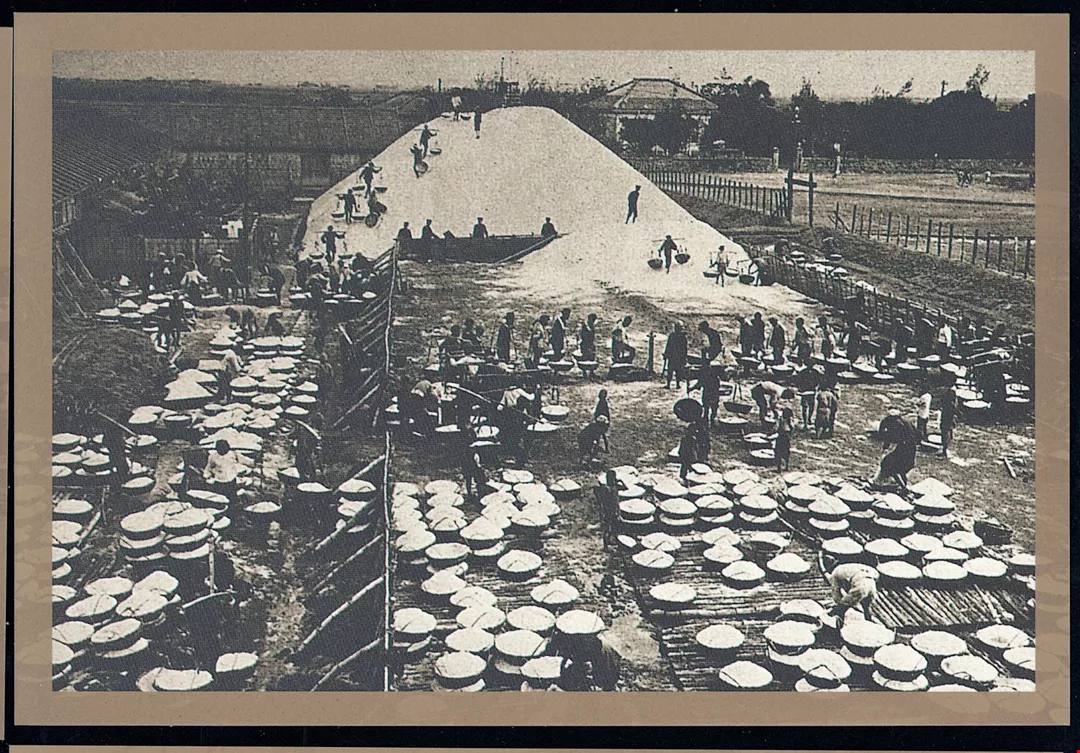
Thanks to its weather and geography, the southwest coast of Taiwan is one of just a few places on the island suitable for producing sea salt in salt pans. In its heyday, there were five major salt production facilities here. (courtesy of Budai Cultural Association)
Taking salt from the sea
Early on, Taiwan’s pioneers would take salt water and boil it off, but the resulting salt was bitter. In 1661, when the Ming loyalist general Zheng Chenggong occupied Taiwan, imports of salt from Qing-Dynasty China ceased. Zheng’s military advisor Chen Yonghua opened up salt fields in Tainan. In 1665, salt pans (fields where salt is produced from seawater via evaporation) were opened in what is today the southern edge of Yancheng Village in Tainan’s Qigu District. It was an historical first for Taiwan.
Taiwan traditionally had two kinds of salt pans: tile pans and earthen pans. Tile pans made use of large tanks or lined the wet fields with pottery shards, which were pressed flat with a stone roller. During the Japanese era (1895‡1945), because of the Japanese military’s demand for salt, fish ponds were turned into salt pans. Tu Dingxin, a retired senior worker at Taiwan Salt, points out that ceramics transmit heat well, so evaporation in tile pans is quick and the salt crystals are fine and clean, making them well suited for food. The water in earthen salt pans evaporates more slowly. Their salt crystals are stronger but rougher, and are largely used for industrial purposes.
During salt production’s heyday in Taiwan, salt was being produced in Budai, Beimen, Qigu, Tainan, and Kaohsiung. Amid the salt pans were 21 hexagonal concrete and red-brick bunkers, which were manned by guards who would patrol the pans.
Early on the government claimed monopoly rights over the production and sale of salt. In 1726 the Qing government announced that they held exclusive rights to sell salt. Although the government monopoly was temporarily suspended at the beginning of the Japanese era, it was reinstated by the colonial government in 1899. After the ROC government decamped for Taiwan in 1949, they established the Taiwan Salt Works in 1952, making the sea-salt-manufacturing business a state industry.
Bobby Chen, vice president of Taiyen Biotech (as the privatized Taiwan Salt is now called) recalls, “From a national security standpoint, salt was an important commodity.” He explains that back then Taiwan Salt’s mission was to produce salt that would be safe for food and for industrial uses.

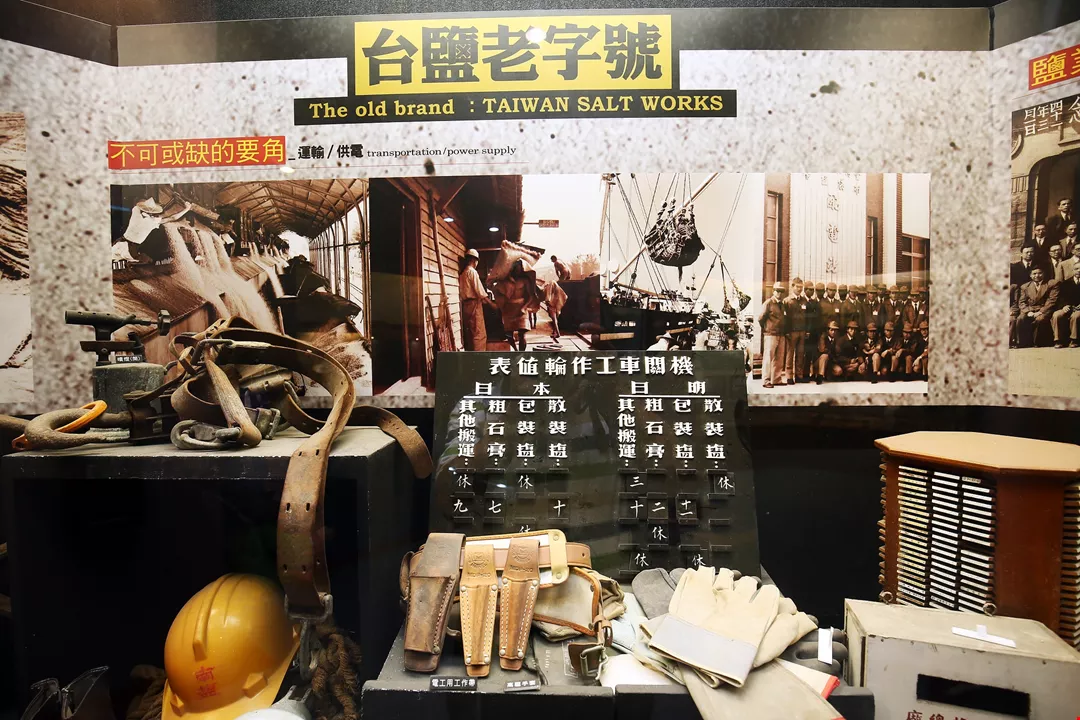
The Taiwan Salt Museum features exhibits on the history of salt production in Taiwan and the lives of the industry’s workers.
From sun-drying to electrodialysis
With global economic liberalization, the government felt that opening up the salt industry was inevitable. In 1995 Taiwan Salt Works was corporatized as Taiwan Salt Industrial Corporation, and by 2002 it had turned into a regular private corporation: Taiyen Biotech. After 272 years during which the government had enjoyed monopoly or near-monopoly power over the salt market, an era of an open markets and diversification had arrived.
What’s more, methods of salt manufacture had undergone a major change. Chen points out that early on Taiwan’s coastlines were unpolluted, so evaporating salt from seawater in salt pans posed no issues. But with industrialization, wastewater from factories polluted the coasts. In 1975 Taiwan Salt opened a salt factory in Miaoli County’s Tongxiao, which uses electrodialysis to produce salt.
Lin Xihong, a member of the factory’s management team, points out that the facility was established there on Tongxiao’s coast because there were no major factories nearby and little industrial pollution, as well as no major rivers entering the sea there, so the salt content of the water was stable.
The Tongxiao factory offered greater reliability than salt pans, which depend on the weather for evaporation. Tu Dingxin, a worker at the plant, explains that traditional salt pans draw their water directly from the sea, after which it is moved in stages from larger to smaller evaporation pans, and finally to crystallization pans. From start to finish, the water is exposed to the sun and wind for over 20 days. If during this process heavy rains dilute the water, then earlier efforts at evaporation will have been for naught.

Though fine and grainy, its uses are many. Call it Taiwan’s “white gold.”
Not subject to the weather’s whims
In comparison to the long timeframe inherent in producing salt in salt pans, Tongxiao’s factory only needs eight to ten hours to produce clean salt crystals.
Bobby Chen points out that electrodialysis not only saves time and brings stability to production levels, it also allows for the removal of heavy metals, environmental hormones and plasticizers, thus enhancing food safety.
Lin explains that the factory’s advanced electrodialysis technology uses ion exchange membranes to produce salt. A meter-wide pipe brings in clean seawater from 1.56 kilometers off the coast and 12 meters deep. Through selective ion exchange, chlorine and sodium ions are drawn through the membranes to create a more concentrated solution. By repeating the process several times, the salt content can be raised from 3% to 21% before the solution is put into evaporation tanks to produce salt crystals.
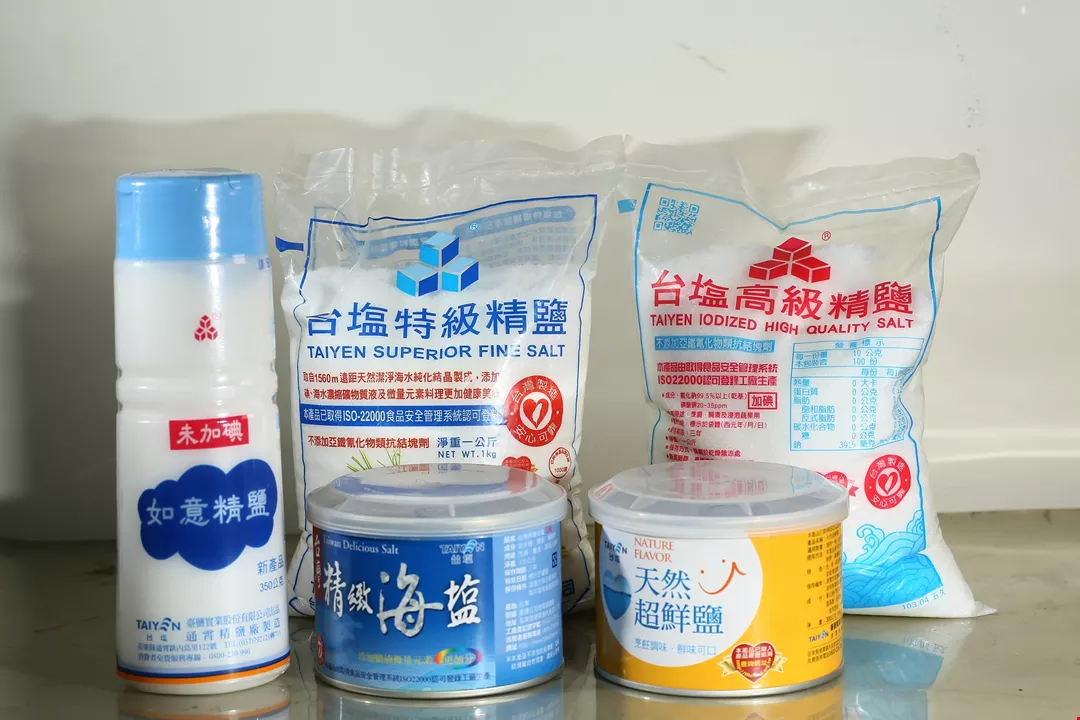
Of course, in addition to filtering out impurities and heavy metals, this process also filters out some beneficial trace elements. Chen points out that in this age of refined foods, many people lack certain minerals in their diets. Consequently, Taiyen collects some of the beneficial minerals it takes out of the water and adds them back into the extracted salt so as to produce “refined sea salt.” “With the rise of consumer concerns about health, refined sea salt has already been replacing highly refined salt,” Chen says.
Since Taiwan allowed imports of salt in 2004, a remarkable variety of salts have entered the market. Although the Taiwanese people have a lot of choice, there are health concerns.
In 2014 the Ministry of Health and Welfare released research results about the iodine content of people’s urine in Taiwan. They discovered that many were deficient in the mineral. Iodine deficiency can lead to problems such as goiter or neurological deficits, and in pregnant women it can result in brain damage to the fetus.
Salt provides the perfect medium for adding iodine to the diet. Chen points out that back when Taiwan Salt built its Tongxiao factory, the potential to add iodine so as to prevent goiter was one of the considerations.
In addition to bringing greater attention to the benefits of fortifying salt with iodine, this year the ministry hopes to reduce the rate of dental cavities by adding fluoride to salt. In accordance with public health strategies, Taiyen will launch fluoridated salt later this year or early next year.
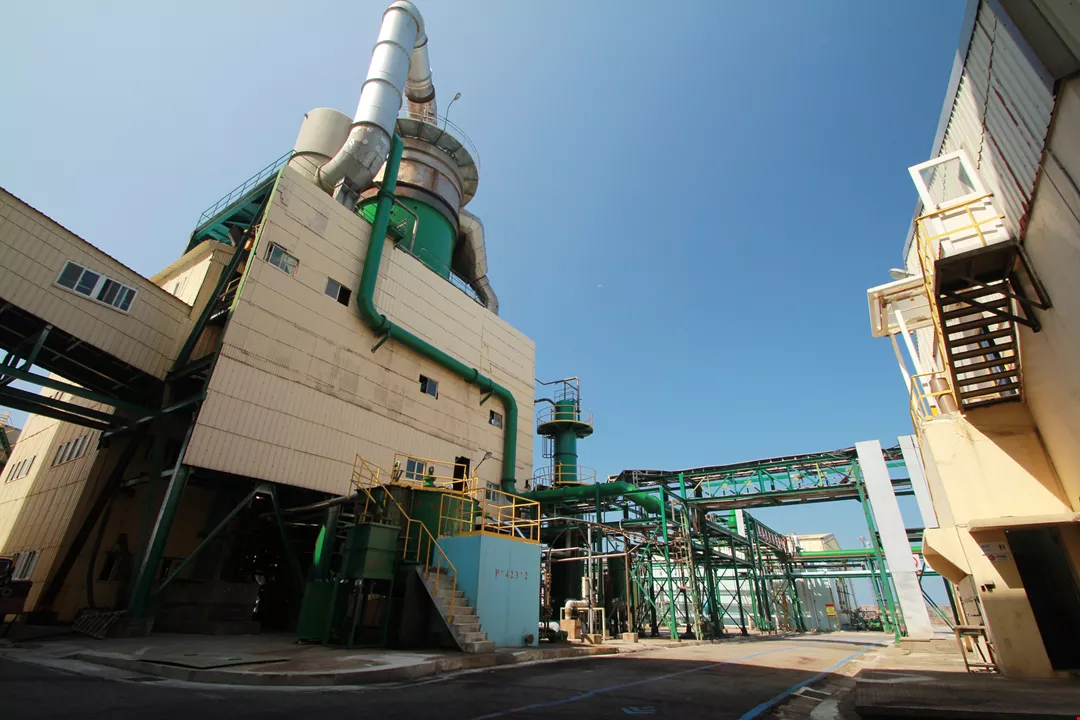
Taiyen Biotech’s salt factory at Tongxiao in Miaoli extracts salt from seawater by electrodialysis. The quality is high and the production levels stable. (courtesy of Taiyen Biotech)

From combat readiness to tourism
The 1995 Taiwan Public Television Service drama Children of the Salt Pans captured true glimpses of the lives of salt workers and the unique scenery of the salt pans in the Anshun area of what was then Tainan County. Seven years later, due to a variety of factors such as higher production costs, industrialization and privatization, Taiyen switched to importing industrial salt from Australia. About 6000 hectares of salt pans were abandoned. With privatization, the land was turned over to the National Property Administration. Taiyen subsequently bought back only the Qigu Salt Mountain and about 30 hectares of abandoned salt pans around it.
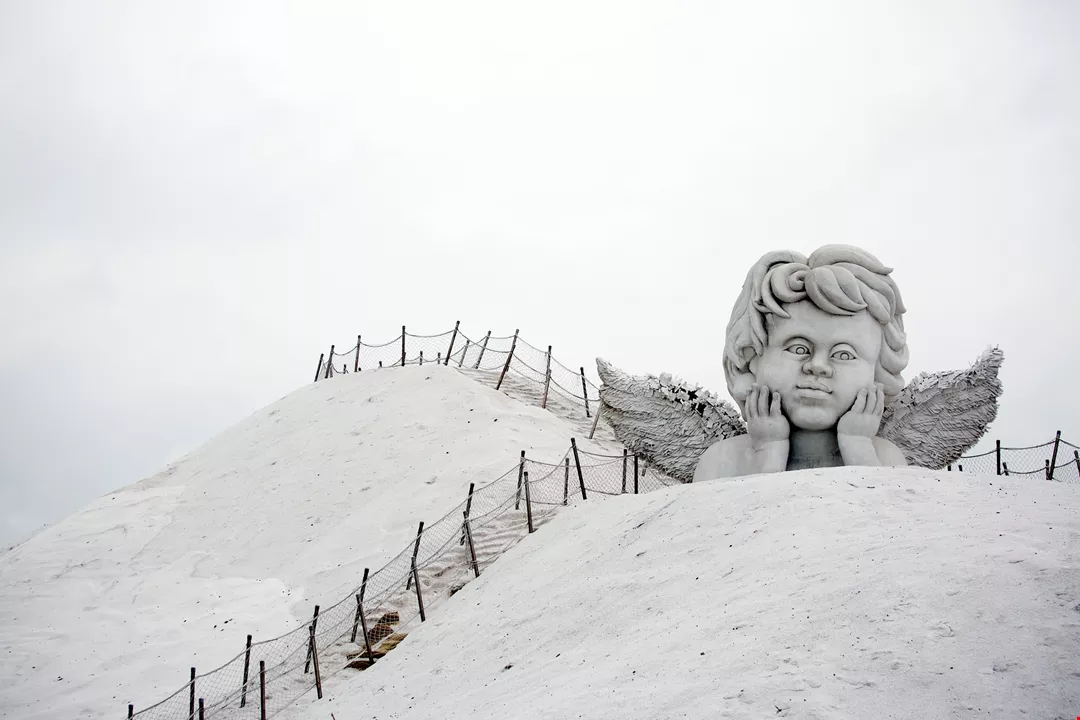
Chen explains that the Qigu Salt Mountain has value in terms of preserving the history of salt pans in Taiwan. As it happens, the salt mound, as tall as a six-story building and composed of 40,000 metric tons of salt, was originally created for the sake of military preparedness. “Back then, with the possibility of war,” Chen explains, “there were concerns that the Tongxiao plant might be bombed. Consequently, it was necessary to store a six-to-eight-months stockpile of salt.” As time passed, the salt that was dumped in the hill-like pile acquired a hard outer shell.
Today the Qigu Salt Mountain has become a famous tourist attraction, and Qigu’s jade-like salt pans have been voted as one of the eight new scenic wonders of Tainan. Unfortunately, salt dissolves and blackens when exposed to wind, sun and rain. Taiyen has had to spend tens of millions of NT dollars a year to replenish it and keep it clean and white.
Standing on the Qigu Salt Mountain and surveying the abandoned salt fields, one gets a first-hand look at evidence of the Taiwanese people’s long historical efforts to wrest salt from the sea.


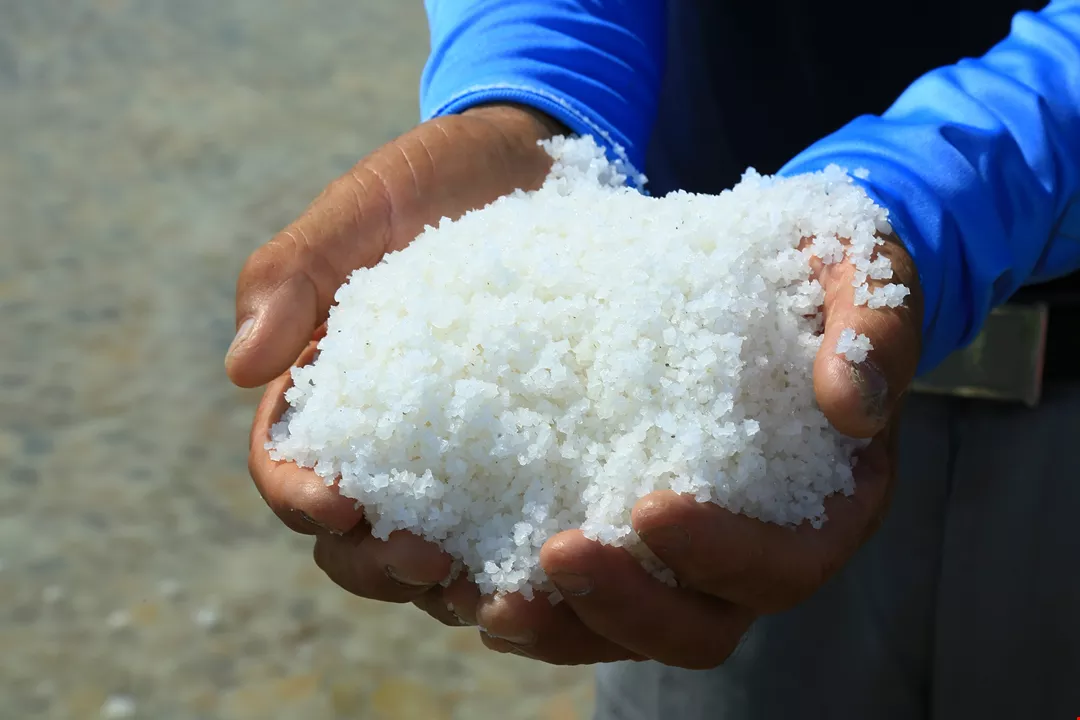
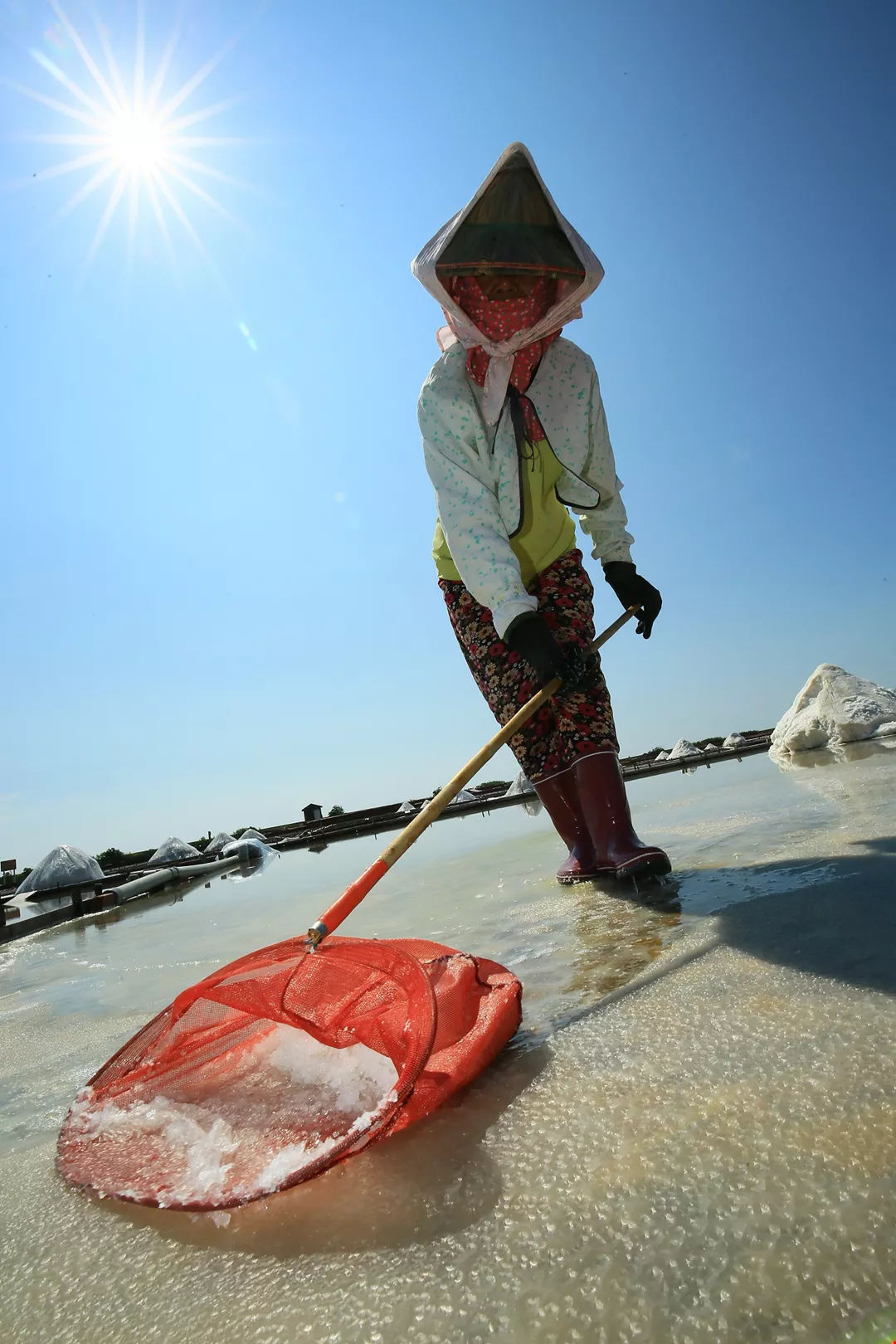
The midday sun that draws the salt out of the brine beats down mercilessly on humans too. At the salt pans, workers toil at dredging up the thin layer of high-quality “fleur de sel.”

Six or seven stories tall, this salt “mountain” made from a war-preparedness stockpile has become a landmark in Qigu. Looking out upon nearby salt pans from its summit offers a truly unique experience. (photo by Chin Hung-hao)