Exploring Taiwan Anew (9) A Flighty Idea-- Gliding Through the Air Over Saichia
Jane Wang / photos Lin Meng-san / tr. by Phil Newell
November 1995


People have long been fascinated with flight. A Greek myth had it that a brilliant inventor, Daedelus, made wings out of feathers and wax. He and his son, Icarus, stuck the wings to their arms, and flew out of the old fortress in which they were imprisoned.
Leonardo Da Vinci grasped the basic principles of flight in the 15th century. Today, new flying machines are continually being developed, and we can sail through the air to our hearts' content just by taking a comfortable seat in an aircraft cab in. Yet, there remains a marked difference between cruising through the clouds in a 747 a nd the dream-like freedom of flying on the wind.
But that subconscious desire in all of us, to turn ourselves into birds and feel the wind and the air currents with our own bodies--that age-old dream of flight-- can become a reality. All you need to do is take a trip to Saichia Village, Santi Rural Township, in Pingtung County. There you will find a site that Taiwan flight enthusiasts consider either the finest or second finest in all of Asia for hang gliding and paragliding.
The wind is up.
It is just after high noon. The wind indicator at the end of the Saichia launch site, at 350 meters above sea level, bucks around, showing a westerly wind. A dozen or so fliers have been "lounging" next to their "wriggled up'' paragliding gear, catching a few winks or just chatting. But when they hear about the wind, their spirits immediately do a 180-degree turn. As if jolted by electricity, the fliers cover the area with their colorful paragliders as they take up their positions.
They don their one-piece flight suits, and put on helmets and dark, reflective wind goggles. They strap altimeters on their right legs, radios on their chests, and harnesses on their backs. Now they look like real airmen.
The first to take off spreads his paraglider out in the preparation zone, and checks to make sure none of the lines are tangled. He fastens several sets of straps across his chest, and with both hands pulls taut the first main strap and the steering. Then, setting his body at an angle of 60 degrees to the ground, he begins to run.
Those watching quietly off to the side feel a sudden emotional charge when the paraglider leaves the ground. Alas, the chute hangs down to one side, and the runner comes to a halt. Everybody just sighs, feeling as deflated as the paraglider itself. "The wind isn't right." "He wasn't running fast enough." "Not strong enough." Everybody gets their two cents in analyzing why the attempt failed. It seems like everybody is an expert.
His teammates go forward to help him fix his chute, and offer him advice, while he makes preparations for a second try. This time there is not the slightest hitch, and quickly the parachute rises to its proper position directly over his head. Just run a few steps and then float into the sky under the paraglider--it looks like the simplest thing in the world. After several more gliders have smoothly taken off, it is suddenly our turn.
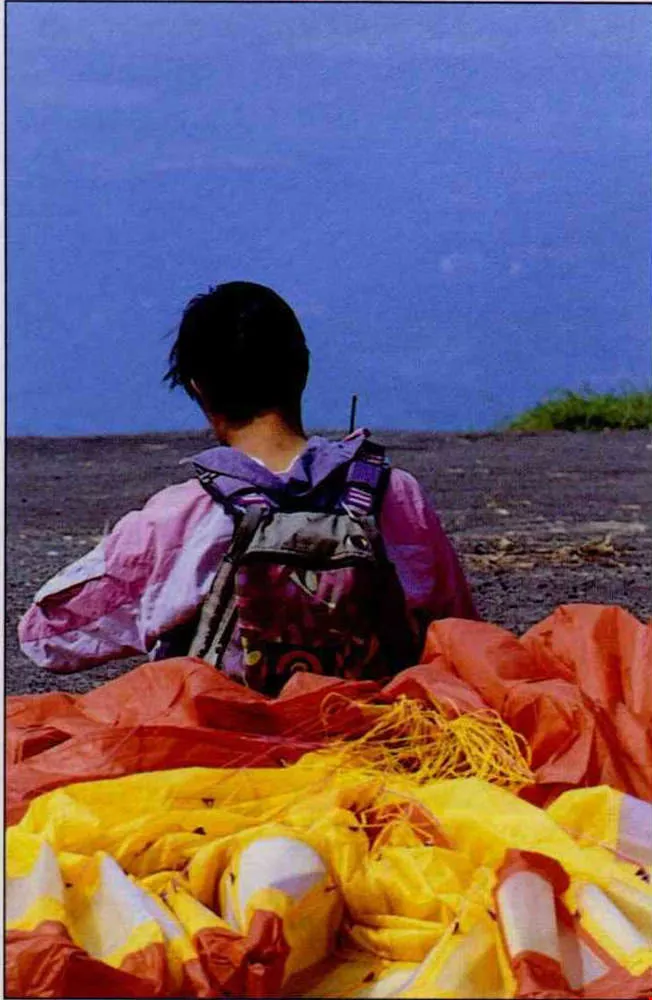
(above) Fliers wait for the wind to come up.
Maiden flight
My heartbeat seems to get ever faster as the time to take off approaches. It's true that I had basic training in Fengshan. It's also the case that I am in a two-person glider, navigated by Chen Yu-jong (nicknamed "Bleater"), who has seven years of experience as a trainer and is a member of the Hunter Team. On top of it all, I even snuck off to the little temple at the extreme end of the field and prayed to Amida Buddha, Guanyin, and other deities for protection. But when I found out you only have five meters before you hit the yellow warning strip on the incline which helps runners pick up speed, after which there is a sheer 90 degree cliff, the question "Will I lose my footing and tumble over?" kept running through my brain, and I felt my legs getting weak.
Hunter Team founder Chien Wan-chuan helped us through the preflight check and reminded me, "When the time comes you just have to charge forward, and not care about anything. Even when you reach the very edge of the cliff and feel like you are going to fall over it, you have to keep on running until you can't run anymore." It seems he has noticed my skittishness, and he teases, "Anyway, so what if you burn one life up. In eighteen years, at most, you'll be a strong young person again." I wanted to laugh, but discovered that my facial muscles were locked so tight I couldn't even turn up the corners of my mouth.
The moment finally arrives. After the field is clear, I grab tight with both hands and bend my back and my knees to get into a running posture. I put all of my attention into my ears: "One, two, three, run!" Chien's command is like opening a floodgate, as all the pent up energy in my muscles is released at once. Within a couple of steps, the harness on my shoulders is pulling upward with tremendous force. I can feel that my "buddy" behind me has been filled by the wind, and in an instant it has gone from being a strip of cloth to a robust and powerful aerodynamically shaped "wing."
"Charge!" There is no time even to think. There is nothing in my brain but this simple idea. Abruptly, my body feels incredibly light, and a fierce wind blows in my face. The sound of the wind replaces the astonished gasps of the onlookers. "Well done. Now adjust the seat so you can sit down." Bleater's instructions come from behind me, and it is only now that I realize that we are in the embrace of the sky!
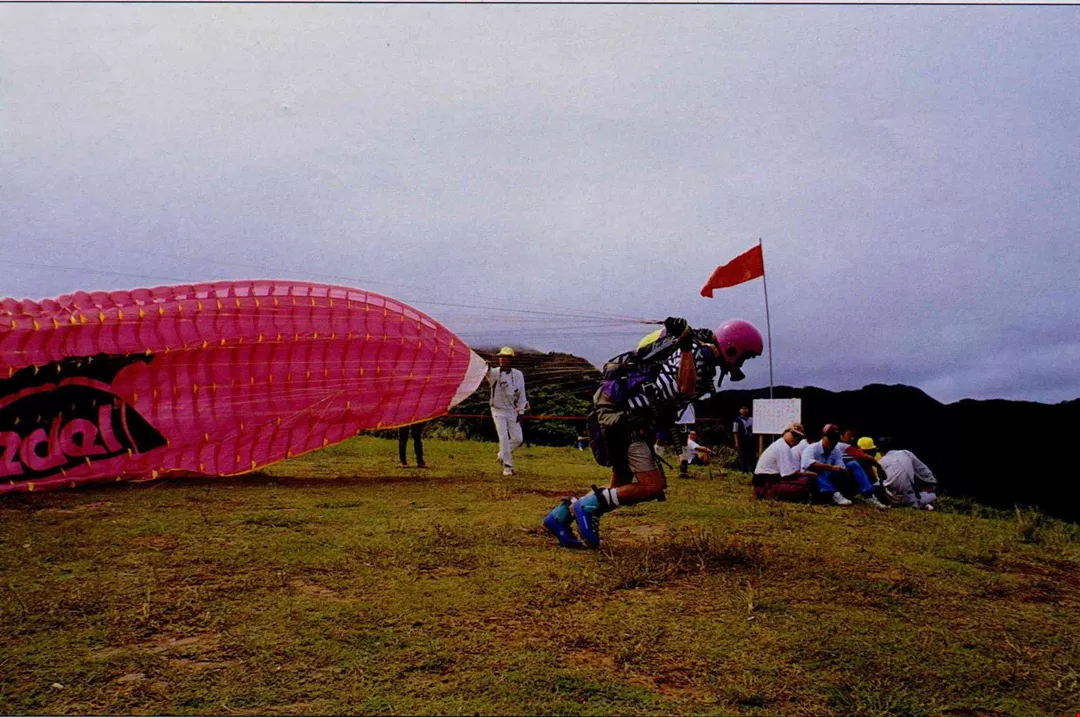
(below) The paraglider fills with wind, transform ing from a limp piece of cloth into a powerful "wing.".
Fly away!
What's amazing is how the natural scenery, which could only be glimpsed from a single distant point on the takeoff field, now passes under your feet yard by yard. And in the eyes of the onlookers, we have become part of the splendid view. Off to the right, light green squares are inlaid amidst dark verdant patches of mango trees and sparkling streams running through gorges. This is where we plan to land. Off to the left, the little spot of white amidst the puffs of smoke and dense green is Saichia Village.
When you lift your gaze to the horizon, your field of vision takes in Kaoshu, Chishan, and Pingtung. Veterans say that on a clear day you can see Little Liuchiu, and even the monkeys playing at Kaohsiung's Chaishan Zoo (using a high-powered telescope, of course!). Unfortunately, today these places are all hidden behind dense clouds.
Just as I take out my camera, greedily thinking to capture all of these visions on film, I feel the paraglider beginning to shake. The altimeter on Bleater's right leg sends up urgent beeps. It seems we are being dragged upwards by an invisible force, and the constant circles in which we are turning make me feel dizzy. "We've hit a warm air current, though it's pretty weak," says Bleater. "It's very typical to have strong currents around mountains or where there are sharp differences in temperature. If you hit a whole series of them, you can fly much higher and go on an extended sail." But this time, wouldn't you know it, we are out of the range of its impact within a short time.
Besides sailing, skilled gliders can do patterns in the air. Seeing how excited I am, and how apparently fearless, Bleater begins tugging alternatively at the suspension line, swinging us back and forth, to give me a taste of what it feels like to be in free fall at speeds approaching 100 kilometers per hour. Sitting up front, I am ashen-faced and scream repeatedly.
Because there is a weather front passing through the area, in the afternoon the sun ducks behind heavy clouds, leaving relatively little upward wind. Therefore, we come down after only 10 or so minutes in the air. Bleater navigates us through several figure-eights, bringing us down to between 30 and 50 meters for our landing.
In theory, if properly controlling his chute, a person should land as softly as a feather. But it is more difficult to find the center of gravity on a two-person glider. Add to that the fact that we forgot to agree beforehand to run in different directions when we touch down, and the result is a slight accident: The two of us end up in a pile in the thick grass, finishing off my "maiden flight" in Saichia in a somewhat dramatic fashion.
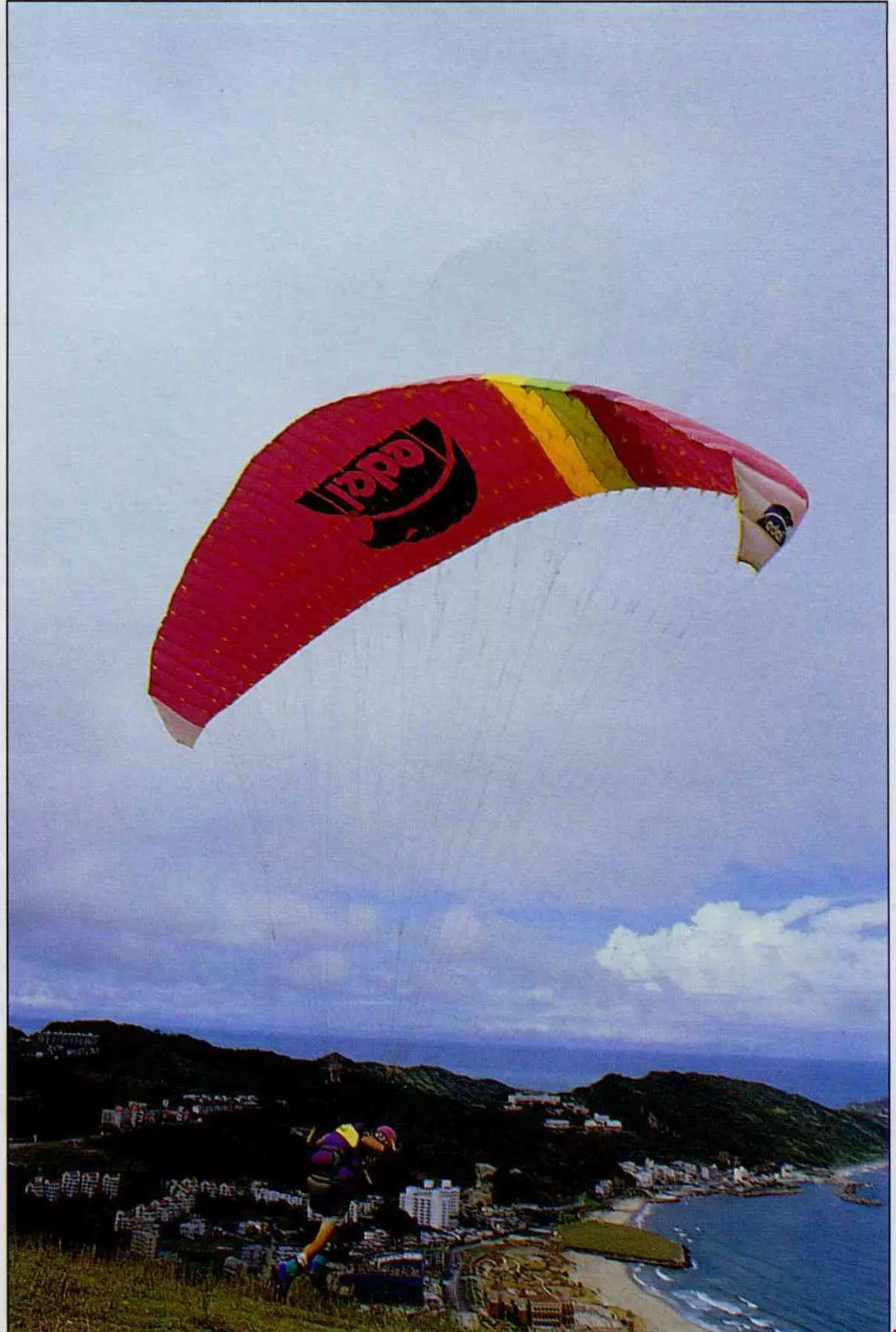
For once, let us break free from the bounds of gravity and satisfy our longing to take to the skies.
Fliers' paradise
Saichia has superior climatic and geographic attributes for gliding. Looking eastward, you can see the tail end of the Central Mountain Range, a string of verdant ridges running north to south from Liukuei in Kaohsiung County to Fangliao in Pingtung County. The Saichia takeoff field lies in one of the crevices of this chain.
Luo Chung-hao, head of the Kaohsiung branch of the Eagle Team, who has studied a great deal of meteorology and is in the aeronautical instruments export business, says that the best time for gliding in Saichia is from October to April or May. In this period, out of every ten days you'll get around eight that are suitable. This is the time of year when the weather is affected by cold high-pressure areas from the continent. These create sharp differences in temperature, generating strong upward currents. Also, humidity is low, and there is less concern about rain caused by hot air currents running into cold air at high altitudes.
In addition, for about ten kilometers around the site there are few rice fields or other wet patches. Therefore, all you need is sun to create a series of hot air currents, which makes for extremely good long-distance sailing.
The landing field is about as big as four football fields, and the adjoining land is cleared meadow. Except for some betel nut and mango trees planted by farmers, there are no major obstructions; there are also few power lines, so the area is quite safe. As Luo Hsiang-ming, head trainer of the Eagle Team, describes it, "you can be easily found no matter where you land."
Simon Ueng, Taiwan's top paraglider, says that because the lie of the mountains is very simple-- there are gaps every two or three kilometers, and there are no complicated topographic features--it is always easy to find a safe place to come down.
Linking the takeoff and landing fields is a twisting mountain road wide enough for two vehicles. The road has already been paved with asphalt, and it only takes about 20 minutes to drive, so getting back and forth is easy. But before 1980, this area was still undeveloped virgin forest.
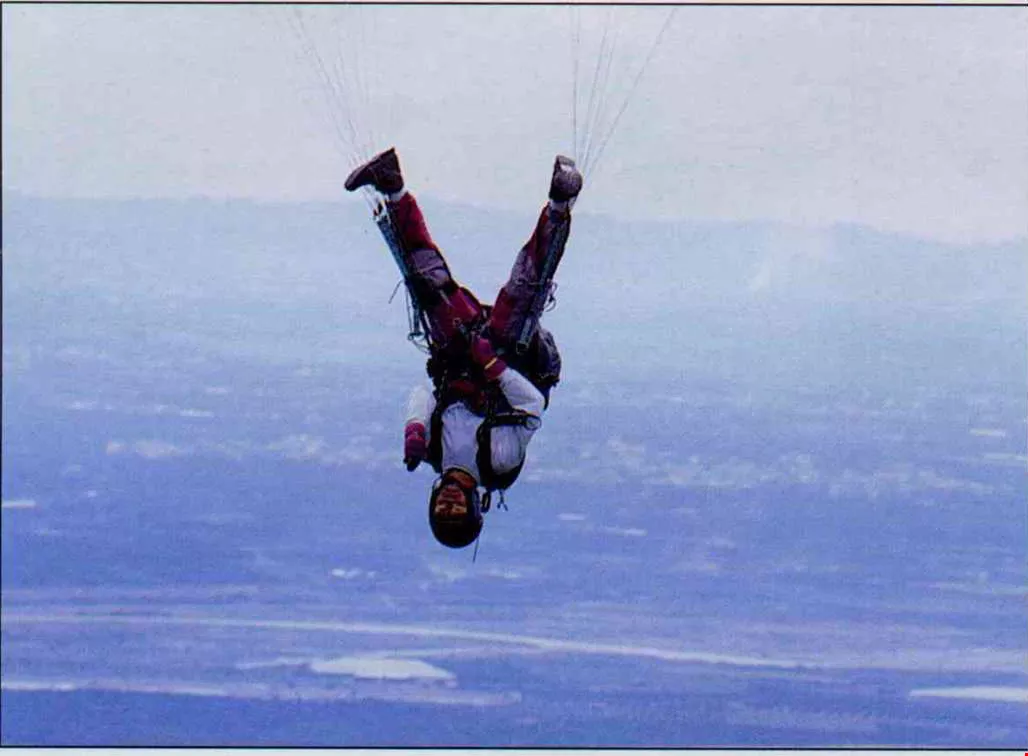
(left) Paragliding experts can do tricks like hanging upside down. But many veterans recommend against trying such moves. (photo by Cheryl Sheridan)
Trespassing in the mountains
Simon Eung still has a few photos in his files of what Saichia looked like then. Though this was well over a decade ago, he remembers it like it was yesterday.
At that time hang gliding had only just been introduced into Taiwan. The main location for it then was Green Bay (Feitsuiwan) on the north coast. Because the equipment was so expensive, however, it remained a sport for a wealthy few. Later, the China Youth Corps sponsored a camp by Chengching Lake. Eung, who lived in southern Taiwan, was immediately attracted by the picture of a colorful hang glider sailing through the blue sky that he had seen in an advertisement on a bus. He signed up for the camp, hoping to finally realize his dream to fly that he had ever since he was small. But when he went he was left disappointed.
It turned out that even the coach had never actually gone up, and the hang gliders there were very primitive. They were nothing like the brilliant gliders in the advertisement. There was no understanding of the basic principles of hang gliding. They were on flat ground, so it's no surprise they couldn't build up any speed running. The hang glider hung like a limp cloth, never filling up and lifting into the air. Even the coach fell and broke his arm when he tried it.
Later they went to a small mountain slope behind the Military Academy in Fengshan to practice. After several successful flights, they decided to face the challenge of greater altitudes. Coincidentally, one of the participants, Pan Feng-yi, hailed from Taishan Village, right near Saichia. Struck by an inspiration, Pan suggested there would be no harm in trying out Saichia. Carrying equipment they had designed and manufactured themselves, Pan and friends formed a group and went on a test run. Since the little road covered over by trees was too narrow to drive, they had to hike up to the top. But they were very pleased when they got there and had a look around. Without regard for whom the land might belong to, they immediately began cutting down trees to create embryonic takeoff and landing fields.
Having been busy for a while, by the time they got set up for a formal takeoff they noticed the sky darkening. But it proved impossible for them to resist the seduction of flying.
"At that time the landing area was a sugar cane field. I just glanced over the area and then took off. I didn't expect to see when I approached the field that bamboo had also been planted there, and I ended up hung up on the bamboo. Later when everybody got together, Yu Chi-kao was gone. Because visibility was low, and we had prepared no form of communications, we decided to call the police to come and search. We were really surprised when we got to the police station and there he was! He thought we had been killed in an accident, and had gone to get help. Because Saichia was at that time considered a Class A Restricted Mountain Area, we were punished for having gone there in the first place, and the landowner, who was furious, demanded NT$50,000."
Thereafter, regardless of rain or cutting winds, they continued to show up at Saichia. They did it to fly, but also not to let down the aboriginal children who would enthusiastically wait for them without fail. Even if the weather was so bad they absolutely couldn't go gliding, they could still hang around the whole day and have a great time. In 1980, Eung formed the Firebird Team, taking in 30 students at no charge. As word got around, Saichia became a hang gliders' paradise.
In early 1981, Eung held an enormous hang-gliding wedding, a first in Taiwan. Media reports on it kept up for a month or more, making Saichia famous. Then Taiwan provincial governor (and now president) Lee Teng-hui visited here on a local inspection tour, and set aside two special appropriations for the county government to lay out and maintain the site, creating fertile ground for the future growth of hang-gliding activities.
Unfortunately, with no precedents to follow, mistakes were inevitable. Originally the takeoff field was about 20 meters long, at an incline of 20 to 30 degrees. But because of inappropriate construction, it has become a precariously steep slope. Also, to one takes regular care of the grass. Not long ago, the roadway was built so that it cut the landing field right in half. The "Saichia Recreation Center," built next to the road, was originally put under the management of the Hang Gliding Committee of Taiwan, ROC, but has since been turned over to a certain school for educational purposes. The result is that it does not now offer housing and food to gliders, the things they are most urgently in need of.
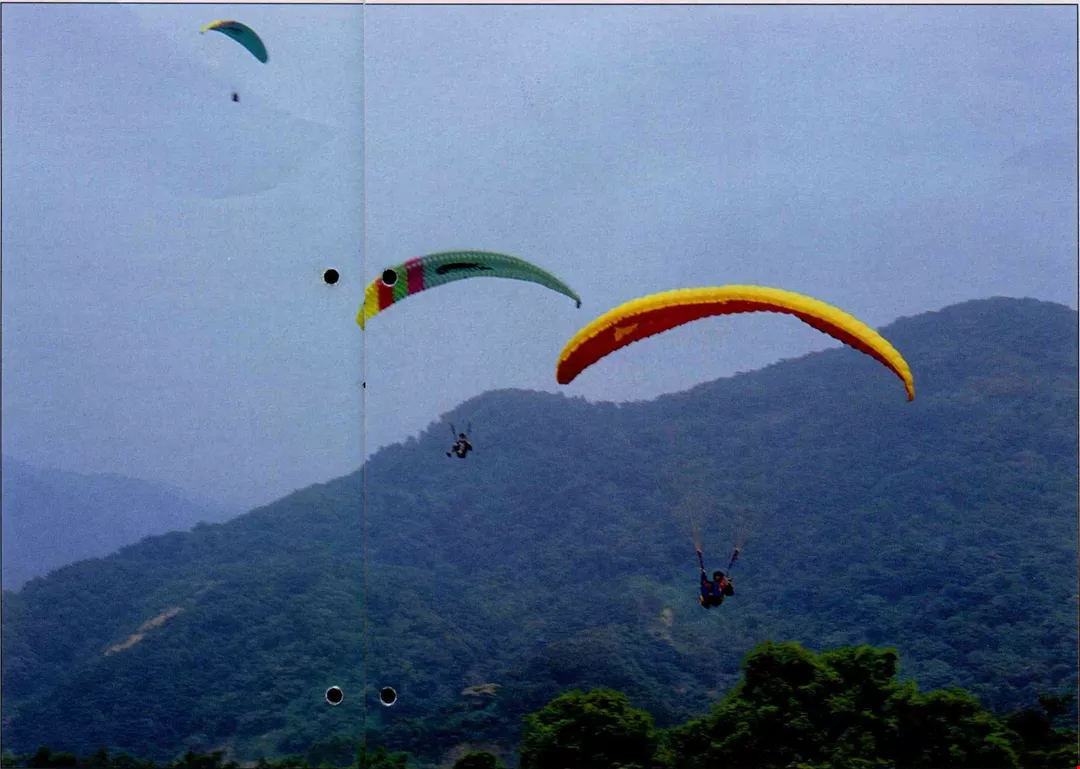
(right) A mountain chain is one of the advantages Saichia offers for gliding.
(Man) powered flight
In the skies around Saichia, the paraglider, which we tried, is now even more common than the hang glider. The early history of the paraglider in Taiwan parallels that of the hang glider: It was also the preserve of a small group of people who thrived on risk.
Chien Wan-chuan was the first person in Taiwan to learn paragliding. He used to be a paratrooper, and he was also in the first class of members of the Firebird Team. He was only 17 when he first came into contact with flying.
Chien relates that in 1986 he got his first paraglider from an import firm. Adapted from high altitude parachutes, paragliders had already become very popular in the Alps. Despite his efforts to learn from foreign magazines, Chien couldn't quite get the knack of how to operate one.
"I remember the first time I went to Saichia to fly. I didn't even know I needed a running start. I just stood on the takeoff field and let the wind fill up my chute, but I couldn't get up the courage to jump off the edge. Later on I tried being pulled by a vehicle and by human power, finally getting up in the air. But the people pulling me got carried away, and when I turned around to look I saw them tumbling one by one down the incline."
A year later, an Austrian who had brought his own glider went down to Saichia. Seeing Chien's plight, the Austrian spent more than an hour teaching him how to get up in the air. Thus the actual import of paragliding techniques into Taiwan can be dated only to 1987.
Paragliding equipment is lighter and easier to handle than hang-gliding gear, and paragliding is easier to learn. Even students who begin knowing absolutely nothing can be airborne within three days, whereas it usually takes about three months to get the hang of the other sport. Therefore paragliders have steadily replaced hang gliders and have begun to spread through Taiwan's skies. Paragliding clubs have sprung up one after another. National hang gliding team member Liu Tsung-hui estimates that at the peak in 1991 and 1992, about 1000 people received paragliding training.
Yet, the very ease of learning which has helped this sport to flourish may also be its Achilles heel. Many people take it too lightly, and rashly attempt it with insufficient training, inevitably leading to accidents. Most people who have had an accident never try again. There is even the so-called "three-minute lesson," which relies entirely on wireless communications, in which the equipment is rented out and the people are sent immediately up into the air. We met one such quack trainer the day we were there. It was said that he was already responsible for two damaged spines, two broken arms, and four fractured legs.
In addition, because of narrow-mindedness, paragliders did not learn very much from some of the tragic experiences of hang gliding. Simon Eung says that generally speaking there are great upward currents around Saichia on summer afternoons, because of the convection. But experienced hang gliders also know that this is the prelude to intense thunderstorms, so no one should go up. But one time more than 20 paragliders took off. Within a half hour, a strong southerly wind had scattered them all over. The disaster repeated itself a week later, says Luo Chung-hao, and one of the Wild Geese Team was drowned when he landed in the ocean.
According to a report on accidents Eung compiled, there have been five to six times as many accidents in paragliding as in hang gliding. There have been on average more than ten serious injuries or deaths a year. It is perhaps because there are too many examples of this nature that gliding has not achieved wide popularity.
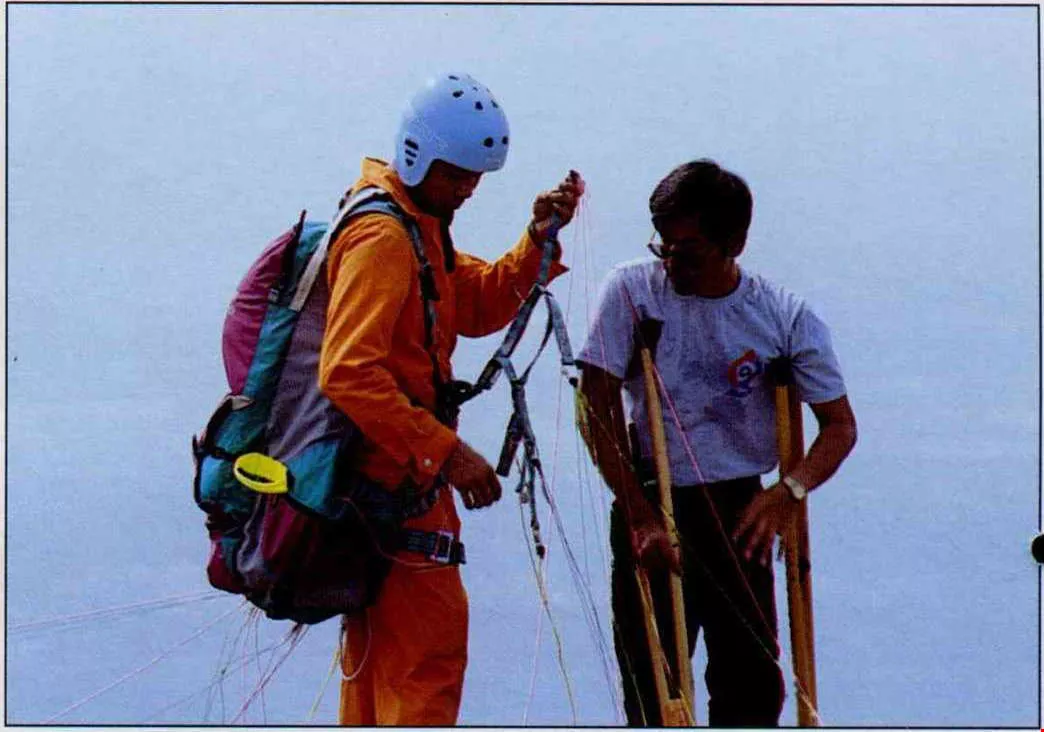
In the air, flying creates a sensation of breaking away; on the ground, it draws people together.
Bullfighting first
The risks of paragliding have decreased dramatically in recent years: There have been constant technical improvements and new innovations in equipment. Local clubs have actively recruited experts from Europe, North America, and Japan for instruction and exchanges of information. And now there is wireless communications gear. In addition, there has been steady development of various instructional systems.
Before going to Saichia on this occasion, we participated in the Eagle Team training process. First we had classes in the structure of the paraglider, the principles of flight, and on takeoff procedures. Then came the so-called "bullfighting"--operation of the paraglider while still on the ground. We had to learn how to keep the paraglider directly overhead and killed with wind to its "wing" shape under any circumstances. This procedure is known as bullfighting because, under conditions in which there is no drop-off, the "fliers" must rely completely on running to keep the glider overhead. While training at the Chungyi Primary School in Taliao Rural Township, Kaohsiung County, we could only run two or three times in the afternoon heat before we were gasping for breath and sweating a river.
For two consecutive days, we practiced takeoffs and landings behind the army officer's school. The little slope, at only 50 meters, seems hardly worth noticing. But when you strap on that glider, you feel like you are on the edge of an abyss.
My first successful flight was completely unexpected. By then it was already dusk. I just remember that I was running into the setting sun, and by the time I realized what was happening I discovered I was flying. I immediately heard the sound of Luo Hsiang-ming's voice from behind giving instructions to land, and I was in the air for probably no more than 10 seconds.
I asked "assistant instructor" Chang Pai-yuan for his opinion. Only then did I discover that all novices feel that the first time is a little unreal. Perhaps it is because the time in the air is so short, or perhaps because one is completely unprepared for it when it finally happens.
Because man by nature lacks wings, even if you understand the theory of flight well--which is of course very important--training in safe areas, with actual time in the air, is critical. Indeed, it may even be necessary to learn from countless failures.
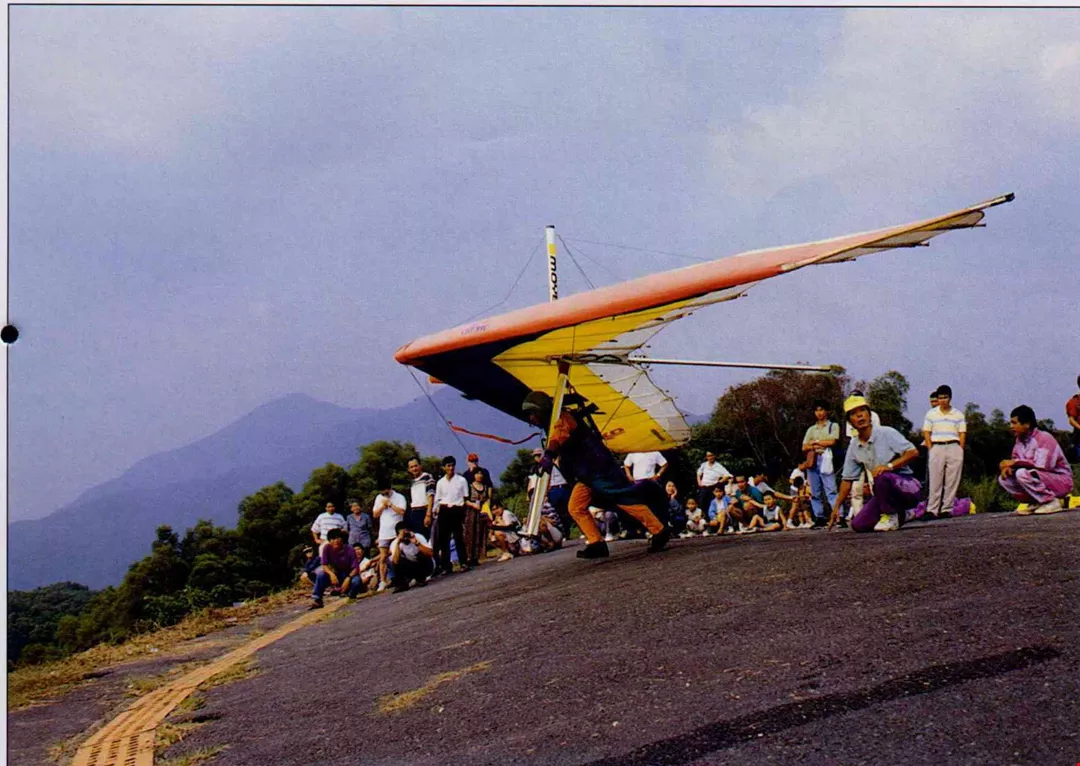
The gliding craze at Saichia began with hang gliders.
A challenge to mind and body
Ho Chun-hui, a member of the Hunter Team who had been learning paragliding for only two months and was in Saichia for some practice runs, was blown into a mountain after he failed to turn quickly enough. Another student in the same class, Tseng Chun-wei, got the takeoff procedure wrong. The last thing he heard was the crowd shouting in surprise as he tumbled over the ten-story high cliff. Fortunately Tseng, like most people who fall off the cliff, was somewhat held up by his open chute, so he did not drop precipitously and was not seriously injured.
Nevertheless, once you achieve a level of skill so you don't worry anymore, then you can really enjoy the thrill of flight.
Photographer Cheryl Sheridan, who learned how to fly a plane when very young, also had the experience of trying a two-person flight when she did a story from Saichia. She points out that the paraglider is very soft, so the form of flight feels much closer to nature. Fliers must humbly learn from and follow nature in order to be able to fly truly freely. Thus, for example, gliders will automatically set off after an eagle they see in the air, because where there are eagles there are currents. This spirit of learning from the eagles is itself a channel for rethinking the relationship between man and nature.
Liu Pang-tun, who has represented Taiwan in international competition, looks like a typical rough-edged country boy from southern Taiwan, always chewing betel nut when he isn't in the air. But once up, he feels "like an eagle, looking down from above, continually searching out one air current after another and sailing majestically though the boundless sky."
Luo Chung-hao says that flying is a sport that tries both mind and body, testing the glider's grasp of all different types of meteorological conditions. Once you become an expert, you can tell from a single movement whether some other glider has correctly judged the conditions, and decide at once whether or not to follow. Part of the fun is the mixture of cooperation and competition with other gliders.
Luo, who was struck with polio at the age of seven, cannot run forward under his own power. But relying on his perseverance and a specially designed hang glider, he has realized his dream of flight.
You can often hear dialogue such as the following when gliders touch down at the end of their flights:
"Shoot. I couldn't get up in the air at all. Really disappointing."
"That's because you aren't sensitive enough to the air currents. I went up about the same time you did, but got up much higher than you. Heck, I was probably up the highest of anyone the whole...."
"Not! I was the highest, but you couldn't see me because I was above you!"
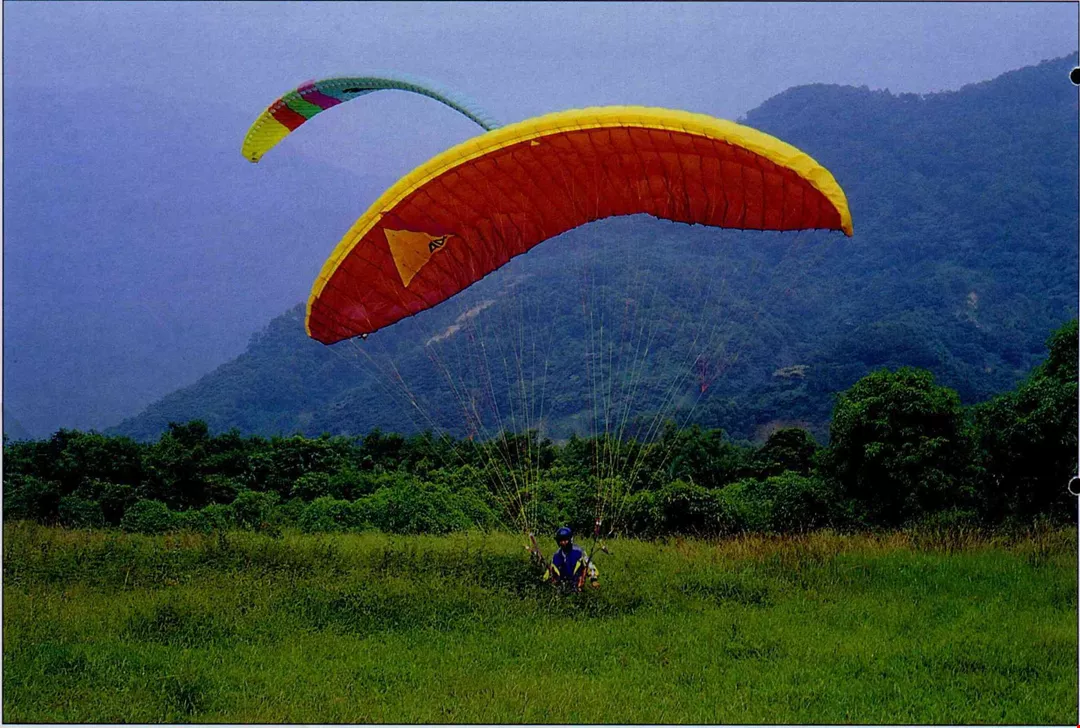
If skilled at controlling the chute, a paraglider should land as softly as a feather.
Fair air
Those speaking might very well be the owner of a karaoke, a middleman for hiring labor from abroad, a career military officer, a professor, a student, or whatever. Paragliding brings together these diverse people who would never have much to do with each other in the course of their daily lives. Liu Pang-tun, who broke his leg at the 1995 World Cup Paragliding Tournament held in Japan in March and is still recuperating, still makes a point of going out each week to Saichia to talk to his friends.
Simon Eung, who has similarly been injured in competition, once offered a memorable description of the energy generated by the congregation of gliding enthusiasts: "Even if I'm not actually up in the air, even if we are just talking about something to do with flying, I feel like there is electricity in the air, like every cell in my body is flying...."
In the air, gliders are in an extremely personal world of their own. But once on the ground, they become part of a select group whose common link is a sensation that can only be understood first hand. They get tremendous satisfaction from exchanging experiences. In the travels from sky to earth, the status distinctions of daily life seem to disappear without a trace.
Chang Kun-yi set the record for farthest flight on the day of our visit: "I flew all the way to Nanhua Bridge." Despite the fact that after 3:00 gathering clouds cut visibility to only 10 meters, and the wind indicator was constantly pointing between south and southwest, a poor direction for takeoff, he still put on the gear one more time and decided to take to the sky, to take on an even more challenging climatic environment.
Looking at his silhouette, he might have been an eagle, facing into the wind, preparing to launch into flight....
[Picture Caption]
p.74
Fly like an eagle....A paraglider can take you there. (photo by Cheryl Sheridan)
p.76
(above) Fliers wait for the wind to come up.
p.76
(below) The paraglider fills with wind, transforming from a limp piece of cloth into a powerful "wing."
p.77
For once, let us break free from the bounds of gravity and satisfy our longing to take to the skies.
p.78
(left) Paragliding experts can do tricks like hanging upside down. But many veterans recommend against trying such moves. (photo by Cheryl Sheridan)
p.78
(right) A mountain chain is one of the advantages Saichia offers for gliding.
p.80
In the air, flying creates a sensation of breaking away; on the ground, it draws people together.
p.81
The gliding craze at Saichia began with hang gliders.
p.82
If skilled at controlling the chute, a paraglider should land as softly as a feather.
p.83
The "wriggled up" chute is temporarily packed away, waiting for the chance to spread its wings.
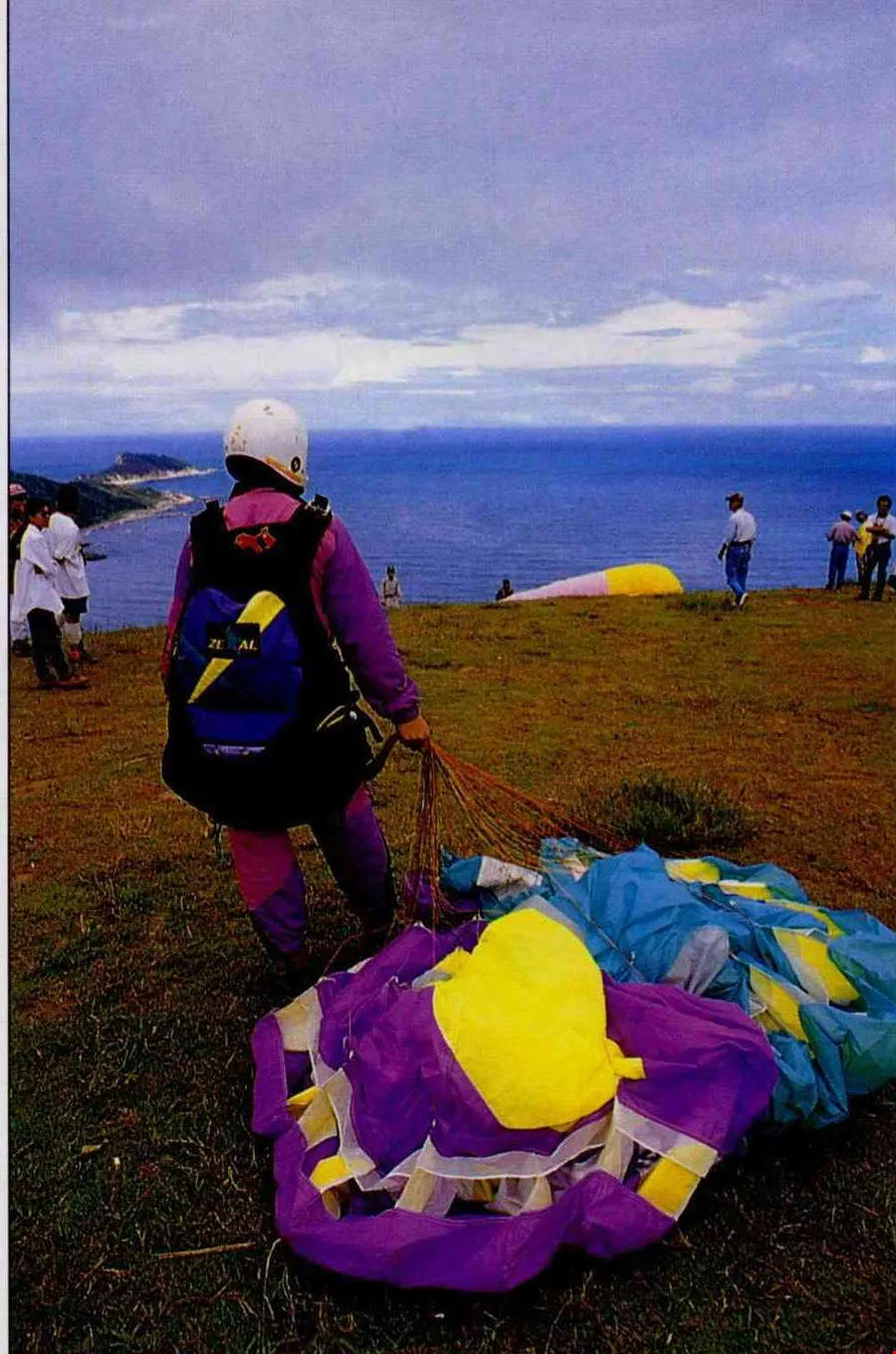
The "wriggled up" chute is temporarily packed away, waiting for the chance to spread its wings.
@List.JPG?w=522&h=410&mode=crop&format=webp&quality=80)


