A Look Back at the Songshan Tobacco Factory
Chen Hsin-yi / photos Jimmy Lin / tr. by Jonathan Barnard
August 2009


The Songshan Tobacco Fac-tory was built in the 1930s, near the end of the era of Japanese rule. It was once among the most state-of-the art industrial facilities in Taiwan. For the long period when the government monopolized the sale of alcohol and tobacco, the plant greatly bolstered the national coffers. Then in 1998, due to a variety of factors-including impending reforms that were to open up the cigarette market to imports and turn the Taiwan Tobacco and Wine Monopoly Bureau into the Taiwan Tobacco and Liquor Corporation-the factory closed. Despite occupying a large expanse of real estate in expensive East Taipei, the site was left unused, and the offices and residences under the old smokestacks stood derelict and deserted, visited only by bugs and birds. Green and lush and overgrown with plants, the site began to be looked upon as precious open space within the urban jungle.
Bizarrely, as a result of the twists of fate that have befallen the "Taipei Cultural and Athletics Park" plan, the site remains empty down to the present day. At the beginning of this year, the BOT (build, operate and transfer) plan for a large domed stadium on part of the site entered the stage of urban design review and environmental impact assessment, so that the location is once again busy with human activity. Elsewhere on the site, the restoration of the old buildings is underway, so it would seem that it is soon to return to magnificence.
While the Songshan Tobacco Factory gets its makeover, let us stop and gaze backward through the spiraling smoke of history. Let us investigate the significance of this unusual space, which has generated so much controversy and speculation.
Most Taiwanese have vivid recollection of the slogan "smoking a cigarette after a meal makes you as happy as an immortal," but few have any memories of the Songshan Tobacco Factory during its years of operation, even though it was where most of the cigarettes were processed when the government had a monopoly on tobacco here.
Back then only a few outsiders were ever permitted inside for a look. In the 1950s, the "model factory" was an important stop on the tour given to official government visitors, both Chinese and foreign, and to "anti-communist knights" (defectors from the mainland). Women factory workers would even come out to welcome visitors and present them with flowers. Horticulturalists would also tour its whimsical baroque central garden. And in the 1980s, before development of the Xinyi district had begun, the high smokestacks at the factory served for years as an east Taipei landmark.
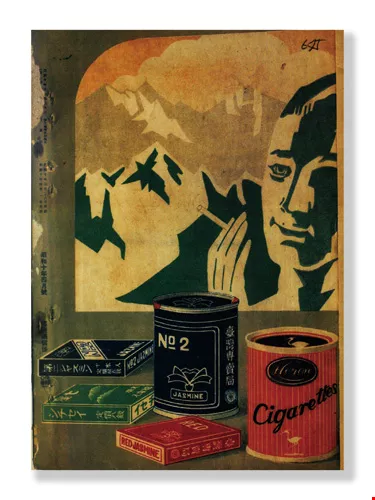
(above) A cigarette advertisement designed by the monopoly bureau of the Governor-General's Office during the era of Japanese rule. Back then the factory's cigarettes were packaged in different brands, depending on whether they were being shipped abroad or marketed to Han Chinese, the armed forces (below), or Taiwanese Aborigines.
A secret garden
In July of 1998, factory staff said their reluctant goodbyes, and the plant formally closed. At the end of the year, the "Taipei spaces investigation team" organized by Yaoshan Cultural Foundation, invited legislators, historic site preservationists, and urban planning designers to come together to make on-site surveys of three large industrial sites in Taipei: the Songshan Tobacco Factory and the Taipei First Winery (now the Huashan Art District), neither of which were still in use, as well as the Jianguo Brewery, which was still in operation. The idea was to take suggestions about how to handle these large expanses of public land in Taipei. It was the first time that modern-day citizens of Taipei and members of the cultural community had entered the tobacco factory's big gates. The tours lifted a veil of mystery from the site.
Among the three locations, the tobacco factory was largest at about 18 hectares (180,000 square meters, about 70% as large as DaAn Forest Park). The original buildings were still in good structural and cosmetic condition, and the site had the most strikingly beautiful gardens. It made a big impression on the visiting experts and cultural figures.
As architecture expert Wu Kuang-ting describes it, the facilities, emptied of machinery, resembled "the elegant residence of a noble family that had once enjoyed a golden era." Everywhere you turned, you saw lush foliage, vines and parasitic plants. "The trees, water, earth and architecture here appear as if they have been fashioned by time into mutually supportive and symbiotic relationships," exclaimed Yang Shizhi, an artist. The art critic Huang Haiming made the following comparison: "The Songshan Tobacco Factory doesn't require many changes. It is a place well suited for strolling and thinking, and it has high potential as a general arts village. In comparison, the Huashan Art District is much rougher and has the look of abandoned ruins, so it is better suited as an alternative and youth-oriented arts space."
Those urban planning and architecture experts who participated in the tour (including Ye Tingfen, Li Qianlang, Shiue Chyn, and Wu Kuang-ting) were happily surprised by what they saw. Independently, they all came to the same conclusion: Taipei, with its high population density, most needed open space. Consequently, to improve the city's quality of life, they argued, the Songshan Tobacco Factory, Jianguo Brewery, and the Huashan Arts District should all be preserved as much as possible as green open space, rather than opened up for consumer-oriented commercial development.
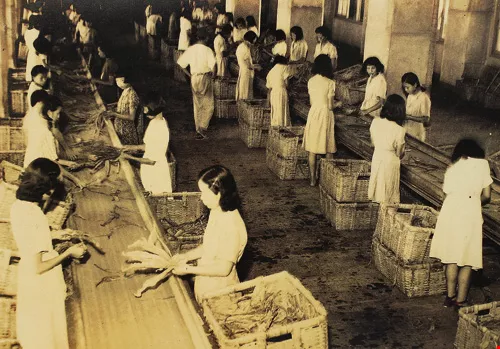
During the Japanese era women on the first floor would process the tobacco by hand. This was the first step in producing cigarettes. The purpose was to rid the tobacco of sand, dirt and dust, and to remove large veins from the leaves.
Industrial archeology
In fact, as early as 1986 the Executive Yuan had proposed turning the Songshan site into the "Sun Yat-sen Campus," which would hold a national history museum and various other government agencies concerned with culture and history. Back then little thought was given to the preservation of industrial sites. Consequently, the proposal was to tear its structures down and rebuild. The plan resurfaced during Huang Ta-chou's term as mayor in the early 1990s, but no formal decisions were taken.
Then, in 1990, with the huge success of Taiwan professional baseball's first year, many began to call for the creation of a "big egg"-a large domed stadium-for baseball games. The Taipei mayoral administrations of Chen Shui-bian and Ma Ying-jeou both viewed the tobacco factory site as the best location for a big dome. In 2001, despite vocal opposition from both local residents and historic preservation and urban planning experts, the decision was finally reached to build the 40,000-seat Taipei Dome on the site, while also reserving part of the site for historical buildings. This was followed up by surveys, measurements and analysis related to historic preservation, carried out in order to extend and transform the life of the old tobacco factory buildings.
These surveys and reports, though differing in the details, are alike in their basic character. They have a highly nostalgic flavor to them, and there is even something a little utopian in the way that planners and designers from various eras have invested this "modern" facility with their ideals. Becoming an "historic site" hasn't reduced its charm. To revisit and explain the history of the Songshan Tobacco factory, is also to invoke the cultural and social landscapes of the modern era.
Let our tour through the history of the Songshan Tobacco Factory begin!
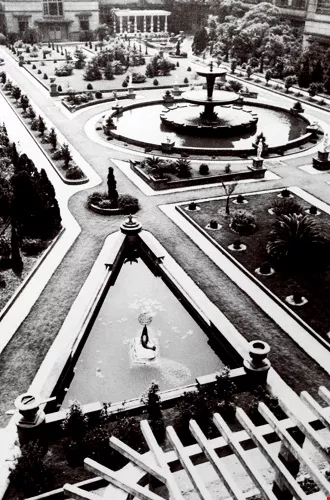
The central garden of the Tobacco Factory was completed in 1958. It adopted a geometric design. At the very center of the garden was a three-level fountain, surrounded by four triangular-shaped pools. Statues of seals, penguins and pelicans still remain. (the photo on the facing page, showing the garden's original appearance, is courtesy of garden designer Lin Yuanlang.) Originally the plantings were neat and clipped, but over many years they have grown into a thick and lush forest (above). The statue to the side of the pool is said to have been based on one of the factory's workers, who was used in place of the Western Lady Liberty.
Stop No. 1: The railroad and the industrialization of Taipei
The history of industrialization in the city of Taipei begins early in the 20th century, during the era of Japanese rule, with private factories such as those making soy sauce, soap, ice and sugar. These factories were located mostly within the city, in the neighborhoods of Mengjia and Dadaocheng.
By the 1920s Taipei, home to the Japanese governor-general's office, was the political and economic hub of the island. Taipei was growing dramatically, and various large factories were beginning to appear on its outskirts. These included an alcohol plant and a cigarette factory (on today's Huayin Street), which were operated by the Monopoly Bureau; Takasago Brewery, which is today the Jianguo Brewery; and a textile plant located near today's intersection of Zhongxiao and Fuxing roads. Farther out, you could find a paper mill, steel mill, caustic soda factory and other plants.
The considerations that went into picking a site for the factory were pretty much the same as for any other factory. Industrial plants back then were all located near rail lines, so that large quantities of raw materials and finished goods could be moved in and out quickly. What's more, because factories brought lots of smoke and pollution, they were best located in relatively sparsely populated areas on a city's outskirts.
Yet the Songshan Tobacco Factory would not be built until 30 years later after the government established a monopoly over tobacco distribution. Its creation was closely connected to Japanese ambitions to extend power southward.
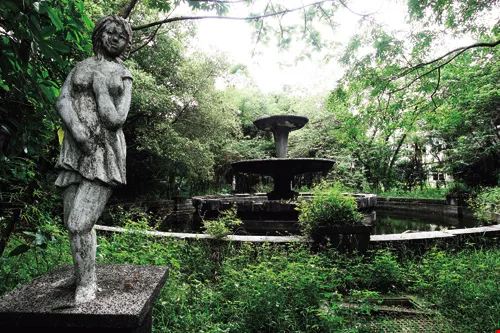
The central garden of the Tobacco Factory was completed in 1958. It adopted a geometric design. At the very center of the garden was a three-level fountain, surrounded by four triangular-shaped pools. Statues of seals, penguins and pelicans still remain. (the photo on the facing page, showing the garden's original appearance, is courtesy of garden designer Lin Yuanlang.) Originally the plantings were neat and clipped, but over many years they have grown into a thick and lush forest (above). The statue to the side of the pool is said to have been based on one of the factory's workers, who was used in place of the Western Lady Liberty.
Stop No. 2: The political economy of the tobacco monopoly
By the late 1870s Europe and America had established leadership in the processing and marketing of tobacco, and they were strongly pushing the import of raw materials and export of finished product. Japan, a latecomer to capitalism, hoped to break those nations' market dominance and stem the huge amounts of tobacco it imported from them. Consequently, it began to promote modern techniques of cultivating and processing tobacco, and in 1904 established a government tobacco monopoly. The following year its colony Taiwan followed with its own law giving the state a monopoly over tobacco. The purpose of the law was to strengthen the financial resources of the governor-general's office. Early in the Japanese era the government would also grant itself a monopoly over opium, salt, camphor, matches, alcohol, weighing and measuring devices, and gasoline.
In 1912, the Taipei Tobacco Factory, which was only one-sixth the size of the Songshan facility, was finished. The Monopoly Bureau no longer contracted out the processing of tobacco products to private companies, and it began to exercise full control over the tobacco process, from cultivation, to research and development, to production and sales.
In 1937, militaristic Japan budgeted the huge sum of ¥2.6 million to build the Songshan plant over three years. It was expected that the plant would be able to turn out 2 billion cigarettes a year. Apart from supplying the Taiwan market, the plant was also expected to supply troops in various areas of Japanese control, including central China, southern China, and the South Pacific.
In 1943, the situation in the Pacific theater of the war had changed, and allied forces began to carry out bombing raids on Taiwan. The Songshan factory, the largest cigarette plant in Southeast Asia, was very fortunate to escape unscathed. When the seat of the ROC government moved to Taiwan after the war, the Taiwan Provincial Government took over the Japanese government's monopoly powers, and named the plant the "Songshan Tobacco Factory of the Taiwan Provincial Government's Tobacco and Wine Monopoly Bureau." What didn't change was the factory's mission to bolster the government's finances.
Production records from 1959 show that the factory produced 5.8 billion cigarettes and 430,000 cigars that year, which equaled half of total provincial demand. Production value peaked in 1987 at NT$21 billion.
During the period of government monopoly, cigarettes had a completely different image from the way they are regarded today as agents of harm, as the "factory song" on a wall of the factory bears witness: "...When talk is flowing smoothly, a cigarette after wine or tea boosts your health. Their sales bolster the national treasury, and sent abroad they bring glory to the nation!"

Stop No. 3: The "industrial village" culture
Apart from fulfilling its national mission, the Songshan Tobacco Factory came out of the "industrial village" movement that was in vogue during the Japanese era, and which still seems quite progressive today. Apart from the factory buildings, smokestacks, and boiler room (the factory's energy source), the site also included a small hospital, daycare center, nursing room, dining hall, library, and community center. It used these humanistic spaces to raise working efficiency.
Occupying more than 160,000 square feet, from the air the factory looked like the Chinese character ri ( ) for "sun" or "day." It's a modern two-story reinforced concrete structure, with large expanses of glass windows, high ceilings, and a looped shape that is uniquely suited to tobacco production. It creates a feeling of cleanliness, discipline and order.
During the Japanese era, the staff numbered 1,400, with a ratio of Taiwanese to Japanese of 5:4. The ratio of men to women was 1:4. The 60-plus managers were almost entirely Japanese, and living accommodations on the factory grounds were reserved entirely for Japanese. Taiwanese could only fill lower-level positions.
What's more, because the cutting, rolling and packaging of cigarettes left a strong scent of tobacco on the workers and created a lot of sticky tobacco dust, there were separate men's and women's baths for workers to use before and after their shifts. The plant's boilers provided them with hot water. Back then this amenity was quite a luxury.
Since the revenues at the tobacco factory were so good, a job there was widely regarded as a "golden rice bowl." Many workers described working at the plant as like being part of a big family. Many got married at the factory and gave birth to children there. The children grew up in the factory's nursery and daycare center. Fruit trees were planted in its gardens and fish were raised in its pools. Former workers remember fondly the field day held once a year at the factory's track.
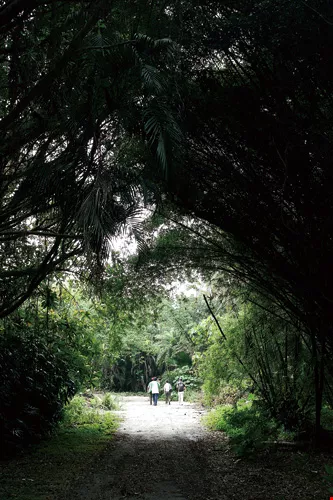
Entering this "secret garden" in east Taipei not only offers a chance to learn about human history; it also prompts visitors to revel in the glories of nature.
Stop 4: Dream of a city-center stadium
At the end of the 20th century a fashion for large domed stadiums spread from America to cities around the world. Development of this nature was regarded as helping to create business opportunities and adding to the variety of leisure experiences available in cities. Moreover, it was also connected to efforts to host international competitions and to growing domestic interest in sports.
Take, for instance, the Tokyo Dome, Japan's first domed stadium, which can hold 55,000 spectators and is home to the Yomiuri Giants, a baseball team. It is the only large arena in central Tokyo. To make it easier to crowds to scatter, it has been placed at the intersection of three mass transit lines. The facility includes an amusement park, a skating rink and a theater. Since its opening in 1988, it has achieved high rates of use, and has been very profitable.
Something else to consider: all of the case studies show that in order to lessen the impact on area transportation, large amounts of money must be spent on public facilities, and comprehensive planning must be carried out ahead of time. There are also a few domed stadiums with retractable roofs. These help to meet people's desire to see "grass and sky" when watching baseball, but this amenity comes at a high price.
The craze for domed stadiums in Taiwan began in the early 1990s. In the years previous, ROC teams had performed with great success in international amateur competitions. In 1990 a professional league was formed in Taiwan. At first the championship games would tour different stadiums in northern and southern Taiwan, and baseball fans in each locale would go wild-it was all very exciting. Then shortcomings in the design of the stadiums and the stoppage of games because of rain received greater attention, and then ROC President Lee Teng-hui expressed the wish for a large domed stadium suitable for professional baseball.
Many years passed without a site for the domed stadium being determined. In the period that Ma Ying-jeou served as Taipei's mayor, the plan for a domed stadium on the Songshan Tobacco Factory site finally received central government approval, with plans for an indoor stadium that could hold 40,000 people, as well as conference rooms, an exhibition space, a library, a multimedia room and workout spaces that would be open to the public on ordinary days. In the plan, 7.1% of the land was to be saved for commercial use, with hotels, restaurants and retail establishments permitted.
This plan, which was thought to hold great potential, kept getting delayed. After Taipei 101 had already been the world's tallest building for six years, after the "small egg" of the Taipei Arena and the renovated Taipei Gymnasium had already opened to great fanfare, the "big egg" has remained mired in delays, and the plan to construct it remains one of the most controversial issues for the Taipei City Government.
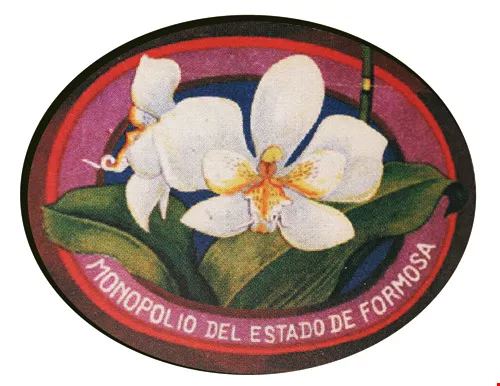
The photo at right shows the label of a cigar produced during the Japanese era, when the Governor-General's Office held a monopoly over tobacco sales. The white flower is a tobacco flower.
Stop No. 5: The city's last expanse of Green Space
It is hard for people to imagine that when the Songshan Tobacco Factory was built, it was surrounded by rice fields and wetlands. Over the course of half a century, eastern Taipei, which has become known as the city's second center, turned into a concrete jungle. In comparison, in the years right before the Songshan Tobacco factory closed, its grounds were largely allowed to return to nature, and after it shut down there was even less human disturbance. The old plantings mixed with later arriving volunteers to create a biologically diverse ecology.
According to a survey of the site's ecology carried out by the Taiwan Nature Trail Society, more than 10,000 years ago this was a marshy area with pioneer plants such as Chinese hackberry, elephant's ear, and paper mulberry. The report provides people with an understanding of the natural history of the Taipei Basin. The site now includes more than 80 plants, ranging from tropical to temperate zone species. Some 1700 trees grow on it. Among these, small-leaved barringtonia, sweetgum, and varieties of palms are most numerous. All in all, the Songshan Tobacco Factory site is eastern Taipei's largest "green island," and it's also the first "relay station" for the natural environment from the Nangang Hills to extend into Taipei City. Consequently, the report recommends leaving the site a mix of historic architecture and natural ecology, which could lay the foundation of Taipei becoming an eco city.
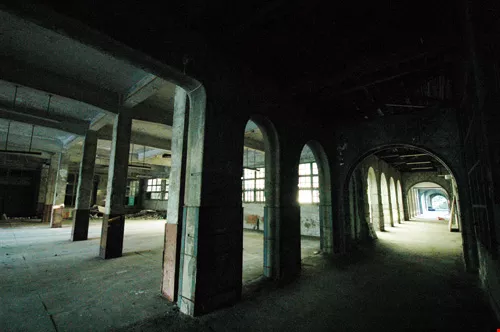
Amid the vibrant urban bustle of central Taipei lies a wild and beautiful secret realm: the Songshan Tobacco Factory. The photo shows its No. 4 Warehouse, which was used to store unprocessed tobacco. Although old and left vacant for many years, it is still in good structural condition.
A memo to future prosperity
Old factories have always been regarded as sites that are full of potential energy. Though they may appear to be empty and abandoned, they are capable of stimulating much imagination and reflection. Looking back at the varied schools of thought regarding the future of the Songshan Tobacco site at the end of the 20th century, many were rooted in rising conceptions of urban citizenship and cultural stewardship and in the idea of using the site as an experiment to see if deindustrialization could progress into the cultural transformation of industry. There are important lessons here for Taipei and for all of Taiwan about the preservation and large-scale redevelopment of industrial sites.
In reality, the tug of war between the "cultural ecology" and "sports and leisure" camps was resolved by dividing the site into two major areas: a "cultural park" (operated by the city's Department of Cultural Affairs and comprising 7.2 hectares) and a "sports park" (operated by the Department of Education, and comprising a total of 10.8 hectares). At long last, the restoration work on the historic structures has begun. Now, the cultural preservation challenges being faced are not matters of restoration technique but rather involve coping with the scale of the dome and traffic flows, as well as preserving plants and scenic views.
In order to lessen the burden on government finances, the Taipei City Department of Cultural Affairs has also designated a 1.2 hectare area of the site as a "non-historic zone." It's where warehouses Nos. 6 to 15 now stand. Under a build, operate and transfer (BOT) contract, the structures will be torn down and new ones built in what is being called a "cultural and creative industry resources base." Cultural facilities, hotels and commercial structures will all be permitted. And money will be collected from the firm awarded the BOT contract for restoration and maintenance of the six-hectare historic preservation zone.
The Department of Cultural Affairs plans on establishing a "Taiwan Design Hall" there, which will include live-work spaces for designers and design labs. The hall will also offer cultural and creatively oriented courses. It is scheduled to be formally opened at the 2011 IDA World Congress, which will be held in Taipei.
As for the athletics park, its progress has been stalled, and the environmental impact assessments and urban planning reviews still haven't been completed. The outcome for this portion of the site will end up determining to a great degree whether the outside world views the rebirth of the Songshan Tobacco Factory as a success or a failure.
For 10 years we have been waiting for a turning point that still hasn't arrived. We can only hope that the Songshan Tobacco Factory site will see a revival of its fortunes-and, more generally, that historical sites in urban corners throughout Taiwan will be given new leases on life so that they can help to achieve the dreams of a civilized society.
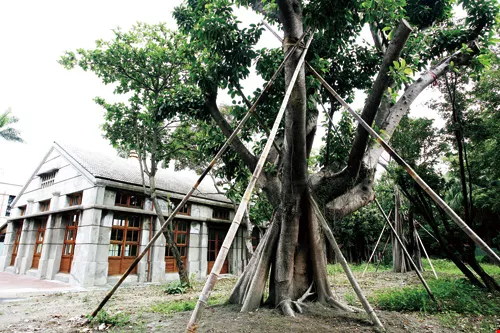
Early this year, the machinery workshop was the first part of the factory to be completely restored. It was responsible for repairing the factory's machine parts as well as its wooden furniture, doors and windows. The two large-leaf banyan trees on either side of the workshop are its new companions, transplanted from the "sports park" area of the site.
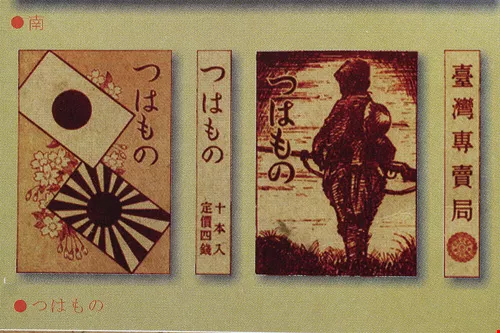
(above) A cigarette advertisement designed by the monopoly bureau of the Governor-General's Office during the era of Japanese rule. Back then the factory's cigarettes were packaged in different brands, depending on whether they were being shipped abroad or marketed to Han Chinese, the armed forces (below), or Taiwanese Aborigines.
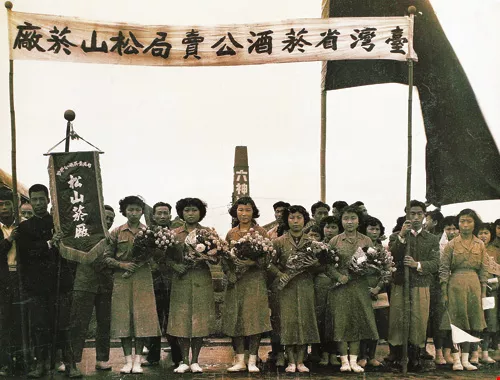
In the 1960s the beauties of the Songshan Tobacco Factory welcomed some "anti-communist knights" (defectors or refugees from mainland China).

@List.jpg?w=522&h=410&mode=crop&format=webp&quality=80)


@List.jpg?w=522&h=410&mode=crop&format=webp&quality=80)
@List.jpg?w=522&h=410&mode=crop&format=webp&quality=80)
