

When Matsu March Madness arrives, Empress of Heaven Temple in the Pescadores holds its water-borne procession, and believers going to the Chen Lan Temple of Tachia Township and the Matsu Temple of Paishatun wind across the Chianan Plain. They come by car or by foot, devotedly following the Matsu palanquin and praying for help and protection. Matsu is like everyone's grandmother, and the burgeoning number of supplicants, the financial power, and the activities of her temples far outstrip those of the run-of-the-mill deities.
Since permitting visits to mainland China, many temples have contended to host Matsu icons from the original Matsu Temple at Meichou, Fukien. Each statue brought over to Taiwan shows a demure, adolesent goddess, dressed in embroidered red, with delicate three-inch bound feet. That's completely different from the full-faced, majestic and graceful adult woman that is the Matsu familiar in Taiwan. What's the same is the indspensible pair of fierce-eyed, fanged companion spirits--Chien-li-yen [lit. eyes that see a thousand miles] and Shen-feng-er [ears that follow the wind].
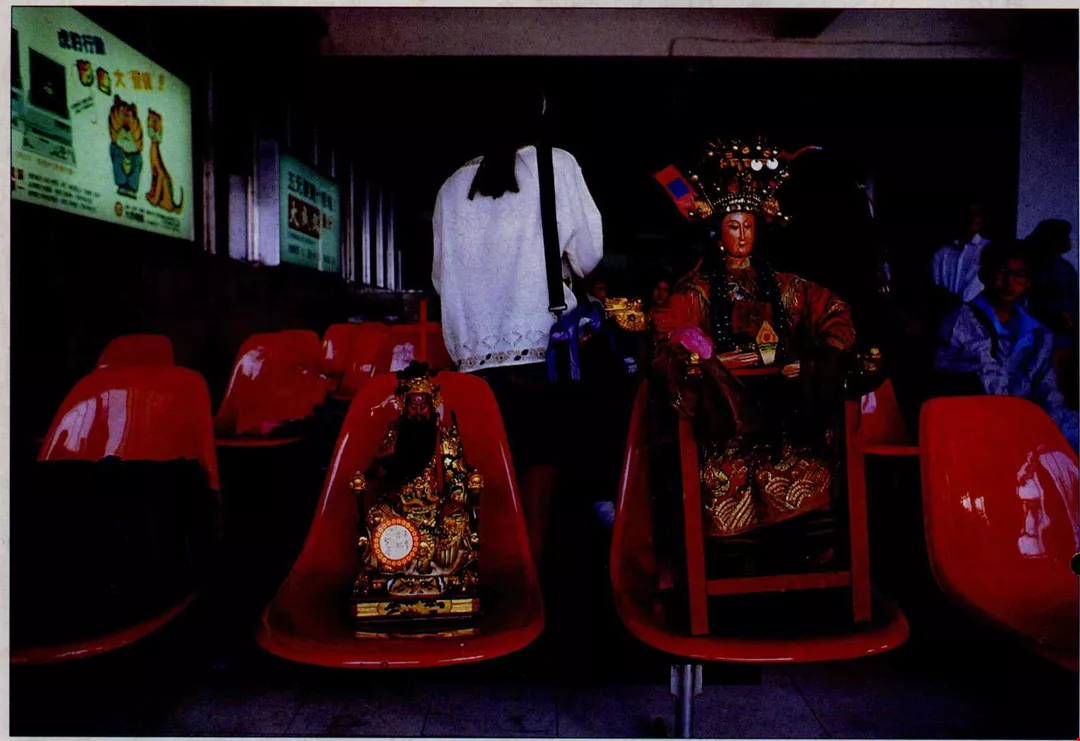
Meichou Matsus which have come to Taiwan from the mainland are younger and more lithe than the customary Taiwan Matsus. They are carved according to Matsu's appearance upon first becoming a deity.
A quiet girl:
Matsu, also called Sacred Mother in Heaven, is of the Taoist pantheon. Thus there are only Matsu temples and halls, but no Matsu monasteries or nunneries. Still, legend has it that Matsu's mother was impregnated by a concoction from the Buddhist goddess Kuan Yin, or that Matsu was actually Kuan Yin appearing in human form.
Though Matsu may be associated, like other gods, with "Sacred" and "Heaven," Matsu originally was part of the mundane world of men. The Meichou Matsu is done up in the same dress and makeup as that worn by young girls a thousand years ago.
In the first year of the Chien Lung reign of the Sung dynasty (960 AD), the Lin family of Putien in Fukien Province had a girl. Because she did not utter a cry or scream in the months after she was born, she was called "the quiet little miss." It is said that she could swim free of cares in the sea in weather both fair and foul. Thus people said she was a female dragon, or a transmogrified goddess of the sea.
When sixteen, standing by the side of a well, the "quiet little miss" had her divine inspiration, and from then on had supernatural powers. She could ride the ocean waves on a straw mat and turn rice stalks into fir trees to save traders in peril at sea. At 29 (988 AD), on the festival of the 9th day of the 9th month, she said goodbye to her family, climbed a peak outside Meichou and from there rode the wind, ascending into heaven. The villagers immediately set up a memorial to worship her, and called her the "virtuous spiritual-medium maiden."
Because Matsu never married, many tales of romance have been attached to her legend. The strange beasts Chien-li-yen and Shun-feng-er ended up becoming Matsu's servants after failing to coerce her into marriage, becoming the generals opening the road before her. And the fact that it always seems to rain on the morning of Matsu's birthday procession is because Lord Paosheng, having failed in his pursuit of Matsu, is intentionally trying to wash away her rouge.
Legends and myths about Matsu's family could fill a volume. What's interesting is there are few records from the era in which she was born, nothing but a few simple descriptive lines. But by the end of the Ming dynasty, almost 700 years later, even her ancestors from the Tang dynasty, seven generations previous to hers, were coming out of the woodwork. There were also many records of the routine things of her life, such as her upbringing and education. Lee Feng-mao, a researcher at the Institute of Chinese Literature and Philosophy at the Academia Sinica, describes this type of development as "starting with nothing and filling in the information later."
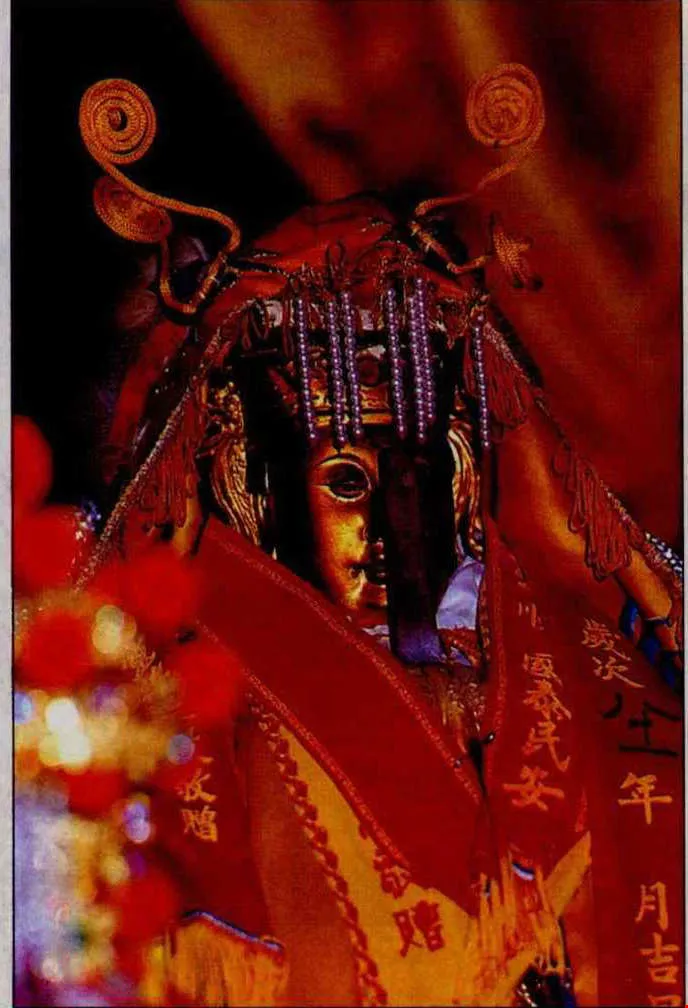
There are powder-faced, black-faced and gold-faced Matsus. The gold-faced ones represent the dignity and honor of achieving Taoist perfection.
A parade of seafood:
In early fishing villages, one look at the size of the Matsu Temple would tell you whether the haul of fish in this village has been good or bad. Matsu has always been the deity in whom fishermen have had the greatest faith; she not only protects vessels at sea, she governs the oceans. It is said that each time Matsu's birthday comes up, sea creatures large and small, even whales, will swim near to the Empress of Heaven Temple in the Pescadores to pay their respects. There is also a legend that when the Matsu Temple at Kuantu was completed, 10 million sea creatures paraded up the Tamsui River to pass by the front of the temple in review.
The deified Matsu was originally only worshipped in the area around Putien. Because most of the people who lived in that area were fishermen, plus the many anecdotes of divine manifestations which saved those in peril at sea, Matsu gradually evolved into the patron deity of navigation. Following behind sea travel, exploration and colonization, faith in Matsu spread across the whole country and beyond. Tracing the development of the cult of Matsu would also end up depicting a maritime history of China.
Under the Southern Sung, the southeast coast of China became the main point for interaction with the outside world. The construction of the northsouth Grand Canal under the Yuan dynasty included holding prayer ceremonies at Matsu temples along the way, so that Matsu spread from the south to northern China and Shantung. Although there was a ban on sea travel under the Ming dynasty, not only did the great armada led by Cheng Ho rely on Matsu to bring together the mostly Fukienese sailors and soldiers to take the risk of crossing the oceans, she followed Cheng's footsteps, setting down in Southeast Asia. And embassies to tributary states brought Matsu there as well; today there are temples to her in Okinawa and in Nagasaki.
During the flood of immigrants out of China at the juncture of the Ming and Ching dynasties, Matsu was placed at the highest point on the ship, and called the "figurehead Matsu," leading the first Han Chinese to cross the "Black Moat" (the Taiwan Strait) to the Pescadores. The place name of Makung, today the main town in the Pescadores, comes from the words for "Matsu Temple." Now-old temples were also situated in Luerhmen, Peikang, Lukang, and Kuantu.
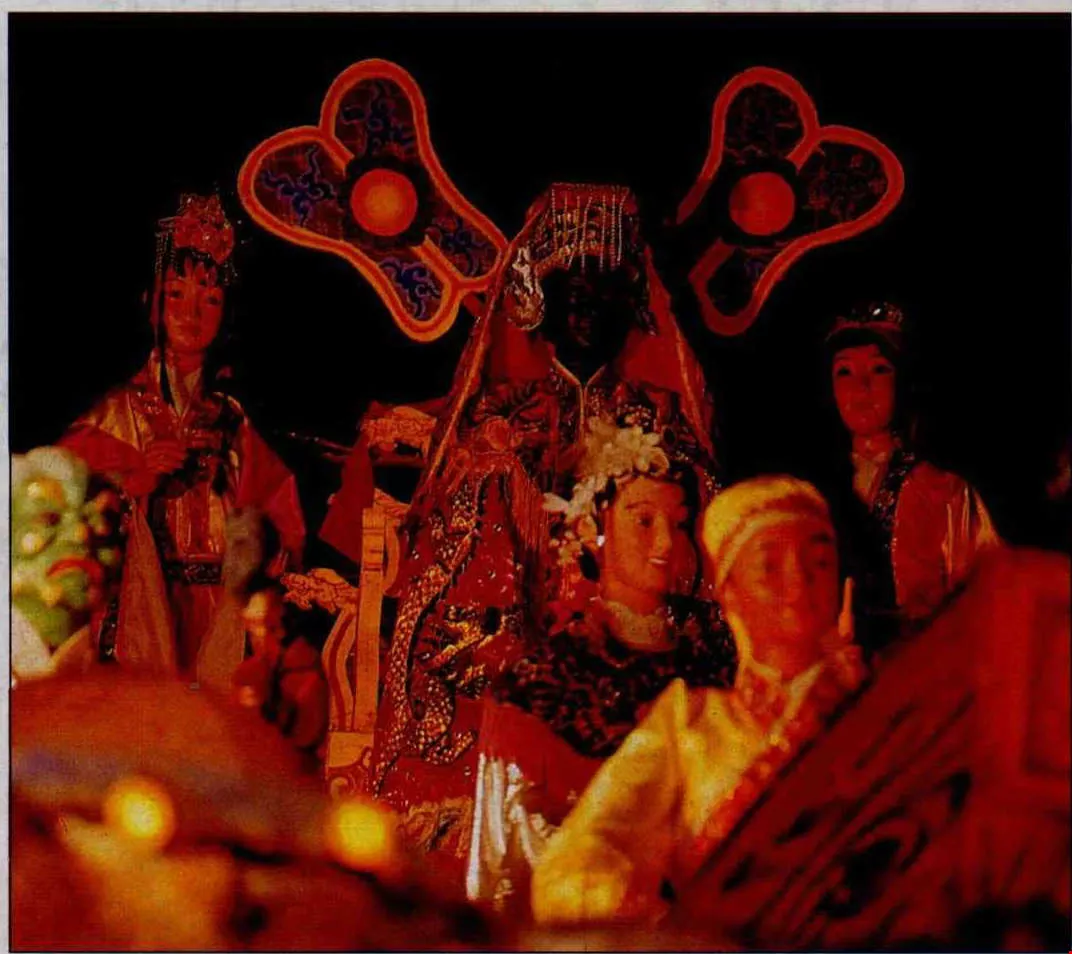
At the Taipei Lantern Festival, every large temple sponsored a large lamp display. The photo shows the black-faced Matsu made by the Sacred Mother Temple of Tucheng.(photo by Diago Chiu)
The Goddess of Peace in the Taiwan Strait:
"The main reason why Matsu has risen above ordinary deities, especially other sea gods, is political intervention by successive dynasties," argues Tsai Hsiang-hui, a professor in the Department of History at Chinese Culture University, who has written the book, Wang Yeh and Matsu in Taiwan. For example, both the Great Empress of Heaven Temple in Tainan and the Chiu Tsu Temple in Lukang were built by the Ching dynasty and patronised by Shih Liang, the top official in Taiwan at that time.
After Matsu's calming the oceans and safely shepherding of envoys to Korea starting in the Sung dynasty led to her being given a wooden tablet inscribed with the title "Smoothness and Assistance," each time ships were to set sail thereafter the goddess would be present. She was consequently given the additional honorifics of "Madame Benevolent Spirit" and "Imperial Consort Benevolent Spirit." The Yuan dynasty suddenly promoted her to be the "Consort of Heaven," putting her well above the other maritime deities in status. By the Ching dynasty, which often put fleets to sea to battle anti-Ching forces and which never failed to appeal to Matsu for assistance to His Majesty's generals, the Kang-hsi Emperor named her the "Empress of Heavenly Kindness," the Chien-lung emperor tacked on "Empress of Heaven," and the Tao-kuang emperor added "Sacred Mother of Heaven." Thus Matsu went from being a virtuous young maiden to being lady, consort, and empress, achieving the highest divine status. By the time of the Hsien-feng reign period, her complete title included 64 Chinese characters for being a guarantor of "protection," "refuge," "courage," "assistance," "sincerity," "safety," "transit," and a host of other qualities. Finally the Board of Rites, finding that this overly-lengthy title detracted from the appropriate solemnity and dignity, brought to an end the continued extension of the titles bestowed on Matsu.
Coming to the Republican era, the Chao Tien Temple in Peikang has a calligraphic inscription from former president Chiang Ching-kuo. Meanwhile, Matsu across the Taiwan Strait, under the impact of intensifying exchanges between the two sides, has acquired a new appellation: "The Goddess of Peace in the Taiwan Strait."
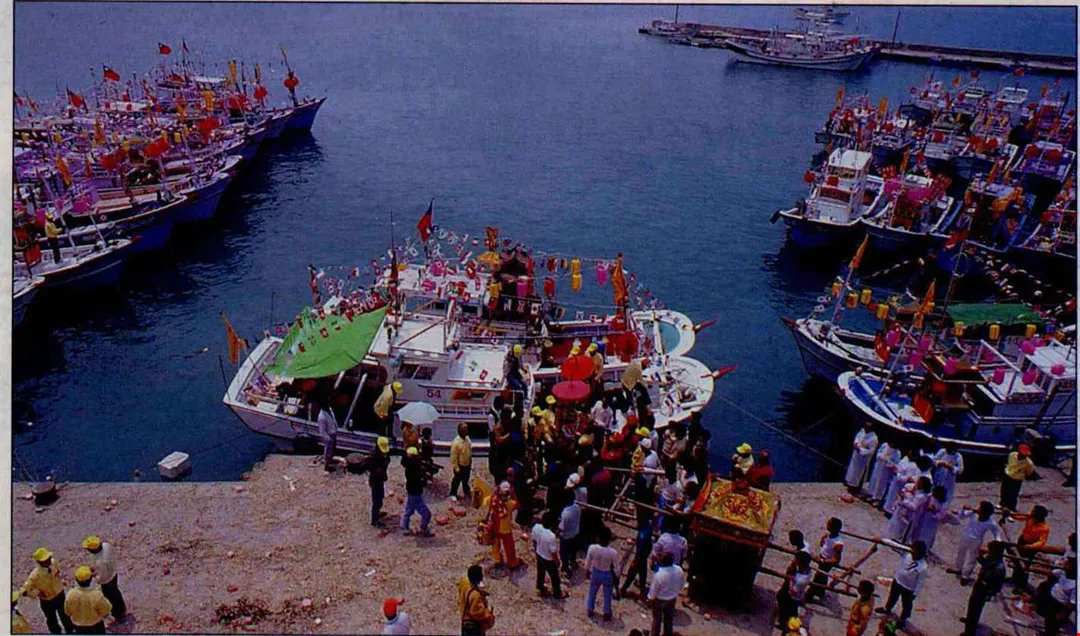
The residents of the Pescadores hold a water-borne procession for Matsu, a goddess of the sea, to ask for safe navigation and abundant seafood harvests.
Compare--who's bigger?
Once immigrants got ashore, they no longer faced the pounding waves, but epidemics and natural disasters followed one after the other. Just as natural mothers seem omnipotent, Matsu's maritime nature gradually became obscured, until she became an "omnipotent deity" on land as well. During the early period of agriculture, people believed that rain would evitably follow behind the procession during the period of worship and water the sprouts just popping up; this was also thought to dispel infestation or disease. In the Kuang-hsu imperial reign in the Ching dynasty, during the great Chiayi drought, local officials didn't eat meat for three consecutive days, praying to Matsu to bring the seasonal rains. Thus in the Chao Tien Temple in Peikang there is a wooden plaque inscribed, "Waters of Kindness."
As the number of believers grew, temples were established in droves by virtue of bringing Matsu icons or incense from one already in place. With those in charge of some temples erroneously raising the "value" of the goddess, there evolved a distinction among Great Matsu, Second Matsu, and Third Matsu; divided between gold-faced, black-faced, and powder-faced. Separation into Great Matsu, Second Matsu, or even more, originally came from a convenient way for the temples to distinguish among the many images therein; who would have expected it would imply a competition between them? As for the black-faced Matsu, this arose because long periods of burning incense turned the powder-faced Matsu ebony, and is nothing like the case of other deities who have black faces because they took toxic concoctions to become divine. Whatever the case may be, it has come about that the powder-faced represents kindness, the black-faced represents rescue or refuge from peril, and the gold-faced is to command the appropriate amount of respect. It seems there is some hierarchy among them, and in order to stay in good with customers shops that sell religious paraphenalia had to begin selling Matsu with face already blackened.
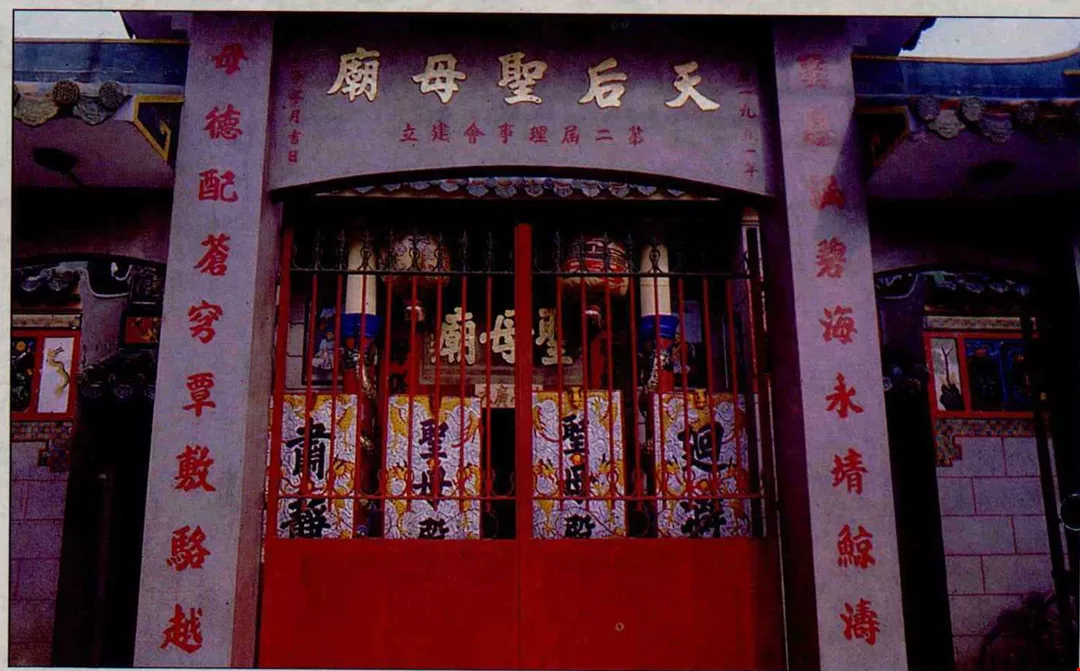
Worship of Matsu followed immigrant waves to all lands in Southeast Asia. The photo shows the Matsu Temple in Ho Chi Minh City, Vietnam. (photo by Huang Li-li)
We were here first:
There is not only comparison among deities, there is competition among temples as well, and every Matsu temple has its twin. Thus the Great Empress of Heaven Temple in Tainan and the Empress of Heaven Temple in Anping are vying for the title to be the earliest temple in Taiwan to bring Matsu ashore. The Empress of Heaven Temple of Lukang has also joined the fray. The Sacred Mother Temple of Tucheng and that of the same name in Luerhmen both claim to have the original Matsu brought to Taiwan by Cheng Cheng-kung (Koxinga). The Chin An Temple and the Nan Tien Temple in Suao have been at each other for years.
Methods of combat range from hiring scholars to find historical verification for their claims to competing to add to their own importance by bringing an icon from the mother temple in the mainland. Those who don't go to the mainland figure that mainland temple facades and statues are actually all newly made, and the right thing would be for them to come to Taiwan to "pick up the ancestral thread." As a result, while there are extensive celebrations in mainland China for the 1,000th birthday of Matsu, on this side there will be an extravagant procession of Matsu around all of Taiwan, welcoming all the Matsus in Taiwan to come together to emphasize the local roots Matsu has set down here in the last 300 years.
When topics of dispute pass, if no new ones arise, and the leaders of some of the temples stop constantly thinking about their place in the hierarchy, each begins to show its own special features. Lukang's Matsu temple has a cultural center, the one at Tachia a library, Peikang has a hospital, while the Luerhmen temple is in the midst of a cultural festival. If the bickering can be stopped, and be replaced by a civilized rivalry among cultured gentlemen, that would make the temples, the faithful, and, no doubt, Matsu herself quite happy.
[Picture Caption]
p.100
(photo by Huang Li-li)
p.102
Meichou Matsus which have come to Taiwan from the mainland are younger and more lithe than the customary Taiwan Matsus. They are carved according to Matsu's appearance upon first becoming a deity.
p.103
There are powder-faced, black-faced and gold-faced Matsus. The gold-faced ones represent the dignity and honor of achieving Taoist perfection.
p.103
At the Taipei Lantern Festival, every large temple sponsored a large lamp display. The photo shows the black-faced Matsu made by the Sacred Mother Temple of Tucheng.(photo by Diago Chiu)
p.104
The residents of the Pescadores hold a water-borne procession for Matsu, a goddess of the sea, to ask for safe navigation and abundant seafood harvests.
p.104
Worship of Matsu followed immigrant waves to all lands in Southeast Asia. The photo shows the Matsu Temple in Ho Chi Minh City, Vietnam. (photo by Huang Li-li)

@List.jpg?w=522&h=410&mode=crop&format=webp&quality=80)


