Paradise Lost—Tough Times for Taiwan Agribusiness in Hainan
Sam Ju / photos Jimmy Lin / tr. by Jonathan Barnard
August 2012


Land is the mother of agriculture. Twenty-some years ago, Taiwan agribusinesses brought money, plant species and techniques to the PRC’s Hainan Island, leased large tracts of land and began to harvest high-quality fruits: mangos, rose apples, longans, bananas, papayas, and so forth. Those farmers have already made quite a name for themselves. But with the local government taking back leased land, what should these Taiwanese farmers do?
Were they in Taiwan, these investors in Hainan agriculture would be known as agribusiness “magnates” or “experts,” but in Hainan they keep a low profile, only occasionally appearing in newspaper reports about land disputes. Most of the time, they can be found quietly working away on farms that aren’t as big as they used to be, preparing land, weeding, grafting trees and picking fruit with their hired local hands. They pass their time at these activities, day after day, year after year.
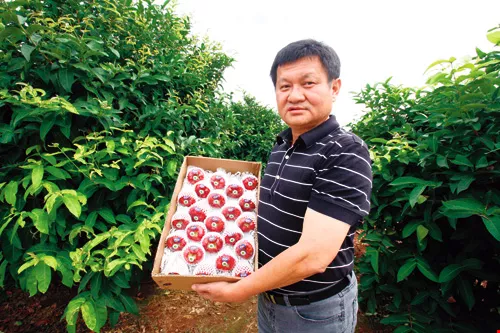
Taiwanese agribusiness brought techniques that revolutionized fruit growing on Hainan Island. The photo above shows Taiwanese farmer Huang Yifeng displaying ‘Black Vajra,’ a variety of rose apple introduced from Taiwan. The inset photo shows ‘Jambu Madu Red,’ a large-leaved variety introduced from Indonesia.
Sanya, the most tropical of Hainan cities, saw development start from Sanya Bay, Dadonghai, and Yalong Bay, before it turned northeast toward Haitang Bay. Traveling along that route, you pass one luxury hotel one after another.
In 1990, Huang Jindao, a tea farmer from Nantou, arrived with a plan to plant tea. He found, however, that Hainan’s tropical climate didn’t suit high-quality Taiwanese tea. On the other hand, pig farming, though uncommon on the island, was well suited to the climate. Consequently, he changed his plans and leased 80 some hectares to raise pigs. At the peak, he was raising 13,000 pigs and was the largest private pig farmer in Hainan.
Five or six years after starting, Huang began to run into difficulties. It turned out that profits from pigs were very sensitive to hikes in the cost of materials. The PRC government tightly controlled the price of pigs and simultaneously was giving subsidies to Hainan Luo Niu Shan Pig Breeding, a state-run company. Huang’s pig-farming operation, meanwhile, was battered by falling prices. From yearly earnings of RMB2 million (about NT$10 million), it fell to losses of RMB1 million.
Seeing the writing on the wall, Huang gradually began to shift out of raising pigs, taking 50 some hectares of the farm and turning it into orchards, where he introduced ‘Tainong No. 1’ mangos and ‘Sunrise Solo’ papayas. After a few years, local farmers began planting the same crops, and the wholesale price per mainland catty (0.5 kilograms) fell from RMB7–8 to RMB1. It was devastating.
Constantly introducing new varieties has become a strategy that Taiwanese farmers in Hainan have strictly followed. “Farmers can only hope to make hay for a short while, not for an era.” Huang has realized that no agricultural product can be expected to be consistently profitable over the course of a farmer’s lifetime.
When Huang first decided to shift into fruit, he wasn’t planning on developing new sales channels. In accordance with his usual practice, he sold his fruit at the farm for cash to wholesalers with whom he had long working relationships. They in turn shipped them to the mainland for sale.
Because Sanya has a fully tropical climate, Huang’s longans can be harvested as early as January, and yields peak in March and April. In one day pickings can reach 5,000 kilos.
Huang says that typically 5–8% of what is harvested is of secondary quality. That lower-priced fruit is sold locally.
Yet because their fruit is marketed as “Taiwanese fruit,” some Taiwanese farmers in Hainan have felt uneasy about turning their crops—and their valuable “brand”—over to a wholesaler.
“Because of improper handling by wholesalers or shipping delays, much of the Hainan-grown fruit is in poor shape by the time it reaches consumers in inland areas of the mainland,” says Huang Yifeng, the chairman of Haikou-based Jindefeng, who was elected as the director of the Taiwan Businessmen Association, Hainan in July.
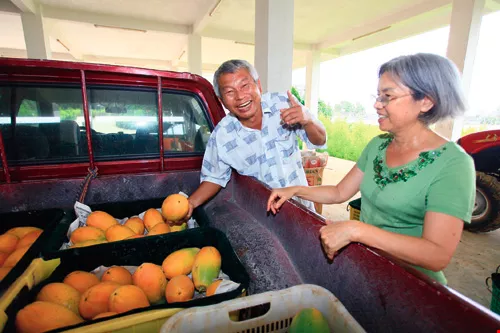
The fruit produced by Taiwanese-operated orchards on Hainan are sold as high-value fruit to mainland markets or to luxury hotels on the island itself. The photo shows Huang Jindao and his wife, with the papayas they grow on their Hainan farm.
Huang Yifeng is well known as the Taiwanese rose apple king, someone whom visiting officials, whether from Taiwan or the Chinese mainland, almost always come to see when they tour Hainan Island. In 1999, back when most mainlanders didn’t even know what rose apples looked like, he planted the Taiwanese variety ‘Black Vajra’ in Wenchang in Hainan’s northeast. He discovered that Hainan-grown rose apples were the equal of Taiwan’s in both looks and taste.
When he established Jindefeng in Haikou in 2001, he had serious doubts about whether he should go all out in growing rose apples.
“The mainland market for rose apples back then was zero,” he recalls. “By planting exclusively rose apples, I felt I was either going to win big or lose big. I figured the odds were 50:50.”
Eventually, the success of ‘Black Vajra’ in conquering the market in Taiwan bolstered his confidence. “In one year 10,000 hectares—the equivalent of 150,000 mainland mu—were planted in Kaohsiung and Pingtung. If that much land under cultivation still couldn’t meet the demand of 23 million Taiwanese, how would my rose apples grown on 1000-some mu not find buyers among 1.3 billion mainland Chinese?”
With that positive outlook, Huang pressed ahead with planting rose-apple trees. His rose-apple orchards only harvested 300,000 catties in 2003, but by 2007, the harvest jumped to 20,000 catties per day. With a wholesale price of RMB15 per catty, daily revenues had reached RMB300,000.
Jindefeng was also the first Taiwanese firm to open a stall at Nanbei Wholesale Fruit Market, Haikou’s largest. “We adopted the strategy of gaining a foothold in satellite cities before attacking the big metropolis,” explains Huang. “From that small fruit stand in Haikou, we sold rose apples to various mainland cities.”
But a few years after ‘Black Vajra’ had conquered the inland winter fruit market, Huang discovered that demand started to weaken.
“Rose apples don’t store well, and shipping took too long,” he says. “By the time consumers got ahold of them, some had already started going bad.” That was the conclusion he came to after he researched the supply chain.
In Taiwan, rose apples are picked in southern fields one day, and brought to wholesale markets the following morning, reaching consumers later in the day. But it takes at least seven days for Hainan rose apples to get into the hands of Shanghai consumers.
Consequently, the bold and decisive Huang, who is about to take over as president of the Taiwan Businessmen Association, Hainan, is preparing to press for improvements on both the production and marketing fronts. The first step is to replace ‘Black Vajra’ with the variety ‘Jambu Madu Red’ from Indonesia, which is cold hardier. The second step will be to establish a fruit shipping company, which will consolidate shipping for all rose apple producers in Hainan and organize harvesting periods for corporate producers, large family farms and small family farms alike, so as to prevent too much fruit from being harvested at the same time.
Huang’s Jindefeng orchard in Haikou’s Yunlong is the largest producer of rose apples in all of Hainan.
“The new variety has Black Vajra’s mouthfeel yet better cold hardiness,” says Huang. “The only flaw is that the leaves are bigger, so that its wind resistance is inferior.” The introduction of ‘Jambu Madu Red’ represents the start of a second rose-apple revolution in Hainan.
In fact, the first person mentioned when talking about who sparked the revolution in Hainan fruits is none other than Hong Zhaoming, who is called the “mango godfather” by local media and has five orchards outside of Sanya that total 4000 mu (270 ha).
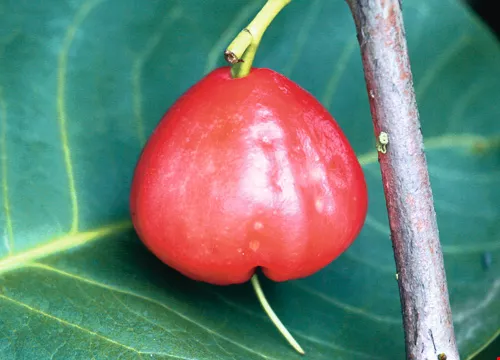
Taiwanese agribusiness brought techniques that revolutionized fruit growing on Hainan Island. The photo above shows Taiwanese farmer Huang Yifeng displaying ‘Black Vajra,’ a variety of rose apple introduced from Taiwan. The inset photo shows ‘Jambu Madu Red,’ a large-leaved variety introduced from Indonesia.
“Among the 1.3 billion mainlanders, probably 600 million have never even tried a mango,” says the 60-year-old Hong, who is chairman of Qianju Baolai Agricultural.
Hong was born to a Tainan farming family. After making an information-gathering visit to Fujian, Guangzhou and Hainan in 1988, he decided to focus on producing “high-end” fruits for the mainland market. Originally he was thinking of planting strawberries, but he was staggered to see that green and brown native mangos would sell for RMB1 at local Hainan markets. “The fact that people spent that much on mangos when local farm workers only earned RMB6 per day showed that there must be strong demand for mangos here.”
Hong didn’t misjudge the market’s potential. Beginning in 1991, he brought various mango varieties—including Irwin, Jinhuang and Keitt—planting them in his Sanya orchards that encompass several thousand mu. To meet demand, he had to employ over 100 workers.
The way Hong sees it, so long as the climatic conditions are right, you can grow any kind of tropical fruit. “I made the right decision!” He discovered that the conditions for fruit growing in Sanya were better than in Taiwan’s Pingtung. With relatively few typhoons hitting shore during the summer months, it was extremely well suited to planting tropical fruit.
During the mango season from February to May, Hong works well into the night picking 60 tons of mangos. The first thing the next morning, they are shipped out for sale at Zhejiang’s Jiaxing Wholesale Fruit Market.
More than 60% of the mangos produced in Hong’s orchards used to be Irwins. Much loved by Taiwan’s consumers, they also found favor in the mainland domestic market for high-end fruit. Unfortunately, high-maintenance Irwins are also prone to black spots and to damage from fungal anthracnose, so they started being replaced with “Jinhuangs.” Nevertheless, mainland consumers have begun to show in the last few years that they truly prefer Irwins, so Hong is preparing to plant some more of them.
“In earlier years Taiwan businesses brought the advantages of new varieties, techniques, capital and marketing expertise,” Hong recalls. “Now the only advantages they really have are their technical and marketing skills.” He explains that large-scale production and reliable quality are still the strong suits of Taiwanese farmers. Consequently, they have more marketing choices.
Short and thin, Hong, 60, carries many battle scars from his 20-plus years of farming in Hainan, years that have been physically and psychologically taxing. Three times he has been imprisoned when falsely accused of legal wrongdoing and told not to leave the country. Within the last 10 years, he has seen 1000 mu of his land expropriated. “When I can’t do it any longer, I’m going back to Taiwan.”
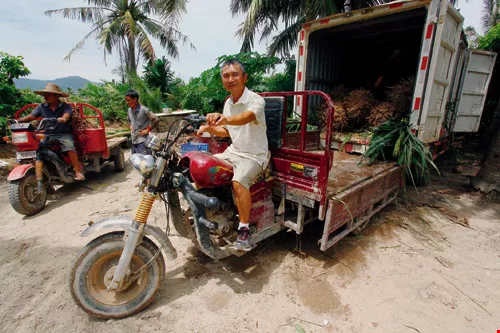
Taiwanese who are farmers on Hainan must wear multiple hats, including those of boss and coworker. The photo shows Taiwanese farmer Hong Zhaoming at work with his hired hands.
The biggest problems for Taiwanese farmers doing business in Hainan involve land.
Tracts of undeveloped land that were regarded as worthless by local government were leased on the cheap 10 or 20 years ago by Taiwanese businesses. The leases typically run for 30 to 50 years. Even though the dates of return are still a ways off, many farmers have nevertheless faced expropriations.
Take Huang Jindao, who farms in Sanya’s Haitang Bay. He is already prepared mentally to have all of his land taken back by the government within five years.
In Hainan’s Taiwanese business circles, there is an open secret that people shy away from discussing: The local government expropriates land, working in cahoots with developers who artificially bid up the price of vacant land and give kickbacks to the officials.
One Taiwanese businessman says: “In Sanya one mu is going for about RMB3–4 million. But even if you have the money, the government, looking at general development goals, might not approve it being leased to you.”
Another Taiwanese businessman, who was unwilling to give his name, says bitterly: “It’s rule of man here. If the political leader responsible changes, Taiwanese businesses must brace themselves to get burned. If the top man says to sell it to you, you can count on getting it. If he says not to sell it, forget about it. It’s what the leader says that counts.”
Because of lease cancellations, Taiwanese businesses in Hainan have almost all been involved in legal disputes. Currently, there are 300-some Taiwanese agribusinesses in Hainan. That’s probably only about a third of the number at the peak.
Without land, farming doesn’t exist. The leases of local land provide the basis for Taiwanese agribusinesses to operate in Hainan. Ahead of that last mu being taken away, have Taiwanese farmers developed good exit strategies?
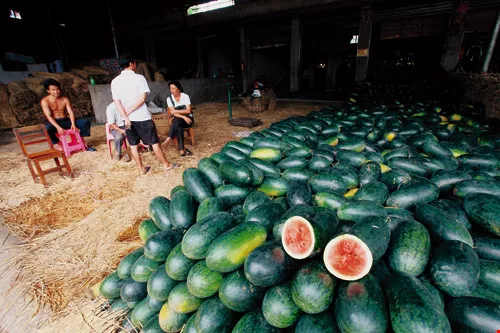
More than 90% of tropical fruit consumed on the mainland come from Hainan. The photo shows the Nanbei Wholesale Fruit Market in Haikou.


@List.jpg?w=522&h=410&mode=crop&format=webp&quality=80)


