

When the earliest Han Chinese settlers crossed the strait and began populating the island of Taiwan, they brought their traditional religious beliefs and customs with them. Even while fighting against typhoons, disease, and each other, they managed to construct many temples and carry out colorful temple festivals, where a mixture of solemn religious fervor and riotous celebrations provided a break from the rigors of the daily struggle for survival. In the process, our forebears left behind a rich historical legacy. We hope that the reports on Taiwan's temple festivals in our "Ethnography Notes" series will bring modern readers closer to their cultural roots.
In the summer of 1845, a typhoon gen-erated a tidal surge along the coast of Yunlin County that inundated several coastal villages near Chinhu. Thousands were killed. Every year since, residents of the area have held shui zang ceremonies to help the "water ghosts" get to paradise. Shui zang ceremonies are normally very private affairs, but in the Chinhu area as a result the disaster they developed into a huge community event. Chinhu is the only place in Taiwan where shui zang ceremonies are carried out on a large scale.
A hot sun glares down from a cloudless sky as a salty sea breeze ruffles the pennants atop row after row of shui zang. The fluttering flags seem somehow animate, as if the ancestors were trying to tell the people of Chinhu of the hardship they experienced when they lived there farming this heavily saline land.
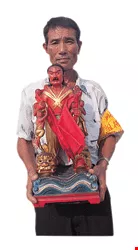
"It's started! It's started!" As water ghosts arrive on the scene, the numerous shui zang become possessed and begin to jump and race about in a frenzy.
Each shui zang stands about chest high and is made of two tubes, one inside the other, with the outer tube covered with a thin decorative paper. The likenesses of the netherworld's twelve "ox demons and snake spirits" are affixed to the various shui zang, which are arranged in groups representing three different levels of the cosmos: the water, the netherworld, and heaven. In the water are the spirits of those who have died untimely deaths, as well as the righteous Water King and the evil Filth God. Representing the netherworld are various greater and lesser errand-running demons, who are in charge during the shui zang ceremonies of escorting the spirits of the dead on their journey to the land of the living and back again. Also on hand from the netherworld is the City God (cheng huang) and various "ox-headed horse-faced demons" (niu tou ma mian). Representing heaven are the Goddess of Mercy and her attendants. Planted in the top of each shui zang is a triangular pennant which serves to beckon the spirits hither.
The Chinese character for zang is a rather unusual one. The term comes from Daoist ritual, and originally meant "spin."
According to Huang Wen-po, an ethnologist who has written extensively on beliefs regarding the afterlife, "They spin the shui zang in order to help the spirits of the drowned people come up out of the water." Shui zang might be called life jackets for ghosts, for they are mainly used in rites aimed at getting ghosts into paradise. Huang notes that in addition to these "water" zang (shui means "water"), people also use "blood" zang (xue zang), which are covered with red paper, to carry out similar rites for women who have died in childbirth.
The Chinhu area is the only place in Taiwan that holds large-scale shui zang rites. They take place on the seventh and eighth days of the sixth lunar month (late August or September) at the main temple (Wanshan Temple) in Hantsailiao and the sub-temple (Wanshanye Temple) in Chinhu's New Harbor district.
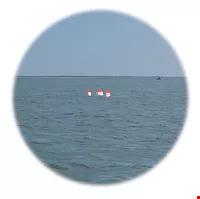
Floating lanterns guide the water ghosts ashore, where they rendezvous with people in the land of the living.
In all there are nearly 4000 shui zang at the two temples, fluttering and wobbling furiously on a stiff ocean breeze. Amidst the rustling and hissing of the pennants, one can almost hear cries of the 3000-plus victims snatched away by the storm that awful day over 150 years ago. A weathered old woman, her head wrapped in a bandana and topped by a conical farmer's sunhat, says: "We'll never forget that horrible day in Chinhu."
In the 17th century, the seemingly endless coastal sand dunes of Yunlin used to have a long, narrow tidal lagoon called Shuling Lake. Chinhu Harbor, known during the Qing dynasty as Lower Harbor, was located at the lower end of the lagoon, where Peikang River and Niutiaowan River emptied into the sea. According to Li Chun-ching, director of the Shui Zang Cultural Center, the Chinhu of that time included present-day Chinhu plus Taitsu, Hantsailiao, Chenglung, Hsinkang, Lower Hukou, and three other villages.
Chinhu is the closest place in Taiwan to the Penghu Islands. The Chinhu harbor was once large and deep, and it offered excellent protection for ships. Thanks to these advantages, it numbered among the eleven top ports in the early days of Taiwan, and the town was a thriving commercial center.
But then in 1845, on the seventh day of the sixth lunar month (July 12th), black clouds suddenly filled the sky and in the blink of an eye unleashed a furious storm. The town's two rivers quickly filled the lagoon, and the overflow combined with the typhoon-maddened seas to form an immense tidal surge that inundated the coastal region.
The entire coast between Huwei River and Peikang River was under water. The flooding was most severe in the vicinity of Chinhu. According to a report on the disaster prepared by a government official, "The coastal land in Lower Hukou and eight other nearby villages is at a very low elevation. Countless victims drowned when the flood waters rolled in."
After the water retreated, boats and homes alike lay in splinters, and dead bodies littered the town. It is written in the General Gazetteer of Taiwan that over 3000 people drowned in the flood, but local residents have always put the number at 7000. Tseng Jen-kou, author of a history of Chinhu, relates that in interviewing old folks in the area over 20 years ago, many of his informants recalled that as children they had often heard their elders say that there was not a single survivor in Hsiatsailiao, while only two or three families in Chutaliao managed to come out alive. Many family pedigrees in the local area also provide evidence of the fearsome loss of life that occurred.
The deluge even came to the attention of the emperor himself, who ordered the imperial granary to ship emergency rice supplies. It was impossible to dig separate graves for each of the victims, so they ended up laid to rest in four large pits. Expressing deep sorrow over the disaster, the emperor declared that the "spirits of the victims would all end up in heaven just like the rest of us." This type of declaration was customary after large disasters in China, for according to a widely held folk belief, the spirits of those who met untimely deaths did not go to heaven, but ended up stranded in the nether-world.
After the flood waters subsided, disease spread rapidly in the unsanitary environment and claimed another 3000 victims. Added to the 7000 deaths that the locals said were caused by the flood, that brought the total to 10,000, thus coinciding with the emperor's proclamation that "the 10,000 victims [meaning "everyone"] would end up in heaven just like the rest of us."

Daoist priests lead a gaggle of people on scooters past fish ponds and over the seawall to invite the water ghosts ashore. The sea is very much a part of life and death to the residents of the salt flats around Chinhu.
The survivors had to face the hardship of moving to new quarters and rebuilding. But local residents faced an even thornier problem. Everyone desperately wanted to know: "Why should we be singled out for such a terrible catastrophe?"
Li Feng-mao, a Kouhu Rural Township native and researcher at Academia Sinica's Institute of Chinese Literature and Philosophy, explains that according to Chinese folk beliefs, an unnatural death is a breach of taboo, and when a large number of people are killed en masse it is a form of punishment from heaven. Luckily for the people of Chinhu, however, a whale happened to beach itself soon after the flood and enabled the creation of a myth that relieved the locals of responsibility for the disaster.
A group of older people sits around in the administrative office of Wanshan Temple in Hantsailiao animatedly relating the mythical explanation of the flood. It turns out that the Jade Emperor in heaven had ordered the Deaf Dragon to send the flood ashore in Tungkang and Ketsuliao, but the Deaf Dragon mistakenly thought the Jade Emperor had said Hsinkang (part of Chinhu) and Potsuliao (near Hantsailiao). Because he had failed to carry out the will of heaven, the Deaf Dragon turned into a whale and beached himself so that the people of Hsinkang and Potsuliao could eat his flesh. Those who had contracted disease were cured completely after eating the whale meat.
Says Lin Kun-lung, deputy chairman of the Wanshan Temple committee, "That whale was for real. If my granddaddy was still alive today he'd be 150 years old, and he used to always say the whale was so big that if you took the two eyes and stacked one on top of the other they'd be as high as a man." An elderly gentleman by the name of Mr. Tsai says that as a boy he once saw a bone from the whale, and it was big enough to use as a post.
"This myth," says Li, "served a couple of purposes. Firstly, it absolved the local residents of any responsibility for the disaster. And secondly, it enabled them to get revenge by eating the whale meat. The tale had a soothing effect, and the spinning of it represented a sort of group therapy."
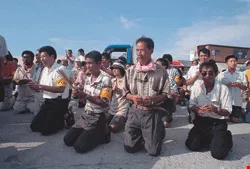
(opposite page) Worshippers kneel, incense in hand, and pray to the boddhisatvas and demon gods to show mercy and set the lonely ghosts free from the netherworld.
A few years after the flood, the people of Chinhu built Wanshan Temple next to the communal grave in Hantsailiao. Later, because many residents moved to the Hsinkang district, a sub-temple called Hsinkang Wanshanye Temple was established. There are many Wanshanye temples throughout Taiwan, but wanshanye is defined uniquely in Chinhu. Everywhere else in Taiwan, it refers to spirits who don't have descendents to pray for them, but in Chinhu the wanshanye, being the ancestors of current residents, do have descendants to pray for them. But "they are regarded as wanshan-ye," says Huang Wen-po, "because no one could identify individual corpses."
The seventh day of the sixth lunar month (July 27th this year) is a bigger day in Chinhu than even the lunar new year. Members of the younger generations come back home from the big cities, and their cars fill every available parking space near the temple and along the streets. A huge outdoor feast takes place, with a cook preparing enormous amounts of food using a huge wok and cooking utensils. Local residents purchase shui zang and bring them to the temple. Upon arriving they sign the names of their family members on their shui zang.
Activity is even more intense inside the two temples, where temporary altars have been set up facing the front gates. A bit after 2 o'clock in the afternoon they bring out censers that symbolize the drowned spirits, then they paint the pupils in the eyes of the deities who are in charge of guarding the drowned spirits. All at once the temple music starts up, with the mournful wailing of the suona and beating of drums and gongs. When the celebrants bring out the censers and beat on the drums, it signals the beginning of the rite to help the spirits leave their watery abode and rise to heaven. The basic purpose of the ritual is to ask the gods to come and offer their assistance.
In spite of the sweltering heat, nearly a hundred people are gathered outside the temple waiting to take part in the highlight of the day's activities: the release of the floating lanterns. At 3 or 4 o'clock in the afternoon, Daoist priests lead the way to the seacoast. As they head across the broad expanse of fish farms, the priests and the accompanying drum-and-gong convoy are followed by locals tagging along on their motor scooters. They make their way across the seawall and come to the remains of the former town of Chinhu at the water's edge.
Waiting in the water are small boats and bamboo rafts. The rafts, normally used for oyster-raising operations, ferry the Daoist priests and the temple celebrants to the open water beyond the mouth of the harbor, where they release one floating lantern after another. These serve as a signal to the drowned spirits that the way has been prepared for them to come ashore. On the way back to the temple, the people light incense sticks in hopes that their ancestors and any water ghosts without descendents will smell the incense and be guided to the temple. Once the retinue reaches the temple, sutras are read to help the spirits reach heaven.
Even at 11 o'clock in the evening, long past the hour when the temple has normally fallen silent, crowds still mill about. The temple is ringed with vendor stalls, and the exciting zou she ma ("chasing the horse of absolution") rite is just getting started.
On the altar hang the likenesses of the three highest-ranking Daoist gods and two bodhisattvas, while the ten kings of hell are arrayed to either side. A table and bench are set up in front of the altar, and a Daoist priest stands on top of the table reading a text, a report to heaven on the proceedings. After the text has been read, two Daoist priests play the roles of an official and a horse (both being from the spirit world). They run back and forth, symbolizing a lot of running around in the netherworld. The official uses fodder to tame the animal and drives it back to the "administrative center" of the netherworld (di fu), where he requests an audience with the Fengdu Emperor, ruler of the netherworld.
After the absolution document is presented to the Fengdu Emperor, seven or eight Daoist priests appear. Carrying torches in hand, the priests run about, jump, spin, and do somersaults. This shows what a tough time they've had in their day-and-night journey through rugged mountains. At last they ask on behalf of the drowned spirits for absolution, thus bringing an end to their sacred mission to the netherworld. It is already midnight by the time the dramatic absolution ritual finishes. The vendors pack up their stalls and go home. But all of this has just been a warm-up; the real shui zang ceremony isn't until the next day.
They're going crazy!Early on the morning of the eighth lunar day (July 28th), locals take the shui zang they've bought and deliver them to the temples. At Wanshanye Temple in the New Harbor district, shui zang line both sides of Provincial Highway 17 for nearly a kilometer. At Wanshan Temple in Hantsailiao, the shui zang are massed in the open square outside the temple.
All of Chinhu begins to buzz with activity around 4 o'clock in the afternoon. Next to the Daoist altar they've set up seven rotating shui zang, and in front of each one stands a banana tree for calling in the spirits, a broom to clear the way for them, a basin where the water ghosts can wash their clothes, a pair of slippers, and other items. One rooster each is placed at the front and rear of the shui zang. The roosters serve to detect whether the water ghosts have come ashore.
A Daoist priest spins the seven shui zang and the common folk file past them to do likewise. It is said that if the shui zang start becoming harder to spin, it means that the water ghosts have arrived on the scene. With everyone anxiously pushing forward for their chance to spin the shui zang, the roosters start crowing and jumping up and down. The crowd yells excitedly, "It's started! It's started!" Two men pick up a bamboo pole with a shui zang mounted on the end. The contraption jumps about like a wild horse, and the crowd goes crazy, swarming along with the shui zang into Wanshan Temple. Meanwhile, outside the temple the other six shui zang do not disappoint those who have remained outside: "Here go the others! They've started!" Everyone follows the spirit-possessed shui zang as they careen about. The air crackles with tension and excitement.
After the mood calms a bit, the crowd follows the Daoist priest to the open square, where over a thousand stationary shui zang are arrayed. Everyone files past, running their hands over the shui zang. In spite of the great numbers of shui zang, the people of Chinhu do not hurry about the task or miss a single one. They want to be sure to help every single ancestor escape from the netherworld. According to a local resident, "The older folks used to call out the names of their ancestors as they filed past the shui zang, and they'd weep and wail something fierce."
Huang Wen-po asserts, "These rites are not just for the water ghosts. They're even more for the sake of the living." By carrying out such an elaborate series of rituals to help the water ghosts get off to heaven, the people can feel assured that they've done all they can for the flood victims, and that the ghosts will be at peace.
The sun is setting brilliantly as the rite comes to an end. It is now time to "lead back the ghosts," for the quick and the dead do not belong together in the same world. One Daoist priest blows on a buffalo horn while another beats on a gong to guide back to the netherworld those ghosts that are unable or perhaps unwilling to be taken off to heaven. To deal with the ghosts that would prefer to linger in the land of the living, another Daoist priest takes a rolled up straw mat in hand and strikes the ground hard with it. The rolled mat represents the Straw Dragon, a banisher of evil spirits. The rites come to an end with a farewell to the gods and burning of the shui zang. The people of Chinhu breathe a sigh of relief and proceed to throw feasts for friends and relatives.
History of ChinhuAfter Han Chinese settlers first arrived in the Chinhu area they discovered that although the port was excellent, the surrounding land consisted of salt flats that were unsuitable for farming. They learned to make a living off the bounty of the sea. Today, however, the port has long since silted up. As it fell into disuse, the former harbor was replaced by an expanse of ponds where farmers began to raise the products for which Chinhu was long noted: asparagus, tiger shrimp, and eel. Today the area's main products are mullet and giant tiger prawn.
Unfortunately, excessive pumping of underground water has now become a problem. Local historian Li Wen-bei reports with frustration, "The land is sinking into the water. It has already subsided more than a meter." The land in Kouhu Rural Township now lies 67 centimeters below sea level. Three years ago, Wanshan Temple had to be lifted up two meters onto pilings. The not-yet-completed temple has been elevated an entire storey due the continual subsidence of the land.
The two temples dedicated to the flood victims are both quite large, and they are still being expanded. Two statues greet the eye as you enter the older temple, and both are very unusual. One is an image of a wanshanye (ghost of a drowning victim), dressed in a government official's garments, and the other is an image of "Hero Chen." According to local lore, Mr. Chen pulled nine children from a flood before drowning, and the statue, quite appropriately, depicts nine children climbing all over their rescuer. With the presence of a great hero and a personal declaration of the emperor's concern for the local area, the ghosts of Chinhu took on a level of respectability not normally enjoyed by the wanshanye to which other temples throughout Taiwan are dedicated. While elsewhere the wanshanye only rate ancestral tablets, here they are represented by a statue. It is rare for a temple dedicated to spirits of the netherworld to take on such a high profile. Five years ago, in fact, the wanshanye image was even taken through town in a big parade, an event usually reserved for more high-ranking gods. Explains the temple's deputy chairman Lin Kun-lung, "For the people of Chinhu, these are not netherworld spirits; they are ancestors who have become deities. After all, the emperor declared that these were not just your average lonely ghosts."
Chinhu culture festivalAfter more than 150 years of the shui zang ritual, the focus of the event has evolved slightly away from the original focus. The spirits being helped to heaven are no longer just the ancestors of local residents. According to an elderly man carting a load of paper "spirit money" to burn in sacrifice: "After all this time, you gotta figure the victims of the flood have all made it to the Western Paradise by now. A lot of the people buying shui zang these days are doing it for family members who've died untimely deaths more recently. We do these rites for lonely ghosts from all over the place now, not just Chinhu."
Ten ink sketches hang on the wall of the main office at Wanshanye Temple. They depict scenes from Chinhu's past, including the voyage of the first settlers across from the mainland, the port of Chinhu at the height of its prosperity, the great flood, Mr. Chen rescuing children from the water, and the emperor issuing a declaration that the victims would not be trapped forever in the netherworld. Says Li Ching-chun, who has served as main organizer of a Chinhu culture festival, "The shui zang ceremonies are something that people of all ages take part in together. We would like to use these ten very special sketches to awaken people's memories and heighten their concern for our local culture." Children from Kouhu Rural Township Elementary School visit Wanshanye Temple often on class trips, and many local kids have earned a bit of spending money by making shui zang.
Salt flats and seawater formed the stage for Chinhu's early rise to prominence and its subsequent retreat. They have also had a hand in molding local religious customs that have been handed down for generations, and will doubtless continue to thrive for countless more to come.

_DSC2938@List.jpg?w=522&h=410&mode=crop&format=webp&quality=80)

@List.jpg?w=522&h=410&mode=crop&format=webp&quality=80)


