
In the early days, taking a picture was a major event. Those who were having their portraits taken put on their best clothes. They would sit in a big hall, arranged according to age, the eldest receiving the place of highest honor. Those who took the pictures had no understanding of art; they had no professional concept of what they should try to depict. The important motivation for taking the picture was the photograph's most basic utility: creating a record.
In one family portrait from the end of the Ching Dynasty, the male head of the family sits in the center of the room, holding his daughter in his arms. That young girl is actually the daughter-in-law of Lu Chi-tou, the inventor of Hsinkang jelly. Today she is the ninety-year-old company heiress, Hsieh Hao. This dynasty founded on Hsinkang jelly observes the rule of passing on the legacy to the daughter-in-law, not to the son, because so many of the sons tend to move away for business.
This photo, besides providing a record of the Hsinkang jelly trade, lets the people of today observe the genuine appearance of people nearly one hundred years ago: the way the head of the family wore his hair in a pigtail, the little daughter's hat, the arrangement of the room. In the past people commonly said that a photograph could ensnare a person's spirit. When modern people travel mesmerized with the people of old through these enlarged old photographs, the history behind them is readily evident.
The more than 300 photos displayed by the Hsinkang Foundation of Culture and Education of Chiayi County expose the long history of Hsinkang, which can be divided into the Ching dynasty, the Japanese occupation era, the period of retrocession, and the last forty years of modern life.
When looking at these pictures we see not just the works of a single photographer or the products of a single era. The number of pictures is quite limited, so we have not attempted to present a complete historical chronology. Among all the photos in the exhibition, we have used ten that seemed to leap out. The text is provided by Liao Chia-chan. In addition, many detailed anecdotes are revealed in an accompanying article.
[Picture Caption]
p.114
Ching Dynasty civil servant
Lin Wei-chao
Lin Wei-chao (1868-1934) began at the age of seven to study The Canon of Filial Piety, The Analects and Mencius. At eight he studied The Book of Odes, at nine the I-ching. At twenty he completed examinations to be a scholar in Chiayi County. This civil servant of Hsinkang was the great grandfather of Lin Huai-min, the ereator of the Cloud Gate Dance Troupe.
In 1893 (the 19th year of the reign of Emperor Teh Tsung), bandits succeeded in robbing some funds, and Lin Wei-chao led the village militiamen, joining forces together with Penkang county deputy Chen Lu-yi to rout out the thieves' hideout, capturing the chief bandit and bringing peace to the land. (photo courtesy of Lin Kuang-lu)
p.115
The Hsinkang jelly dynasty
Lu Chi-tou made a living selling malt jelly and peanut candy. One day in 1891, it began to rain, and he could not go outside to do business. The unusually damp air made the candy slowly melt. He looked at the dismal sky and sighed. Suddenly, he came up with an inspiration- -mix these two candies together and mold the resulting mass into cones. The shapes looked like little mice. Later on, it became the famous Hsinkang jelly.
The baby girl being held in the photo is his daughter-in-law, who later inherited the entire Hsinkang jelly business. She is the ninety-year-old Hsieh Hao. (photo courtesy of Lai Huei-ching)
p.116
Hsinkang Public School
The school was constructed after the Japanese occupied Taiwan, "to spread the national (Japanese) language among the native population, to prepare for local administrative measures and to provide a basis for education." It was founded as the National Language Practice Center and Language School. In 1898 it was renamed the Hsinkang public School. Once established, it became one of the three largest public schools in Chiayi County at the time.
The photo is a group portrait of a graduating class from the early days of the public school. The clothing and hair style of the people in the picture preserve the styles of the period of transition from the Ching Dynasty to the Japanese occupation era. (photo courtesy of Cheng Mao-jen)
p.117
Old Postman Lin Tsai
The post office and the postman were important parts of the people's lives during the Japanese era. The man standing second from the left is Lin Tsai, today 90 years of age, who has 37 years of experience delivering letters.
One time during a typhoon, Lin Tsai carried a bicycle on his shoulders to cross the Niouchou River, which was running in a torrent and high up to his neck. A single registered letter was hidden under his hat, and once safely across he completed his duties. (photo courtesy of Lin Tsai)
p.118
Weaving grass hats
When they were not busy with farming, the women of Hsinkang early on started to develop a handicrafts industry. The picture, taken in the 1920s when Lin Lan-ya was mayor of Hsinkang, shows an assembly of women in front of the Feng Tien Temple weaving grass hats. (photo courtesy of Tsai Yu-tsun)
p.119
Tree bark entrepreneurs
Toward the end of World War II Japanese troops were in steady retreat. Because of the critical conditions of the war, the Japanese intensified the exploitation of resources from their colonies. A group of Hsinkang youths went far into the mountainous areas, climbing trees and stripping the bark, pulling out the fibers for clothing material. (photo courtesy of Cheng Mao-jen)
p.120
The last class in East Asian Co-prosperity
Taiwan became the launching pad for the Japanese military invasion of Southeast Asia. "Imperialist" education seeped down into every level of life.
In the classroom, the Hsinkang public school teachers catechized the philosophy of "East Asian Co-pros-perity." On the wall at the front of the class is a large map showing the "Co-prosperity Circle" of East Asia. Taiwan can easily be seen situated in a crucial position. (photo courtesy of Cheng Mao-jen)
p.120
Peace at last
On August 14, 1945, the Japanese military surrendered unconditionally, ending 51 years of colonial rule in Taiwan. Some young men from Hsinkang who have just returned from serving abroad in the Japanese navy join ranks with a young people's performance group to sing, looking forward to a new age, celebrating peace and prosperity. (photo courtesy of Lin Chiu-lin)
p.121
Trachoma, lice, infectious disease
In Taiwanese farming communities during the early days of restoration from Japanese occupation, the sanitary conditions had considerably degenerated following the ravages of war. Trachoma, lice and boils were the common maladies that rapidly spread among students of that time.
Those who went to elementary school during the 1950s and 1960s can still recall that in the school and during class, classmates helped each other pick lice from their hair, dab trachoma ointment, treating these infections. (photo courtesy of Cheng Mao-jen)
p.121
The August Seven Flood
Two hundred years ago the Peikang River flooded with black water, causing the collapse of the land supporting old Penkang. The mighty flood of August 7, 1959 in the Yunlin-Chiayi-Nantou area wrought even greater catastrophe.
A fierce rain instantaneously unleashed itself upon the mountain region. After nine o'clock, the overflowing waters of Peikang River ran wild in all directions. They first rushed to Pitsaitou Village; within one or two hours, the water had surged to the rooftops. During the dark of night, the waves of black water wiped away 29 lives. The river water was playing evil tricks downstream; in Chung and Pantoutsuo Villages, six more people lost their lives. The August Seven Flood became the most haunting nightmare since the war. (photo courtesy of Li Tung-pi)
(text by Liao Chia-chan/tr. by Brent Heinrich)

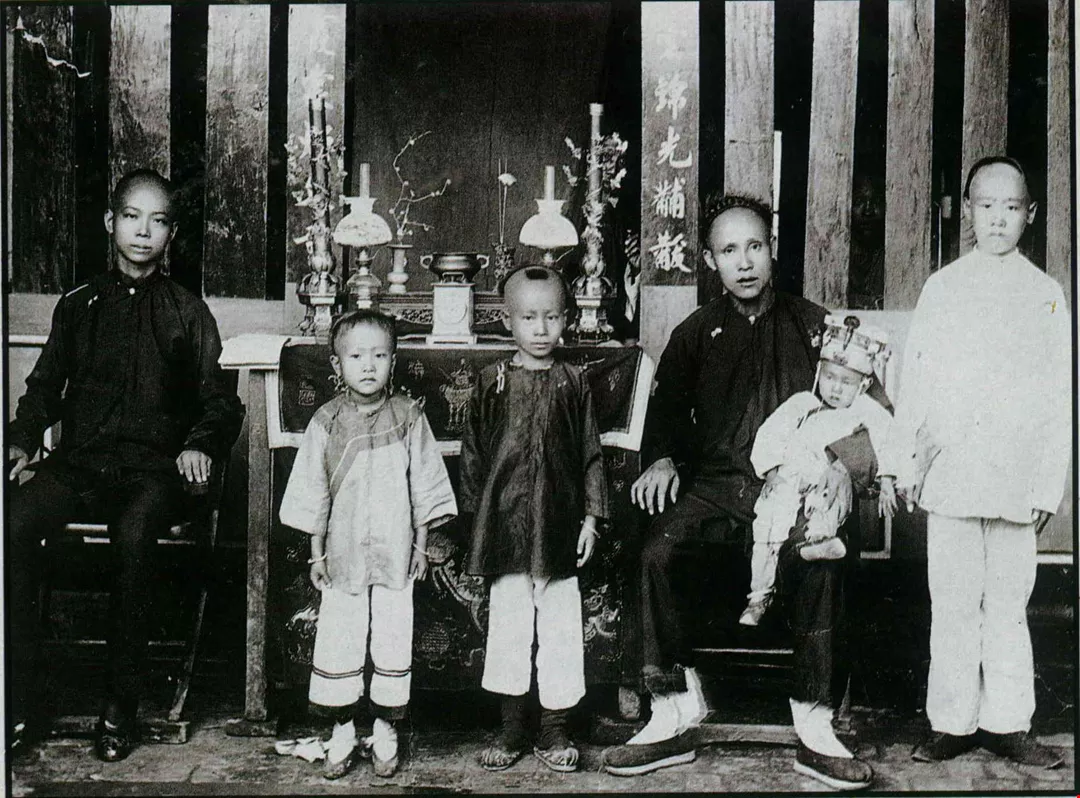
The Hsinkang jelly dynasty Lu Chi-tou made a living selling malt jelly and peanut candy. One day in 1891, it began to rain, and he could not go outside to do business. The unusually damp air made the candy slowly melt. He looked at the dismal sky and sighed. Suddenly, he came up with an inspiration- -mix these two candies together and mold the resulting mass into cones. The shapes looked like little mice. Later on, it became the famous Hsinkang jelly. The baby girl being held in the photo is his daughter-in-law, who later inherited the entire Hsinkang jelly business. She is the ninety-year-old Hsieh Hao. (photo courtesy of Lai Huei-ching)
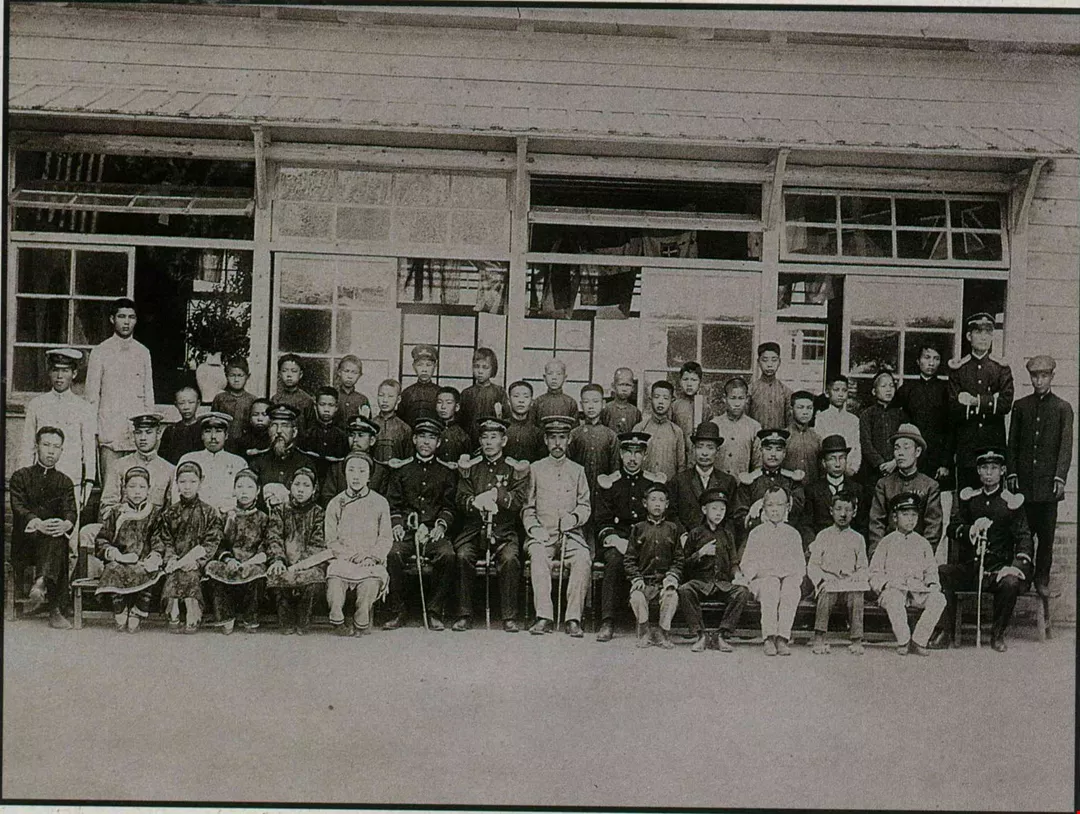
Hsinkang Public School The school was constructed after the Japanese occupied Taiwan, "to spread the national (Japanese) language among the native population, to prepare for local administrative measures and to provide a basis for education." It was founded as the National Language Practice Center and Language School. In 1898 it was renamed the Hsinkang public School. Once established, it became one of the three largest public schools in Chiayi County at the time. The photo is a group portrait of a graduating class from the early days of the public school. The clothing and hair style of the people in the picture preserve the styles of the period of transition from the Ching Dynasty to the Japanese occupation era. (photo courtesy of Cheng Mao-jen)
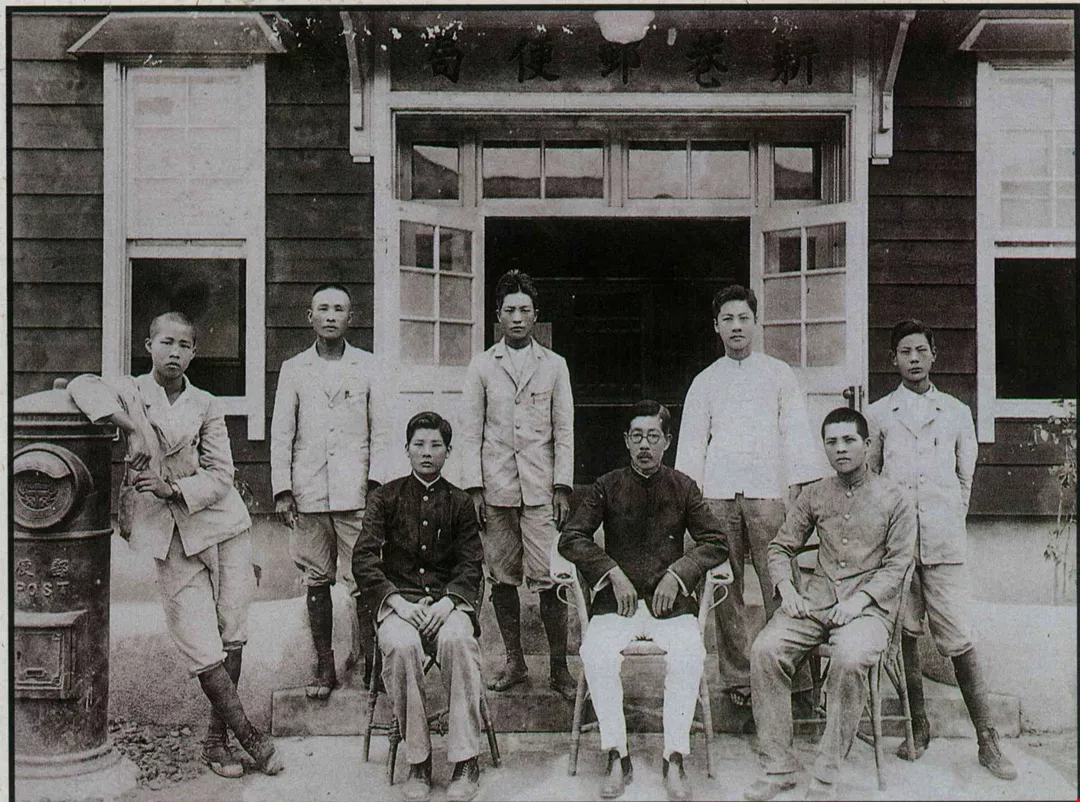
Old Postman Lin Tsai The post office and the postman were important parts of the people's lives during the Japanese era. The man standing second from the left is Lin Tsai, today 90 years of age, who has 37 years of experience delivering letters. One time during a typhoon, Lin Tsai carried a bicycle on his shoulders to cross the Niouchou River, which was running in a torrent and high up to his neck. A single registered letter was hidden under his hat, and once safely across he completed his duties. (photo courtesy of Lin Tsai)
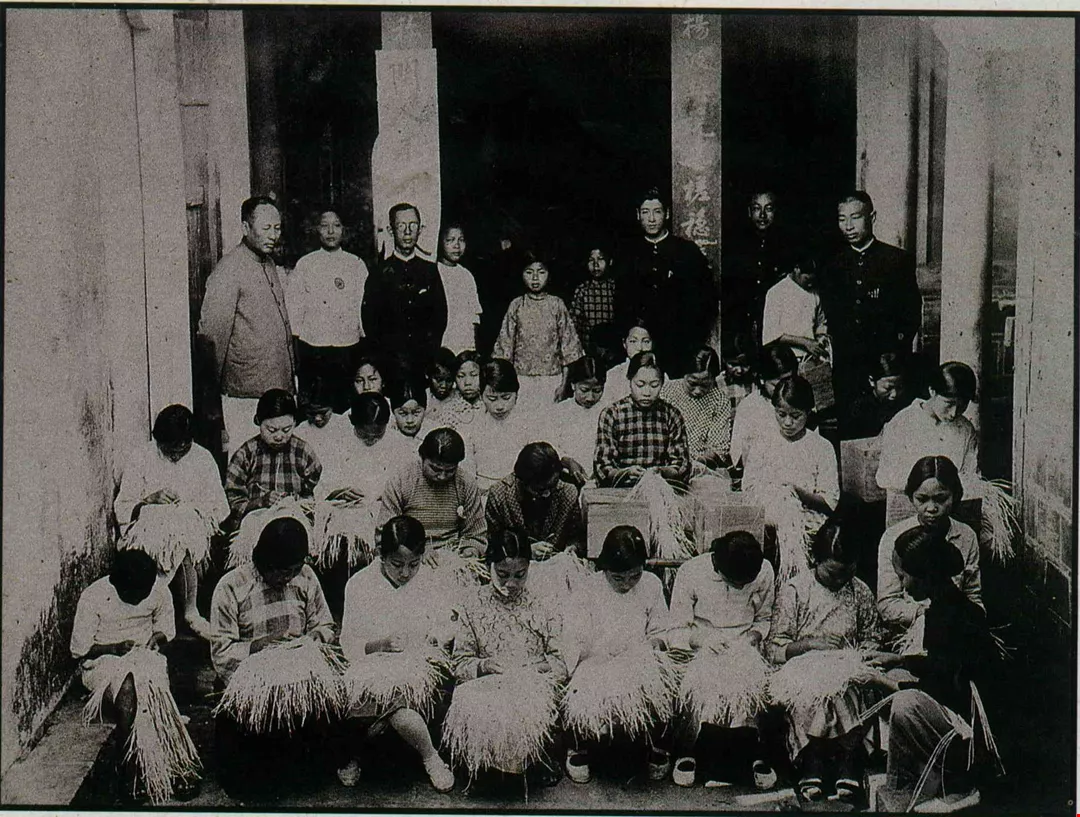
Weaving grass hats When they were not busy with farming, the women of Hsinkang early on started to develop a handicrafts industry. The picture, taken in the 1920s when Lin Lan-ya was mayor of Hsinkang, shows an assembly of women in front of the Feng Tien Temple weaving grass hats. (photo courtesy of Tsai Yu-tsun)
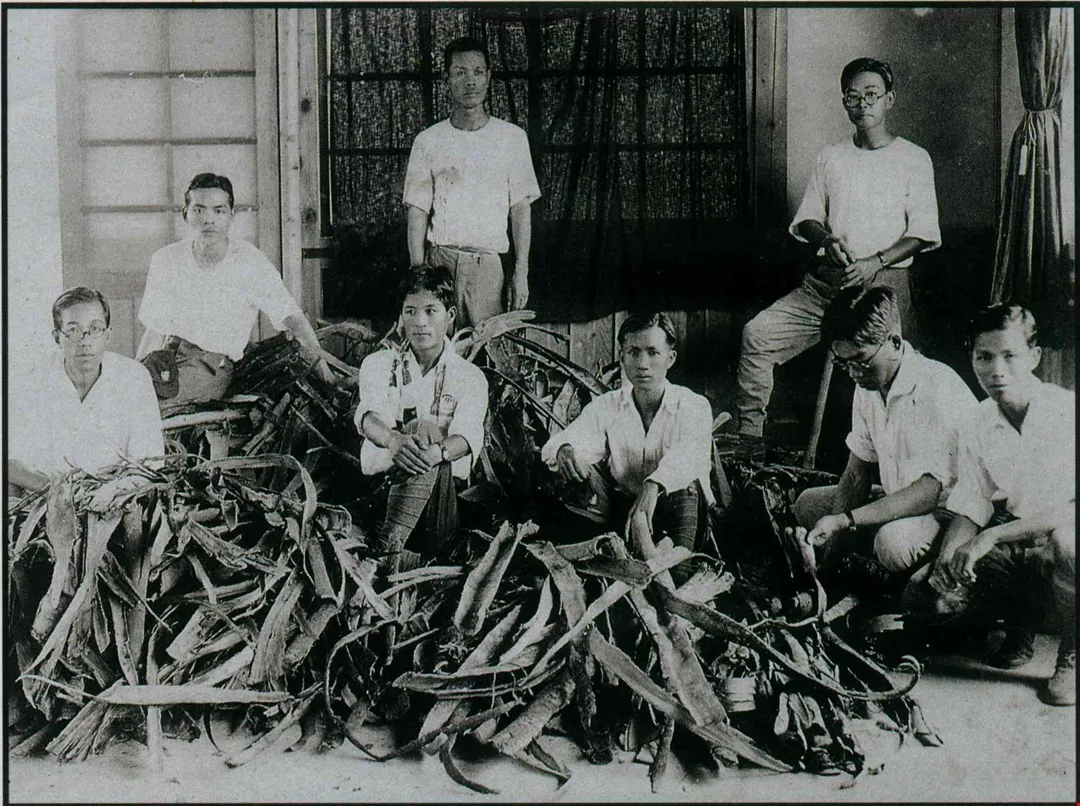
Tree bark entrepreneurs Toward the end of World War II Japanese troops were in steady retreat. Because of the critical conditions of the war, the Japanese intensified the exploitation of resources from their colonies. A group of Hsinkang youths went far into the mountainous areas, climbing trees and stripping the bark, pulling out the fibers for clothing material. (photo courtesy of Cheng Mao-jen)
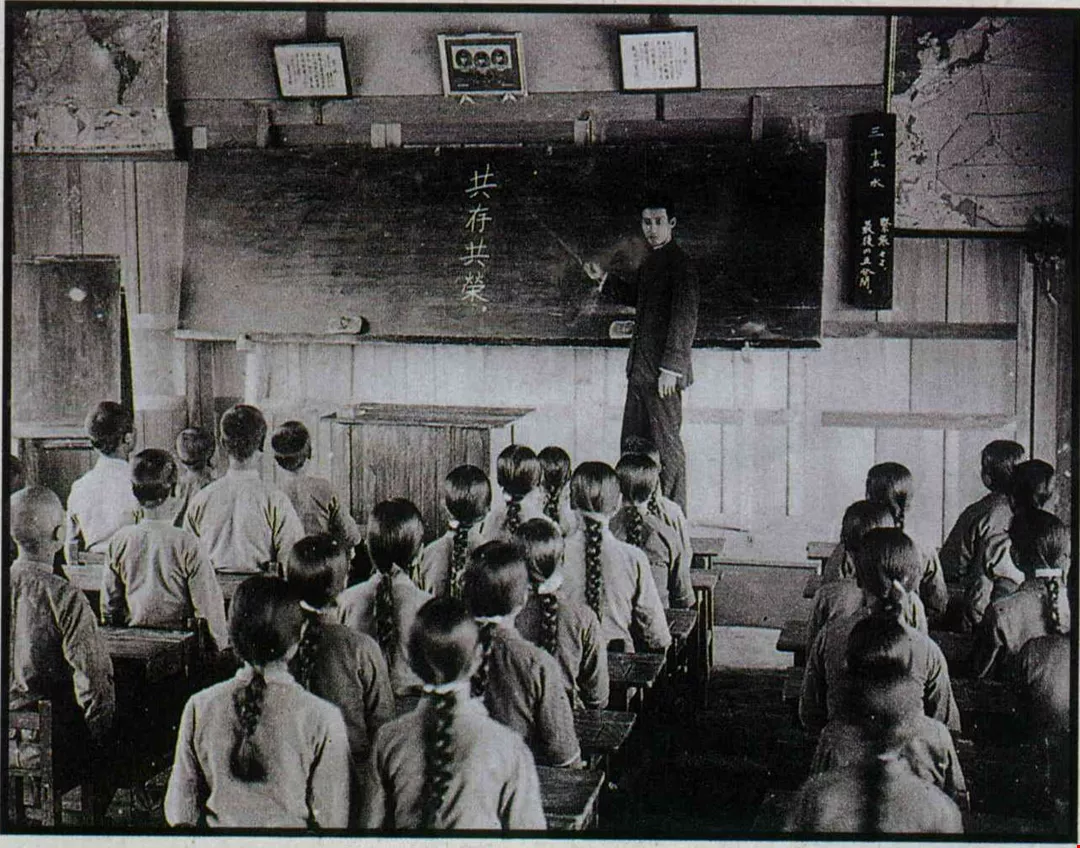
The last class in East Asian Co-prosperity Taiwan became the launching pad for the Japanese military invasion of Southeast Asia. "Imperialist" education seeped down into every level of life. In the classroom, the Hsinkang public school teachers catechized the philosophy of "East Asian Co-pros-perity." On the wall at the front of the class is a large map showing the "Co-prosperity Circle" of East Asia. Taiwan can easily be seen situated in a crucial position. (photo courtesy of Cheng Mao-jen)
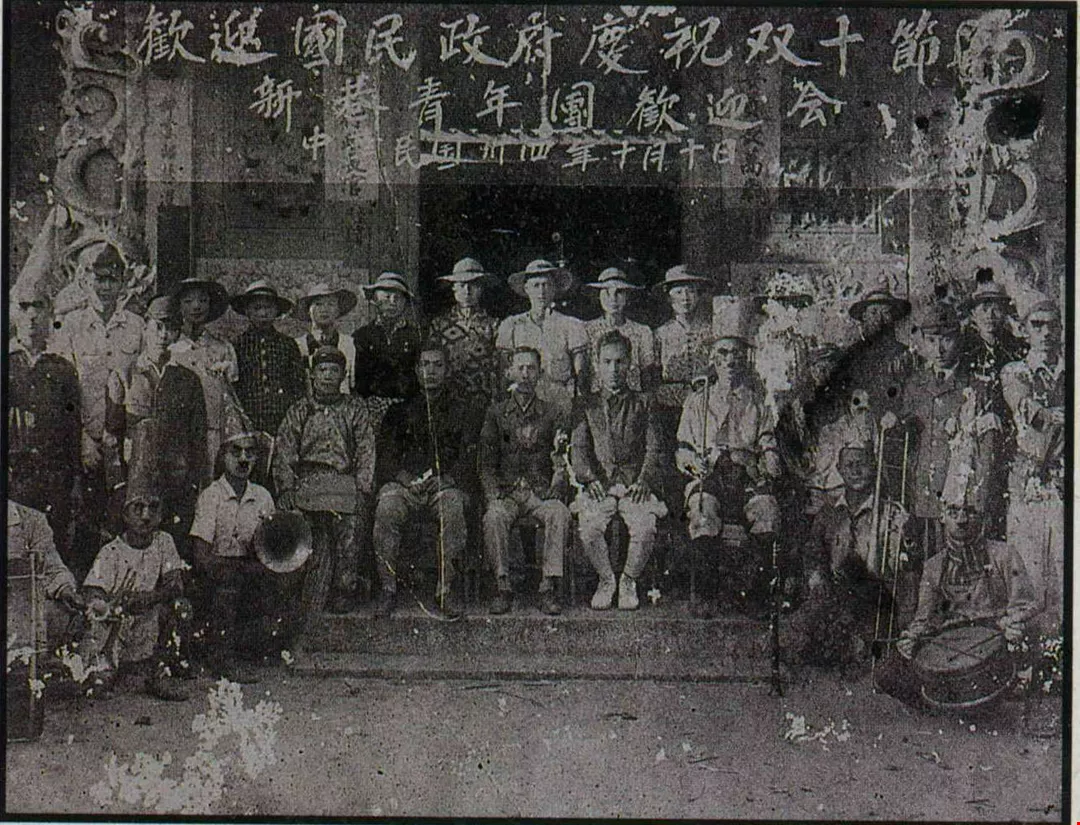
Peace at last On August 14, 1945, the Japanese military surrendered unconditionally, ending 51 years of colonial rule in Taiwan. Some young men from Hsinkang who have just returned from serving abroad in the Japanese navy join ranks with a young people's performance group to sing, looking forward to a new age, celebrating peace and prosperity. (photo courtesy of Lin Chiu-lin)
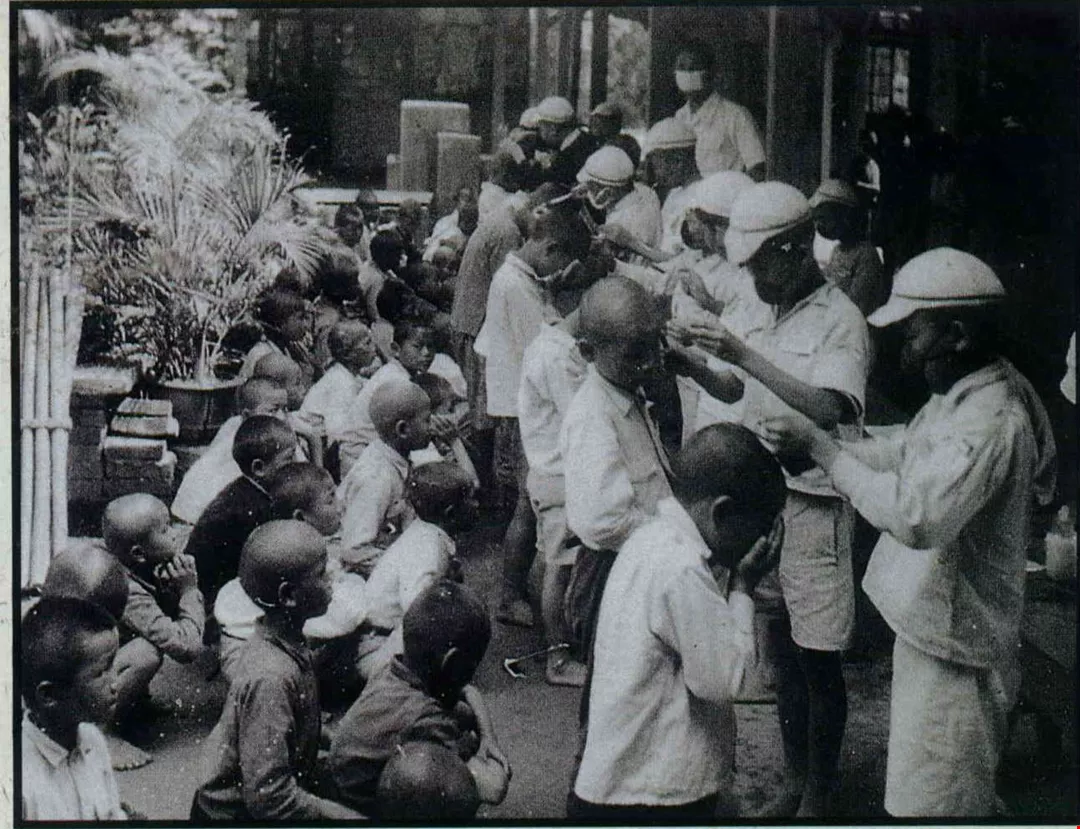
Trachoma, lice, infectious disease In Taiwanese farming communities during the early days of restoration from Japanese occupation, the sanitary conditions had considerably degenerated following the ravages of war. Trachoma, lice and boils were the common maladies that rapidly spread among students of that time. Those who went to elementary school during the 1950s and 1960s can still recall that in the school and during class, classmates helped each other pick lice from their hair, dab trachoma ointment, treating these infections. (photo courtesy of Cheng Mao-jen)
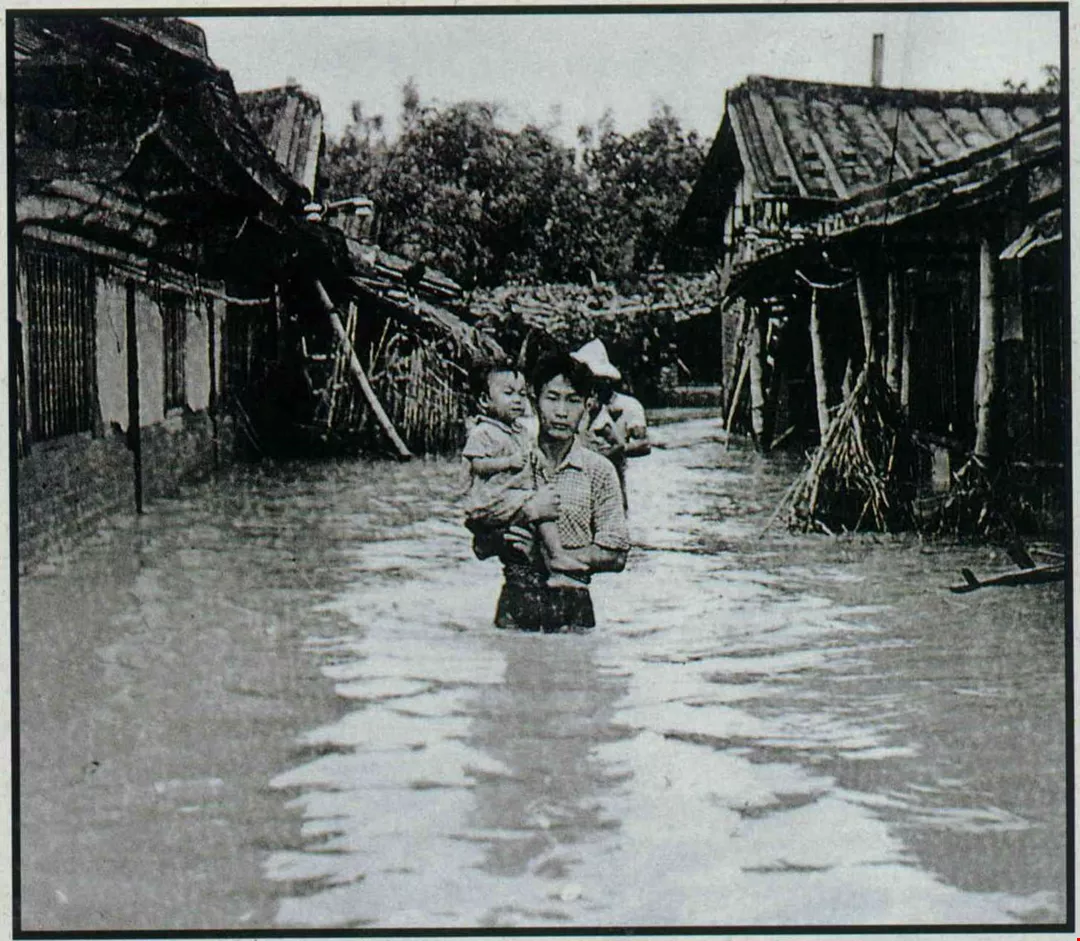
The August Seven Flood Two hundred years ago the Peikang River flooded with black water, causing the collapse of the land supporting old Penkang. The mighty flood of August 7, 1959 in the Yunlin-Chiayi-Nantou area wrought even greater catastrophe. A fierce rain instantaneously unleashed itself upon the mountain region. After nine o'clock, the overflowing waters of Peikang River ran wild in all directions. They first rushed to Pitsaitou Village; within one or two hours, the water had surged to the rooftops. During the dark of night, the waves of black water wiped away 29 lives. The river water was playing evil tricks downstream; in Chung and Pantoutsuo Villages, six more people lost their lives. The August Seven Flood became the most haunting nightmare since the war. (photo courtesy of Li Tung-pi) (text by Liao Chia-chan/tr. by Brent Heinrich)

_DSC2938@List.jpg?w=522&h=410&mode=crop&format=webp&quality=80)


