

After months of noisy campaigning, the elections for mayors and city councils in Taipei and Kaohsiung Cities were held on December 9, 2006. Kuomintang (KMT) nominee Hau Lung-pin won the race for mayor of Taipei, while Democratic Progressive Party (DPP) nominee Chen Chu won a narrow victory (by only 1114 votes)--amid a storm of controversy--for mayor of Kaohsiung, becoming the first woman to be popularly elected as chief executive of a special municipality in Taiwan.
Following on the fall in the DPP's fortunes in the three-in-one elections at the end of 2005, and the First Lady's being implicated in the scandal over expenditures from the special state affairs fund for discretionary use by the president, at least the DPP was able to hold on to one of Taiwan's two major cities in this election. The Ma Ying-jeou-led KMT failed, meanwhile, to win back Kaohsiung, and People First Party (PFP) chairman James Soong announced following his defeat that he will withdraw from politics in Taiwan, meaning that the "Pan-Blue" parties are again facing a restructuring challenge.
If we see the elections for Taipei and Kaohsiung mayor as preliminary skirmishes before the 2008 battle for the presidency, what is the big picture now that the municipal elections are over?
With the Pan-Green and Pan-Blue forces each holding onto their current seats in the Taipei and Kaohsiung mayoral elections, a lot of political analysts have been left bug-eyed, and media polling has suffered a blow to its credibility. It appears that interpreting the results is now a wide-open field. The basic issue in analyses of Taiwan's political scene in the wake of the elections has become, "What were citizens in Taipei and Kaohsiung thinking?"
Undeniably, these were extremely alienating mayoral and council elections, without policy focus and with little long-term perspective on how these cities will develop. Instead, most of the fuss was raised over highly charged allegations or scandals over the use of the special state affairs fund, the discretionary funds of the mayor of Taipei and many other government officials, the purchase of Lafayette frigates, and the high-speed railway, as well as by political maneuvering such as attempts to direct strategic voting and the "secret" summit between Ma Ying-jeou and James Soong. And at the last minute assertions emerged that vote-buying was taking place on behalf of the KMT's Kaohsiung mayoral candidate Huang Jun-ying, with charges and denials and various versions of the story flying all over the place. All of this further alienated uncommitted voters, who were already tired of incessant political infighting and plotting, with voter turnout sliding in Taipei and Kaohsiung to set record lows (64% and 67%) in both municipalities.
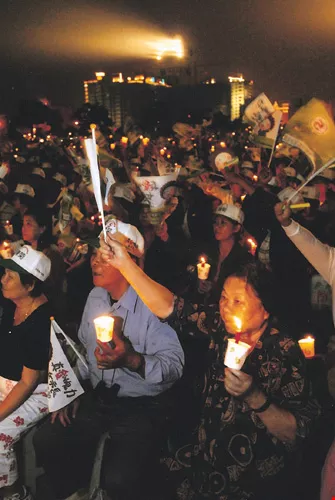
As the countdown to the elections ticked down, election activities in Taipei and Kaohsiung reached fever pitch, although no-one could truly know what the end results would be. In this photo, residents of Kaohsiung participate in an election rally.
Taking the south
For the DPP, whose overall image has been greatly tarnished recently by such things as recurrent allegations of corruption at the highest political levels, the "Red Shirt Army" led by former DPP heavyweight Shih Ming-teh which protested in front of the Presidential Palace, and calls by former Academia Sinica president Lee Yuan-tze for President Chen to consider resigning, these municipal elections were the severest test of the party since its founding. In the end, Chen Chu, who started slow but finished fast, held down the party's southern bastion, while Frank Hsieh--with an impressive resume of six years as mayor of Kaohsiung and one year as premier--lifted the DPP vote in Taipei to 520,000 ballots (41%), an increase of more than 100,000 over the last Taipei mayoral election, which can only be considered a strong showing.
Many people believe that a decisive element in the Kaohsiung election was that Lin Yi-hsiung, the revered former chairman of the DPP, came out strongly on behalf of Chen Chu in the last three days before the poll; this is said to have persuaded a number of uncommitted voters that they should not hand the government--which more strongly emphasizes "Taiwanese" identity in contrast to the KMT's more "Chinese" identity--another setback, but should give the DPP a chance to redeem itself. Analysts on the ground in Kaohsiung emphasize that the people of Kaohsiung should be given more credit for their ability and willingness to rationally distinguish candidates based on individual credentials and practical policies, rather than blindly voting along party or ethnic lines. Polls show that 60% of Kaohsiung residents are satisfied with the city's development (new infrastructure, improvement in water quality, etc.) through the "New Maritime Metropolis" program of the last eight years, during which the city has been run by the DPP, and this could have been the major factor in their willingness to vote for Chen Chu.
In contrast to the jubilant mood at the DPP over its surprisingly strong showing, at the KMT there was a wave of voices calling for reassessment and asking who should take responsibility.
Huang Jun-ying, an academic taking his second run at the mayoralty of Kaohsiung, was unable to take back this "lost territory" for the KMT despite the all-out personal effort that KMT chairman Ma Ying-jeou made on his behalf. Some in the KMT put the blame on Huang's personality, seeing him as too scholarly and wooden, out of touch with the southern city's tradition of hard-charging leaders with strong grassroots ties. But if Kaohsiung were really such a traditional place, why would it elect a woman mayor?
Very early on the KMT defined these elections as "a mid-term confidence vote on President Chen." But during the campaign the story broke about alleged wrongdoing in the use by outgoing Taipei mayor Ma Ying-jeou's administration of the mayor's special fund. Then, in the final moments of the countdown before voting day, came revelations of a "secret" meeting between Ma and PFP chairman James Soong (who was running as a third party candidate in the Taipei mayoral election), casting further doubt on Ma's leadership.
A number of the KMT's "Taiwanese" legislators asserted that the main reasons for the party's disappointing result are that the KMT is "too focused on the north" (Taipei), and is "insufficiently Taiwanese." The KMT, they charge, has never taken seriously enough Taiwanization and the "new Taiwanese" discourse, instead remaining closely linked with "Chinese" identity. At the simplest level this means that all party leaders should be able to discuss national affairs in the Taiwanese dialect and should more strongly promote policies affecting the lives of ordinary working people, and also should more prudently handle issues of party assets and corruption among party members, as well as try to identify with the "new Taiwanese" who make up the bulk of uncommitted middle-of-the-road voters. These are all key issues faced by the KMT and by Ma Ying-jeou.
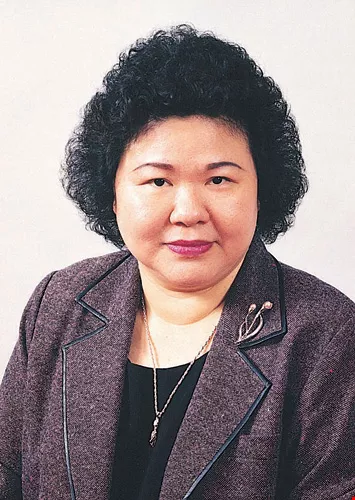
Kaohsiung mayor Chen Chu: 56-year-old Chen is a former member of the National Assembly, head of the Bureau of Social Affairs in Taipei and then in Kaohsiung, and chairman of the Council of Labor Affairs for five years from 2000.
Looking ahead to 2008
The municipal elections seemed to shift Taiwan back in the direction of a system of two dominant parties, with small parties some suffering serious setbacks.
Of the 52 seats of the Taipei City Council, the KMT took 24, remaining the single largest party, while the DPP ended up with 18. The PFP took only two seats, while all four nominees of the New Party were elected and the Taiwan Solidarity Union and independents grabbed two seats each. In Kaohsiung, both the KMT and DPP came out ahead, while the PFP slipped from five to four seats and the TSU collapsed, going from five seats to only one.
Though both the PFP and the TSU have strongly denied they will disband, as the elections for the Legislative Yuan and the presidency approach, observers will be closely following the degree to which the "Pan-Green" (DPP and TSU) and "Pan-Blue" (KMT, PFP, and New Party) camps will coalesce.
Looking at the big picture for 2008, the defeat of the KMT in Kaohsiung means that the apparent super-popularity of Ma Ying-jeou, who has been chairman of the KMT for over a year now, may be waning. Ma's real test will only begin after he passes the baton of Taipei mayor to Hau in December of 2006, after which, lacking the resources of any formal political office, he will have to deal with the very real power that challengers Lien Chan and Wang Jin-pyng wield in the party, as well as the problems of reviving morale in and coordinating the entire Pan-Blue camp.
Meanwhile, in the DPP, Chen Chu's holding down the base in Kaohsiung and Frank Hsieh's strong performance in Taipei has returned the party to the original "Four Kings" situation, in which four major contenders will be marshaling their strength in preparation for seeking the party's nomination for the presidency in 2008. Satisfied with the fruits of victory, the DPP should not delude itself that all the corruption problems will fade away; it will only remain competitive in the future if it can produce positive policies now.


@List.jpg?w=522&h=410&mode=crop&format=webp&quality=80)
@List.jpg?w=522&h=410&mode=crop&format=webp&quality=80)
