Back to the Future:Tainan's Unique Mix of the Traditonal and the Contemporary
Coral Lee / photos Jimmy Lin / tr. by Phil Newell
March 2011


Though weaker in industrial or commercial power than other metropolises, the new Tai-nan City-now covering all of Greater Tai-nan by combining the old city and county-makes up for it with its rich history and agricultural resources, thereby permitting it to win approval for elevation to the level of special municipality: "a special metropolitan area directly under the jurisdiction of the central government." Newly elected mayor Lai Ching-te (William Lai) paints a vision of the future in which Greater Tai-nan will be, in the words of hometown literary -giant Ye Shi-tao, "a city that is ideal for dreaming, making a living, falling in love, and moving at a leisurely pace."
Greater Tai-nan covers 2200 square kilometers and has a population of 1.87 million. It straddles the divide separating elite and folk culture, and incorporates both urban and rural assets. Given the particular pride that the people of Tai-nan take in their cultural heritage, can culture become "good business" as well? How can this metropolis, already faced with the burden of a large and aging rural population, convince young people to have hope for the future and stay in Tai-nan to build the economy?
Walking through the historic lanes and alleyways of Tainan, in the air one feels a slower pace, a feeling that this would be a comfortable place to live, and somehow, without even knowing it, you even begin to stroll at a more leisurely speed. Just before the Chinese New Year, an exhibit of decorated lanterns is being held on Shen-nong Street, turning this narrow lane into a time tunnel that takes visitors back to the glory days of the port of Tai-nan a century ago. The passersby under the lanterns are imbued with elegance and romance.
"Sculpted narcissus" sit on tables set out on the flagstone-paved street, and when you lift your head you see antiquated wooden structures and elaborately and meticulously worked lanterns. A rich sense of the grand old days permeates the very air.
Shen-nong Street, 300 meters long, was the busiest and most prosperous street in all of Tai-nan back when this city was the capital of Taiwan and one of its most important ports and commercial centers. In those days there were five canals in the city leading to An-ping Harbor, and businesses and residences sprang up first along these waterways.
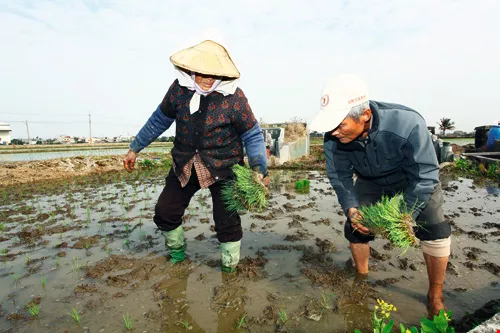
Organic farming is being strongly promoted in Houbi Township, where a Rice Production and Marketing Special Zone has been established to explore new marketing possibilities through rice branding. The photo shows "Uncle Kunbin" and his wife planting out rice seedlings for the first growing season of 2011.
During the Qing Dynasty (1644-1912), junks carrying cargo from Fu-jian in mainland China would stop at An-ping Harbor, and from there small transfer boats would carry the goods along the canals right to the back doors of shops. Shopowners only had to move the goods to the front door to sell them. Shen-nong Street, known formerly as Bei-shi Street, had the most important location of the five canals. Whenever -Mazu, goddess of the sea, visited Tai-nan from her temple in Bei-gang (in today's Yun-lin County), her icon would always spend a night at Yao-wang Temple at the end of Shen-nong Street before entering the walled part of Tai-nan and making its way to the Empress of Heaven Temple.
Zheng Dao-cong, director of the Tai-nan City Cultural Association, states that Shen-nong Street is still the same width it was 300 years ago, though the canal behind the street has long been filled in. Ten years ago, his group began to lobby for funds to renovate the old street, keeping many of the old facades, paving the street with flagstones, and installing elegant street lamps. Because the residents still live there, the street is a historic site that remains very much alive and fresh.
All over the city are fourth-generation businesses that go back a century or more, such as tea retailers, embroidery shops with exquisite craftsmanship, incense shops where the incense is still made in the old way, and even a maker of religious statuary in papier mache. Heck, even the eateries where you get everyday food like rou-zong (meat-filled glutinous rice dumplings steamed in bamboo leaves) and winter-melon juice are often venerable shops that have been in business for 100 years.
These traditional craft masters could be considered "sleeping tigers, crouching dragons" (untapped resources). Take for example Wei Jun-bang, the owner of the Wei Jun-bang Sculpture Studio, located in front of the Temple of the God of War. For half a century he has been expert in the special art of making religious statues out of papier mache, and is also proficient working in concrete or wood, painting and decorating wooden religious statues, and making decorated lanterns. His works are incredibly lifelike and colorful, and he has often been invited to exhibit them in other countries. He is one of Tai-nan's national-treasure craftsmen.
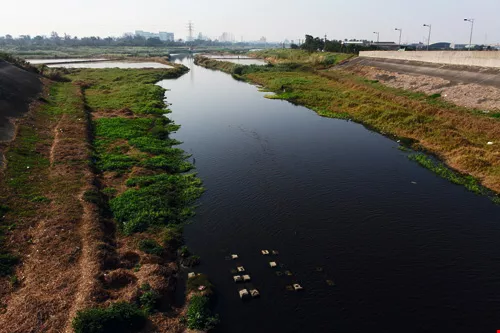
The Yanshui River, the main river through Greater Tainan, is heavily polluted, as you can see from its blackish-green color. Collapse of parts of the river dikes during the August 8, 2009 floods caused extensive damage to surrounding areas. How will the new Tainan City deal with the pollution and flood control issues? In the background are factories in the Southern Taiwan Science Park.
The cultural ambience that is omnipresent in Tai-nan and the more forgiving pace of life have in recent years served as magnets to waves of young people with creative ideas to come here. In corners all across the city there are individual cases of old houses being renovated or put to novel uses-the so-called "New Tai-nan phenomenon."
Unlike other cities in Taiwan where all the attention goes to the latest new lux-ury apartment high-rises, and old houses are torn down whenever possible, Tainan folk seem to find their old houses more and more attractive as time goes by, and are always trying to come up with ways to give old structures new life.
Near the Confucius Temple you will find a unique looking building that is home to the Tsao-chi Second-Hand Bookstore. Owner Cai Han-zhong, who had become tired of his monotonous job as a commercial photographer, rented this old house, then opened a passageway between the front and back parts and tore down the ceiling in the basement, leaving the bookshop with a straightforward, rough-and-ready design. It has also become a center where people can learn techniques for renovating old structures.
Also well known are the young rocker and his girlfriend who turned an old structure next to the train tracks-a hybrid Japanese and Western-style house-into a music bar with an antique feel by the DIY mechanism of decorating the place with old chests and bureaus from their own homes. Others have turned old residences into homestays, hairdressers', art spaces, and hand-made cookie shops. These people are employing a wide variety of operating models and design styles, some quite innovative.
What's especially interesting about these people is that they have not only changed the houses, but have reinvented their own futures.
And let us not forget about those who have tried to make it in the big city and been, in one way or another, disappointed, and who have returned home to remake not only old houses, but whole streets and neighborhoods, and have thereby "reawakened their passion for life."
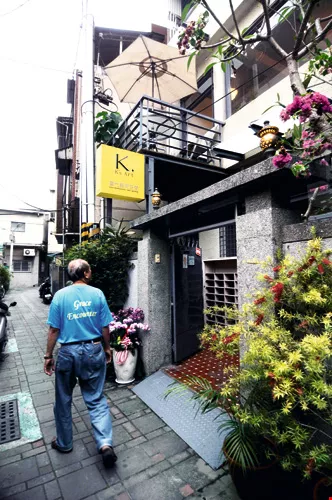
An old apartment building has been turned into a beautiful exhibition space. Many people have converted old structures to new uses, greatly rewarding visitors who don't mind exploring the lanes and alleyways.
Outside of Tainan's urban districts, the broad and open country of the former Tai-nan County has a somewhat different cultural vista. But it does not play second fiddle to the former Tai-nan City in terms of the energy being shown by communities by the sea or near the mountains.
Tai-nan County's most important and unique cultural treasures have been the performance troupes (yi-zhen) and festivities that are part of temple ceremonies and celebrations. For example, one troupe known as the "Twelve Grandmothers and Elder Sisters," which performs for the birthday of "The Lady of Lin-shui" (a local deity), and which in addition to generally chasing off malevolent forces and calling forth good fortune has the special function of protecting mothers and children, exists today only in the rural Tai-nan districts of Ma-dou and Xin-ying. When they go out for their "rounds," the "Grandmothers and Elder Sisters" wear masks and colorfully decorated outfits, and, fans in hand, dance and strut their way along swinging and swaying in a way that is as hilarious as it is warmhearted in intent.
Li Jun-xian, the leading force in long-term planning for the future of the Grandmothers and Elder Sisters, says that the Ma-dou troupe once nearly disbanded, but, as a result of efforts by local people, elders were invited to provide guidance about skills and techniques, and the crisis was transformed into an opportunity. The yi-zhen has flourished in recent years, even attracting some young people to pick up the baton and run with it in the direction of becoming part of the country's "cultural industry." Cooperating with artists to produce innovative spin-off goods like koji pottery, brass sculptures, and even pastries, they have found a sustainable path as an enterprise specializing in religious culture.
Another example is the renaissance of indigenous Si-raya culture going on near the mountains. Ka-bua -Alak, convener of the Tai-nan County Si-raya Community Alliance, notes that elements of tradi-tional Si-raya villages have been preserved up to the present in Baihe, Dong-shan, Da-nei, Guan-tian, Jiali, and Yu-jing. The borders between these communities and those of Han Chinese are distinct, and the indigenous people have a high level of ethnic identification. Each year they hold a Night Festival, a ceremony of respect and prayer to ancestral spirits, in the plaza of the traditional "public house." The "Plains Aborigines" of Taiwan launched their movement for recognition of their own tribal names in 2000, and the Si-raya movement has set strong roots and flourished in the former Tai-nan County.
The problem now is how these scattered local cultural resources can be connected and coordinated in the new Greater Tainan.
Tseng Shu-cheng, former assistant magistrate of Tai-nan County and now chairman of the Graduate Institute of Architecture at Tai-nan National University of the Arts, suggests that a cooperative platform can be built on the locales where over the past decade and more the "community regeneration" program has reached maturity.
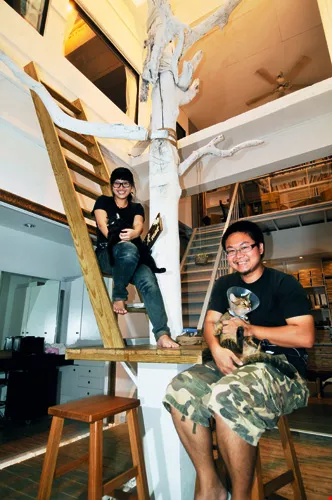
Jimmy and Kelly Li, "outsiders" who have resettled in Tainan, have turned an old apartment building into a creative wedding photo studio; the first floor is also available for art exhibitions.
Tseng states that many of the villages and neighborhoods in Tai-nan County's 31 townships and cities date back at least 400 years. After the establishment of a political regime built around Han Chinese at the end of the Ming Dynasty under the Ming loyalist Zheng Chenggong (Ko-xinga), who took over Taiwan after the Ming fell in mainland China, the authorities began opening up land for agriculture. Pioneers who started farms in what was then considered wilderness and soldiers based in various locations began to start families and create Han communities.
Tseng's clan home in Xia-ying dates back seven or eight generations, and there are similar extended families with long lineages all over the former Tainan County. The close ties among people and their deep feelings for the land are the main assets for community regeneration here. Moreover, most of southern Taiwan is plains, and many villages used to depend on well water that was considered a common resource. With innate advantages in terms of space and human resources, the community regeneration program launched in 1994 has already borne fruit in terms of rural culture and economic activities.
"Greater Tainan needs to make good use of this non-governmental power to build cooperative relations between the urban and rural areas." Tseng says as one example that in the past few years the Tai-nan County Government was strongly promoting organic farming. The markets originally targeted under this scheme were Tai-pei City and Japan, but in the future there could be more cooperation with retailers in the former Tai-nan City, with urban consumers giving organic farmers a boost and rural dwellers, by keeping their communities vibrant, giving urbanites a place to escape to and experience a fast-disappearing traditional way of life.
But the main problem to be overcome in the short term is to bridge the gap between city and country, so the two sides can get to know each other.
Kabua Alak says that non-governmental groups in both the city and the county have in the past held many meetings to discuss future development, and in these he discovered something: The people of the former Tai-nan City know very little about Tai-nan County geography, and even less about the problems that people there most care about. Some city people even have a strong sense of superiority, and think that "the way people think and act in the countryside just doesn't make the grade." There is still a lot to be done to wear down such prejudice.
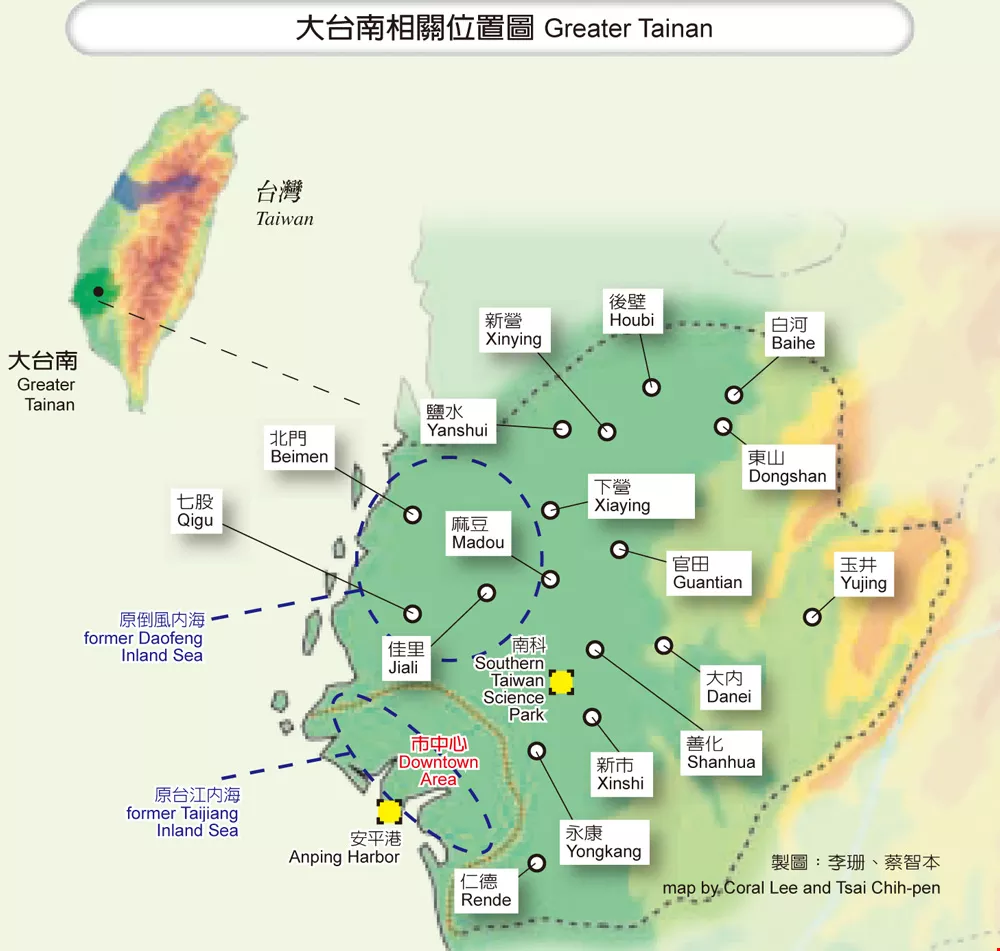
Greater Tainan
Going back a step, given the existing foundation, one area in which something could be done straightaway to link urban and rural resources would be "cultural tourism."
The Tai-nan region, as cultural historian Zheng Dao-cong points out, was developed very early on, with development starting in what later became Tai-nan City following the so-called Tai-jiang Inland Sea and that in future Tai-nan County following the so-called Dao-feng Inland Sea. Although these two bodies of water have both been filled in with silt over time to become dry land, many of the temples, folk customs, and historic sites from along the whole stretch of what used to be coastal harbor towns still exist. From south to north you can still see historic sites dating to the eras of Zheng Cheng-gong and the Qing Dynasty, as well as living intangible culture like religious festivals. With the combination of the city and the county, it is now possible to lay out a single tourist route that includes all the main sites, which would make Greater- Tainan into the perfect place to explore the history of Taiwan.
Besides the rich historical and cultural resources, another of -Greater Tainan's strong points is its deep and diverse agricultural sector.
A total of over 90,000 hectares are under cultivation in -Greater Tainan, which boasts the greatest area of land in Taiwan devoted to paddy rice, and which leads Taiwan in the production volumes and techniques for mangoes and wendan pomelos. When you also add in the lotus flowers, coffee, and other select crops, as well as the steadily growing orchid biotechnology industry, you're looking at a pretty strong hand.
Huang Kun-bin, a farmer from Houbi in Tai-nan, became famous across Taiwan after the making of the documentary film Let It Be, which depicts the crisis faced by rice farmers in southern Taiwan after the ROC entered the World Trade Organization. However, with help from the Tai-nan District Agricultural Research and Extension Station (ARES), Huang-known better as Uncle Kun-bin-went into organic farming, remade himself as an expert in the production and marketing of rice, and established his own brand, making it possible to survive.
Uncle Kun-bin joined up with the Fang-rong Rice Production and Marketing Special Zone, one of three special zones established in -Houbi in recent years. This brought together 100 contract farmers under the guidance of the ARES to grow organic rice using a method in which ducks are allowed to wander in the paddies, where they eat the insects. No chemical fertilizer at all is used, with the only growth agents being duck feces and legumes. With farmers and specialists from the ARES visiting the fields daily to care for the crop and make tests, the result has been award-winning rice.
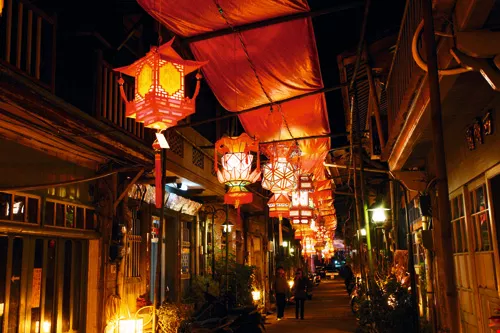
Walking into the old street, bathed in the wavering light and shadows of decorative lanterns, is like strolling into a scene from Chinese New Year in the prosperous port city of long ago. Tainan enjoys a rich variety of historic and cultural assets, its strongest comparative advantage.
Huang Li-qin, the owner of the Fang-- rong Rice Company and the executive director of the Fang-rong Rice Production and Marketing Special Zone, says that -Houbi rice has not been sullied by factory processing, is irrigated with water from Wu-shan-tou Reservoir, and is cultivated with organic methods. Compared with rice from Taiwan's other 13 special rice production zones, -Houbi tops the rankings for safety in use of pesticides, soil quality, irrigation water, and marketing.
Moreover, says Huang, Fang-rong He-jia Rice has already achieved a certain renown. Though mainly sold over the Internet, this year even the Shin Kong Mi-tsu-ko-shi department store chain came knocking on their door, hoping to use their product as a bonus giveaway for customers. Their order turned out to be quite noteworthy.
Huang notes that in the past, local farmers sold rice to wholesalers in 30-kilo sacks with profits of only NT$0.3 to 0.5 per kilo. Now they market their own rice through the special zone arrangement, mostly directly to consumers, in two-kilo bags that turn a profit of several tens of NT dollars per bag. Therefore it has been possible to pay farmers more than the guaranteed purchase price they would get in the market, which keeps them happy to be part of the program.
"Branding is very difficult, but at least you can see that there is hope," concludes Huang. Over the past five years, sales from the special zone have accounted for only 5% of revenues at the rice shop, but 95% of the man-hours. But since she can see that this is taking rice marketing into new territory, she feels it is worth it.
It is not only government resources that are behind the revitalization and innovation of Tai-nan's agriculture and aquaculture. One cannot overlook the energy brought to bear by communities.
Take for example, Du-jia Borough in -Qigu District, where the main business is raising cuttlefish and milkfish. The borough has about 150 hectares of aquaculture ponds for cuttlefish alone. In the past, the local fish farmers would just sell their harvest to a food processor producing cuttlefish roe. Income was limited. At the end of 2006, the community development association adopted a strategy of "fresh top-end products," placing orders for fish with farmers to stimulate the people of the community to start producing their own cuttlefish roe from cuttlefish they freshly caught themselves. The resulting food has a texture very different from eggs that have been frozen and reprocessed. After going on sale over the Internet, as much as NT$3 million worth has been sold in a single year.
Vision 3: Rural aestheticsThe energy to be found in abundance in Tai-nan's rural communities cannot only be applied to the marketing of agricultural products. There are also people working to open new frontiers in "aesthetic industries." Over the past decade, the artist Lin Wen-yueh, who lives in -Baihe, is representative of those working to bring aesthetics down to the farm.
Lin's -Baihe Pottery Studio is located next to the Lu-liao Reservoir. Like the Peach Blossom Paradise of the ancient poet Tao Yuan-ming, it is a pure land free of pollutants. In his yard of roughly one hectare in size grow various kinds of plants and herbs. The smell of grass wafting in the air and the shimmering sunlight from overhead create a relaxing mood. The surroundings are not meticulously sculpted as they are at so many other homestays; his yard runs wild, and this is precisely the "nature" that Lin wants his visitors to experience.
"Nature has the power to raise people's experience of aesthetics," explains Lin. The slow, leisurely pace of life in Tai-nan's rural communities is perfectly suited to developing rural aesthetics, and the sounds of birds and insects convey the rhythms of the natural world, giving him endless inspiration to create. This kind of aesthetic that springs from the living world itself is the paradise that modern people are looking so anxiously to find.
"In the era of globalization, the myth that urbanization is the only way to really develop has been shattered. Rural communities can bring to bear the soft power of accommodation to absorb the blows brought by cities," argues Lin, adding that he believes that future prospects for "creativity on the farm" are virtually limitless.
The prerequisite is that "economic farm communities" must be redirected toward becoming "aesthetic farm communities." For example, how can a lotus flower that now sells for NT$10 be turned into a lotus-flower artwork that sells for several hundred or even several thousand? Or, how can -Baihe be transformed into a place of beauty where people will have meaningful and memorable personal experiences like Kyoto in Japan? There is, it must be said, a long long way to go before such targets can be achieved.
So now Tai-nan City and Tai-nan County, whose histories are interconnected, have been reunited after a 65-year separation. With everyone watching and comparing the five special municipalities as if they were in a competition, will Tai-nan-the one with the fewest financial, industrial, and commercial resources-be able to build on its strengths in history and agriculture to create a slow but melodic symphony, one that may even find a place on the international stage?


@List.jpg?w=522&h=410&mode=crop&format=webp&quality=80)
@List.jpg?w=522&h=410&mode=crop&format=webp&quality=80)
