

In recent years, working holidays have become an increasingly popular option for travelers, giving young people opportunities to meet people from around the world, try out different kinds of work, and maybe even find their vocation.
Young Taiwanese can take advantage of the various working holiday agreements between Taiwan and other countries to experience life overseas, while young people coming into Taiwan from abroad can exchange physical or creative energy for free board and enjoy the sights and sounds of Taiwan without having to fork over too much money. It’s not hard to see why this has become such a popular alternative travel plan!
The French say that travel is the best teacher a young person can have, and it is the spirit of this saying that has motivated countless young Westerners to pack their bags and head overseas to work for a while and experience life in another land.
Over the past few years, Taiwan has begun to get on board with these “working holiday” plans as well.
In June 2004, the Taiwanese and New Zealand governments signed a working holiday agreement, with New Zealand offering some 600 opportunities for Taiwanese between 18 and 30 years of age to spend a year working and traveling around the country. In the years since, Taiwan has signed similar agreements with Australia, Japan, Canada, Germany, South Korea, and the United Kingdom.
According to numbers from Taiwan’s Ministry of Foreign Affairs, as of late April 49,626 young Taiwanese had taken up these opportunities, with Australia—which places no limits on the number of places available—being the destination of choice for 36,010 of them.
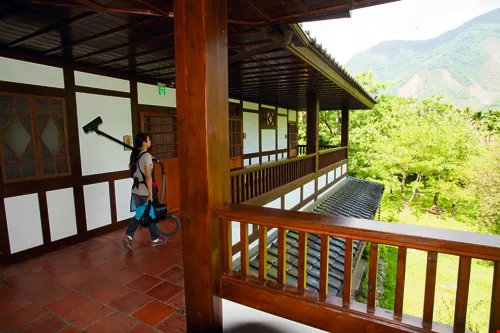
11:00 AM: Clean and straighten rooms after guests have checked out.
These bilateral working holiday agreements may sound like a great way for young Taiwanese to see the world, but what about the other direction? Just how many young people from other countries make use of these opportunities to come to Taiwan and work?
According to Su Cherng-tyan, dean of the College of Tourism at Chung Hua University, while Taiwanese youth are enthusiastic about working holidays, with some 10,000-plus heading for distant shores each year, barely 1,000 people have come to Taiwan for working holidays to date. One reason may be that there are simply too few short-term opportunities available, and what opportunities there are often pay too little to cover living and travel expenses. On top of this, Taiwanese employers are generally unclear about their rights and responsibilities with regard to working holidays, and the whole exercise is poorly promoted. There is clearly plenty of room for improvement.
Traditionally, the first line of work to occur to most young foreigners coming to Taiwan has been English teaching, but in the past couple of years backpackers have begun choosing to take up work at guesthouses or organic farms. These have been especially popular choices with youngsters from Hong Kong, Malaysia, and Singapore, who generally come in through non-governmental channels, such as organizations like KiTaiwan and World Wide Opportunities on Organic Farms (WWOOF). Generally they arrive in Taiwan on one-month tourist visas, and rather than work for pay, they exchange their physical or creative labor for room and board. Although there are no official age limits on these jobs, they tend to be most popular with young women between 20 and 30 years of age.
In anticipation of the business opportunities that come with working holidayers, veteran traveler and founder of guesthouse reservation website “B&B Home” Pai Chih-tang secured a grant of some NT$1 million from the Ministry of Economic Affairs’ Department of Commerce under the “Service Industry Innovation Research Project,” and used the money to found the website KiTaiwan in February 2011. The site successfully organizes two or three working holidays each day, and so far has attracted signups from over 3,000 young travelers. Hong Kongers and Taiwanese each account for a third of that total, with the rest primarily Malaysians, Singaporeans, and Canadian Chinese. A majority of applicants from HK and Malaysia are in the workforce, while the majority of Taiwanese are students.
To help the site succeed, Pai has spent a year visiting guesthouses and farms around Taiwan, getting some 150 of them on board so far.
WWOOF, meanwhile, was founded in the UK in the 1970s, and is a global organization specializing in working holiday opportunities on organic farms. Taiwanese farms like Yilan’s Feng Chun Villa and Nantou’s Old Five Guest House are members of WWOOF, with the latter having hosted travelers from as far away as the Republic of Ireland.
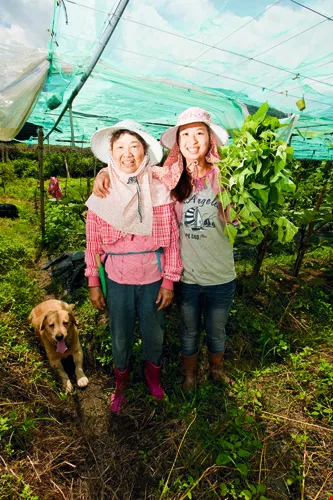
9:00 AM: Head to Tianshanling Farm to do some weeding, bug catching, and planting of vegetables.
Interestingly, it is the youth of neighboring territories like Hong Kong, Malaysia, and Singapore that make the most use of Taiwan-bound working holiday opportunities.
Hong Konger Ivy Wong quit her job this past April and headed abroad to a group of small islands she’d never seen before: Penghu. Compared to the tense, fast-paced lifestyle of Hong Kong, “the people in Penghu are so much friendlier and the lifestyle is so much slower and simpler. I’ve barely been here a month and I’m already thinking about moving to Taiwan for good,” she laughs.
In the past, Wong wasn’t a big eater of seafood, but the rich waters of Penghu enticed her to give it a shot. Now, having tried the local cuttlefish, squid, and oysters, she is full of praise for their light flavors and distinctive textures. She also strongly recommends local specialties like seaweed and squid vermicelli, brown-sugar ice, and cactus ice cream.
One particularly memorable experience for her since coming to Penghu has been seeing the waters between Kuibishan and Chiyu roll back at low tide, like Moses parting the Red Sea, revealing a winding, walkable path of land between the two.
This working holiday, says Wong, has helped her really integrate herself into the Penghu community, and has been an experience so much more meaningful than ogling scenery from a tour bus.
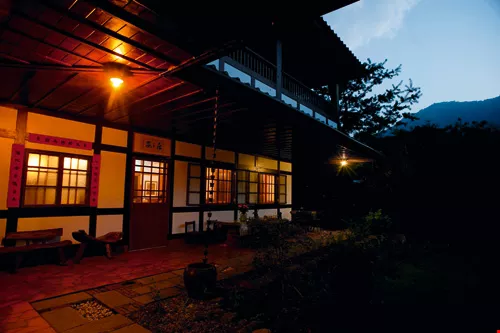
6:00 PM: As the sun sets, another day of hard work ends, and it’s time to get ready for the sandman’s nightly visit.
There are essentially two kinds of working holiday work at guesthouses: general and specialist. General work includes things like cleaning rooms, preparing breakfasts, washing dishes, weeding gardens, and other manual jobs; specialist work, meanwhile, involves things like developing meals, translating websites, painting murals, working on interior design, designing and planting gardens, guiding tours, doing scientific fieldwork, and holding musical performances.
The owners of different guesthouses have different needs—some want help with photography, some want travel articles written, some want to learn to use social media…. Once worker and employer have agreed on how long the stay will be and what kind of work will be done, they then have to sign an agreement that lays out working hours and other details in order to protect the rights of both parties.
Pai explains that the travelers who choose working holidays in Taiwan doing general work essentially become assistants to the managers of these guesthouses, and for those who want to open their own guesthouse in the future, it’s an invaluable introduction to the business. However, there are a lot of restrictions and requirements involved in the general class of work—most of these new assistants have to get up at 7 a.m., and sometimes as early as 5 a.m., to set to work making breakfast, and given the ease with which they can be replaced, those who choose this path have less freedom than those working on more specialist duties.
Said specialist work, meanwhile, can be much more varied. By way of example, Pai mentions a student from National Kaohsiung University of Hospitality and Tourism who took up work at Beicheng Villa in Yilan, working on a lotus-themed menu; and an economics major from Hong Kong with a penchant for art who was invited to work on painting murals at Hualien’s Shin-Liu Farm, leaving her creative mark on the farm’s guest rooms.
Hung Ting Ting, a graphic designer from Hong Kong, started work this May at “Meet” guesthouse in Penghu, and not only works making both beds and breakfasts, but has also used her professional talents to help owner Xu Mingmao design brochures for travel shows in Hong Kong.
Some owners have more unique requests for working holidayers, such as the owners of Ching San Farm in Taitung, who want children’s dance and movement specialists to lead their own and their guests’ children in singing, dancing, and stretching. Lu Zhenxu, owner of Old Five Guest House in Nantou, is an avid marathon runner, and has in the past looked for travelers interested in joining him on the road.
Old Five Guest House also offers other unusual jobs, like making and bottling vinegar; weeding, catching bugs, and growing vegetables at nearby Tianshanling Organic Farm; bagging and harvesting grapes at the neighboring Ganxi Vineyard; or even making mantou (steamed bread) at the Old Five’s mantou shop.
Even just chatting with the guests in the evenings can count as part of travelers’ “work.” At Meet guesthouse in Penghu, owner Zeng Wanting has organized a system by which guests are given a beer voucher at check-in, and from nine each night they gather in the garden to enjoy a drink under the starry skies. Accordingly, she hopes that travelers who take up work with her will also join them and be part of the socializing that goes on.
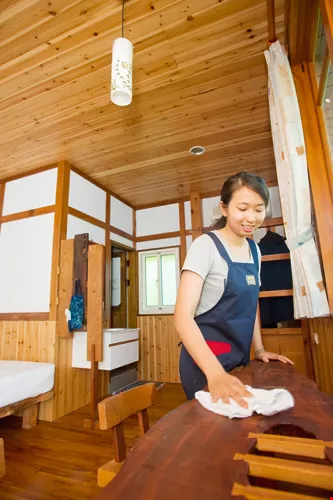
11:00 AM: Clean and straighten rooms after guests have checked out.
“This kind of ‘exchange’ of work for accommodation is one of the big draws of working holidays in Taiwan,” explains Pai, who encourages young people to make the most of these opportunities to exchange their creative energies for accommodation in order to see what Taiwan has to offer without having to spend a ton of money.
However, he reminds prospective working holidayers, the cost of getting to and from the place you plan to work is on you, as is any other travel outside of work. It’s also important to have your own travel insurance. And remember that you might not be staying in the actual guesthouse, but more likely in employee dorms. Some guesthouses provide three meals a day, while others require you to sort that out yourself. And since you will, naturally, be working as well as traveling, you have to plan your schedule and budget carefully, lest you end up overwhelmed and not getting everything you could out of the journey.
“Working holidays are much cheaper than ordinary travel, especially when accommodation is all paid for,” says Hong Konger Dora Ng. By her estimates, accommodation would normally cost her somewhere between NT$700 and NT$1000 a night, and with her plan being to stay in Taiwan for three months on a maximum budget of HK$40,000 (approx. NT$150,000), saving so much on accommodation has enabled her to see much more of Taiwan.
Ng, who recently left a nearly decade-long job as a travel agent, began working in the restaurant at Provence Rose Lodge in Qingjing, Nantou, this May. By day, she traveled around the area, seeing the sunrise on Mt. Hehuan and frolicking in the mountain grasslands, and by night she went firefly watching and visited local hot springs. After leaving Qingjing, she headed for Penghu, visiting Alishan, Sun Moon Lake, Kenting, Kaohsiung, and other destinations along the way.
Wanting to experience sea travel, the adventurous Ng chose to get to Penghu by ferry from Budai Port, Chiayi, although after an hour and a half on rough waters, her head was spinning. Nonetheless, she soon fell in love with the seaside lifestyle in Penghu; “It’s a paradise here,” she says, “especially the beautiful beaches. It’s really exotic!”
Once her time in Penghu is over, Ng plans to head to Hualien and work at Ocean Home guesthouse, from where she also plans to head on to Taitung and take to the skies at the Luye hot-air balloon festival, to get a bird’s-eye view of the landscape.
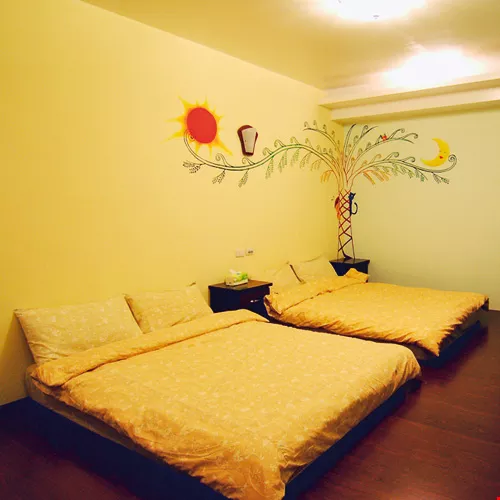
The rooms at Hualien’s Shin-Liu Farm boast the artwork of one of their former working holidayers.
Since getting to know the locals, Ng has found herself changing and growing. When she started at Qingjing, she rarely smiled on the job, having grown accustomed to the Hong Kong way of rarely showing emotion at work. But every day at Provence Rose Lodge was just so much fun that that gradually started to change, helped along by the other staff there always telling her she should “relax and smile a bit more!”
With her working holiday drawing to a close, Ivy Wong was surprised to realize how much more capable she’s become: at first, she could barely even make the beds right—the sheets wouldn’t fold properly, the bedspreads were never smooth, the pillows were never quite right—but by her last day, she could handle everything a room required on her own.
While these kinds of working holidays might not pay anything financially, they pay off in a more valuable way—life experience. Travelers get the chance to meet people from around the world, broadening their horizons and becoming more independent.
When a couple of Swiss girls and a German couple stayed at Meet, the watersports-loving Ivy Wong seized the chance to charter a yacht with them, relaxing in the sea breezes, going swimming and surfing, and generally just having a great time. “What’s the fun in traveling if you don’t get out and try new things?”
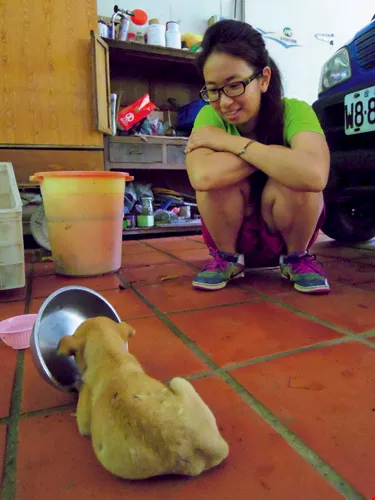
5:00 PM:Feed the former stray dog the guesthouse has taken in.
Working holidays aren’t just something for overseas travelers to enjoy either! Pai Chih-tang encourages Taiwanese youth to take advantage of their summer vacations to travel their homeland and expand their horizons. They might even find their calling in the process.
Luo Qianyi and Lü Jun, of Taichung and Taipei respectively, first came to Old Five Guest House for working holidays, but ended up staying on full time.
The 26-year-old Luo first went to work at Bafu Farm in Shuili, Nantou, before continuing on to jobs at Old Five Guest House and Tianshanling Farm. “The people here have such a connection with the land, and their dedication to organic farming was what inspired me to stay.”
Part of their trademark healthy meals, Old Five Guest House used to offer mantou just as part of breakfasts for guests, but their popularity was such that owner Lu Zhenxu ultimately opened his own mantou store. Their ingredients, including pumpkin, taro, and green onions, are all sourced from local farms, and the mantou themselves are steamed in the traditional way. As they come out of the oven, their light fragrance fills the store, making mouths water just as much as the buns’ characteristic texture and chewiness.
Lü Jun, who started work at Old Five Guest House in March, was fortunate enough to be around just as the mantou store needed staff for its opening in April, and thus ended up in his first full-time job. A National Taipei University graduate in economics, Lü didn’t want to be like the rest of his classmates and go into the high-pressure world of finance. Instead, he wanted a job that would get him closer to nature.
As soon as he got a taste of farm life, says Lü, he knew that one day he wanted to own his own organic farm.
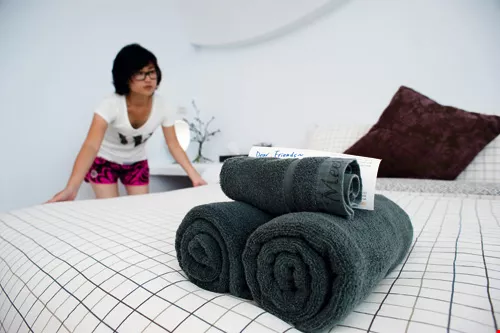
For Hung Ting Ting, learning to make beds properly, roll washcloths just right, and do everything else needed to straighten up a guest’s room has been an invaluable experience.
Old Five Guest House owner Lu Zhenxu started growing organic tea over a decade ago, but between the relative novelty of organic farming in Taiwan and the constant battering of his tea by typhoons, he decided to move into running his own guesthouse. His aim was to give guests and working holidayers a chance to experience farm life and understand what is involved in organic farming.
At first, he explains, it was difficult to get local farms on board with pesticide-free practices, but eventually Zhang Yougan of Ganxi Vineyard heeded the call, and from this year they, too, will start offering opportunities for working holidayers.
Zhang Yangyi, owner of Bafu Farm, was already set on owning his own farm when he was in vocational high school, and to help prepare for that he spent a year working in Australia to experience real farm life. Then, in August 2010, he began a working holiday split between Grateful Growers, Old Five Guest House, and Tianshanling Farm.
With the help of Lu Zhenxu and others, in December that same year Zhang began leasing three-quarters of an acre of land for NT$4,000 a month, growing his own pumpkins and selling them to Lu’s mantou store. After growing too many pumpkins last year, this year Zhang decided to add cucumbers to his plot. His crops, however, were struck by diseases and insect damage, so he was forced to further reduce the space used for pumpkins, instead planting more disease- and pest-resistant crops like corn and okra. He has maintained an environmentally friendly approach to farming, though, living the “half-farmer, half-X” lifestyle.
Lü and Zhang are just two examples of working holidayers who not only had a memorable experience, but found their vocations through their holiday work.
In the words of French writer Marcel Proust, “the real voyage of discovery consists not in seeking new landscapes but in having new eyes.” Through travel, younger generations can explore the world and discover themselves. They might even find more than they expected, so long as they can summon up the courage to take that first step out!
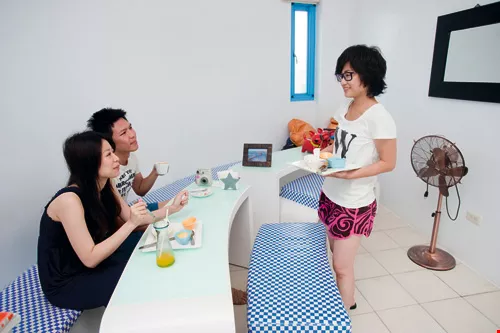
Preparing breakfasts and providing customer service are amongst the simpler jobs people undertake for B&B working holidays.
Twenty-six-year-old Luo Qianyi from Taichung, a lover of nature, enjoyed a working holiday last year in Nantou helping out at Tianshanling Farm, Old Five Guest House, and Bafu Farm. At Old Five, she had the chance to try out a variety of jobs before ultimately choosing to become a full-time employee of the guesthouse.
She encourages other Taiwanese youth to do the same, experiencing more of what Taiwan has to offer and broadening their horizons.
6:00 AM: Wake up, go for a run, and warm up for another beautiful day.
7:00 AM: Prepare healthy, nutritious breakfasts for the guests.
9:00 AM: Head to Tianshanling Farm to do some weeding, bug catching, and planting of vegetables.
11:00 AM: Clean and straighten rooms after guests have checked out.
3:00 PM: Steam some baozi (filled buns) and mantou (steamed bread) on a traditional stove, filling the air with their mouthwatering scents.
5:00 PM:Feed the former stray dog the guesthouse has taken in.
6:00 PM: As the sun sets, another day of hard work ends, and it’s time to get ready for the sandman’s nightly visit.
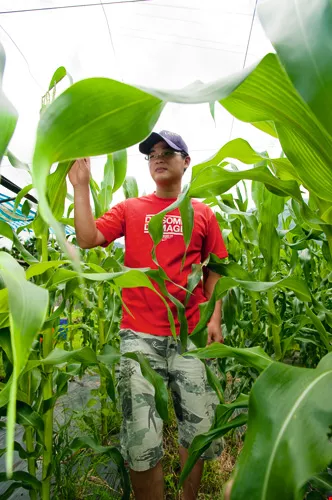
Zhang Yangyi has always dreamed of running his own organic farm, and today he does just that, using environmentally friendly methods and living the “half-farmer, half-X” lifestyle.
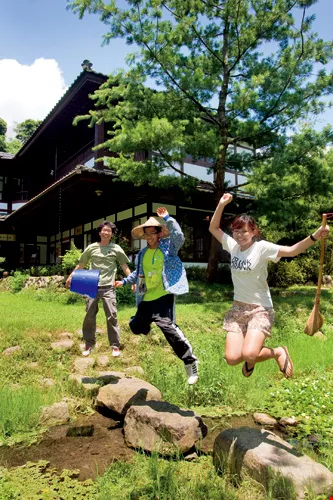
Co-workers Hong Konger Cheng Hiu Tung (right), a student of environmental policy, and National Taipei University economics graduate Lü Jun (center), in front of the beautiful Old Five Guest House with owner Lu Zhenxu. They are greatly enjoying the chance to work amid the beauty of nature.
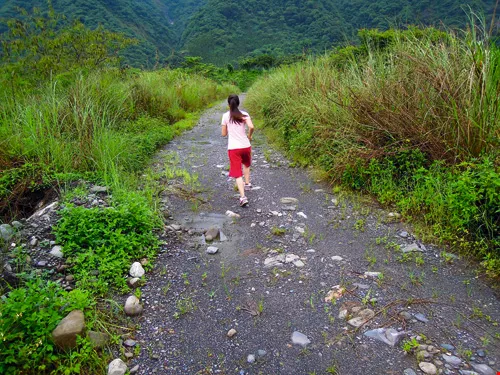
6:00 AM: Wake up, go for a run, and warm up for another beautiful day.
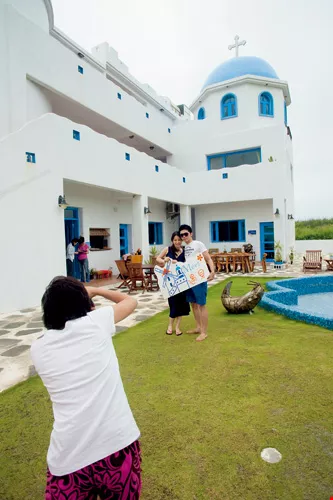
Before guests check out, they’re sure to want a photo to remember the stay by, so many B&B owners look for working holidayers who are good at photography.
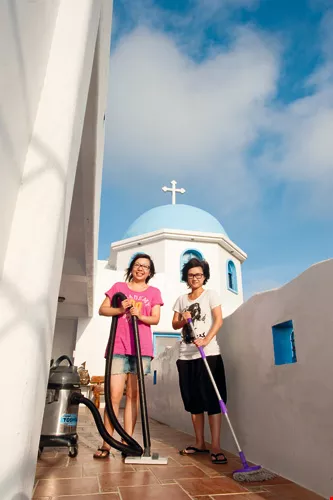
Hong Kongers Hung Ting Ting (right) and Dora Ng both chose to come to Penghu’s “Meet” B&B, paying for their accommodations by taking care of the cleaning.
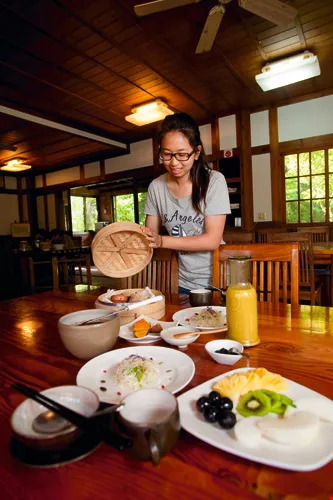
7:00 AM: Prepare healthy, nutritious breakfasts for the guests.


@List.jpg?w=522&h=410&mode=crop&format=webp&quality=80)


