From an Elite Taipei High School To Cultivating the Bunun Tribal Elite
Teng Sue-feng / photos Lan Chun-hsiao / tr. by Jonathan Barnard
September 2010


"Look how many resources Bukut-one person-has discovered for the Bunun! The goal of Vox Nativa is to seek out and cultivate more people like Bukut." So says Liao Dashan, a mover behind the planning of Vox Nativa who has retired from teaching at Taipei's prestigious Jianguo Senior High School. Liao has spared no effort in calling for her colleagues and students to get involved and create a path toward modernization for Bunun children.
Yanwei, a fourth grader who lives in the Shuanglong tribal settlement in Xinyi Township is one of the 40-some original members of the Vox Nativa choir. Every time the choir practices, he has to walk half an hour to the bus provided by Vox Nativa. But he's never missed a practice. One day the bus left without him. Many students would have simply decided to skip class that day, but Yanwei ran home and pleaded with his uncle to drive him to practice on his motorcycle. His commitment greatly moved his teacher.
The first semester that Vox Nativa recruited students, Shuanglong sent eight students to the choir. Seven of them ended up dropping out, feeling that the long trek to practice was too much of a burden. Only Yanwei stayed on. The teacher asked him: "Why didn't you give up?"
"If I quit," he replied, "then Vox Nativa won't come to recruit students here any longer, and my younger brothers and sisters won't have a chance to join."
But Yanwei has a big problem: He often doesn't do his homework. "He's very diligent about coming to class but isn't so diligent in class," says Liao Dashan, the director-general of the Vox Nativa Association. Yanwei's parents work down in the lowlands, and he lives with his grandmother, who runs a small karaoke parlor. When Yanwei returns home, he's got to cook and help his younger siblings wash. And the grandmother has no energy left over from work to prod Yanwei to do his homework.
Yanwei's school performance has posed a big headache for Vox Nativa's teachers, and they discussed giving his place to another child. "We can't waste limited resources," says Liao. But they worried that if they cut him loose, he might drop out of school, or his family elders might force him to get a job. So everyone agreed to continue to observe Yanwei's performance and encourage him to take steps to improve.

Dongpu is a Bunun village famous for its hot springs and mountain scenery. The elementary school sits at the center of the village and also of a dream to cultivate Taiwan's equivalent of the Vienna Boys Choir.
Borrowing a corner of the Dongpu Primary principal's office, Liao handles such matters as training volunteers, deciding whether to accept various performance offers, and providing briefings on Vox Nativa's educational principles to visitors from afar.
In June, Vox Nativa was invited to perform for the Chiayi Business Advancement Association. After association members heard these adorable children sing, they opened up their wallets, contributing NT$1 million. During summer vacation, they delivered the money and took advantage of the opportunity to visit with their young friends.
In her briefing, Liao stated that most children have middle-range academic aptitude, and the schools can handle those children well. For the disadvantaged kids on the left end of the curve there is Richard Lee's Boyo Social Welfare Foundation and the Ministry of Education's After-School Alternative Program. Elite children in the cities, moreover, don't lack for opportunities. But what about the academically gifted children in the mountains? Could it really be that there are none?
"Vox Nativa wants to make up for this lack," Liao says. In front of Han Chinese, Aborigines tend to harbor feelings of inferiority. They withdraw, and take defensively sneering attitudes. They tend not to be go-getters and "can seem almost hopelessly happy-go-lucky," she says. "But if you help and encourage the highly talented minority, their achievements can be very impressive."
She admits that whenever she mentions "the elite," she gets an earful: "How typical of a Jianguo Senior High School teacher! You only care about the elite!"
"We want to educate future doctors, lawyers and teachers," says Liao. "Tribal settlements have people who suffer from gout and other chronic ailments, so they need doctors. They need lawyers so their land won't be taken from them by Han Chinese. And these tribal settlements even more need teachers willing to stay up in the mountains, so the people there can have brighter futures."
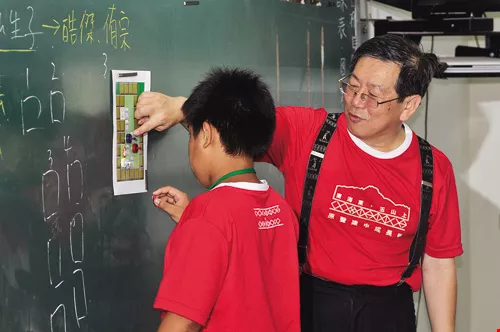
Math, civics, languages... the summer camp features a rich and varied curriculum. Some of the "big brothers" who serve as counselors captured some crickets. By dissecting them, the campers gain an understanding of the anatomical structure of living beings.
When Liao retired at 55, she first only thought of taking it easy and enjoying herself. It was only by an unexpected twist of fate that she got involved in Vox Nativa. In 2004 the Teco Technology Foundation was holding an "arts and English" camp at Xinxiang Elementary School in Xinyi Township, and it needed two more volunteers. One of Liao's students asked for her help, and she became the camp's oldest counselor.
During the evening of the first day of that summer camp, the children were practicing singing, rehearsing "Pislahi" ("The Hunting Ceremony Song"). "At the first notes, I got goose bumps," recalls Liao. "There were tears streaming down my face, I was so moved."
Liao was a teacher for 30 years and has helped to cultivate numerous highly successful and talented individuals. Her first class included Luo Lunyou, who is Greater China president for a transnational financial group. Knowing that his former teacher was on the verge of retirement, Luo took the initiative to ask her if there was any way that he could help her realize her dreams.
At her student's constant urging, Liao Dashan, who has always had modest material desires and a strong sense of gratitude toward those who have helped her, turned her focus toward helping to realize Bukut's dreams.
What with her initiative, encouragement and determination, Liao reminded Bukut of his mother, who has passed away, so he gave her his mother's Bunun name: Akuan, which means "capable woman."
At the beginning of 2007, "Teacher Akuan" came to learn that Huang Sheng, acting president of National Taiwan Normal University and one of Liao's own former teachers, was looking for an Aboriginal performance group to bring to Thailand. The Rajabhat Universities in Thailand are sister schools with NTNU, and the third of a series of world symposiums on indigenous peoples and ecological diversity was being held there, so it was hoped that Taiwan could show its support by sending an Aboriginal performing arts troupe.
With Akuan's forceful support, the choir from Dongpu Primary prepared to make the journey. Although the organizers in Thailand would provide room and board, Vox Nativa was required to come up with NT$700,000 for airfares. Liao had no experience with raising money, so she had no choice but to thicken her skin and approach colleagues and friends. Back then the Vox Nativa Association hadn't been created yet, so they had no way of providing official receipts for charitable contributions. "All the money was deposited in my personal account. It was really moving. The people of Taiwan are truly a generous and loving people!"
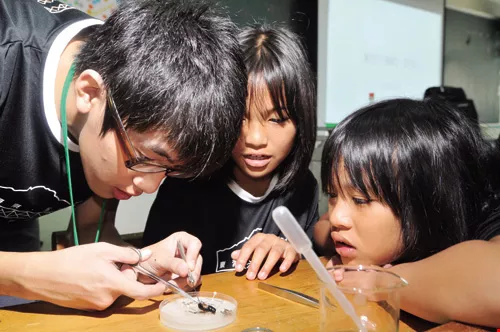
Math, civics, languages... the summer camp features a rich and varied curriculum. Some of the "big brothers" who serve as counselors captured some crickets. By dissecting them, the campers gain an understanding of the anatomical structure of living beings.
With Liao's superhuman initiative and executive abilities, she was able to recruit more than 60 volunteers for the Vox Nativa Association, including Jianguo's principal, other teachers at the school, and former students. She pulled in Sun Lanfang, a retired biology teacher from Jianguo, to serve as secretary-general and handle accounting duties. In 2008, after the Vox Nativa Music School was established, the two of them often scurried back and forth between Taipei and Dongpu, bringing various resources with them.
In 2008 some members of the Dongpu Primary School choir were just about to graduate, so Bukut wanted them to have a keepsake of their time with the choir, and the association provided NT$600,000 to shoot a video of them performing entitled Let's Sing! (The 8000 DVDs were all provided by Ritek and U-Tech). The effort ended up winning the special jury prize at the 2009 Golden Melody Awards.
These bookworms, however, didn't understand distribution, so they simply put the 4000 DVDs they burned for sale on their website (http://voxnativa.org). It was like taking a boat out on the water and hoping the fish would jump in. But thanks to word of mouth and the publicity the choir has gained from appearing in various commercials, the DVDs started to sell, and now there are only some 300 left. Yet there's still some work to do on this front.
When Typhoon Morakot struck last year in early August, it washed out the road that provides access to Dongpu, and the village became cut off. The Vox Nativa choir wasn't able to start practicing again until the end of September, which derailed plans to attend the World Choir Games in mainland China during July of this year (since Vox Nativa couldn't submit its application recordings on time). But unexpectedly the Sing It! DVD earned the choir a chance to go the World Expo in Shanghai.
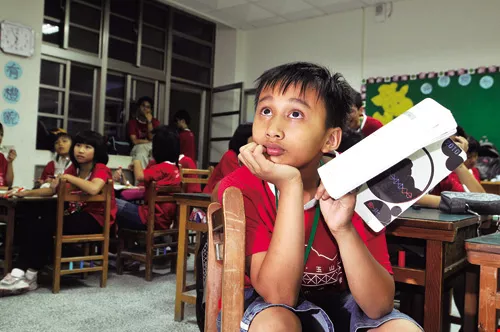
Math, civics, languages... the summer camp features a rich and varied curriculum. Some of the "big brothers" who serve as counselors captured some crickets. By dissecting them, the campers gain an understanding of the anatomical structure of living beings.
The children were thrilled that they could get on an airplane and go overseas, but Liao is clear about the focus of Vox Nativa: "Performances or competitions are just a ticket to world travel for these children. Vox Nativa intends to care for and guide the children through college. We've made a 10-year promise with the children that each and every one of them will have the power and right to choose his or her own future."
Vox Nativa estimates that it requires about NT$8000 per student, per month (about NT$100,000 over the course of a year). In all, it needs about NT$10 million per year to operate.
Apart from working hard to raise money, an even larger difficulty is finding teaching resources for the children: When the children enter junior high school, they inevitably face academic pressures with regard to passing the entrance exams for senior high school. Mathematics in particular is a discipline more suited to Western or Han Chinese modes of thought. For Bunun children, math often seems an unfathomable riddle.
Bukut discovered Lin Yicheng, the principal of Nantou's Qingshui Elementary School, who has been researching "constructive mathematics" for 20 years. Patiently, he teaches via "mathematical conversations," finding situations in everyday life to foster a love of mathematics among the children. Lin will take children out to a trapezoidal plot of land, asking them to divide it equally for planting three crops. This teaches them about drawing triangles. Questions about how much seed to sow, how much manure to apply, and so forth also require developing mathematical conceptions. Through these hands-on life experiences, he develops confidence and interest in mathematics among the children.
Setting out from Taipei at 8 a.m., foreign teachers from the Association for Empowering Fundamental English Education come every Saturday to hold class.
"It is only through the good works and generosity of many," says Liao, "that we can achieve success."
In order to realize the ideal of "putting Aborigines on a path toward modernization," Vox Nativa has engaged in much internal discussion and debate. What if these children embark on bright futures only to be assimilated into Han Chinese society like so many of their forerunners, demonstrating an unwillingness to return to the mountains and give something back to tribal society?
"That would show that they have the ability to live down in the lowlands-and in fact are 'returning home' after being displaced from there by the Dutch, the Japanese and the Han Chinese," says Liao. "Let nature return to nature."
Vox Nativa has set this mid-to-long-term goal for itself: In 2012, at the seventh World Choir Games in the United States, "We want to take the gold," so that "Taiwan's Vienna Boys Choir" can make a name for itself on the world stage.
@List.JPG?w=522&h=410&mode=crop&format=webp&quality=80)


