New Year Minus One--Single-Parent Families
Lin Hsin-ching / photos Hsueh Chi-kuang / tr. by Geof Aberhart
February 2011
Statistics from the Ministry of the Interior show that between 1990 and 2010, the number of single-parent households (unmarried, divorced, or widowed-separations were not counted) with at least one child under 18 rose from 250,000 to 320,000. Such families now account for 4.04% of Taiwan's 7.92 million households.
At this time of year when relatives come together, these families can be haunted by the missing element, with the adults being confronted by the hidden scars left by losing a lover, and the children having to face once again the empty chair at the family table. This "holiday depression" is something that all single-parent families have to work hard to overcome.
"The first time I ever thought that maybe I'd be better off dead was Chinese New Year's Eve that second year after the divorce," says 49-year-old Mr. Fu.
Seven years ago, Mr. Fu's wife, 11 years his junior, suddenly left her family with no warning at the urging of friends online. Behind her she left not only a NT$1 million credit-card debt, but also three children aged under 10. She said she left because she wanted her freedom and didn't want to be tied down by a family. Eventually, the two decided to divorce.
"I never felt like I could escape the shadow her leaving cast over us. I could keep myself busy at work, but the moment I had some free time, it hit me hard," he says. That first Chinese New Year, he had work to do and was able to give the kids to relations to take care of, which made things easier. The second year, though, he and the children had a lonely New Year's Eve meal, the memory of past, vibrant holidays hovering over their heads.
Once dinner was done, Mr. Fu shut himself away in his room, his mood so low he couldn't bear being with his children. All he could think about was whether he wouldn't be better off just ending it all. "The kids noticed something was up with me and got right in touch with my best friend. He brought some drinks over, and once the alcohol caught hold of me, I just broke down in tears. The kids did too," he says. "Once all the negative feelings were out, though, I felt much better, and I wiped away the tears ready to start again with the New Year. After all, I still had three kids to raise!"

Starting in the third year after his divorce, Mr. Fu set about picking himself back up by getting actively involved in single-parent-family support groups, taking part in counseling and sharing his experiences. "When you realize that your situation isn't as terrible as it could have been, you really do start feeling better," he says.
Since then, every Chinese New Year he's taken his kids to attend special banquets for single-parent families organized by groups like Tzu Chi and Dharma Drum Mountain. The upbeat atmosphere helps them shake off the feeling of being hemmed in by their sorrows, as well as offering a great way to make new friends. These last few years have helped the Fus break free of the specter of "New Year's depression."
Mr. Fu's experience is far from unique. Mr. Zhu, widowed 15 years ago, and Ms. Su, a twice-divorced mother of three, both agree that the first couple of years after losing their partners were the hardest. The problem was not only the feeling of emptiness they and their children had to face, but also the hypersensitivity and pitying looks of family and friends, which were a second assault on their already fragile emotions.
Mr. Zhu recalls that when his wife, a lupus sufferer, passed on, it was only a couple of months before Chinese New Year. As he and his two children prepared to head off to visit family in Hsinchu, his father was worried that he wouldn't be able to take care of the kids alone, and anxious about the days ahead.
"My friends and family were so concerned and it made me even sadder, but to stop them worrying, I put on a front, helping comfort them to show that the kids and I would be fine and that things weren't as bad as everyone thought," says Mr. Zhu. After a few years, though, the excessive sympathy dissolved, and the three were able to go back to ordinary New Year holidays.
Ms. Su, meanwhile, faced the additional problem of cultural factors. Having been divorced twice, her family considered her "married off," and so on Chinese New Year's Eve and Day, she couldn't go home because traditionally for a married daughter to do so is considered a bad omen. Instead, she had to spend the time with only her children.
"Those first few years were not easy, but time heals all wounds, and I eventually realized that a day spent smiling is as much a day as one spent crying, so why not just try and smile and have a fun New Year?" Ms. Su, who works as both a cleaner and an estate agent, still has the pleasure of having her children come home every Chinese New Year, even though they're all fully grown and studying away from home. "We may not have the most things, but we have a lot of love, and we always spend the Lunar New Year vacation chatting and having fun. Who says single-parent families can't have a good time during the holiday?"


If single parents need time to get over "New Year Syndrome," then what about the children, still young and unable to understand why a parent is gone? How can we help them during this undoubtedly low time?
Executive director of the Child Welfare League Foundation Alicia Wang notes that adults often think that since their children are so young, they don't know what's going on, and sometimes even don't seem to care, which makes the remaining parent unwilling to explain. Children, though, are more sensitive than we often imagine, and can see the anxiety and hurt their father or mother is going through as Chinese New Year approaches. It's just that sometimes they don't let it show. And with television bombarding us with images of big, happy families every Chinese New Year, children of single-parent families are constantly reminded that their families aren't like everyone else's.
Wang suggests that since single-parent families are already past the point of no return, the remaining parent may as well come clean to the children and help them really understand why Mom and Dad split and what their situation is now. "Single parents and their children have to become confidantes, and although it can take time, they can still create a warm Chinese New Year atmosphere. In the long term, this will also help everyone's mental health."
In addition to these problems, though, many single-parent families find themselves left in bad financial situations. Wang reminds us that around Chinese New Year, many poorer families are under even greater pressure from their inability to scrape together enough money; this is when non-governmental and public resources need to be marshaled to help these families weather the financial and psychological storm.
The Child Welfare League Foundation, for example, delivers New Year's meals worth NT$2,000-3,000 to 700-800 impoverished families every year, and each child can collect a red envelope containing NT$200-500. "Showing them that society cares for them can provide comfort and hope, helping them get back on their feet," says Wang.
The feeling of emptiness when someone is gone can be a difficult thing to shake off, but we should never let ourselves or our children be dragged under by negativity. With honest communication, support from friends and family, and the assistance of society, single-parent families can make their way out of the valley and into a brighter New Year!

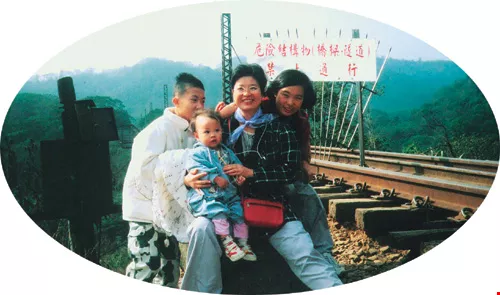
Ms. Su, who has been married twice, and her three children now treasure every moment together, even going on family outings during Chinese New Year.