Summoning the Divine--Celebrating the Third Prince's Birthday
Tsai Wen-ting / photos Chuang Kung-ju / tr. by Julius Tsai
January 2005


On the ninth day of the ninth lunar month, the birthday of the Princely Lord Nezha is celebrated. Beginning in the second half of the eighth lunar month, incense associations from all over Taiwan make a pilgrimage to the most magnificent of temples dedicated to Nezha, Sanfeng Temple in Kaohsiung, as well as Kaichi Temple in Hsinying. Two or three days before the celebration of the god's birthday, devotional activities reach a climax. These rites are the grandest of the popular religious festivals of the latter half of the year.
Moreover, the Princely Lord's unbending integrity, divine form as a child, and childish impulsiveness attract spirit-mediums from all over to come and vie with each other in their spirit-summoning and in acts of courage.
On the eve of the ninth day of the ninth month, all of Sanfeng Temple seems like a coliseum of competing spirit-mediums.
One of them, red-faced as if inebriated, and garbed in the patched robes of the monk known as Jigong (Crazy Ji), holds a palm fan in one hand and a gourd of wine in the other as he staggers up the steps to Sanfeng Temple. Off to one side, a female spirit-medium from another temple wears the green garb of a traditional heroine and imitates the posture of the Third Prince (Nezha) treading a wheel of wind and fire. With one hand upraised, she bounds up the 21 stairs to the temple on her right foot, all in one go.
Inside the main temple hall, a junior high school girl induces dry heaves while a companion waves three sticks of burning incense in front of her nose. It is said that this "consuming of the incense" enhances communication with the gods and accelerates a person's entry into a state of receptivity to the spirits. "What's the matter? Is it not 'catching?' Why don't you let her ingest the smoke from 36 incense sticks at once, to make things go faster?" Despite these words from bystanders, the young girl's companion replies, "We can't do that because that would be too strong a dose of incense smoke. We just have to take it slowly."
Suddenly, a spirit-medium in his 70s falls with a crash to the ground. He begins to kick his legs, fuss, and make childish sounds. "The Princely Lord has descended. Quick, bring the pacifier!" Now with pacifier, the old spirit-medium begins to giggle.
A pilgrim shouts, "Three spirit-mediums in the hallways have also started to act up!" The crowds begin to throng into the already packed corridors of the temple.
The three spirit-mediums nod their heads fiercely to the enthusiastic accompaniment of gong and drum. Their companions let them ingest the smoke from incense braziers. The spirit-mediums enter into a trance. One of them takes up the burning incense and passes it before his face and over his body. Elderly women looking on cry out in alarm, "Oh! You'll burn yourself to death!" Another of the mediums allows his companion to pierce his cheeks with a 60-centimeter needle. Finally, yet another of the spirit-mediums takes up a sharktooth saw and fiercely hacks away at his backside, the blood dripping down drop by drop....
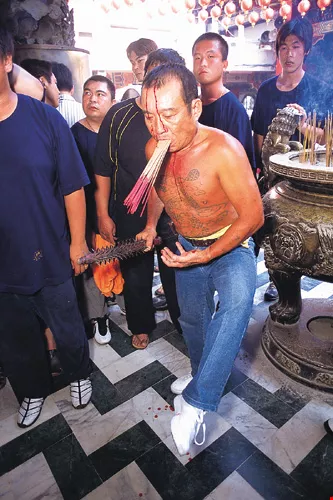
Piercing the cheeks with a long needle, walking blindfolded, holding burning incense in the mouth, or transforming into drunken Jigong, the birthday of the Third Prince Nezha every year brings spirit-mediums from temples all over to come to offer their prayers and display their spiritual prowess. It is truly an eventful gathering of spirit-mediums.
Carving bones
Why have so many spirit-mediums come to Sanfeng Temple, and why do they experience such vivid bouts of possession? To answer these questions we need to begin with the story of Nezha, also known as the Third Prince.
The Third Prince is a child-divinity who is known by such names as the Jade Emperor's Princely Lord, Prince Nezha, the Princely Marshal, and the Marshal of the Central Altar. According to popular tradition, the Princely Lord was one of the attending generals to the Jade Emperor. He later descended to earth as Nezha, the third son of Li Jing, the Celestial King Tuota. Nezha was extremely intelligent and a peerless warrior. When he was ten years old, he got involved in a fight with the son of the dragon king of the Eastern Sea. In his anger, Nezha killed the son of the dragon king and stripped the corpse of its tendons. When the dragon king marshaled his armies to punish the offender, the resolute Nezha, unwilling to implicate his parents, stripped off his flesh and scraped away his bones to redeem his mother and father. Fortunately, his teacher, the Perfected One of Taiyi, used the leaves and branches of a lotus to reconstitute his scattered hun and po souls. After his resurrection, Nezha came to wield magical weapons granted him by his teacher, such as the wind and fire wheel, flaming spear, silk of the primordial heavens, and ring of the trigrams qian and kun. He became the martial deity most relied upon by the people to quell and exorcise demonic forces.
Due to his fierce character, potent supernatural powers, and his office as the Marshal of the Central Altar with command over the heavenly hosts and chariots of the divine encampments of the four cardinal directions, Nezha has become the protective deity for almost every god, and his cult may be found in almost every temple. When the Taoists practice their magical rites, they invariably call upon this divine marshal to exorcise the demonic. Thus, Nezha has also become the main object of devotion for many altar-side spirit-mediums of the popular religious traditions. For this reason one sees not only prayers offered to this divinity, but also a scene of lively competition at the temples and among the spirit-mediums around the altar whenever the birthday of the Princely Lord comes around.
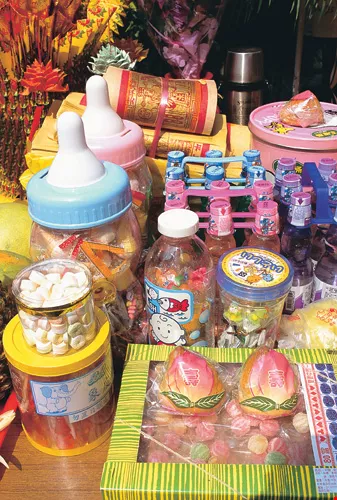
Devotees show that their love for the Third Prince is like the love for a child. Here, they offer up longevity peaches, soda, as well as jars of candies shaped like baby bottles.
Sanfeng Temple
Kaohsiung's Sanfeng Temple and Hsinying's Taitzu Temple (in Tainan County) are the most representative of temples dedicated to the Princely Lord.
Sanfeng Temple is located in the old neighborhood of Santetsu. Due to its proximity to Kaohsiung Port, and the river connecting it, this was an important distribution site for Kaohsiung goods in earlier periods. A place where the wealthy congregated, this was one of the nine largest districts of Kaohsiung during the Qing Dynasty. Similar to Lungshan Temple in the Wanhua District of Taipei, one can tell from its address that Sanfeng Temple occupies a place with a venerable history and an important location. Today, one can still find right outside the temple over a dozen traditional medicine shops, the scent of herbs and incense combining to form a unique and ancient aroma.
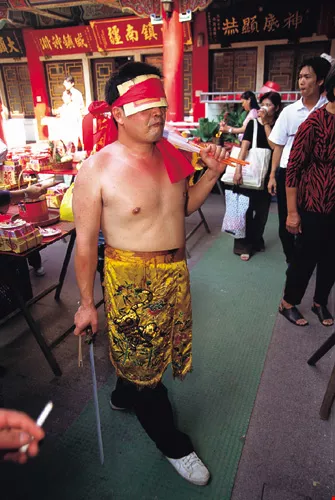
Piercing the cheeks with a long needle, walking blindfolded, holding burning incense in the mouth, or transforming into drunken Jigong, the birthday of the Third Prince Nezha every year brings spirit-mediums from temples all over to come to offer their prayers and display their spiritual prowess. It is truly an eventful gathering of spirit-mediums.
The Princely Lord returns home
In popular religious tradition, whenever the spirits and incense of a main temple are distributed to its branch temples, representatives of those branch temples will return to the main temple on the eve of the god's birthday. Not only does this augment the fire that burns in the incense burner at the main temple, but the icons from the branch temples that are brought back to the main temple with the devotees as they stay for a few days at the mother temple are said to be "recharged" after the visit.
On the eve of the Princely Lord's birthday, representatives from the branch temples will come to receive back the icons that have been recharged by their visit here at Sanfeng Temple. On the weekend immediately preceding the god's birthday, more than 500 incense associations will come to Sanfeng Temple each day, with pilgrims vying for the more than 1,000 spots available. Those who are veterans at this know that during the pilgrimage one has to reserve next year's spot to be assured a place.
Incense associations that have returned for the ritual rekindling of incense fire shield their incense braziers from the sun with black umbrellas. Upon entering Sanfeng Temple they first step over the incense burner of the Heavenly Lord, then enter into the main hall for the opening of the little wooden door of the main incense burner. After the chief executive of Sanfeng Temple has filled the incense burners of the branch temples with the ashes from Sanfeng Temple's incense burner, the little door is again sealed up with a red seal. This marks the end of the ritual rekindling of the incense fire.
Comments Tsai Tsai-yuan, chief executive of Sanfeng Temple, "This is a kind of mutual hosting between the gods and the people. This kind of interchange means that, in the future, whenever there are activities at those temples represented here today, the chief executive of our temple will also be in attendance to offer up our blessings."
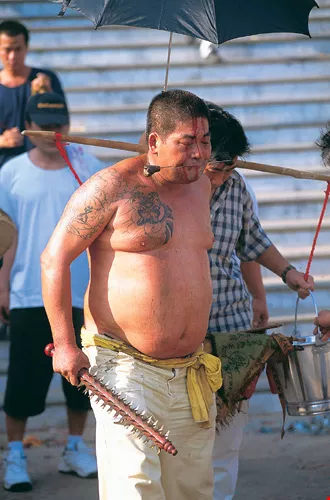
Piercing the cheeks with a long needle, walking blindfolded, holding burning incense in the mouth, or transforming into drunken Jigong, the birthday of the Third Prince Nezha every year brings spirit-mediums from temples all over to come to offer their prayers and display their spiritual prowess. It is truly an eventful gathering of spirit-mediums.
Exploding the Third Prince
At eight in the evening, on the eve of the god's birthday, the steps leading up to Sanfeng Temple are already filled with people. Locals know that the last incense association to arrive is from nearby Tiantzu Temple, and that according to tradition this entails the "consuming of the fireworks" to celebrate the birthday of the Third Prince.
The expansive temple square has been cleared away, and the cars around the temple's parking lot have for the most part been moved. Staff from Tiantzu Temple drive in with microbuses filled with fireworks, laying them out in a weblike array in the temple square.
Right at eight, fireworks burst forth in the sky above Tiantzu Temple. With the spirit-mediums in front and the Third Prince's palanquin behind, the party advances with wave after wave of skyward fireworks bursting in all directions in the dark night sky. The youth bearing the palanquin that houses the divine icon proceed fearlessly though the firework-filled square and advance slowly towards Sanfeng Temple. Amidst earsplitting fireworks and clouds of thick smoke, they rhythmically pace out the pattern of the seven stars of the Dipper.
After this first round, the staff from Tiantzu Temple arrange a waist-high heap of fireworks in the temple square. The palanquin is to pass right over this heap of fireworks. In front of and behind the heap, a dozen or so youth clasp arms and ready themselves for a fiery baptism. The fireworks are lit, and amidst their fierce flashing, the youth, garbed in long sleeves, long pants, and with no protective headgear whatsoever, do not so much as flinch.
Only after passing through three heaps of fireworks does the procession carry the palanquin into the main hall of the temple. After setting it down, the youth consume glass after glass of milk, a sharp contrast to their divinely-protected fierceness just a moment ago.
"It's not good to inhale too much of the smoke, so the elders tell us to drink milk," says one of the youth. They also say that it of course hurts when the fireworks land on one's body, but that all one needs to do is to fast and maintain a sincere heart, which will assure the protection of the Third Prince. In all these years, no one has gotten hurt at this event. However, the youth do need to make sure that they get flattop haircuts. Otherwise "your hair will be singed into a perm!"
Why is this rite of consuming the fireworks needed? The leader of the youths says, "Our Prince is a god who is especially fond of playing with fireworks. No matter how fierce the fireworks are, Nezha can still withstand them." In fact, when compared to similar rites associated with the pilgrimage devoted to Matsu in Peikang held every year, one can find that aside from signifying purification, the consuming of the fireworks also serves to display the courage of the palanquin-bearing brethren and to testify to their protection by the gods.
Amidst the sounds of the fireworks, and after several climactic waves, the youth gloriously bear the palanquin back to Tiantzu Temple, reverencing the deity with three ritual obeisances and nine kowtows. They do this to thank the Third Prince for his awe-inspiring divine protection. To these youth, just in that rebellious, indignant stage of life, the Third Prince's fearless challenging of authority as well as his hot-blooded attack on the son of the dragon king seems to suit them perfectly.
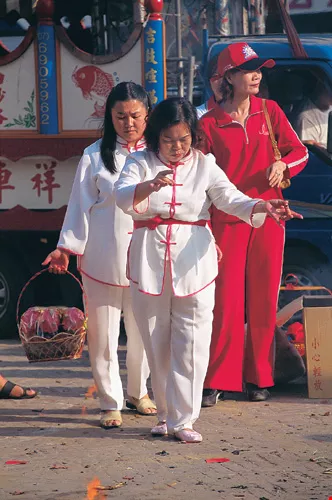
Piercing the cheeks with a long needle, walking blindfolded, holding burning incense in the mouth, or transforming into drunken Jigong, the birthday of the Third Prince Nezha every year brings spirit-mediums from temples all over to come to offer their prayers and display their spiritual prowess. It is truly an eventful gathering of spirit-mediums.
Happy Birthday
With the climactic rite of consuming the fireworks completed, the incense associations gradually return to their temples, and a measure of quiet returns to Sanfeng Temple.
On the morning of the ninth day of the ninth month, one finds a different arrangement at Sanfeng Temple, its main gates now sealed shut. The eaves and halls are adorned with red lanterns and propitious garlands are set out, contributing to the festive mood of this birthday.
The auspicious hour of six o'clock arrives, the temple gates open, and the sacrificial officiant appears in a long, collared robe. He is followed by temple committee members bearing incense burners, lanterns, and fans. Slowly they proceed to the altar at the temple square and sacrifice to Heaven, thus informing the Jade Emperor of the day's rites, and inviting all of the heavenly divinities to join in the celebration.
After the sacrifice to Heaven, the birthday celebrations formally commence. Thrice are the drums beaten and the bells sounded. The main drum sounds forth 108 times, and with a second and then a third round of drumming, the arriving divinity is joyfully welcomed. The sacrificial officiant reads out a blessing, offering three obeisances and nine kowtows. After that, three offerings are advanced. When the god has enjoyed these offerings, he is sent off with a burnt sacrifice of paper money, houses and other paper offering goods. With the rites completed, the offerants withdraw. The temple staff, who have busied themselves for the past half month or so, finally breathe a sigh of relief.
On the day of the god's birthday itself, there is not the commotion of the incense associations, but rather the sight of young and old coming to advance their sacrificial offerings and birthday wishes. On the offering table, aside from the traditional longevity peaches and noodles, one can also find Western-style birthday cakes, some even with candles. More interestingly, one can also find bubble gum, mint candies, toy cars, marbles, and pacifier-shaped candies, all offerings that a child would love. From these thoughtful offerings one can see that, aside from revering the Third Prince, the people show an additional measure of tender love for him. Who knew that there could be such closeness between the gods and the people?
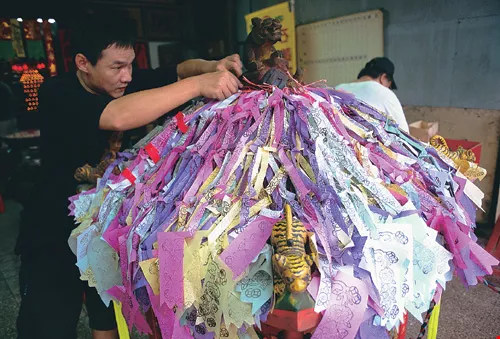
With the divine palanquin exquisitely adorned with paper money, Tianhsi Temple in Kaohsiung puts on the annual rite of "consuming the fireworks" to celebrate the Princely Lord's birthday.
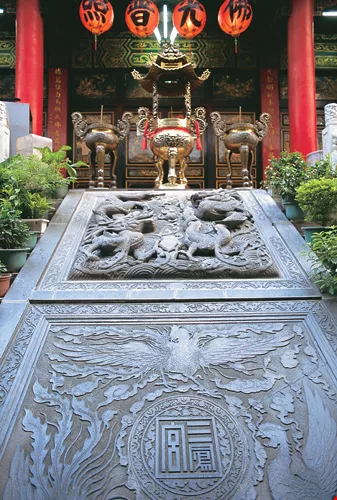
At Sanfeng Temple in Kaohsiung, which takes the Third Prince as its main deity, the incense fires burn resplendently and the temple has produced innumerable branch temples. The temple is one of the most important temples dedicated to the worship of the Princely Lord.
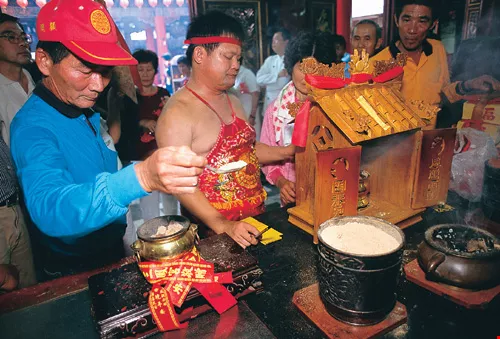
Scooping up the ashes from the incense burner of the main temple into their own incense burners is a way for branch temples to return to their source and be recharged, enhancing their own spiritual power.
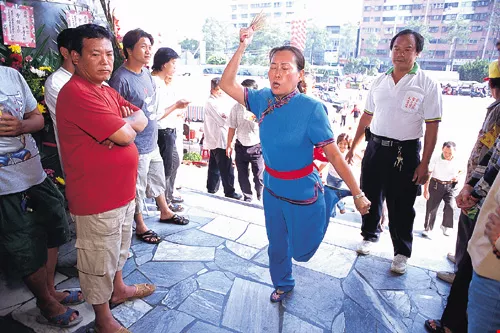
Piercing the cheeks with a long needle, walking blindfolded, holding burning incense in the mouth, or transforming into drunken Jigong, the birthday of the Third Prince Nezha every year brings spirit-mediums from temples all over to come to offer their prayers and display their spiritual prowess. It is truly an eventful gathering of spirit-mediums.
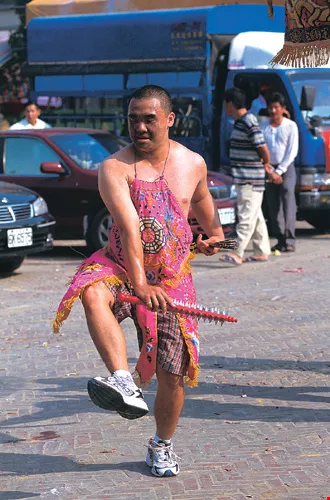
Piercing the cheeks with a long needle, walking blindfolded, holding burning incense in the mouth, or transforming into drunken Jigong, the birthday of the Third Prince Nezha every year brings spirit-mediums from temples all over to come to offer their prayers and display their spiritual prowess. It is truly an eventful gathering of spirit-mediums.
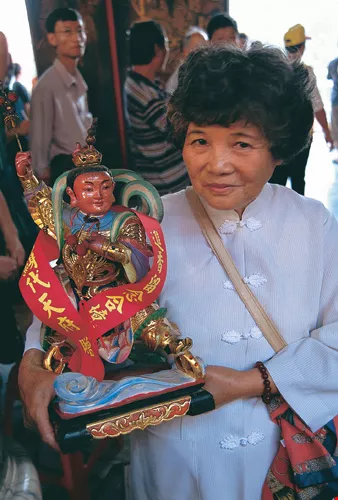
The gods protect humans, and humans care for the gods. This elderly grandmother reverently cradles the icon of the Third Prince, showing how close the relationship between human and divine can be.
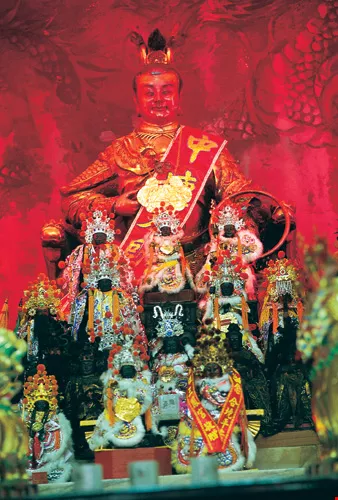
With a wind and fire wheel underfoot, wielding the ring of the trigrams qian and kun, and wearing the silk banner of the primordial heavens, the Third Prince, who has taken the divine form of a child, is deeply revered and loved among the people.
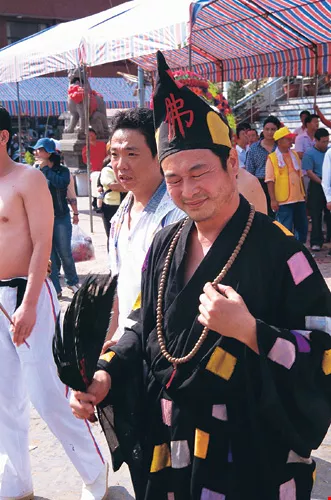
Piercing the cheeks with a long needle, walking blindfolded, holding burning incense in the mouth, or transforming into drunken Jigong, the birthday of the Third Prince Nezha every year brings spirit-mediums from temples all over to come to offer their prayers and display their spiritual prowess. It is truly an eventful gathering of spirit-mediums.

@List.jpg?w=522&h=410&mode=crop&format=webp&quality=80)


