Palpable Poetry:
Exposed Aggregate Concrete
Cathy Teng / photos by Lin Min-hsuan / tr. by Brandon Yen
July 2025
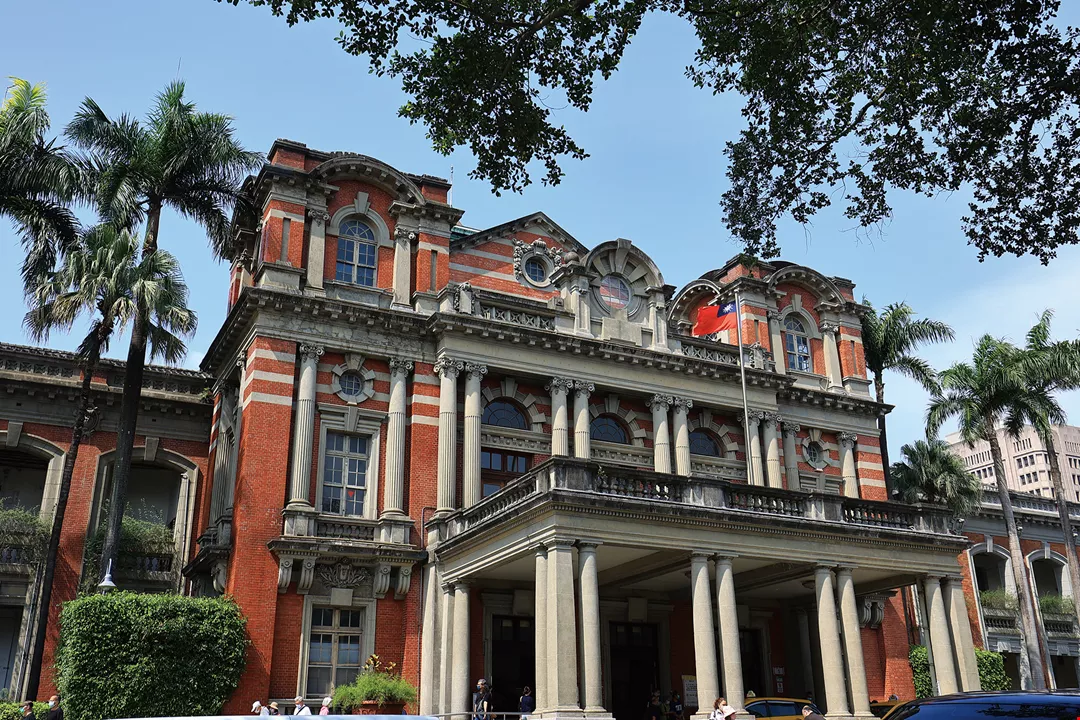
Exposed aggregate concrete can be used on different structural elements and can take a wide variety of shapes. This photo shows the Museum of Drinking Water in Taipei’s Gongguan area.
Visitors from far and near come to Taipei’s Dihua Street to experience the bustling energy and warm hospitality in the clusters of shops selling traditional dried foodstuffs. Architectural styles from different eras complement each other here, with numerous buildings dating from more than a century ago. Light gray exposed aggregate concrete is seen on the external walls amidst red bricks, gracing the European-style façades of the terraced houses, or achieving perfect harmony with brick structures. It’s not too far-fetched to say that exposed aggregate is one of the most authentically Taiwanese architectural features.
Unlike the warmth of red brick, or the austere simplicity of popular béton brut, exposed aggregate at once imitates the heavy solidity of stonework and regales our eyes with its rich textures. Lending itself to remarkably different shapes, and conveying the loving care of traditional craftsmen, exposed aggregate gives buildings a great diversity of looks and a great deal of charm.
An alternative to stonework
Exposed aggregate concrete (a.k.a. washed concrete or washed terrazzo) is a type of surface finish used by builders. Typically, a mixture of cement and small stones is applied to the surface of a building. Before it dries, the top layer of the cement is washed off with water to expose the stones (aggregate) underneath, thus creating a richly textured surface.
The main purpose of exposed aggregate is to mimic the look of stonework. Yeh Jun-lin, assistant professor of architecture at Chung Yuan Christian University, explains that considering the dearth of building stone and the high cost of quarrying, exposed aggregate is a more accessible material which helps expedite construction and reduce expense.
Though common across Taiwan, exposed aggregate did not originate here, but was introduced from Japan as one of various rendered surface finishes comprising decorative aggregates in a cement matrix. The mix may be left to set and then ground smooth to create a polished terrazzo finish, or some of the matrix may be removed while still soft to expose the aggregate, by spraying with water or by using a brush or sponge, or the surface may be sculpted using a blade, thus giving a variety of textures. “Exposed aggregate is extensively used in Japan, but not as much as in Taiwan,” Yeh says.
.jpg?w=1080&mode=crop&format=webp&quality=80)
Various combinations of exposed aggregate, red bricks, and wall tiles give buildings richly textured looks.

photo by Jimmy Lin
.jpg?w=1080&mode=crop&format=webp&quality=80)
Exposed aggregate imitates the solidity of stonework but has a very tactile texture. Lending itself to an infinite variety of shapes, it also expresses the artistry of its makers.
courtesy of Yeh Jun-lin
From flat to three-dimensional
As well as the beauty of the material itself, exposed aggregate also derives its charm from its versatility and from the ingenuity of craftsmen. Exposed aggregate can be applied to flat surfaces, or used for more complex three-dimensional shapes—either sculpted by hand or cast in molds. The two-dimensional type is more common: it is often seen on the external walls of buildings, and on columns or steps, serving to protect internal structures.
The hand-sculpted type, on the other hand, draws inspiration from the conventional use of stucco as a decorative material. Yeh tells us that craftsmen begin by making a skeletal framework from copper or steel wire. A cement paste is applied to this armature and then carefully carved by hand before a layer of concrete is applied and washed to expose the aggregate. The result looks very similar to stone sculptures. This type of exposed aggregate sculpture relies on the skills of makers who have an eye for beauty and plenty of practical experience. Yeh says that many of the examples we see across Taiwan are the works of craftsmen specializing in cut-and-paste ceramics (jiannian, ornamental pieces made by assembling pottery shards).
Hand-sculpted exposed-aggregate works gave rise to the idea of using molds to produce ornaments. When making repetitive use of the same designs to decorate a big area, “it would take too much labor to create every single item from scratch. Craftsmen are very clever. They use molds to turn out replicas when significant numbers of them are required,” Yeh says.
.jpg?w=1080&mode=crop&format=webp&quality=80)
The Taipei Beimen Post Office, whose external walls sport large areas of ribbed tiles complemented with exposed-aggregate decorations.
A quietly beautiful presence
The most representative building in Northern Taiwan from the early part of the Japanese colonial era (1895–1945) that makes extensive use of exposed aggregate is the pump room of the former water treatment facility in Taipei’s Gongguan area (now the Museum of Drinking Water). Built in 1908, its external walls boast an abundance of exposed-aggregate decorations. Either sculpted by hand or cast in molds, the Ionic capitals, garlands, and foliage patterns fully exploit the potential of exposed aggregate concrete as an alternative to natural stone.
Exposed aggregate was widely used as an external wall finish in Taiwan during the decades between 1910 and 1970. In the 1930s, with the introduction of wall tiles, people began to decorate walls by combining exposed aggregate, red bricks, and tiles in various ways. Finished in 1930, the external walls of the Taipei Beimen Post Office building feature not only large areas of ribbed tiles but also exposed-aggregate ornaments on the pediments, the capitals, and the aprons beneath some of the windows. The frontage of the Government-General of Taiwan’s Taihoku Hospital (now the West Campus of National Taiwan University Hospital), which underwent renovation from 1912 to 1921, comprises red brick interspersed with exposed aggregate.
These official building projects propelled the popularization of exposed aggregate in Taiwan. From public offices to residential buildings, exposed aggregate became an integral part of vernacular architecture. Built in 1933, Sanxia Arch Bridge—an engineering feat known for its refined elegance—is faced with exposed aggregate. The terraced houses on many historic streets across Taiwan—including Dihua Street, Heping Old Street in Taoyuan’s Daxi District, Minquan Old Street in New Taipei’s Sanxia District, and Xinhua Old Street in Tainan—also witness the deft hands of exposed-aggregate artisans.
The Sin Hong Choon Tea Museum on Taipei’s Minsheng West Road is a municipal historic site. Dating from the 1930s, the exterior of the building combines Chinese and European architectural elements, characteristic of Dadaocheng in that era. Exposed aggregate adorns many places inside Sin Hong Choon. The rooftop balustrades overlooking the first courtyard have vase-shaped exposed-aggregate balusters: a visual pun on “blessings of peace and safety” (bao ping’an), the Chinese word for “precious vase” being baoping. The other courtyards are furnished with graceful exposed-aggregate drainpipes shaped like bamboo stems, symbolic of “career advancement.”
Far from being merely a construction material, exposed aggregate tells us about the history of our towns and embodies both beauty and the ingenuity of its makers. Integral to the soul of Taiwan’s streetscapes, it is a kind of palpable poetry that breathes a distinctively local philosophy of life. To experience this quietly beautiful strand of Taiwanese sensibility, why not hold out your hand to touch the walls of an old building, or explore the turns of a staircase? There, you’ll perhaps hear the whispers of exposed aggregate concrete.
.jpg?w=1080&mode=crop&format=webp&quality=80)
Sanxia Arch Bridge is more than 90 years old. Its elegant structure is faced with exposed aggregate.
.jpg?w=1080&mode=crop&format=webp&quality=80)
The façades of old terraced houses across Taiwan furnish representative examples of sculpted exposed-aggregate decorations. (MOFA file photo)
A bamboo-shaped drainpipe with an exposed-aggregate finish in a courtyard at the Sin Hong Choon Tea Museum. (photo by Cathy Teng)